
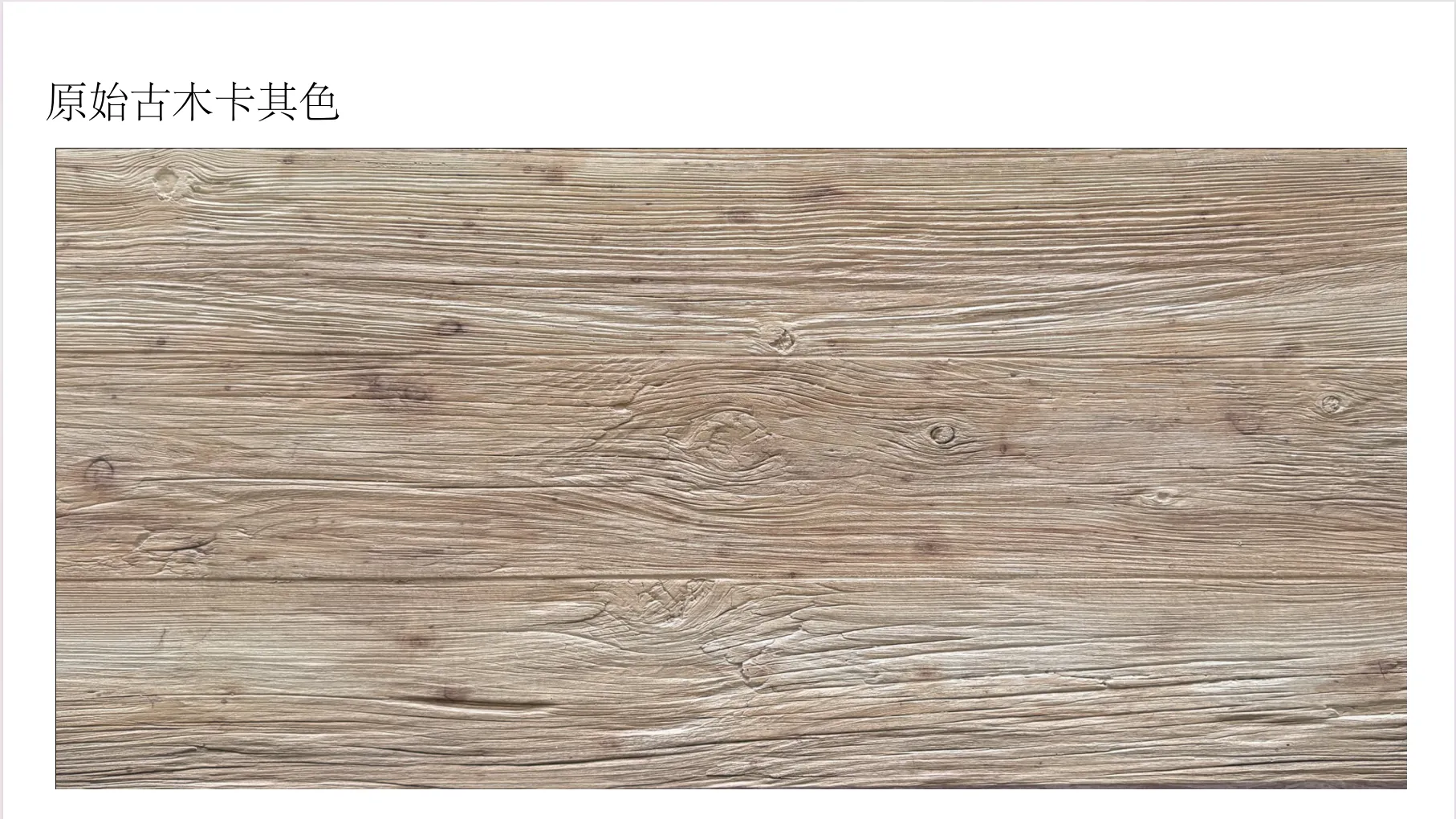
The first light of dawn spills over the weathered roof of the 18th-century village hall, casting gold over wooden beams that look like they've stood guard for centuries. I reach out, my palm brushing the surface of a lintel—rough, warm, marked with the kind of grain that tells a story of wind, rain, and time. But as my fingers trace a knot, I notice something unexpected: there's no rot, no softness where age should have eaten away at the wood. A local restorer, passing by with a dust cloth, smiles. "MCM's Ancient Wood series," she says. "Looks like the original, but it'll outlive us both."
Heritage isn't just about old buildings. It's the creak of a door that remembers horse-drawn carriages, the way sunlight slants through a window frame carved by a craftsman with calloused hands, the quiet hum of stories embedded in every stone. When these structures crumble—victims of rot, pests, or the slow march of weather—we lose more than walls. We lose a connection to the people who came before us: their hopes, their struggles, the way they saw the world.
In the hills of Tuscany, I once stood in the shell of a 16th-century villa where the original oak beams had turned to powder. The restorer on-site shook his head, holding a fragment of wood so brittle it crumbled at his touch. "We can't find oak like this anymore," he said. "And even if we did, it would rot in a decade here—too much moisture, too many beetles." That's the paradox of preservation: to save the past, we need materials that honor its spirit but outlast its weaknesses.
For decades, restorers have walked a tightrope. Use original materials, and watch them decay again in years. Use modern alternatives, and risk turning a historic gem into a plastic-looking imposter. Traditional ancient wood, for all its beauty, is a prisoner of biology: fungi feast on its fibers, termites tunnel through its heart, and water warps it beyond repair. Masonry stone, hewn from quarries long closed, chips and fades, leaving gaps that scream "patched up." Even concrete—once hailed as a savior—often looks harsh, its uniformity clashing with the organic chaos of aged structures.
Take the case of the coastal church in Cornwall, UK, where 200-year-old masonry stone was flaking away like dry skin. The restoration team sourced new stone from the same quarry, but it lacked the patina—the soft, weathered glow that comes only from centuries of salt wind. The result? A wall that looked like a teenager wearing their grandfather's suit: well-meaning, but unmistakably out of place.
MCM didn't set out to replace heritage materials. They set out to become them—only better. Their product lines, from the Ancient Wood series to Historical Pathfinders Stone, are love letters to the past, crafted with the science of the future. Let's start with that village hall lintel I touched earlier: MCM's Ancient Wood isn't just a replica. It's a masterclass in mimicry, capturing the swirl of grain, the (qiàdào hǎodào—perfectly judged) cracks, even the slight discoloration where rain once pooled. But unlike the original oak, it's engineered to resist rot, repel pests, and laugh off humidity. "We studied 300-year-old barn wood for a year," says Elena Marini, MCM's lead material designer. "We 3D-scanned every knot, every split, then built a formula that makes the material breathe like wood but last like stone."
Then there's Historical Pathfinders Stone—a line so dedicated to authenticity that MCM's team spent months collecting samples from dilapidated castles, old market squares, and forgotten cemeteries. The result? A masonry stone that carries the ghosts of time: the pockmarks from medieval tools, the subtle color shifts from decades of lichen, the way light plays on its surface like it did when kings walked its halls. "We had a project in Provence where the original stone was pink-tinged limestone," Elena recalls. "No modern quarry had that hue. So we mixed pigments from the soil around the chateau, baked them into the MCM stone, and now you can't tell which is 17th-century and which is 21st."
And let's not overlook MCM Flexible Stone, the unsung hero of curved heritage structures. Think of the domed ceiling of a Byzantine chapel, where traditional stone would be heavy enough to crack the foundations. MCM's version is lightweight, flexible, and thin enough to wrap around curves like a second skin. "We used it on a 1920s theater in Prague with a rounded proscenium," says restorer Jakub Novak. "The original plaster was falling apart, but MCM's stone panels matched the texture so well, even the theater's oldest patron didn't notice the difference. She just said, 'It feels like coming home.'"
MCM's secret isn't just technology—it's reverence. Walk through their workshop in Milan, and you'll find artisans hunched over samples, comparing MCM's prototypes to chunks of 200-year-old wood or fragments of Roman masonry. "We don't just scan and replicate," says Marco Rossi, head of product development. "We feel the materials. A real ancient wood beam has a rhythm to its grain—fast here, slow there—because the tree grew through wet years and dry. We mimic that rhythm, not just the pattern."
Take the Rust Square Line Stone, part of MCM's masonry collection. Traditional rusted stone is unpredictable—too much rust, and it looks artificial; too little, and it lacks character. MCM's team studied how iron oxides leach into stone over centuries, mapping the spread of color like a weather map. The result? A stone that rusts "naturally," developing depth over time without ever flaking off. "A monastery in Greece used it on their cloisters," Marco says. "A monk told me it looked like the stone had been praying alongside them for years."
Even fair-faced concrete, often criticized for its coldness, gets a makeover in MCM's hands. Their version—with its subtle texture, warm undertones, and slight variations in color—blends into heritage sites like a chameleon. "We added tiny aggregates from the original site's soil to a church restoration in Portugal," Elena says. "The concrete now has the same earthy smell when it rains as the old stone. That's the level of detail we chase."
| Material | Traditional Use | MCM Innovation | Why It Matters |
|---|---|---|---|
| Ancient Wood | Beams, lintels, door frames (prone to rot/pests) | Engineered wood-grain texture; rot/pest-resistant core | Preserves the "soul" of aged wood without the decay |
| Historical Pathfinders Stone | Masonry walls, arches (hard to source; fades quickly) | Replicated patina from 300+ year-old samples; UV-stable pigments | Matches original stone so closely, even experts struggle to tell |
| MCM Flexible Stone | Curved surfaces (heavy, hard to install) | Lightweight, bendable panels; easy to shape for domes/arches | Saves historic structures from the weight of traditional stone |
| Fair-faced Concrete | Modern repairs (looks "new" and out of place) | Earthy texture, site-specific aggregates, warm color tones | Blends with ancient masonry instead of clashing with it |
The 1790s watermill in the English countryside was a skeleton when MCM arrived. Its oak beams were so rotted, you could poke a finger through them; the masonry stone walls leaned like a tired giant; and the wooden water wheel, once the heart of the mill, lay in splinters. The local trust wanted to restore it, but traditional materials would have cost a fortune and required constant upkeep. Enter MCM.
The team replaced the beams with Ancient Wood panels, matching the original oak's honeyed hue and grain. They clad the walls in Historical Pathfinders Stone, sourced to mimic the mill's original limestone quarry (long since abandoned). The water wheel? Rebuilt with MCM's wood-concrete board, which looks like weathered timber but stands up to the mill's rushing water. Six years later, the mill hosts tours again. "Kids run their hands over the beams and ask if they're magic," says the trust's director, Sarah Lewis. "I tell them they're better than magic—they're memory keepers."
Heritage preservation isn't about freezing time. It's about letting it breathe—giving old buildings new life so they can keep telling their stories. MCM gets that. Their materials don't shout "new"; they whisper "still here." They're not just products; they're partners in a quiet rebellion against forgetting. When you run your hand over an Ancient Wood beam in a restored library, or trace the edge of a Historical Pathfinders Stone in a castle wall, you're not touching a material. You're touching continuity.
Elena Marini puts it best: "We don't build for today. We build for the person in 2123 who'll stand where you're standing now, look at these walls, and feel like they're home." And isn't that the point? Heritage isn't about the past. It's about giving the future something to hold onto—something that says, "You are part of a story bigger than yourself."
As I leave the village hall, the sun is higher now, gilding the Ancient Wood beams. A child runs past, her hand skimming the lintel, just like I did. For a moment, I wonder if she'll ever know it's not the original. But then I realize: it doesn't matter. What matters is that the hall is still here, still warm, still full of stories. And thanks to MCM, it will be for a very long time.
Recommend Products












