
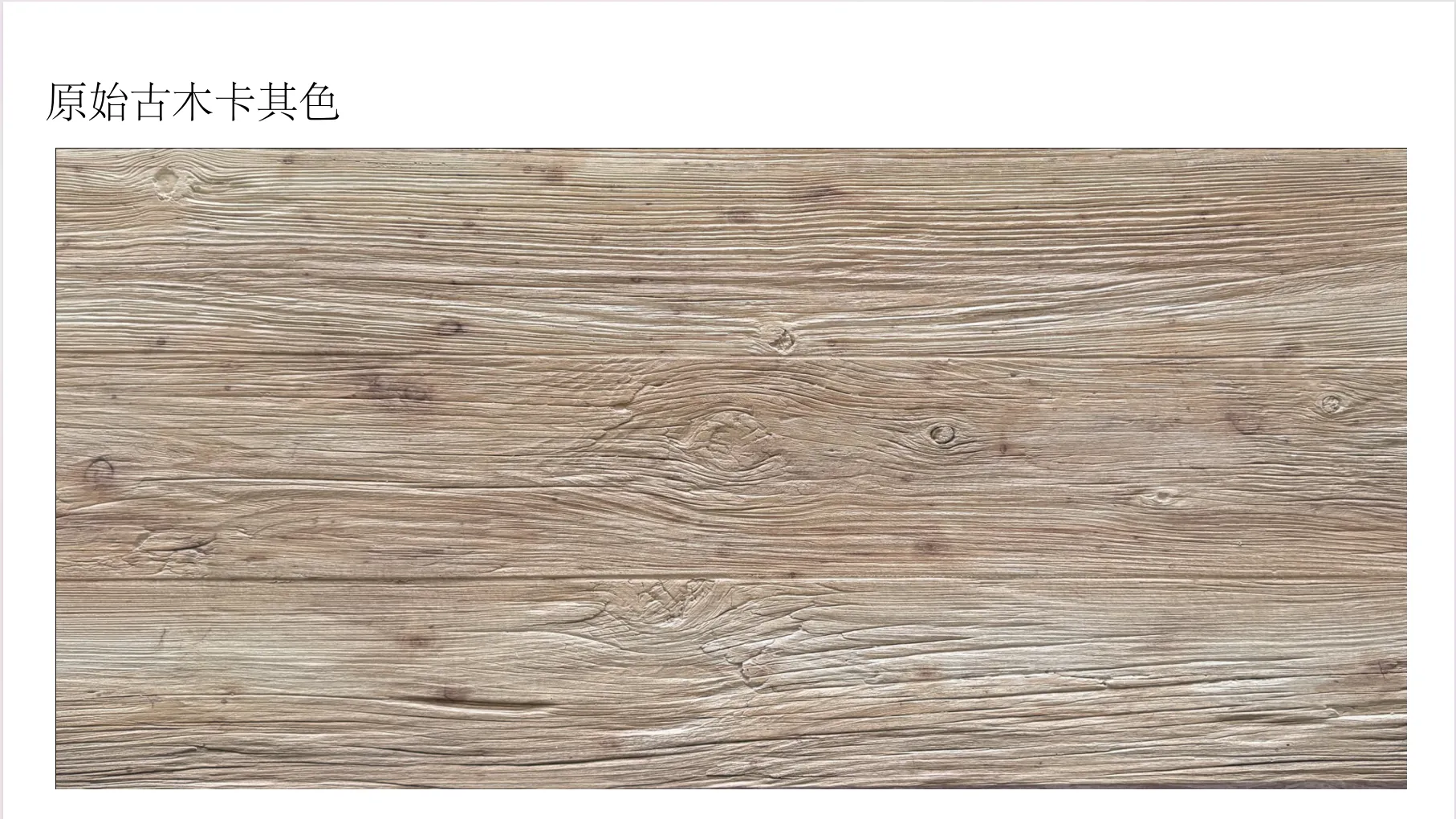
Minimalist design has long been celebrated for its "less is more" ethos—clean lines, uncluttered spaces, and a focus on function. But step into a truly memorable minimalist room, and you'll realize it's never just about emptiness. It's about texture: the quiet hum of materials that tell stories, the soft friction of a surface under your fingertips, the way light dances on a grain that's been shaped by time. In this dance of simplicity and depth, ancient wood emerges as an unlikely hero—a material that carries the weight of history while breathing warmth into the cool restraint of modern minimalism. And MCM, with its innovative approach to material storytelling, has found a way to weave this ancient soul into the fabric of contemporary design.
There's something almost primal about wood. It's not just a material; it's a memory carrier. Run your hand over a weathered oak beam, and you can almost feel the centuries it's stood witness to—storms, sunlight, the quiet comings and goings of life. In minimalist spaces, where every element is intentional, wood adds that missing layer: a tactile narrative that softens the sharp edges of concrete and steel. But here's the catch: traditional ancient wood is finite. Old-growth forests are precious, and the idea of harvesting centuries-old trees for a single accent wall feels at odds with the sustainability that modern minimalism often preaches. Enter MCM's wood grain board—a material that doesn't just mimic the look of ancient wood, but captures its essence .
MCM's wood grain board isn't about replication; it's about translation. Using advanced 3D printing series technology, the team at MCM studied the unique patterns of reclaimed ancient wood—knots that tell of a tree's struggle for sunlight, grain lines that curve like rivers, the subtle color variations that come from decades of exposure to the elements. The result? A panel that feels like it's been pulled from the beams of a 17th-century barn, but with none of the environmental guilt. It's lightweight, flexible, and designed to last—so that the story of ancient wood can continue without cutting down a single old tree.
Minimalist design thrives on contrast, and the pairing of ancient wood with materials like fair-faced concrete is a masterclass in balance. Fair-faced concrete is raw, industrial, almost sculptural in its honesty—it wears its imperfections proudly, with tiny air bubbles and subtle color shifts that feel like a fingerprint. But left alone, it can feel cold, even sterile. Add MCM's wood grain board to the mix, and suddenly the space comes alive. Imagine a living room with fair-faced concrete walls: smooth, gray, and imposing. Now, mount a wood grain board accent wall behind the sofa. The concrete's coolness recedes, and the wood's warmth steps forward, creating a dialogue that's both calm and dynamic. It's not about competing textures; it's about conversation.
This interplay is where MCM's design philosophy truly shines. Take, for example, the way their flexible stone technology complements the wood grain board. Flexible stone—lightweight, durable, and impossibly versatile—adds another layer of natural texture. Consider travertine (starry green), a stone that feels like it holds a piece of the night sky within its pores. Its soft, pitted surface and subtle green undertones echo the organic chaos of wood grain, but with a mineral depth that grounds the space. In a minimalist kitchen, imagine cabinet fronts in MCM's wood grain board, paired with a backsplash of travertine (starry green). The wood brings the warmth of a forest, the travertine the mystery of a starry night, and together, they turn a functional space into a sensory experience.
| Material | Texture Story | Sustainability Note | Minimalist Appeal |
|---|---|---|---|
| Traditional Ancient Wood | Deep, irregular grain; knots and cracks from decades of weathering | Finite resource; often requires reclamation from old structures | Warmth and history, but can feel heavy in small spaces |
| MCM Wood Grain Board | Replicated ancient grain patterns; smooth yet tactile surface | Recyclable core; no deforestation; lightweight (reduces transport emissions) | Warmth without bulk; pairs seamlessly with modern materials |
| Natural Travertine | Porous, with organic pits and veins; cool to the touch | Quarried stone; requires significant energy for extraction | Organic texture, but heavy and difficult to install in large sheets |
| MCM Travertine (Starry Green) | Lightweight, flexible; retains travertine's signature porosity and starry pattern | Reduced waste during production; easier to transport (lower carbon footprint) | Same organic allure, but adaptable to curved surfaces and tight spaces |
| Fair-Faced Concrete | Raw, industrial; air bubbles and subtle color variations | High carbon footprint in production; heavy and brittle | Sleek, modern, but can feel sterile without texture contrast |
What makes MCM's approach so compelling is that it doesn't treat materials as isolated elements. Instead, it sees them as characters in a shared narrative. Take the lunar peak series, for instance—silvery, golden, black—materials that evoke the quiet grandeur of mountain tops at dawn. Pair lunar peak silvery with wood grain board, and suddenly you're not just looking at a wall; you're standing at the edge of a forest at sunrise, where the first light turns frost to silver and wood to amber. It's a sensory journey, not just a design choice.
Or consider the gobi panel, inspired by the windswept patterns of desert dunes. Its rippled surface, rough yet rhythmic, feels like the desert's answer to wood's organic chaos. In a minimalist bedroom, imagine gobi panel walls with a wood grain board headboard. The desert's vast calm meets the forest's intimate warmth, creating a space that feels both expansive and cozy—a refuge from the noise of the world. MCM's materials don't just fill a room; they transport you.
Minimalism, at its core, is about intention. It's about choosing quality over quantity, meaning over excess. MCM's materials align with this philosophy because they're designed to tell a story without shouting. Take their foamed aluminium alloy board (vintage silver)—lightweight, with a muted metallic sheen that feels both modern and nostalgic. When paired with wood grain board, it's like a conversation between past and future: the wood's ancient whispers and the aluminium's sleek forwardness. Together, they create a space that feels grounded yet hopeful.
This balance is perhaps most evident in commercial spaces, where minimalism often struggles to feel human. A café with fair-faced concrete countertops, MCM's wood grain board tabletops, and travertine (starry green) accent walls isn't just a place to grab coffee—it's a place to pause. The concrete keeps it uncluttered, the wood invites you to linger, and the travertine's starry pattern makes you look up, if only for a second, and remember that even in the busiest cities, there's a little bit of the wild left.
As design continues to evolve, the demand for materials with soul will only grow. We're moving beyond the "cold minimalism" of the early 2000s and into a era where simplicity is paired with substance . MCM's work—whether it's the wood grain board that honors ancient trees, the travertine (starry green) that captures the night sky, or the fair-faced concrete that wears its industrial heart on its sleeve—proves that you don't have to sacrifice history for modernity. You can have both.
In the end, minimalist design isn't about empty spaces. It's about filled moments —moments where your fingers brush a textured wall and you smile, unconsciously, because it feels like home. MCM has mastered the art of creating those moments, one material story at a time. And in a world that often feels rushed and disconnected, that's the most minimalist magic of all: spaces that remind us to slow down, touch, and feel.
Recommend Products












