
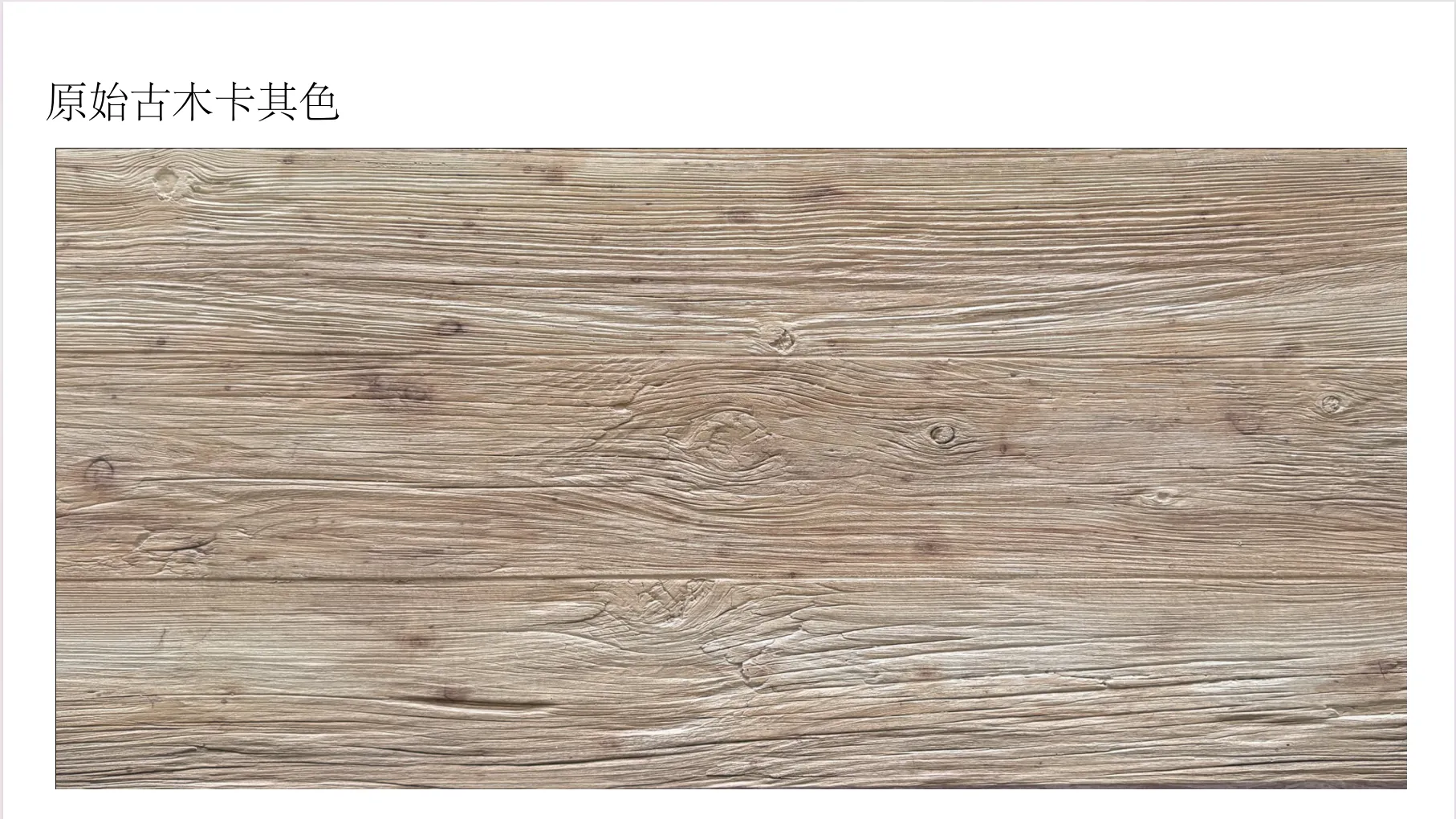
There's something almost primal about the way we respond to wood. It's not just a material—it's a storyteller. For centuries, wood has woven itself into the fabric of human life: the beam that held up our first shelters, the table where families gathered, the ship that carried explorers across oceans, the floor that felt the pitter-patter of a child's first steps. Its texture, with its swirls and knots, grains and grooves, is a fingerprint of time. Ancient wood, in particular, carries the weight of history—each crack a memory, each weathered patch a chapter of resilience. But here's the paradox: as much as we crave that warmth and character, real ancient wood is fragile. It warps, rots, fades, and grows scarce. And in a world where sustainability and durability matter more than ever, we've been left wondering: how do we keep that connection to the past without sacrificing the future?
Enter MCM 3D Printing Series—a technology that doesn't just replicate ancient wood textures, but reimagines them. MCM, or Modified Composite Material, isn't new, but when paired with 3D printing, it becomes a bridge between history and innovation. Suddenly, the rough-hewn charm of a 200-year-old barn beam, the silken grain of an antique oak table, or the sun-bleached patina of driftwood can be recreated with stunning accuracy—without cutting down a single tree, without compromising on strength, and without limiting creativity. This guide isn't just about materials; it's about how we can bring the soul of ancient wood into modern spaces, making every wall, ceiling, or surface feel like it has a story to tell. Let's dive in.
Before we talk about how MCM 3D Printing brings ancient wood to life, let's unpack why we're drawn to it in the first place. Wood is more than a texture—it's an emotion. Think about walking into a room with exposed wooden beams: the air feels softer, the light warmer, the space more grounded. That's because wood has a unique ability to balance the harshness of modern architecture. Glass, steel, and concrete are sleek and efficient, but they can feel cold. Wood? It's organic. It breathes. It reminds us of nature, of growth, of cycles that outlast us.
Ancient wood takes this a step further. It's not just about "wood grain"—it's about imperfection. A knot that formed when a branch grew crooked, a split that happened during a storm, a stain from rainwater that pooled and dried. These "flaws" are what make it human. They tell us that the wood has lived, just as we have. In a world that often values perfection—smooth surfaces, uniform patterns—ancient wood textures are a rebellion. They say, "It's okay to be unique. It's okay to show your age."
But here's the problem: real ancient wood is a finite resource. Old-growth forests are protected, and reclaimed wood, while sustainable, is often expensive and hard to source in large quantities. Even when you do find it, it's delicate. It can't handle moisture, pests, or heavy foot traffic without deteriorating. And if you want to use it on an exterior wall, or in a high-humidity area like a bathroom? Forget it. Real wood would warp or rot in no time. So, for designers, architects, and homeowners who dream of that ancient wood look, the options have long been limited—until now.
MCM 3D Printing Series isn't just a manufacturing process—it's a form of artistry. Let's start with the basics: MCM is a composite material made from natural minerals, polymers, and fibers, engineered to be lightweight, flexible, and incredibly durable. When combined with 3D printing technology, it becomes a tool for precision. Imagine a printer that can layer material so precisely, it mimics the exact depth of a knot in an ancient oak, the subtle variation in color of sun-bleached pine, or the rough texture of a log that was hand-hewn with an axe. That's what MCM 3D Printing does.
The magic lies in the details. Traditional wood-look materials—like vinyl or laminate—often look flat, like a photograph pasted onto a surface. MCM 3D Printing, on the other hand, creates actual texture. Run your hand over a panel, and you'll feel the rise and fall of the grain, the indent of a knot, the slight roughness of weathered wood. It's tactile, not just visual. That's because 3D printing allows for variable layer heights: thicker in some areas to create depth, thinner in others for smoothness. It's like sculpting with material, one microscopic layer at a time.
But what makes the "ancient wood" theme so special with MCM 3D Printing? It's the ability to capture aging . Real wood changes over time—sunlight fades it, rain darkens it, wind wears it down. MCM 3D Printing can replicate that progression. Want a panel that looks like it's been baking in the Mediterranean sun for 50 years? The printer can adjust color intensity, adding lighter patches where the sun hit hardest and deeper tones in the crevices. Want a texture that mimics wood salvaged from a barn that stood through harsh winters? It can layer in tiny cracks and rough edges, making it look like the wood expanded and contracted with the freeze-thaw cycle. This isn't just replication—it's reincarnation .
Take, for example, the "Ancient Wood" line within the MCM 3D Printing Series. Designers worked with historians and wood experts to study centuries-old wood samples—from 18th-century farmhouses in Tuscany to 19th-century barns in Vermont, from traditional teahouses in Kyoto to ancient wooden temples in Nepal. Each sample was scanned, its texture mapped in 3D, and its color variations cataloged. Then, using that data, the 3D printers were programmed to recreate those exact characteristics. The result? Panels that don't just "look" like ancient wood—they feel like it, right down to the way light plays off their surface.
While MCM 3D Printing Series excels at ancient wood textures, the beauty of MCM technology is its versatility. Sometimes, the most striking designs come from mixing materials—blending the warmth of wood with the strength of stone, or the industrial edge of metal. That's where MCM Flexible Stone and MCM Big Slab Board Series come into play. These lines expand the possibilities, letting you create spaces that are layered, dynamic, and uniquely yours.
MCM Flexible Stone is exactly what it sounds like: stone-like panels that bend. Traditional stone is heavy and rigid, limiting where it can be used. MCM Flexible Stone, though, is lightweight (about 1/5 the weight of natural stone) and can curve around corners, archways, or even circular columns. Imagine a feature wall in a lobby: half covered in ancient wood 3D-printed panels, and half in MCM Flexible Stone with a "Gobi Panel" texture—rough, earthy, like the desert wind carved it. The contrast between the warm wood and the cool stone creates depth, while the flexibility of both materials means you're not stuck with flat surfaces.
Then there's the MCM Big Slab Board Series. When you're working on a large space—a commercial lobby, a restaurant ceiling, or an exterior facade—small panels can look choppy. Seams become visible, and the texture can feel fragmented. Big Slab Boards solve that. These panels come in sizes up to 1200x2400mm, meaning fewer seams and a more cohesive look. And because they're part of the MCM family, they're still lightweight and easy to install. Pair a Big Slab Board with an ancient wood texture in a "Boulder Slab (Vintage Silver)" finish, and you've got a surface that looks like a massive, weathered tree trunk sliced open—imposing, yet inviting.
Let's take a real-world example: a boutique hotel in Santorini, Greece. The designer wanted to evoke the island's rustic charm—whitewashed walls, blue domes, and the weathered wood of traditional fishing boats. But with Santorini's harsh sun and saltwater air, real wood wouldn't last. So they used MCM 3D Printing Series for the interior walls, choosing the "Ancient Wood (Vintage Silver)" texture to mimic sun-bleached boat wood. For the exterior, they opted for MCM Big Slab Boards in "Lunar Peak Silvery"—a stone-like texture that shimmers like moonlight on the Aegean Sea. The result? A hotel that feels both timeless and modern, with materials that can withstand the elements for decades.
Another example: a home in the mountains, with a focus on "cabin chic." The homeowner wanted the living room to feel like a cozy retreat, but with a contemporary twist. They used MCM 3D Printing Series for the fireplace surround, selecting the "Sawing Wood Board" texture—rough, with visible saw marks, like it was cut from a local forest. For the adjacent wall, they paired it with MCM Flexible Stone in "Travertine (Starry Green)"—a smooth, porous texture with flecks of green that look like moss growing on stone. The combination feels organic, like the inside of a mountain lodge, but without the upkeep of real wood or stone.
One of the biggest frustrations with off-the-shelf materials is the "one-size-fits-all" mentality. You might love the idea of ancient wood, but the only color option is "medium oak," or the texture is too subtle for your taste. With MCM 3D Printing Series, though, customization is key. This isn't about choosing from a catalog—it's about co-creating a texture that matches your vision, down to the smallest detail.
Let's break down the customization options:
Do you want a subtle grain, like the inside of a well-sanded antique table? Or a deep, rough texture, like the outside of a weathered barn door? MCM 3D Printing lets you adjust the depth of the texture, from 0.5mm (almost smooth) to 5mm (bold and tactile). For a bedroom, you might opt for a shallow texture—soft to the touch, like silk. For a man cave or a restaurant with an industrial vibe, a deeper texture adds edge, making the wall feel like a piece of art you can run your hands over.
Ancient wood isn't just "brown." It's amber, honey, chestnut, walnut, ash, and everything in between. It fades, it darkens, it streaks. MCM 3D Printing Series offers a spectrum of colors, but more importantly, it lets you add "variation." You can have panels that shift from light to dark, mimicking how sunlight hits a tree trunk, or add "stain" marks that look like water damage or age spots. Want a wood texture with hints of blue, like driftwood that sat in the ocean? Or red, like wood that's been kissed by fire? The color lab can mix custom hues to match your mood board.
Whether you need small 300x300mm panels for a backsplash or large 2400x1200mm slabs for a ceiling, MCM 3D Printing can accommodate. And it's not just rectangles. Using digital design tools, you can create custom shapes—arches, hexagons, even organic, free-form panels that look like they were chiseled by hand. Imagine a kitchen backsplash with ancient wood 3D-printed panels cut into leaf shapes, interspersed with MCM Flexible Stone "Lime Stone (Beige)" accents. It's playful, unique, and totally you.
Why stop at wood? MCM technology lets you layer materials within a single panel. For example, you could have an ancient wood texture with inlays of MCM Foamed Aluminium Alloy Board (Vintage Gold)—a metallic accent that adds a touch of luxury. Or mix wood grains with "Weaving (Khaki)" texture, creating a panel that looks like wood and woven rattan were fused together. The possibilities are endless, and the only limit is your imagination.
| Customization Aspect | Options Available | Example Applications |
|---|---|---|
| Texture Depth | 0.5mm (subtle) to 5mm (bold) | Bedroom walls (subtle), restaurant accent walls (bold) |
| Color Variation | Natural wood tones, custom hues, sun-bleached, stained effects | Beach house (sun-bleached), mountain cabin (rich walnut) |
| Size & Shape | Standard panels (300x300mm to 2400x1200mm), custom shapes (arches, hexagons) | Commercial lobby (big slabs), kitchen backsplash (custom leaf shapes) |
| Material Mixes | Wood + flexible stone, wood + foamed aluminium, wood + weaving texture | Hotel lobby (wood + vintage gold aluminium), home office (wood + khaki weaving) |
Ancient wood textures, brought to life through MCM 3D Printing, aren't just for "rustic" or "traditional" spaces. They're versatile enough to elevate any design style—from minimalist to industrial, from bohemian to coastal. Let's explore some of the most popular applications, and how these textures can transform ordinary rooms into extraordinary experiences.
Your home should reflect who you are, and ancient wood textures add that personal touch. Start with the living room—the heart of the house. A feature wall covered in MCM 3D-printed "Ancient Wood (Vintage Black)" panels becomes the focal point, grounding the space with its dark, moody tones. Pair it with a light-colored sofa and metallic accents, and suddenly the room feels both cozy and sophisticated. Or, for a more airy vibe, use "Travertine (Starry Blue)" MCM Flexible Stone on one wall and "Ancient Wood (Starry Orange)" 3D-printed panels on another—the blue and orange complement each other, while the starry texture adds a touch of whimsy.
The kitchen is another area where ancient wood textures shine. Traditional kitchen backsplashes are often tile or granite—functional, but rarely memorable. Swap them out for MCM 3D-printed "Wood Grain Board" panels, and suddenly your kitchen feels like a country cottage, even if it's in the middle of a city. And because MCM is water-resistant and easy to clean, you don't have to worry about splatters or stains. Add a breakfast bar with a "Boulder Slab (Vintage Silver)" countertop, and you've got a space that's as practical as it is beautiful.
Don't forget the bedroom. A headboard wall covered in "Ancient Wood (Starry Red)" 3D-printed panels adds warmth, while the starry texture (tiny flecks of color that catch the light) makes the room feel magical. Pair it with soft, neutral bedding and dim lighting, and you've created a sanctuary that feels like a retreat from the world.
In commercial design, first impressions matter. Ancient wood textures can help businesses tell their story, whether it's a café that wants to feel like a neighborhood hangout or a boutique hotel aiming for luxury with a rustic twist. Take a coffee shop, for example. Cover the walls in MCM 3D-printed "Ancient Wood (Vintage Gold)" panels, and the ceiling in "Bamboo Mat Board" MCM Big Slabs. Add mismatched wooden chairs and soft pendant lights, and suddenly customers feel like they're in a friend's cozy kitchen—not a chain café. The texture invites them to stay longer, order another latte, and maybe even snap a photo for social media (hello, free marketing).
Restaurants, too, benefit from ancient wood textures. A steakhouse might use "Rust Board Granite" MCM Flexible Stone on the exterior and "Ancient Wood (Dark Grey)" 3D-printed panels on the interior, creating a moody, masculine vibe that pairs perfectly with red wine and hearty meals. A vegan café, on the other hand, could opt for lighter tones—"Ancient Wood (Beige)" with "Lunar Peak Silvery" accents—creating a space that feels fresh and earthy.
Even corporate offices are getting in on the trend. Gone are the days of sterile, white-walled workspaces. Modern offices want to inspire creativity, and ancient wood textures help with that. Imagine a tech startup with a breakout area covered in "Ancient Wood (Starry Green)" 3D-printed panels and "Foamed Aluminium Alloy Board (Vintage Silver)" accents. The wood brings warmth, while the metal adds an industrial edge—perfect for a company that values innovation and collaboration.
One of the most meaningful applications of MCM 3D Printing Series is in historical renovations. When restoring an old building—a 19th-century schoolhouse, a medieval castle, or a traditional village home—authenticity is key. But using real ancient wood or stone can be risky: it may not meet modern safety standards, or it may deteriorate further with age. MCM panels offer a solution: they replicate the look of the original materials so accurately that even experts can't tell the difference, but they're stronger, safer, and more durable.
Take, for example, the restoration of a 18th-century inn in the English countryside. The original wooden beams were rotting, and replacing them with real wood would have been costly and unsustainable. Instead, the architects used MCM 3D-printed "Ancient Wood (Historical Pathfinders Stone)" panels to cover the new steel beams. The panels were designed to match the exact texture and color of the original wood, right down to the wormholes and nail marks. Today, visitors walk into the inn and feel like they've stepped back in time—without knowing that the "wood" they're admiring is actually cutting-edge MCM technology.
At this point, you might be thinking, "This all sounds great, but how do I know MCM panels will last?" It's a fair question. After all, no one wants to invest in materials that look good today but fade or crack tomorrow. The good news is that MCM technology isn't just about aesthetics—it's about science. These panels are engineered to be tough, resilient, and built to withstand the test of time.
Let's start with durability. MCM is made from a blend of natural minerals (like calcium carbonate), high-performance polymers, and glass fibers. This combination makes it resistant to just about everything: moisture, UV rays, temperature fluctuations, pests, and even fire. Unlike real wood, MCM panels won't warp in humidity or rot in the rain. They won't fade in the sun or get eaten by termites. And because they're non-combustible, they meet strict fire safety codes—something that's crucial for commercial and public spaces.
Then there's weight. Traditional materials like natural stone or solid wood are heavy, which means they require strong structural support. MCM panels, though, are incredibly lightweight—about 3-5 kg per square meter. That makes installation faster and cheaper, as you don't need to reinforce walls or hire specialized contractors. It also opens up possibilities for high-rise buildings, where weight is a major concern. Imagine cladding the exterior of a 50-story skyscraper with "Ancient Wood (Vintage Black)" MCM Big Slab Boards—something that would be impossible with real wood due to weight restrictions.
Maintenance is another win for MCM. Real wood needs to be sealed, stained, and refinished every few years. MCM panels? They're practically maintenance-free. A quick wipe with a damp cloth is all it takes to keep them looking new. And if a panel gets damaged (say, a chair scrapes against a wall), it's easy to replace—no need to redo the entire surface. That's a huge relief for homeowners and business owners alike, who want their spaces to look great without the hassle.
Sustainability is also a key factor. MCM is made from recycled and abundant materials, and the manufacturing process uses less energy than producing traditional building materials. Plus, since MCM panels replicate ancient wood and stone, they reduce the demand for real, finite resources. It's a win-win: you get the look you love, and the planet gets a break.
Ancient wood textures are more than a trend—they're a connection to our roots. They remind us of simpler times, of craftsmanship, of the beauty in imperfection. But in a world that demands durability, sustainability, and creativity, real ancient wood can't keep up. That's where MCM 3D Printing Series, MCM Flexible Stone, and MCM Big Slab Board Series come in. They don't just give us the look of ancient wood—they give us the freedom to reimagine it. To mix it with stone, metal, or weaving. To customize it in ways that reflect our personality, our style, our story.
Whether you're designing a cozy home, a bustling café, or restoring a piece of history, MCM technology lets you create spaces that are both timeless and modern. Spaces that make people stop, touch, and say, "Wow, this feels special." Because at the end of the day, design isn't just about materials—it's about emotion. It's about creating places that make us feel something. And with MCM 3D Printing's ancient wood textures, that "something" is warmth, nostalgia, and the quiet confidence that comes from knowing you've built something that will last.
So go ahead—dream big. Mix "Ancient Wood (Starry Green)" with "Lunar Peak Golden" MCM Flexible Stone. Create a ceiling with "Bamboo Mat Board" Big Slabs and a wall with "Rust Mosaic Stone" accents. The world of MCM is yours to explore, and every texture, every color, every panel is a chance to tell a story. And isn't that what design is all about?
Recommend Products












