
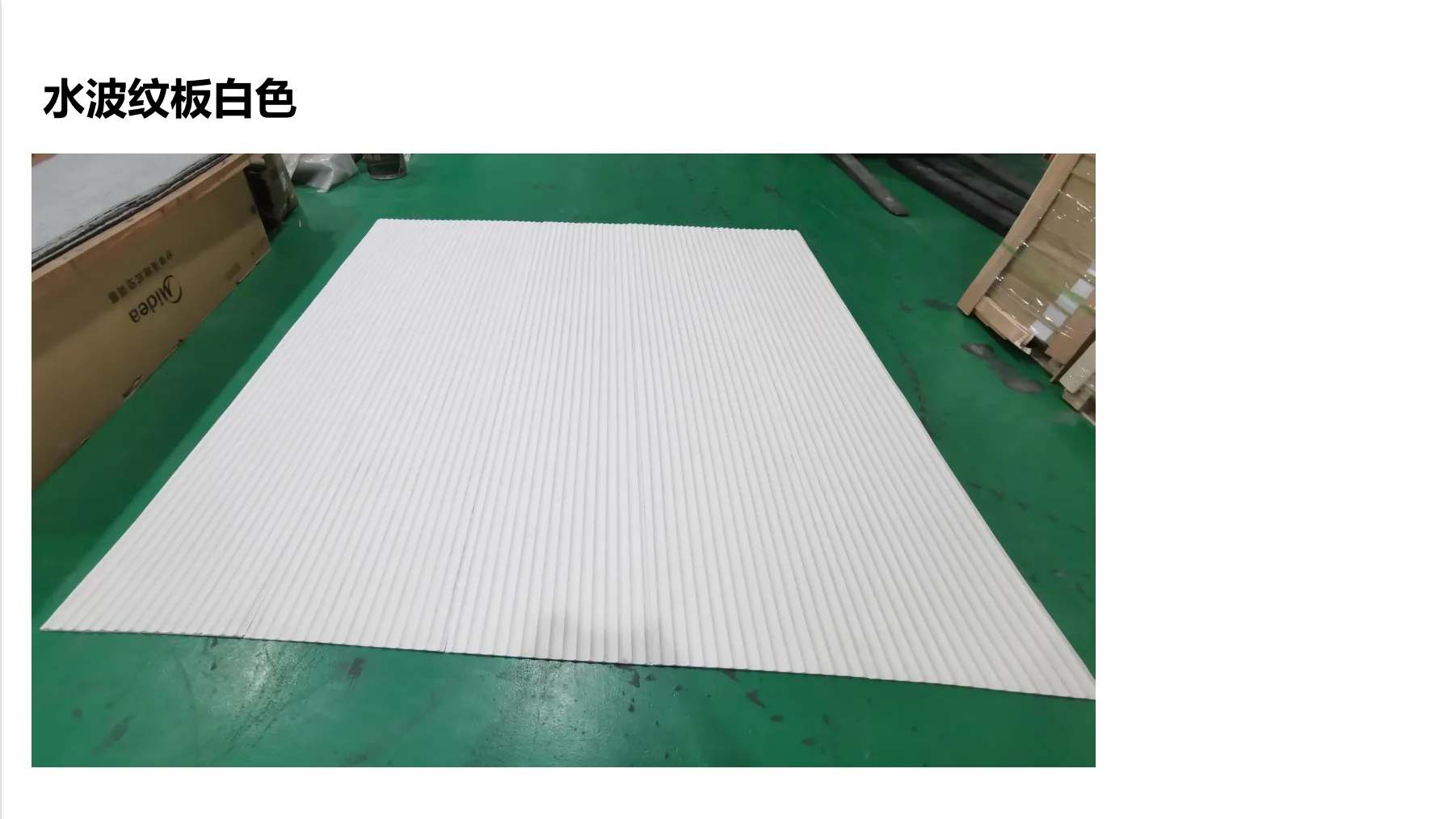
Architecture is more than steel beams and blueprints—it's a language spoken through materials. Every texture, color, and finish tells a story, shaping how we experience a space long after we've left it. In recent years, one material has emerged as a quiet revolutionary in this narrative: Ripple Board. With its undulating surface that mimics the gentle movement of water or wind-blown sand, it's become a favorite among designers aiming to infuse buildings with life. But Ripple Board rarely shines alone. Today, we're exploring how it harmonizes with other standout materials—from the versatility of MCM Flexible Stone to the raw beauty of Fair-Faced Concrete, the cosmic allure of Travertine (Starry Blue), and the metallic elegance of Lunar Peak Silvery—in award-winning projects that redefine modern design. These aren't just construction materials; they're collaborators, turning ordinary structures into unforgettable experiences.
Imagine standing before a building that seems to breathe. That's the effect Ripple Board often creates. Unlike flat, static surfaces, its gently ridged texture catches light at varying angles, shifting from soft and matte in the morning to warm and luminous at sunset. It's a material that invites touch—run a hand over it, and you'll feel the subtle peaks and valleys, a tactile reminder of nature's imperfection. No wonder it's become a staple in projects aiming for organic, human-centered design.
Take the 2024 AIA Design Excellence Award-winning "Azure Residences" in Barcelona, a boutique apartment complex overlooking the Mediterranean. Architect Marina Ortega chose Ripple Board (white) for the exterior cladding, a decision that transformed the building into a canvas for the sun and sea. "I wanted something that would dialogue with the ocean," Ortega explains. "Flat stone would have felt cold, like a barrier. Ripple Board? It's like the waves are part of the building itself. On windy days, the shadows dance, and residents say it feels like the sea is hugging their homes."
Inside Azure Residences, Ripple Board takes a more intimate role. In the communal lounge, a feature wall of Ripple Board (grey) serves as a backdrop for a fireplace, its texture softening the crackle of flames and creating a cozy, cabin-like atmosphere despite the modern setting. "We tested three different textures before settling on Ripple Board," Ortega recalls. "The others felt too manufactured. This one? It has soul."
But Ripple Board isn't just for residential spaces. In Singapore's 2023 "Ember Gallery," a contemporary art museum, curators paired Ripple Board (white) with polished concrete floors to create a neutral palette that lets the art take center stage—until you notice the walls. "Art should be the star, but the space should elevate it," says gallery director Lin Wei. "Ripple Board does that. It reflects light in a way that makes paintings feel alive, like they're floating. Visitors often comment on how 'calm' the gallery feels, even with bold installations. I think that's the texture working its magic."
If Ripple Board is the storyteller, MCM Flexible Stone is the chameleon. Lightweight, durable, and astonishingly adaptable, this modified composite material can mimic everything from aged wood to rough-hewn stone—without the weight or maintenance of natural materials. It's a favorite for designers who want to push boundaries, whether wrapping a curved facade or creating intricate patterns that would be impossible with traditional stone.
Copenhagen's "EcoSpire," a 12-story office building that took home the 2024 Green Building Award, is a masterclass in MCM Flexible Stone's versatility. Designed by sustainability-focused firm GreenLogic, the building's exterior features MCM Flexible Stone (mimicking reclaimed oak) curved around the structure, creating a organic, tree-like silhouette. "We needed something that could handle the curve without compromising on durability or eco-friendliness," says GreenLogic lead architect Lars Hansen. "Natural wood would have warped; traditional stone would have added tons of weight to the foundation. MCM Flexible Stone checked all the boxes—and it looks like it was pulled straight from a forest."
But the real magic happens where MCM Flexible Stone meets Ripple Board. In EcoSpire's lobby, a soaring wall combines vertical panels of MCM Flexible Stone (rough granite finish) with horizontal strips of Ripple Board (beige). The contrast is striking: the "granite" adds ruggedness, while the Ripple Board softens it, creating a space that feels both grounded and airy. "Employees tell us they linger here during breaks," Hansen laughs. "We didn't design it as a lounge, but the materials made it one. That's the power of pairing textures."
MCM Flexible Stone also shines in restoration projects. In Rome's 2023 renovation of the "Vintage Theatre," a 1920s cinema, architects used MCM Flexible Stone (vintage gold) to replicate the original gilded plaster moldings that had deteriorated over time. "We wanted to honor the past without using toxic materials or overloading the structure," says lead restorer Carla Rossi. "MCM Flexible Stone was perfect. It's lightweight, fire-resistant, and the gold finish matches the original so closely, even historians can't tell the difference." Inside, the theater's concession stand features Ripple Board (beige) behind the counter, its texture adding warmth to the sleek, modern design—a nod to the building's Art Deco roots with a contemporary twist.
There's a reason Fair-Faced Concrete has been a darling of architects for decades: its raw, unapologetic simplicity. Unlike polished concrete, which gleams, or stamped concrete, which mimics other materials, Fair-Faced Concrete wears its imperfections proudly—small air bubbles, subtle color variations, the faint impression of the formwork that shaped it. It's industrial yet organic, and when paired with Ripple Board, it creates a dialogue between strength and softness that's hard to match.
Tokyo's "Silent Square," a community center and library that won the 2024 Urban Design Award, is a stunning example. Designed by minimalist architect Yuki Tanaka, the building is a study in contrasts: angular Fair-Faced Concrete walls frame a central courtyard, where a Ripple Board (white) fountain cascades into a shallow pool. "Concrete is often seen as cold, but here, it's a canvas," Tanaka explains. "The Ripple Board fountain softens the hardness, and the sound of water makes the space feel alive. Parents bring their kids to play by the fountain, and seniors read on the benches nearby. It's become the heart of the neighborhood."
Inside Silent Square, the library's reading rooms feature Fair-Faced Concrete ceilings and Ripple Board (light grey) bookshelves. "We wanted a space that felt calm but not sterile," says librarian Mei Sato. "Concrete absorbs sound, which is great for a library, but it can feel like a bunker. Ripple Board adds warmth—literally. The texture traps heat, so the rooms stay cozy in winter without cranking up the heat. And readers love running their hands over the shelves while they browse. It's a small thing, but it makes the space feel personal."
Even in commercial settings, Fair-Faced Concrete and Ripple Board make a powerful pair. In Chicago's "Haven Café," a 2023 James Beard-nominated restaurant, the kitchen is wrapped in Fair-Faced Concrete, its utilitarian vibe balancing the whimsy of a Ripple Board (beige) accent wall in the dining area. "We wanted the kitchen to feel like a workshop—open, honest, hardworking," says chef Elena Torres. "The dining room? A haven. Ripple Board makes it feel like you're eating in a sunlit garden, even when it's snowing outside. The contrast works because both materials are 'real'—no fakeness, just texture and truth."
Not all architectural materials play it safe—and Travertine (Starry Blue) is here to prove it. This striking stone features a deep blue base dotted with flecks of silver and gold, like a night sky spilled across the rock. It's bold, yes, but when used thoughtfully, it adds a touch of drama that elevates any space. And when paired with Ripple Board's neutral texture? Magic.
Santorini's "Luna Villa," a luxury vacation home that won the 2024 International Design Award for Residential Excellence, is a case in point. Perched on a cliff overlooking the Aegean Sea, the villa's interior leans into the island's iconic white-and-blue palette—with a twist. "Santorini is known for bright whites and sky blues, but I wanted something that felt more intimate," says designer Maria Papadopoulos. "Travertine (Starry Blue) was the answer. In the master bathroom, we used it for the shower walls, and when the sunlight hits, it looks like you're bathing under the stars. It's luxurious without being over-the-top."
But the real showstopper is the villa's outdoor terrace. Here, Ripple Board (beige) flooring stretches from the living room to the pool, its texture providing grip underfoot even when wet, while a Travertine (Starry Blue) dining counter anchors the space. "At night, we light the counter from below," Papadopoulos says. "The blue glows, and the Ripple Board floor reflects the light, making it feel like you're dining on a floating platform in the ocean. Guests never want to leave."
Travertine (Starry Blue) isn't just for high-end villas, though. In Portland's "Nebula Brewery," a 2023 Craft Design Award winner, the bar top is made of the stone, paired with Ripple Board (grey) paneling behind the taps. "We wanted a space that felt like a cozy dive bar but with a little 'wow' factor," says brewery owner Jake Miller. "The Starry Blue bar top is that 'wow.' People take photos of their beers on it—it's become our Instagram star. And the Ripple Board? It softens the industrial vibe of the stainless-steel taps. Together, they make the bar feel inviting, like a friend's basement with a luxury upgrade."
For designers craving a futuristic flair without sacrificing warmth, Lunar Peak Silvery delivers. This metallic-finished paneling has a soft, brushed texture that shimmers like moonlight on water—hence the "Lunar" name. It's sleek, modern, and surprisingly versatile, adding a touch of glamour to everything from office lobbies to boutique hotels. And when paired with Ripple Board's organic texture? It's a match made in design heaven.
San Francisco's "Pulse Tower," a tech headquarters that won the 2024 Innovation in Commercial Design Award, is a stunning example of this pairing. Designed by futurist firm NeoSpace, the building's facade features alternating panels of Lunar Peak Silvery and Ripple Board (white), creating a pattern that resembles a heartbeat on a monitor. "Tech companies often default to glass and steel, which can feel cold and impersonal," says NeoSpace architect Raj Patel. "We wanted Pulse Tower to feel innovative but human. Lunar Peak Silvery gives it that 'future-forward' look, but Ripple Board grounds it. Employees say it feels like working in a space that's both cutting-edge and connected to nature."
Inside Pulse Tower, the elevator lobbies are wrapped in Lunar Peak Silvery, their reflective surfaces making the small spaces feel larger. But it's the reception area that steals the show: a curved desk of Lunar Peak Silvery sits in front of a wall of Ripple Board (beige), the contrast of metallic and organic creating a welcoming first impression. "Guests walk in and stop—you can see it in their faces," says Patel. "The silvery desk says 'innovation,' but the Ripple Board wall says 'we care about you.' It's a subtle balance, but it works."
Even in residential design, Lunar Peak Silvery is making waves. In Seattle's "Skyline Penthouse," a 2023 Luxury Home Award winner, the kitchen features Lunar Peak Silvery cabinet fronts paired with a Ripple Board (white) backsplash. "I wanted the kitchen to feel like a high-end restaurant, but still livable," says homeowner and food blogger Sofia Chen. "The silvery cabinets are sleek and easy to clean, but they'd feel too cold alone. The Ripple Board backsplash adds texture and warmth—when I'm cooking, the light hits it, and it feels like I'm in a cozy kitchen, not a sterile showroom. Plus, it hides water spots better than flat tile!"
What makes these materials so effective together? It's all about balance. Ripple Board brings softness and texture; MCM Flexible Stone adds versatility; Fair-Faced Concrete offers raw strength; Travertine (Starry Blue) injects color; and Lunar Peak Silvery brings modern glamour. Below is a breakdown of how these materials complement each other in award-winning designs:
| Material | Texture Profile | Design Role | Award-Winning Project Example |
|---|---|---|---|
| Ripple Board (white/grey/beige) | Undulating, wave-like ridges; soft, matte finish with subtle light reflection | Adds organic movement, warmth, and tactile interest; balances hard surfaces | Azure Residences (Barcelona) – Exterior cladding and communal lounge feature wall (2024 AIA Design Excellence Award) |
| MCM Flexible Stone (various finishes) | Lightweight, moldable; mimics natural materials (wood, stone) with consistent texture | Enables bold shapes/curves; reduces structural weight; sustainable alternative to natural stone | EcoSpire (Copenhagen) – Curved exterior cladding (reclaimed oak finish) with Ripple Board lobby accents (2024 Green Building Award) |
| Fair-Faced Concrete | Raw, unpolished; features natural air bubbles and formwork marks; cool to the touch | Adds industrial edge and structural integrity; absorbs sound; creates neutral, timeless backdrops | Silent Square (Tokyo) – Community center with Fair-Faced Concrete walls and Ripple Board fountain (2024 Urban Design Award) |
| Travertine (Starry Blue) | Deep blue base with silver/gold flecks; smooth yet slightly porous surface | Injects drama and color; creates focal points; pairs with neutral textures for balance | Luna Villa (Santorini) – Bathroom shower walls and outdoor dining counter (2024 International Design Award) |
| Lunar Peak Silvery | Brushed metallic finish; soft shimmer with a subtle, non-reflective sheen | Adds modern, futuristic flair; reflects light to expand spaces; complements organic textures | Pulse Tower (San Francisco) – Facade panels and reception desk (2024 Innovation in Commercial Design Award) |
Awards aren't just about aesthetics—they're about how spaces make people feel. The projects featured here all share one thing in common: they prioritize the human experience. Azure Residences makes residents feel connected to the sea; EcoSpire turns an office into a "forest-like" sanctuary; Silent Square fosters community; Luna Villa creates moments of wonder; Pulse Tower balances innovation with warmth.
"Too often, we design for photos, not people," says architectural psychologist Dr. Maya Krishnan, who consulted on the Azure Residences project. "But these materials—Ripple Board, MCM Flexible Stone, all of them—they're designed for interaction. People touch them, comment on them, build memories around them. That's why the projects win awards: they don't just look good; they make people feel seen."
Take the Ember Gallery, for example. "We didn't just want a pretty space—we wanted one that made art more accessible," says director Lin Wei. "Ripple Board does that. It's not intimidating. It's inviting. Parents tell us their kids run their hands along the walls while looking at paintings, which turns a 'don't touch' space into a sensory experience. That's priceless."
As architects and designers continue to push boundaries, materials like Ripple Board, MCM Flexible Stone, Fair-Faced Concrete, Travertine (Starry Blue), and Lunar Peak Silvery will only grow in popularity. Why? Because they're versatile, sustainable (many, like MCM Flexible Stone, use recycled materials), and—most importantly—they tell stories.
"The next frontier isn't about new materials; it's about new combinations," says designer Marina Ortega. "I'm already experimenting with Ripple Board and Travertine (Starry Red) for a hotel in Marrakech. Imagine a desert-inspired space with waves of texture and pops of starry color. It'll feel like sleeping under the Sahara sky."
Whether you're designing a home, an office, or a public space, remember: materials are more than just building blocks. They're the voices of your design, speaking to visitors long after they've left. And with options like these, the conversation is just getting started.
So go ahead—touch the walls, notice the textures, and let the materials tell you their stories. You might just find your next inspiration.
Recommend Products












