

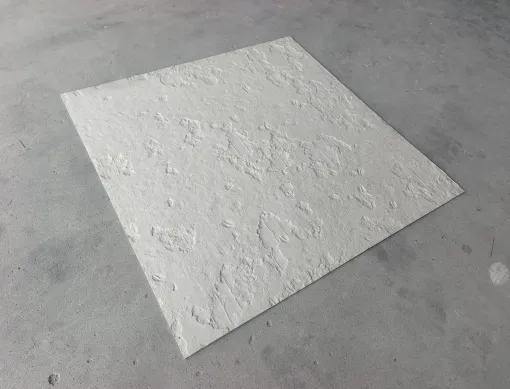
Close your eyes for a moment and let your fingers trace the memory of a sun-warmed stone. Not the cold, polished marble of grand lobbies, but something softer—something that feels like it has breathed the same air as mountains and rivers. That's the essence of Bali Stone. Inspired by the organic beauty of Bali's coastal cliffs and riverbeds, it carries the irregularities of nature: subtle ridges, tiny pits that catch the light, and a color palette that ranges from warm sand to deep terracotta, as if kissed by both the sun and the earth.
But what truly sets Bali Stone apart is its marriage of natural aesthetics with modern engineering. As part of the MCM flexible stone series, it inherits the best of both worlds: the look and feel of quarried stone, but with the flexibility and durability of advanced composite materials. This means it's lightweight enough to adorn skyscraper facades without straining structural integrity, yet tough enough to stand up to Saudi Arabia's extreme temperatures—where summer days can soar above 45°C and sandstorms test the mettle of any surface.
Imagine a home in Riyadh where the exterior walls are clad in Bali Stone. The midday sun beats down, but the stone absorbs the heat gently, releasing it slowly as evening falls, keeping the interior cool. A family gathers on the patio, their hands brushing against the wall's texture—a tactile reminder of nature's simplicity. Inside, a living room features a Bali Stone accent wall, its warm tones softening the harsh glare of artificial light, turning a modern space into a haven of comfort. This is the magic of Bali Stone: it doesn't just occupy space; it nurtures it.
Saudi Arabia's climate is a masterclass in extremes. Blistering heat, low humidity, and occasional sandstorms demand materials that don't just survive—they thrive. Traditional natural stones, while beautiful, can be porous, absorbing moisture (though rare) and fading under relentless UV rays. Bali Stone, however, is engineered to outsmart these challenges.
Thanks to the MCM flexible stone technology, Bali Stone boasts a non-porous surface that resists water absorption, preventing cracks from freeze-thaw cycles (a concern in higher elevations) and repelling dust and sand. Its color stability is another triumph: unlike some stones that bleach over time, Bali Stone retains its earthy tones, ensuring that a building's facade remains as vibrant in year 10 as it was in year one. For architects working on projects like luxury resorts in Jeddah or commercial towers in Dammam, this longevity is not just a practical win—it's a promise to clients that their vision will endure.
But adaptability isn't just about durability; it's about comfort. Bali Stone's thermal insulation properties help regulate indoor temperatures, reducing reliance on air conditioning. In a country where energy efficiency is increasingly critical, this feature transforms Bali Stone from a decorative choice into a sustainable one. It's a material that works with the desert, not against it—a philosophy that aligns perfectly with Saudi Arabia's push for greener, more resilient cities.
Saudi Arabia's architectural identity is a tapestry of contrasts: the grandeur of traditional mud-brick forts, the sleekness of futuristic megaprojects like NEOM, and the intimacy of family homes rooted in Bedouin heritage. Bali Stone fits seamlessly into this tapestry, offering a bridge between old and new.
Consider a boutique hotel in Al Ula, where the goal is to honor the region's archaeological treasures while providing modern luxury. Here, Bali Stone could clad the lobby walls, its texture echoing the weathered sandstone of nearby rock formations. Paired with Lunar Peak Golden accents—with its metallic sheen evoking desert sunsets—the space becomes a dialogue between earth and sky. The result? A lobby that feels both timeless and contemporary, where guests don't just check in—they arrive into a story.
For residential projects, Bali Stone shines as an interior material. Imagine a family villa in Riyadh, where the kitchen backsplash is crafted from Bali Stone. The soft, warm tones complement wooden cabinetry, while the textured surface adds depth to the space. It's a material that invites touch—children running their hands along the wall as they pass, grandparents pausing to feel its warmth, creating memories woven into the very fabric of the home.
Even in commercial settings, Bali Stone adds a human touch. A corporate office in Riyadh, often associated with cold, sterile environments, can be transformed with a Bali Stone feature wall in the reception area. Against the crisp lines of fair-faced concrete and glass, the stone introduces a sense of calm, reminding employees and visitors alike that progress doesn't have to come at the cost of warmth.
To truly appreciate Bali Stone's place in Saudi Arabia's architectural toolkit, it helps to see how it stacks up against other popular materials. Below is a comparison of Bali Stone with two other sought-after options: Travertine (Starry Green) and Lunar Peak Golden .
| Feature | Bali Stone | Travertine (Starry Green) | Lunar Peak Golden |
|---|---|---|---|
| Texture | Warm, organic, with subtle ridges and pits | Polished with crystalline "starry" flecks | Sleek, metallic, with a golden shimmer |
| Climate Resistance | High UV stability, non-porous, heat-resistant | Moderate porosity; may require sealing | Excellent heat resistance; metallic finish prone to scratches |
| Design Vibe | Earthy, cozy, connects to nature | Luxurious, celestial, modern | Bold, futuristic, opulent |
| Best For | Residential interiors, boutique hotels, heritage-inspired projects | High-end lobbies, statement walls, contemporary villas | Commercial facades, luxury retail, modern skyscrapers |
While Travertine (Starry Green) dazzles with its cosmic sparkle and Lunar Peak Golden exudes futuristic glamour, Bali Stone offers something they don't: a quiet, nurturing presence. It's the material you want when you want a space to feel like a home —whether that home is a five-star resort or a family's first house.
In an era where sustainability is no longer a buzzword but a mandate, Bali Stone stands out for its eco-friendly credentials. Traditional natural stone mining can be resource-intensive, disrupting ecosystems and consuming large amounts of energy. Bali Stone, as part of the MCM flexible stone series, is produced using a process that minimizes waste and reduces carbon footprint. Its lightweight composition also lowers transportation costs and structural load, further cutting down on a project's environmental impact.
For developers in Saudi Arabia aiming to achieve LEED or Estidama certifications, Bali Stone is more than a design choice—it's a step toward meeting green building standards. It's a material that aligns with the kingdom's Vision 2030 goals of creating sustainable, livable cities, proving that beauty and responsibility can go hand in hand.
In the end, architecture is about more than bricks and mortar. It's about creating spaces that tell stories, that make us feel connected to something larger than ourselves. Bali Stone, with its earthy warmth, climate resilience, and timeless appeal, is a material that tells a story of harmony—between nature and technology, tradition and progress, durability and comfort.
For Saudi Arabian projects, whether they're soaring skyscrapers in Riyadh or intimate retreats in the Asir Mountains, Bali Stone isn't just a choice—it's a partner. It's there in the morning, catching the first light and softening the day's heat. It's there in the evening, as families gather and laughter echoes off its textured walls. It's a material that doesn't just build spaces; it builds memories .
So the next time you walk through a building clad in Bali Stone, take a moment to touch it. Feel its warmth, trace its ridges, and listen to the story it tells—a story of a desert kingdom that refuses to compromise on beauty, resilience, or heart. In Bali Stone, Saudi Arabia has found not just a material, but a voice.
Recommend Products












