

When you picture a luxurious tropical resort, a serene spa, or a high-end villa, what comes to mind? For many, it's the image of beautiful, natural stone walls, glistening water features, and an overall sense of organic elegance. More often than not, the material that creates this iconic look is Bali stone. Its unique green, grey, and black tones, coupled with a rich, natural texture, have made it a symbol of luxury and tranquility in architecture worldwide. It speaks of a connection to nature, a timeless quality that elevates any space it graces.
But there's a side to this story that architects, developers, and project managers know all too well. Behind that serene facade lies a series of significant challenges. Sourcing authentic Bali stone is just the beginning. It's incredibly heavy, which means your project's budget suddenly needs to account for reinforced structures, heavy-duty lifting equipment, and astronomical shipping costs. It's also notoriously difficult to install, requiring specialized and expensive labor. And for large-scale commercial or residential projects, ensuring color and texture consistency across thousands of square feet can be a logistical nightmare. The dream of a Bali-inspired paradise can quickly turn into a very expensive headache.
What if you could capture that same breathtaking aesthetic—the very essence of Bali stone—without any of the drawbacks? What if there was a material that looked and felt like the real thing but was lightweight, flexible, easy to install, and significantly more cost-effective? This isn't a far-off dream; it's a reality made possible by modern material science. At COLORIA GROUP, we've dedicated ourselves to pioneering innovative building materials that solve these exact problems. This article will dive deep into a game-changing solution for large projects, exploring how a modern approach to wall cladding can deliver the coveted Bali stone look in a way that's smarter, faster, and friendlier to your budget.
Before we explore the solution, it's important to understand just why natural Bali stone is so sought after. It's not just a rock; it's an experience. The most famous varieties, like Sukabumi stone (with its iconic emerald-green hue when wet) and black lava stone, are volcanic in origin. This gives them a unique composition and texture that feels both raw and refined. Architects love them for their ability to create a seamless transition between indoor and outdoor spaces, and their compatibility with water makes them a go-to choice for swimming pools, waterfalls, and reflection ponds.
The aesthetic is undeniable. The stone's natural variations in color and pattern mean that no two installations are exactly alike, giving each project a bespoke, one-of-a-kind character. It weathers beautifully, developing a patina over time that adds to its rustic charm. In a world dominated by mass-produced, synthetic materials, Bali stone offers a touch of authentic, earthly luxury. However, this authenticity comes at a very high price, and not just in monetary terms. For anyone managing a large-scale project, the practical realities can be daunting.
These challenges combined often force developers to compromise. They might relegate the beautiful stone to a small feature wall or lobby, abandoning their original vision for the entire project. This is the exact problem we at COLORIA GROUP set out to solve.
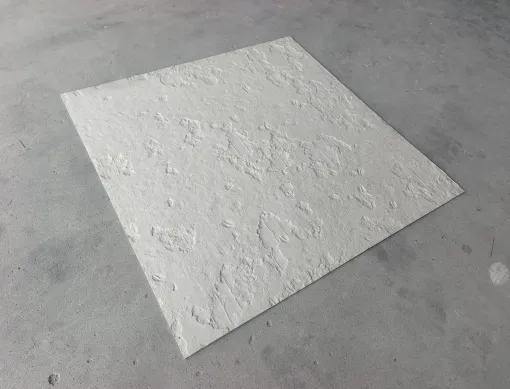
Imagine taking the fundamental elements of the earth—natural soil, sand, and stone powder—and, through an innovative, low-energy process, reforming them into a material that possesses the beauty of natural stone but is astonishingly lightweight, flexible, and durable. That's the core idea behind COLORIA GROUP's flagship technology: MCM, or Modified Cementitious Material.
This isn't just another synthetic imitation. MCM is a transformative technology that redefines what's possible with building materials. Unlike traditional ceramics or porcelain that are fired at over 1200°C, our MCM products are formed through a low-temperature curing process (under 100°C). This process doesn't just save an enormous amount of energy; it fundamentally changes the material's properties. It breaks down and reorganizes the molecules of natural clays and powders, creating a new material that is both strong and pliable. The result is a range of products that are not only beautiful but also incredibly practical and sustainable, making them some of the most advanced eco-friendly building materials on the market today.
When it comes to replicating the iconic look of Bali stone, our MCM flexible stone series is the perfect solution. Using high-fidelity 3D scanning and printing technology, we can perfectly replicate the texture, color variations, and subtle imperfections of a prime-quality piece of natural Sukabumi or lava stone. The finish isn't just a printed picture; the texture is physically part of the material, offering a tactile experience that is virtually indistinguishable from the real thing. You get all the aesthetic rewards without any of the inherent drawbacks.
Now, let's get to the heart of the matter: the budget. For any large project, whether it's a hotel complex, a residential tower, a corporate campus, or a public facility, cost-effectiveness is paramount. This isn't just about finding the cheapest material; it's about finding the solution that provides the best value across the entire project lifecycle—from procurement to installation to long-term maintenance. This is where COLORIA GROUP's MCM technology delivers an undeniable advantage.
Let's directly compare the real-world financial implications of choosing natural Bali stone versus our MCM Bali stone alternative. The savings aren't just marginal; they are substantial and accumulate at every stage of the project.
| Factor | Natural Bali Stone | COLORIA GROUP MCM Bali Stone Alternative |
|---|---|---|
| Material Cost | Very high, premium pricing due to quarrying, processing, and scarcity. | Significantly lower, thanks to an efficient manufacturing process using abundant materials. |
| Structural Requirements | High. Requires reinforced concrete/steel structures to support immense weight (50-80 kg/m²). | Low. Minimal structural load (4-6 kg/m²) allows for use on standard structures, including retrofitting old buildings. |
| Transportation & Logistics | Extremely expensive. High weight leads to huge shipping, fuel, and handling costs. Often requires special permits and equipment. | Highly economical. Lightweight and can be packed compactly, drastically reducing shipping and logistics costs by up to 80%. |
| Installation Labor | Requires highly skilled, expensive stonemasons. Slow, meticulous, and physically demanding work. | Can be installed by general contractors or tilers with basic training. Fast and easy application with a simple adhesive. |
| Installation Speed | Slow. A small team can cover only a few square meters per day. | Very fast. A small team can cover a significantly larger area per day, accelerating project timelines. |
| Waste & Breakage | High. Natural stone is brittle and can break during transport or cutting. Inconsistency leads to wasted tiles. | Minimal. Flexible material resists breakage. Can be easily cut on-site with a utility knife, resulting in almost zero waste. |
| Design Versatility | Limited to flat surfaces or very simple curves, which require expert cutting. | Extremely high. Easily wraps around complex curves, columns, and corners, enabling creative architectural designs. |
| Long-Term Maintenance | Porous material requires regular sealing to prevent staining, algae, and frost damage. Cleaning can be difficult. | Non-porous and self-cleaning properties in some finishes. Easy to clean with water. Highly resistant to weathering and staining. |
While the MCM flexible stone is perfect for intricate designs and detailed work, we understand that large projects often feature vast, uniform wall expanses. For these applications, speed and seamlessness are key. This is where our MCM project board series comes into play. These are larger, semi-rigid panels that offer the same aesthetic fidelity and lightweight benefits but are engineered for maximum installation efficiency on a grand scale.
Imagine cladding the entire facade of a 20-story hotel. Using the MCM project board series, installers can cover large areas quickly and with perfect alignment. The larger format reduces the number of seams, creating a more monolithic and visually impressive appearance. This series combines the beauty of our custom finishes with the practicality needed for commercial construction schedules, further amplifying the cost and time savings on large-scale developments. It's the perfect complement to the flexible series, allowing a project to use the right tool for the right job—flexible stone for curves and features, and project boards for the broad strokes.
While the economic argument for MCM is compelling, a truly great building material must offer more than just savings. It must empower architects to realize their vision, ensure the safety and longevity of the structure, and perform reliably for decades. COLORIA GROUP's MCM products excel in all these areas, offering advantages that go far beyond the balance sheet.
The single greatest frustration for an architect is when a design has to be compromised due to material limitations. Natural stone, for all its beauty, is rigid and unforgiving. With MCM, those limitations disappear. The ability to clad sweeping curves, undulating walls, and sharp corners without complex mitering or cutting is transformative. This flexibility means that the architectural vision, no matter how ambitious, can be executed faithfully. Furthermore, our customization capabilities are virtually limitless. Beyond the Bali stone look, we can replicate any natural texture—from wood grain to slate to travertine—or even create entirely new, bespoke finishes with our MCM 3D printing series. This allows for a level of personalization that makes every project truly unique.
For a large project, consistency is not a luxury; it's a necessity. A hotel chain needs its brand identity to be consistent across all locations. A residential development needs every unit to meet the same standard of quality. With natural stone, this is a constant battle. With MCM, it's a guarantee. Our controlled manufacturing process ensures that the first square meter produced is identical in color, texture, and quality to the ten-thousandth square meter. This eliminates the guesswork, reduces on-site sorting and waste, and ensures the final result is exactly what was specified.
The lightweight nature of MCM isn't just about cost; it's also a major safety feature. In high-rise buildings, reducing the facade's weight minimizes the risk of delamination and makes the structure inherently safer, especially in seismic zones. The material's Class A fire rating provides critical peace of mind, a non-negotiable factor in public and commercial buildings. Its durability is also a key performance indicator. The material has been tested to withstand extreme weather cycles without cracking, fading, or degrading. Its resistance to salt spray makes it ideal for coastal properties, and its performance in the high temperatures and UV radiation of regions like Saudi Arabia, where COLORIA GROUP has a strong presence, has been proven time and again. This long-term, low-maintenance durability ensures that the building looks as good on its tenth anniversary as it did on day one.
The choice of a building's exterior wall cladding is one of the most important decisions in any construction project. It defines the building's character, protects it from the elements, and represents a significant portion of its budget. For too long, achieving a premium, natural aesthetic like Bali stone meant accepting a host of compromises on cost, logistics, and design freedom.
Today, that is no longer the case. COLORIA GROUP's MCM technology offers a solution that is not just an alternative, but an upgrade. It delivers the stunning, luxurious look of Bali stone while simultaneously solving every one of its practical and financial challenges. It is a smarter, more efficient, and more sustainable path to achieving architectural excellence.
For developers, architects, and builders of large-scale projects, the message is clear. You no longer have to choose between your vision and your budget. By embracing innovative materials like MCM, you can create spaces that are not only beautiful and inspiring but are also built efficiently, safely, and responsibly. The future of construction lies in this synergy of aesthetics and intelligence, and it's a future we are proud to be building.
Recommend Products












