

There's an undeniable pull to the industrial aesthetic. Think of vast, open-plan spaces, high ceilings with exposed ductwork, polished concrete floors, and large metal-framed windows. It's a style born from converted warehouses, factories, and lofts, and it speaks of raw authenticity, functionality, and a no-frills sort of elegance. But as this style has matured, designers and business owners have started looking for ways to soften its edges, to bring in warmth and a touch of nature without compromising its core identity. This is where the allure of natural stone comes in, and few stones evoke a sense of tranquil, organic beauty quite like Bali stone.
Imagine a feature wall in a bustling creative agency, its surface a mosaic of cool, earthy tones reminiscent of a Balinese villa. Picture a chic restaurant in a converted mill, where rugged industrial elements are beautifully contrasted with a serene stone backsplash. The look is powerful, sophisticated, and unique. However, translating this vision into reality, especially within a demanding industrial or commercial context, is fraught with challenges. Traditional natural stone, for all its beauty, is notoriously heavy, expensive, fragile during transport and installation, and often difficult to source in consistent batches for large projects. How do you achieve that stunning Bali stone effect on a grand scale without inviting a logistical and budgetary nightmare? The answer lies not in compromising the vision, but in revolutionizing the material itself. It's time to explore a modern solution that delivers the aesthetic you crave with the performance your industrial space demands.
To truly appreciate the need for a modern alternative, we first need to understand why this specific combination of industrial design and natural stone is so compelling. The industrial look is fundamentally about honesty in materials. It's about celebrating the structural elements of a building rather than hiding them. Steel beams, brick walls, and concrete surfaces are not just functional; they become the primary design features. This creates a powerful, masculine, and highly functional backdrop. For a long time, this was enough. The style was stark, minimalist, and efficient.
However, human beings are intrinsically drawn to nature. We seek out patterns, textures, and colors that connect us to the organic world. This is a concept known as biophilia. In an environment dominated by hard, cold, and man-made surfaces, a touch of nature can have a profound psychological impact. It can make a space feel more grounded, more calming, and ultimately, more human. This is precisely the role that a material like Bali stone plays. Its varied textures, subtle color variations, and inherently natural feel provide a perfect counterbalance to the uniformity of metal and concrete. It introduces a layer of warmth and 'perfect imperfection' that prevents the industrial aesthetic from feeling sterile or uninviting. The resulting fusion is a space that feels both strong and serene, professional yet personal. It's the architectural equivalent of a well-tailored suit paired with a handcrafted leather watch – a blend of precision and soul.
But let's be pragmatic. The reality of building or renovating an industrial space is a world of hard numbers, timelines, and physical limitations. Let's consider a real-world scenario: specifying traditional Bali stone for a 500-square-meter feature wall in a new commercial headquarters. The first hurdle is weight. Natural stone is incredibly dense. The sheer tonnage would require significant structural reinforcement of the wall and potentially the foundation, adding immense cost and complexity to the engineering. Next comes sourcing. Finding that much stone with a consistent color palette and texture from a single quarry can be a logistical challenge, leading to delays and potential mismatches. Then there's transportation and installation. The heavy slabs are prone to cracking and chipping, meaning a significant percentage of waste must be factored into the budget. The installation itself is a slow, messy, and labor-intensive process requiring specialized masons. For a business, this means longer construction timelines and higher labor costs. Finally, in a high-traffic industrial or commercial setting, natural stone can be porous, susceptible to staining, and difficult to repair if damaged. The dream of a Bali stone wall can quickly become a practical and financial quagmire.
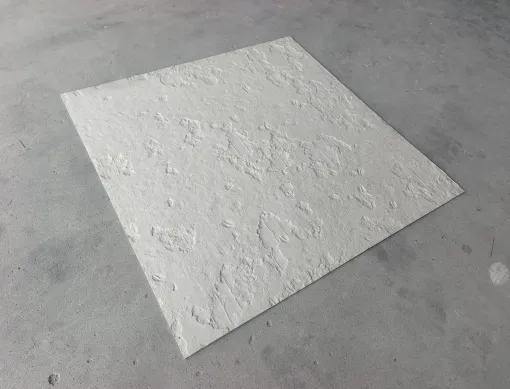
This is where innovation steps in to bridge the gap between aesthetic desire and practical reality. At COLORIA GROUP, we've dedicated ourselves to pioneering advanced building materials that solve these exact problems. Our solution is a groundbreaking technology known as **MCM**, which stands for **Modified Cementitious Material**. Forget everything you think you know about traditional cladding. This is something entirely different.
So, what exactly is it? In simple terms, MCM is an eco-friendly composite material created from a base of natural components like soil, sand, and mineral powders. Through a highly specialized manufacturing process involving molecular-level modification and low-temperature firing (a process that consumes far less energy than producing ceramic tiles or traditional cement), these raw ingredients are transformed into a new form of material. The result is a product that possesses the aesthetic qualities of natural materials like stone, wood, and brick, but with a vastly superior performance profile. It's a true 'best of both worlds' scenario.
The flagship product in this family, and the perfect answer to the Bali stone challenge, is our **MCM Flexible Stone**. This isn't a cheap imitation or a printed laminate. It's a material with genuine texture and depth. Using molds cast from high-quality natural stone, we can replicate the intricate surfaces, subtle tonal shifts, and unique characteristics of everything from rugged slate to, yes, the serene and sought-after Bali stone. When you run your hand over a wall clad in MCM Flexible Stone, it feels real because, at its core, it's derived from the same earthen elements. The key difference lies in its dramatically enhanced properties. It's incredibly lightweight, astonishingly flexible, and exceptionally durable. This trifecta of benefits completely rewrites the rulebook for wall cladding in industrial and commercial spaces.
When you're making decisions for a large-scale project, every detail matters. The choice of material can impact everything from the structural engineer's calculations to the final cleaning crew's instructions. Let's break down exactly why **MCM Flexible Stone** isn't just a good alternative, but the superior choice for bringing natural stone aesthetics into an industrial environment.
This is perhaps the most immediate and impactful advantage. A traditional stone wall is a construction project in itself. It requires heavy lifting equipment, specialized wet saws for cutting, and a team of skilled masons working slowly with mortar. The process is messy, generating significant dust and slurry.
In stark contrast, installing MCM Flexible Stone is more akin to tiling, but even easier. Because the material is so light—up to 80% lighter than traditional stone of the same thickness—it can be easily handled by one or two workers. It can be cut on-site with a simple utility knife, eliminating the need for heavy machinery and reducing dust and noise pollution dramatically. Its inherent flexibility means it can wrap flawlessly around curved walls, columns, and corners without complex miter cuts. It's applied directly to the substrate using a specially formulated adhesive, making the process fast, clean, and efficient. This translates directly to lower labor costs, shorter project timelines, and a cleaner, safer work environment.
An industrial space is, by its nature, a tough environment. It might be a warehouse with forklift traffic, a workshop with moving equipment, or a commercial kitchen subject to heat and moisture. The wall cladding needs to be able to withstand more than just occasional bumps. This is where the 'Modified' in Modified Cementitious Material truly shines.
While we've focused on the Bali stone look, the beauty of MCM technology is its incredible versatility. The molding process allows COLORIA GROUP to create an almost limitless library of textures and patterns. Whether your project calls for the look of raw concrete, rustic brick, warm terracotta, or polished travertine, there is an MCM solution. This allows for incredible design freedom.
Furthermore, you can achieve a level of consistency that is impossible with natural stone. For a large project, you are guaranteed that the panel installed on day one will be a perfect match for the panel installed on day fifty. This eliminates the risk of mismatched batches and ensures a seamless, professional finish across the entire scope of the project. This consistency is also a feature of our other product lines. For instance, you could use our **MCM 3D Printing Series** to create a bespoke, deeply textured logo or artistic element as a focal point, knowing it will perfectly complement the surrounding flexible stone walls.
The advantages become even clearer when viewed side-by-side. Let's compare MCM Flexible Stone to traditional quarried stone for a typical industrial wall cladding application.
| Feature | COLORIA GROUP MCM Flexible Stone | Traditional Natural Stone (e.g., Bali Stone) |
|---|---|---|
| Weight | MCM Flexible Stone"> Extremely Lightweight (approx. 4-8 kg/m²) | Very Heavy (approx. 50-80 kg/m²) |
| Flexibility | MCM Flexible Stone"> Highly Flexible; can wrap around curves (min. radius ~30cm) | Rigid and Brittle; requires cutting for corners |
| Installation Speed & Labor | MCM Flexible Stone"> Fast, clean, lower-skilled labor. Cut with a knife. | Slow, messy, requires specialized masons. Heavy cutting equipment. |
| Structural Requirements | MCM Flexible Stone"> Minimal to none. Can be applied to most substrates. | Often requires significant structural reinforcement. |
| Durability & Maintenance | MCM Flexible Stone"> Impact, water, fire (Class A), and UV resistant. Easy to clean. | Brittle, can be porous, susceptible to staining and chipping. |
| Consistency | MCM Flexible Stone"> High consistency in color and texture across large batches. | Natural variations can lead to inconsistencies. |
| Total Project Cost | MCM Flexible Stone"> Lower total cost due to savings on transport, labor, structure, and waste. | High initial material cost plus significant additional costs. |
| Environmental Impact | MCM Flexible Stone"> Made from natural soil/sand, low-energy production, recyclable. | Quarrying is destructive to landscapes; high energy for extraction and transport. |
A feature wall is just one piece of the puzzle. A large-scale industrial or commercial build-out involves a complex interplay of different surfaces, each with its own set of performance requirements. This is why it's crucial to partner with a supplier that thinks beyond a single product. At COLORIA GROUP, we position ourselves as a true **one-stop solution provider** for architectural surfaces. Our extensive range of MCM products is designed to work together, providing a cohesive and comprehensive material palette for your entire project.
While MCM Flexible Stone is the perfect choice for creating intricate, textured feature walls and wrapping curved elements, other areas of your project might benefit from a different approach. This is where other series from our portfolio come into play.
Consider the vast exterior of a logistics center or a modern factory. Here, speed of coverage, absolute uniformity, and robust weatherproofing are the top priorities. For this, our **MCM Project Board Series** is the ideal solution. These are larger, semi-rigid panels engineered for rapid installation over large surface areas. They provide the same durability and aesthetic quality as our flexible range but are optimized for efficiency in large-scale facade applications. You can clad an entire building in a fraction of the time it would take with traditional materials, all while maintaining a high-end, consistent look.
Now, think about the main lobby, the executive boardroom, or a high-end showroom within that same industrial complex. These are spaces where you want to make a grand statement. For this, our **MCM Big Slab Board Series** offers panels in expansive formats. These large-format slabs minimize grout lines, creating a monolithic, seamless stone appearance that exudes luxury and permanence. You can achieve the look of a solid block of marble or granite without the impossible weight or astronomical cost.
By leveraging the entire COLORIA GROUP ecosystem, an architect or developer can specify materials for the entire building envelope from a single, reliable source. You can use the MCM Project Board Series for the main exterior, transition to the MCM Big Slab Board Series for the grand entrance, and use the complementary MCM Flexible Stone to create a stunning "Bali stone" feature wall inside. This holistic approach simplifies procurement, guarantees aesthetic and technical compatibility between materials, and ensures that the quality and performance standards are consistently met across the board. It streamlines the entire construction process, reducing risk and delivering a more predictable, high-quality outcome.
The desire to blend the raw power of industrial architecture with the serene, organic beauty of natural stone is a testament to the evolution of modern design. For too long, this vision has been compromised by the physical, logistical, and financial limitations of traditional materials. That era is over.
COLORIA GROUP's revolutionary approach to material science, embodied in our versatile MCM product family, has made this vision a practical, durable, and cost-effective reality. Our **MCM Flexible Stone** offers the authentic look and feel of materials like Bali stone, but with the lightweight, flexible, and resilient properties needed to thrive in demanding industrial and commercial environments. The aesthetic you dream of is no longer at odds with the performance you require.
By embracing innovative solutions for wall cladding and beyond, we are not just building structures; we are crafting environments. We are creating spaces that are not only functional and durable but also inspiring, beautiful, and sustainable. The future of industrial design lies in this intelligent synthesis of aesthetics and performance, and it's a future that is being built today.
Recommend Products












