
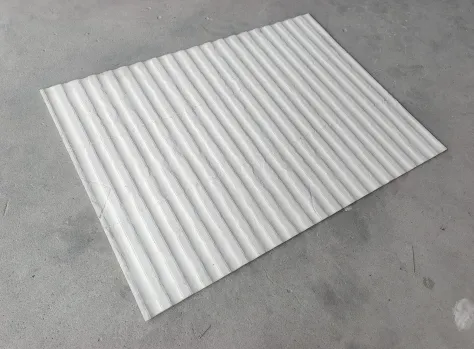
For centuries, the curve has been both the architect's muse and their greatest challenge. From the majestic domes of ancient cathedrals to the flowing facades of modern museums, curved surfaces evoke a sense of organic beauty and dynamism. But realizing these visions has always been a battle against the rigid, heavy, and unforgiving nature of traditional building materials. What if there was a material that could bend, wrap, and flow with the design, rather than fighting it? This is where the story of Century Stone Flexible Stone begins, a revolutionary product from COLORIA GROUP that is redefining the possibilities for architectural expression.
Before we dive into the incredible applications on curved walls, it's crucial to understand what makes Century Stone Flexible Stone so special. It's not just "flexible stone" in a metaphorical sense; it's a tangible reality born from cutting-edge material science. At its core, this product is a flagship example of MCM (Modified Cementitious Material) technology, a field pioneered and perfected by COLORIA GROUP.
Imagine taking natural elements—like common soil, stone powder, and mineral aggregates—and putting them through a highly controlled, scientific process. This isn't the brute-force, high-heat firing of traditional ceramics or the quarrying of massive stone blocks. Instead, MCM technology uses a low-temperature baking process. This unique method modifies the materials at a molecular level, rearranging their structure to create a material that retains the aesthetic and textural essence of natural stone but is endowed with remarkable new properties.
The result is a sheet of material that is incredibly thin (often just 2-4mm), surprisingly lightweight, and, most importantly, flexible. You can literally take a piece of what looks and feels like slate, travertine, or granite and bend it around a pillar. It's a paradigm shift. We're moving from subtracting material (carving stone) to creating it with purpose-built characteristics. This isn't just a new product; it's a new way of thinking about building skins.
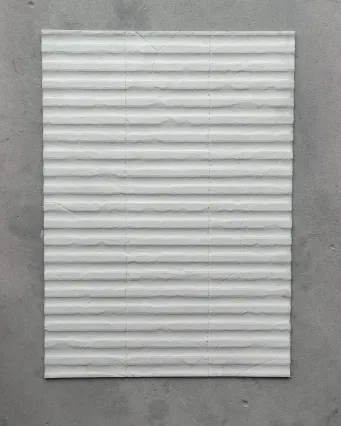
This is where Century Stone Flexible Stone truly shines and transforms architectural possibilities. Historically, cladding a curved wall with a material like natural stone, tile, or brick has been a logistical nightmare fraught with compromise.
Consider a grand, sweeping curved facade or a set of monumental circular columns. With traditional materials, architects and builders face a host of issues. Natural stone must be custom-cut into smaller, trapezoidal pieces to approximate the curve, leading to a faceted, rather than truly curved, appearance. This process is not only astronomically expensive but also generates immense material waste. The numerous joints required are weak points for water ingress and visual disruptions. Brick requires highly skilled masons to lay complex courses. Tiles are even worse, as their small, rigid format creates a jarring grid-like pattern on a surface that cries out for fluidity. The sheer weight of these materials also necessitates a more robust, and therefore more expensive, underlying structure.
"We are no longer forcing a rigid material onto an organic shape. We are now using a material that is born to be organic, to follow the lines and contours of the most imaginative designs."
Century Stone Flexible Stone elegantly solves every one of these problems. Let's revisit our grand, sweeping facade. Instead of a thousand small, cut pieces, large sheets of flexible stone can be applied directly to the substrate. The material simply follows the contour of the wall, bending smoothly and uniformly.
Wrapping Columns and Pillars
For columns, the transformation is even more dramatic. A single sheet or a few large sheets of MCM Flexible Stone can wrap around a column with a diameter as small as 300mm. The result is a seamless, monolithic stone appearance that would be impossible to achieve with quarried slabs. The installation is simple: a specialized adhesive is applied, the sheet is wrapped around the column, and it's pressed into place. There's no complex cutting, no heavy lifting equipment, and minimal joints. What once took weeks of painstaking labor can now be achieved in a fraction of the time with a flawless finish.
Flowing Facades and Undulating Walls
For large-scale undulating walls, like those seen in Zaha Hadid-inspired architecture, flexible stone is not just a good option; it's arguably the only one that can fully realize the architect's intent without compromise. It allows the surface to appear as a single, continuous skin, a "fabric" of stone that drapes over the building's skeleton. This capability empowers architects to design with true freedom, knowing there's a material that can keep up with their imagination.
Arches and Domes
Cladding the underside of an arch or the interior of a dome has always been a test of skill and gravity. With heavy materials, the risk and complexity are immense. Century Stone's lightweight nature and flexibility make it ideal for these overhead and complex-curved applications. It adheres securely and conforms perfectly to the shape, creating stunning and safe overhead features.
While its performance on curved walls is its most visually stunning party trick, the versatility of Century Stone extends to a vast array of other unique architectural challenges. The same properties that make it perfect for curves—flexibility, light weight, and ease of cutting—make it a problem-solver for countless other applications, both inside and out.
Modern architecture often features facades with sharp, non-90-degree angles, recessed windows, and intricate geometric patterns. Cutting heavy, thick materials like natural stone or concrete panels to fit these complex shapes is time-consuming and prone to chipping and breakage. Century Stone, on the other hand, can be easily cut on-site with a simple utility knife or shears. This allows for perfect, crisp fits around any window, corner, or angular feature, ensuring a clean and precise finish on even the most complex designs.
This is where COLORIA GROUP's position as a one-stop solution provider becomes a powerful advantage. A single project can benefit from multiple MCM product lines to achieve a cohesive yet varied aesthetic. Imagine a commercial building: the grand curved entrance is clad in the beautiful, flowing textures of MCM Flexible Stone . The vast, flat expanses of the main walls are covered with the MCM Big Slab Board Series , which provides large-format, uniform panels for a sleek, modern look. This series offers the same durability and lightweight benefits but is engineered for rigidity over large, flat surfaces, ensuring a perfectly plumb and impressive facade.
Now, let's add the finishing touches. Perhaps the company logo or a unique decorative frieze is required. This is where the MCM 3D Printing Series comes into play. This groundbreaking technology allows for the creation of intricate, custom, three-dimensional elements using the same base MCM material. This ensures perfect material and color consistency across the entire project—from the flowing curves to the flat walls to the bespoke decorative details. This level of integration from a single supplier is unparalleled, simplifying logistics and guaranteeing a harmonious final result.
The application of Century Stone is by no means limited to exteriors. Its lightweight and flexible properties make it an interior designer's dream material.
A revolutionary material is only truly revolutionary if it is also practical. Aesthetics and design freedom are paramount, but cost-effectiveness, ease of installation, and long-term performance are what make a material a viable choice for real-world projects. Here, Century Stone Flexible Stone demonstrates a clear and compelling advantage over traditional materials.
The installation process is a world away from traditional masonry or stone fitting. It involves a lightweight, trowel-on application. First, the substrate is prepared to be clean and level. Then, a specially formulated adhesive is applied to the wall. The flexible stone sheet is then simply pressed into the adhesive, and a roller is used to ensure full contact and remove any air pockets. The material is so easy to work with that it can be adjusted for a short period after placement. This process is significantly faster, requires a less specialized skillset than traditional stonemasonry, and creates far less on-site noise and dust.
To put it in perspective, let's look at a direct comparison. The table below outlines the key differences between Century Stone Flexible Stone and traditional materials like quarried stone slabs.
| Feature | Century Stone Flexible Stone (MCM) | Traditional Quarried Stone |
|---|---|---|
| Weight | Very Low (Approx. 4-8 kg/m²) | Very High (Approx. 50-100 kg/m²) |
| Flexibility | High; can wrap around columns and curves | None; is completely rigid |
| Thickness | Ultra-thin (2-4 mm) | Thick (20-30 mm or more) |
| Installation | Fast, simple adhesive application; less labor | Slow, complex; requires heavy machinery and specialized labor |
| Application on Curves | Ideal; wraps seamlessly | Extremely difficult and expensive; requires cutting small pieces |
| Material Waste | Minimal; can be cut with a knife | High, especially on complex shapes |
| Transportation Cost | Low, due to light weight | Very high, due to extreme weight |
| Structural Load | Negligible impact on building structure | Requires significant structural reinforcement |
| Eco-Friendliness | Low-energy production, less resource-intensive | High-energy quarrying and processing |
The innovation behind Century Stone Flexible Stone and the broader MCM family of products is not just about solving today's design challenges. It's about responding to the needs of the future. The construction industry is under increasing pressure to be more sustainable, more efficient, and more innovative.
By choosing materials like these, architects and developers are making a conscious decision to reduce their environmental impact. The manufacturing process consumes a fraction of the energy required for quarrying and firing traditional materials. The light weight drastically cuts down on the carbon emissions associated with transportation. And the durability of the product ensures a long lifespan, reducing the need for replacements and repairs. This is the definition of building smart.
COLORIA GROUP's commitment extends across its global operations, ensuring that projects from the dynamic markets of Saudi Arabia to urban centers across Asia have access to these advanced, responsible building solutions.
Century Stone Flexible Stone is more than just a cladding material. It is an enabler of creativity. It liberates architects from the constraints of rigidity and weight, allowing them to design the fluid, dynamic, and expressive buildings they have always envisioned. It bridges the gap between the wildness of imagination and the reality of construction.
The ability to seamlessly wrap a column, to flow over an undulating wall, or to perfectly finish a complex arch is no longer a costly dream but a practical reality. Paired with the comprehensive solutions offered by the entire COLORIA GROUP portfolio, including the MCM Big Slab Board and 3D Printing series, designers have a complete toolkit to build the architectural landmarks of tomorrow. The era of fighting with materials is over. The era of flowing with them has begun.
Recommend Products












