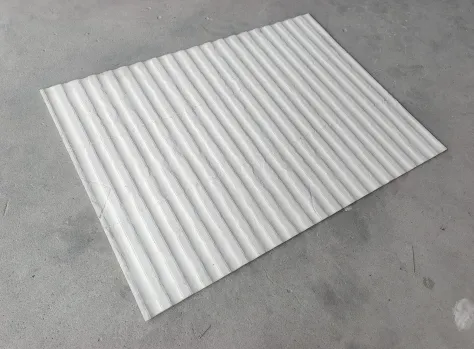
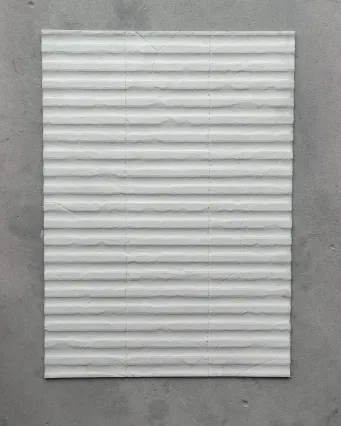
Not all MCM products are created equal. COLORIA's lineup includes specialized solutions tailored to different restoration needs. Let's dive into four standout options that are making waves in historic preservation projects around the world.
1. Flexible Stone: The Gentle Giant of Restoration
When you hear "stone," you probably picture something hard and unyielding. But flexible stone turns that idea on its head. This MCM innovation is exactly what it sounds like: stone-like panels that can bend and flex without cracking. How is that possible? The secret is in the fiber-reinforced matrix, which gives the material elasticity while maintaining its structural integrity.
For historic buildings with curved walls or irregular surfaces—think the domes of a Baroque church or the rounded arches of a Romanesque cathedral—flexible stone is a revelation. Traditional rigid stone panels would require custom cutting and fitting, a time-consuming and error-prone process. Flexible stone, however, can be shaped to follow the building's natural curves, ensuring a seamless, authentic look. It's also ideal for buildings with existing damage: the material can conform to uneven surfaces, hiding minor cracks and imperfections without the need for extensive prep work.
Take, for example, a 19th-century opera house in Lisbon, Portugal, with a facade featuring ornate curved cornices. Years of exposure to coastal humidity had caused the original limestone to flake and crack. Using flexible stone panels, restorers were able to replicate the cornices' intricate details and install them without removing the original structure. The result? A facade that looks identical to the original but with the durability to withstand future weathering.
2. Travertine (Starry Green): Nature's Beauty, Engineered for Longevity
Travertine has been a favorite building material for millennia, from the Colosseum in Rome to the Hagia Sophia in Istanbul. Its unique porous texture and warm earth tones give it a timeless appeal. But natural travertine is porous and prone to staining, making it a poor choice for modern restoration projects where low maintenance is key. Enter COLORIA's Travertine (Starry Green)—a MCM take on this classic stone that retains its beauty while addressing its weaknesses.
Starry Green gets its name from the subtle flecks of green and gold that mimic the look of natural travertine quarried in certain regions of Italy. But unlike its natural counterpart, this engineered version is non-porous, meaning it resists water damage, mold, and staining. It's also UV-resistant, so the color won't fade under harsh sunlight—a critical feature for buildings in sunny climates like the Middle East or the American Southwest.
In a recent project in Cairo, Egypt, restorers used Starry Green panels to replace damaged sections of a 18th-century mosque's courtyard walls. The original travertine had deteriorated due to saltwater intrusion from the nearby Nile. The MCM panels not only matched the mosque's historic aesthetic but also withstood the humid environment better than the original stone. Local preservationists noted that the panels required minimal upkeep compared to natural travertine, which had needed regular sealing and cleaning.
3. Rammed Earth Board: Bringing Back the Warmth of Ancient Walls
Rammed earth construction—compressing layers of soil, clay, and gravel to form walls—dates back to neolithic times. It's prized for its natural insulation, earthy appearance, and sustainability. But traditional rammed earth is heavy, labor-intensive, and prone to erosion in wet climates. COLORIA's Rammed Earth Board reimagines this ancient technique for the modern world.
These panels are made by compressing a mixture of natural clays, sands, and MCM binders under high pressure, creating a material that looks and feels like traditional rammed earth but with enhanced durability. They're lightweight enough to be installed on wooden or steel frames, making them suitable for historic buildings with fragile structures. Plus, they come in a range of colors and textures, from soft beiges to rich terracottas, allowing restorers to match the original earth tones of a building.
A prime example is the restoration of a 17th-century adobe mission in New Mexico, USA. The original rammed earth walls had begun to crumble due to years of heavy rainfall. Using Rammed Earth Board, restorers were able to replicate the mission's iconic warm, earthy facade without adding weight to the aging wooden roof structure. The panels also included a moisture barrier, preventing future water damage—a feature the original builders could only dream of.
4. 3D Printing Series: Precision for the Most Intricate Details
Some historic buildings feature decorative elements so unique and complex that they're nearly impossible to replicate by hand. Think of the intricate stone carvings on a Gothic cathedral or the detailed tile patterns on a Mughal palace. This is where COLORIA's 3D Printing Series shines. Using advanced 3D printing technology, the company can create custom MCM components that match even the most elaborate historical details with pinpoint accuracy.
Here's how it works: restorers scan the original decorative element—say, a carved stone gargoyle or a floral tile pattern—using 3D imaging technology. That scan is then used to create a digital model, which is fed into a 3D printer. The printer then layers MCM materials to build an exact replica of the original, down to the smallest indentation. The result is a component that's indistinguishable from the original but made from durable, weather-resistant MCM.
In a recent project in Florence, Italy, a historic palazzo with a damaged marble relief panel was restored using the 3D Printing Series. The original panel, featuring a scene from Greek mythology, had been chipped during World War II and was too fragile to repair. By scanning the remaining parts of the relief, COLORIA was able to 3D print a perfect replica, which was then installed in place of the damaged panel. Art historians praised the result, noting that the new panel maintained the palazzo's historical authenticity while ensuring the relief would last for generations.