
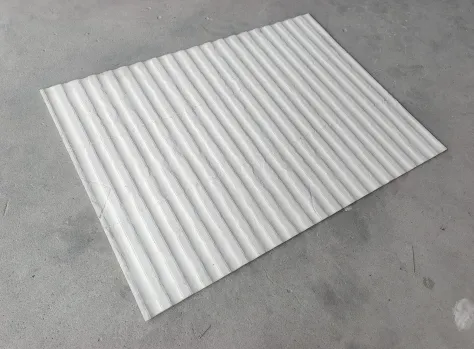
Walk into the lobby of a contemporary art museum in Riyadh, and your gaze is immediately drawn upward. There, a 12-meter-tall decorative column rises toward the glass ceiling, its surface rippling with the texture of travertine (starry green) —tiny flecks of emerald scattered like distant stars across a creamy base. What's remarkable? This isn't carved from solid stone, nor is it a heavy concrete monolith. It's a product of MCM 3D Printing Series, a technology that's quietly revolutionizing how architects and designers approach both aesthetics and functionality in building details. Let's dive into how Century Stone Works, powered by COLORIA GROUP's MCM innovations, is turning structural elements into storytelling pieces.
Traditional decorative columns have always been a balancing act. Carving marble or stacking stone demands time, labor, and often compromises on design complexity—curves that are too sharp, textures too intricate, or heights too grand risk becoming structurally unstable or prohibitively expensive. Enter MCM 3D Printing Series: a modified cementitious material that's as durable as it is malleable, printed layer by layer to capture even the most ambitious designs.
Take that museum column, for example. The client wanted a texture that evoked both ancient stone and cosmic wonder—something that felt rooted yet otherworldly. The MCM 3D printer delivered exactly that: travertine (starry green) patterns embedded directly into the material during printing, with no need for post-processing or painting. The result? A column that weighs 60% less than a traditional stone equivalent, installs in half the time, and can withstand Saudi Arabia's harsh sun and sandstorms without fading or cracking.
But it's not just about weight and durability. 3D printing unlocks geometries that were once impossible. Imagine a boutique hotel in Dubai with spiral columns that twist upward, their surfaces adorned with lunar peak silvery —a metallic sheen that mimics moonlight on rock. With MCM's precision, each spiral turn is consistent, each silvery fleck placed intentionally, creating a visual rhythm that guides guests through the space. It's structural engineering meets art, made possible by a material that bonds layer upon layer into a single, seamless piece.
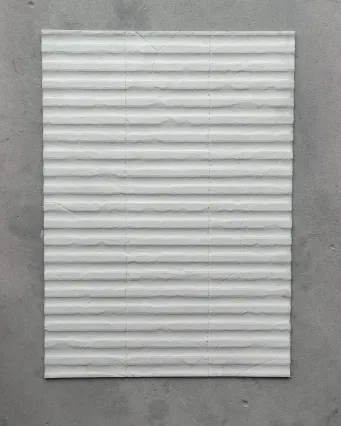
Not all structural details are grand columns. Sometimes, the magic is in the small, curved transitions—like the rounded edges of a reception desk, the archway of a heritage building restoration, or the undulating facade of a retail store. For these, MCM Flexible Stone steps into the spotlight. This isn't your typical rigid cladding; it's a thin, bendable material that can wrap around curves, cling to uneven surfaces, and still maintain the look and feel of natural stone.
Picture a café in Jeddah with a feature wall that curves gently around the seating area. The designer wanted the warmth of natural stone but needed something lightweight enough to follow the wall's organic shape. MCM Flexible Stone in travertine (beige) was the answer. Installers rolled it out like a large, textured fabric, pressing it into place without gaps or cracks. The result? A space that feels both cozy and expansive, with the stone's subtle veining flowing uninterrupted around the bend.
What makes Flexible Stone so versatile? Its modified cementitious base is reinforced with fibers, giving it the tensile strength to flex up to 90 degrees without breaking. And because it's customizable, you're not limited to neutral tones. A recent project in Kuwait used Flexible Stone in rusty red to clad the cylindrical pillars of a cultural center, creating a bold contrast against the building's white facade—proof that even structural elements can be statement pieces.
While columns and curves steal the show, the backbone of any building's aesthetic lies in its larger surfaces. That's where MCM Big Slab Board Series comes in. These panels—available in sizes up to 3 meters by 1.5 meters—turn exterior walls, lobby feature walls, and even ceiling details into canvas-like expanses, free from the distraction of grout lines or mismatched seams.
Consider a corporate headquarters in Doha with a lobby wall designed to mimic a desert landscape. The architect chose gobi panel texture, a pattern of wind-worn ridges and valleys that evoke the Gobi Desert's rugged beauty. Using MCM Big Slab Boards, the entire 20-meter wall was covered in just 12 panels, each printed with precise, continuous gobi panel detailing. From a distance, it reads as a single, sweeping landscape; up close, you can trace the texture with your hand, feeling the depth of each ridge.
The advantage here is twofold: fewer joints mean less maintenance (no grout to clean or repair) and a more immersive visual experience. Plus, like all MCM products, these slabs are eco-friendly—made with recycled materials and low VOC emissions, aligning with the growing demand for sustainable building practices in the Middle East and beyond.
| Feature | Traditional Stone/Concrete | MCM 3D Printing/Flexible Stone/Big Slab |
|---|---|---|
| Weight | Heavy (200-300 kg/m²) | Lightweight (30-50 kg/m²) |
| Design Flexibility | Limited by carving/molding tools | Unlimited geometries (3D printing) and curves (Flexible Stone) |
| Installation Time | Weeks (carving + assembly) | Days (printing + lightweight installation) |
| Sustainability | High carbon footprint (quarrying, transportation) | Low emissions, recycled materials, energy-efficient production |
| Durability in Harsh Climates | Prone to cracking/fading in extreme heat/sand | UV-resistant, weatherproof, and color-stable |
What ties all these innovations together? Century Stone Works isn't just selling materials—it's offering a partnership. COLORIA GROUP's decades of experience in global building solutions mean they understand the unique challenges of projects in the Middle East: the need for materials that can handle 50°C summers, the demand for designs that honor cultural heritage while embracing modernity, and the pressure to deliver projects on tight timelines.
Whether it's a lunar peak silvery 3D-printed column in a Riyadh mall, travertine (starry green) accents in a Dubai hotel, or Flexible Stone curves in a Kuwaiti museum, each piece tells a story. And with COLORIA's one-stop approach—from custom design to on-site installation support—architects can focus on creativity, not logistics.
So the next time you pass a striking column or a seamlessly textured wall, take a closer look. Chances are, it's not just stone or concrete—it's MCM technology, turning structural details into something more: a conversation starter, a piece of art, a testament to how innovation can make buildings feel less like structures, and more like spaces with soul. Century Stone Works isn't just building with materials; it's building with possibility.
Recommend Products












