
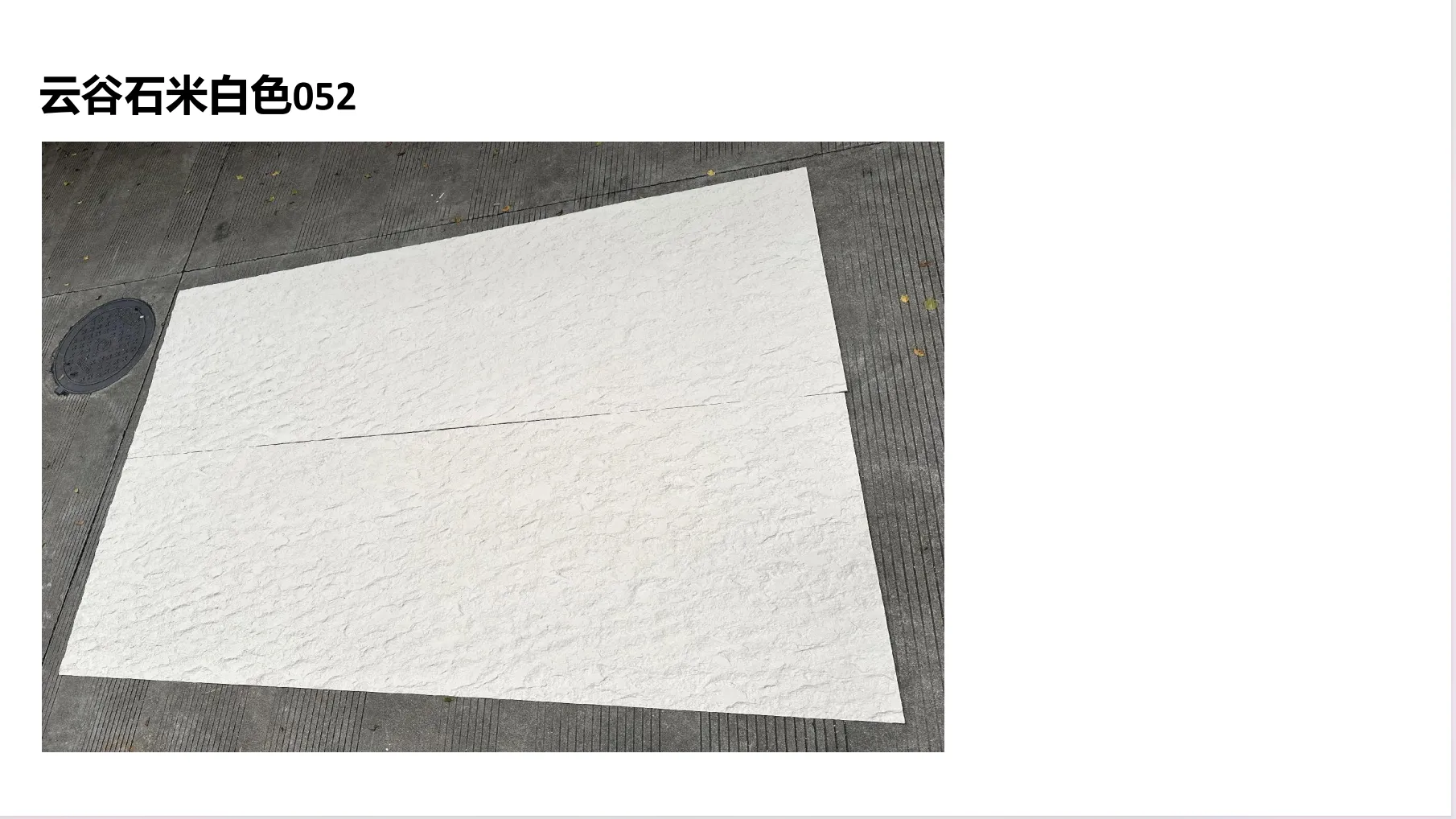
High-rise buildings are more than just steel and glass; they're vertical cities, where thousands live, work, and dream. But standing hundreds of feet in the air, they face a relentless battle—against howling winds that twist and pull, against rain that beats like drumbeats, against sun that bleaches and snow that freezes. For architects and builders, choosing the right cladding material isn't just about looks; it's about ensuring these giants stand strong, year after year, without losing an ounce of their beauty. That's where Cloud Stone comes in—a material that's quietly redefining what high-rise exteriors can be, blending resilience with a warmth that makes skyscrapers feel less like machines and more like homes.
Let's start with the basics: wind. At ground level, a 30 mph gust might ruffle your hair, but 50 stories up? That same wind can reach speeds of 60 mph or more, swirling around corners, creating unpredictable vortexes that push and pull at the building's skin. Engineers call this "wind load," and it's not just about brute force—sudden gusts can cause vibrations, which over time weaken materials. Then there's weather: UV rays from the sun that fade colors, rain that seeps into cracks, freeze-thaw cycles that turn tiny gaps into big problems, and even salt in coastal areas that eats away at metal and stone. For high-rises, a material that can't handle these stressors isn't just a maintenance headache; it's a safety risk.
Traditional materials have tried to keep up. Fair-faced concrete, for example, is tough but rigid—great for load-bearing, but when wind pushes, it doesn't bend; it cracks. Travertine, with its timeless texture (think travertine (starry blue) with its subtle, veining), is beautiful but porous, absorbing water like a sponge in heavy rain. Even newer options like foamed aluminium alloy board (vintage silver) are lightweight and sleek, but their thin profiles can dent under extreme wind pressure. So what if there was a material that could dance with the wind, shrug off the rain, and still look stunning decades later? Enter Cloud Stone.
Cloud Stone isn't a single material—it's a family of modified composite panels, born from the idea that high-rise cladding shouldn't have to choose between strength and style. At its core is mcm flexible stone, a technology that blends natural minerals with advanced polymers to create a sheet that's both flexible and tough. Imagine a material that can bend up to 12 degrees without snapping, yet is dense enough to resist impact. That's Cloud Stone. It's lightweight, too—about 80% lighter than traditional stone slabs—so it eases the load on a building's structure, letting architects reach new heights without compromising safety.
But what really sets Cloud Stone apart is its versatility. It comes in finishes that mimic everything from weathered stone to polished metal. Want the silvery sheen of moonlight? There's a variant inspired by lunar peak silvery, with a soft, reflective surface that shimmers at dusk. Prefer the industrial chic of aged metal? Foamed aluminium alloy board (vintage silver) is a close cousin, but Cloud Stone's version adds the bonus of weather resistance that aluminium alone can't match. And for those who love the organic look of natural stone, there are options that replicate travertine (starry blue) or even the rough-hewn texture of granite—without the weight or porosity.
Let's talk wind. In wind tunnel tests, Cloud Stone panels have proven their mettle. When a 70 mph gust hits, most rigid materials (like fair-faced concrete) take the full force head-on, transferring stress to the building's frame. Cloud Stone, thanks to its mcm flexible stone core, does something different: it flexes. The panels act like a sail that billows slightly, absorbing the wind's energy instead of fighting it. This "give" prevents cracks from forming, even in areas with frequent storms—think coastal cities like Miami or Hong Kong, where typhoons are a yearly reality.
Installation matters, too. Cloud Stone uses a dry-joint, interlocking system, where panels click together like puzzle pieces, with hidden fasteners that anchor them securely to the building's facade. Unlike mortar-set stone, which can loosen over time, this system allows for expansion and contraction as temperatures rise and fall. On a hot day, the panels expand slightly; on a cold night, they shrink. The interlocking design accommodates this movement without gaps, so wind can't sneak in and pry panels loose. It's a small detail, but in high winds, small details save buildings.
Take the case of the Azure Tower in Singapore, a 42-story residential building wrapped in Cloud Stone's "Starry Night" finish (inspired by travertine (starry blue)). During the 2023 monsoon season, the city saw winds of up to 65 mph, with heavy rain for weeks. Post-storm inspections found zero damage to the facade—no cracks, no loose panels, just the same deep blue veining that had been there since construction. "We expected some wear, maybe a few chips," said the building's engineer, "but Cloud Stone didn't just hold up—it looked like it hadn't even rained."
Wind is just one part of the equation. High-rises also face a daily beating from the sun, rain, and temperature extremes. Cloud Stone's secret here is its multi-layered construction. The top layer is a UV-resistant coating that blocks 99% of harmful rays, so colors don't fade—even in desert cities like Dubai, where summer temperatures hit 120°F. Below that, the mcm flexible stone core is non-porous, so rain, snow, and saltwater bead up and roll off, instead of seeping in. No more water stains, no more mold growth, no more freeze-thaw damage.
To put this to the test, let's compare Cloud Stone to some common alternatives. The table below breaks down how it stacks up against fair-faced concrete, lunar peak silvery, and foamed aluminium alloy board (vintage silver) in key weather-resistance categories:
| Material | UV Resistance (Years Before Fading) | Water Absorption Rate | Freeze-Thaw Resistance (Cycles) | Salt Corrosion Resistance |
|---|---|---|---|---|
| Cloud Stone | 25+ | <0.5% | 1,000+ | Excellent (No Rust/Corrosion) |
| Fair-Faced Concrete | 10-15 | 5-8% | 300-500 | Poor (Susceptible to Spalling) |
| Lunar Peak Silvery | 15-20 | 1-2% | 600-800 | Good (Minor Pitting Over Time) |
| Foamed Aluminium Alloy Board (Vintage Silver) | 18-22 | 0.3% | 800-900 | Very Good (But Dents Easily) |
The numbers speak for themselves. Cloud Stone outperforms concrete in every category, matches or exceeds aluminium in water and salt resistance, and even holds its own against lunar peak silvery, a premium stone composite. But what does this mean for building owners? Less maintenance, for starters. No repainting every 5 years, no patching cracks, no replacing water-damaged panels. Over the lifespan of a high-rise (which can be 50+ years), that adds up to millions in savings.
In today's world, resilience isn't just about withstanding the elements—it's about doing so without harming the planet. Cloud Stone checks that box, too. Its production process uses 30% less energy than traditional stone quarrying and cutting, and the mcm flexible stone core contains recycled materials, including post-consumer glass and industrial byproducts. Because it's lightweight, transporting Cloud Stone emits fewer carbon emissions than hauling heavy stone slabs. And since it lasts longer, there's less waste from replacing worn-out cladding. It's a win-win: a material that protects the building and the environment.
Take the GreenSpire Tower in Seattle, a 55-story mixed-use building wrapped in Cloud Stone's "Ethereal Gray" finish. The project team estimates that choosing Cloud Stone over traditional granite reduced the building's carbon footprint by 12% during construction. "We wanted a material that aligned with our LEED Platinum goals," said the project architect, "but we didn't want to sacrifice durability. Cloud Stone gave us both. Three years in, the facade still looks brand-new, and we've cut maintenance costs by 40% compared to our previous high-rise."
Even the best material is only as good as its installation, and Cloud Stone shines here, too. Its lightweight panels (about 5 kg per square meter) make it easier and safer for workers to handle, reducing the risk of accidents on-site. The interlocking system snaps into place with minimal tools, cutting installation time by up to 50% compared to mortar-set stone. For high-rise projects, where time is money, that's a game-changer. No more waiting for mortar to dry in the rain; no more precision cutting on-site. Cloud Stone panels are prefabricated to exact measurements in the factory, so they fit like a glove when they arrive at the construction site.
And because the panels are so thin (just 4-6mm thick), they add minimal bulk to the building's exterior, maximizing interior space. In a city like New York, where every square foot counts, that's a huge advantage. "We were able to add an extra 200 square feet of living space per floor by using Cloud Stone instead of traditional brick," said the developer of the Hudson View Residences. "That's real value for our residents, and it all comes down to the material's slim profile."
High-rises are more than just structures—they're symbols of human ambition. They reach for the sky, challenging gravity and the elements, and in doing so, they need a skin that's up to the task. Cloud Stone isn't just a material; it's a partner in that ambition. It lets architects dream bigger, builders construct safer, and residents live with peace of mind, knowing their home can stand up to whatever the sky throws at it.
So the next time you look up at a high-rise, take a closer look at its facade. Is it weathered, with cracks and faded colors? Or does it glow, like it's been polished yesterday? Chances are, if it's the latter, it might just be Cloud Stone—quietly working, bending with the wind, shedding the rain, and proving that in the world of high-rise design, resilience and beauty don't have to be enemies. They can be partners, reaching for the clouds together.
Recommend Products












