


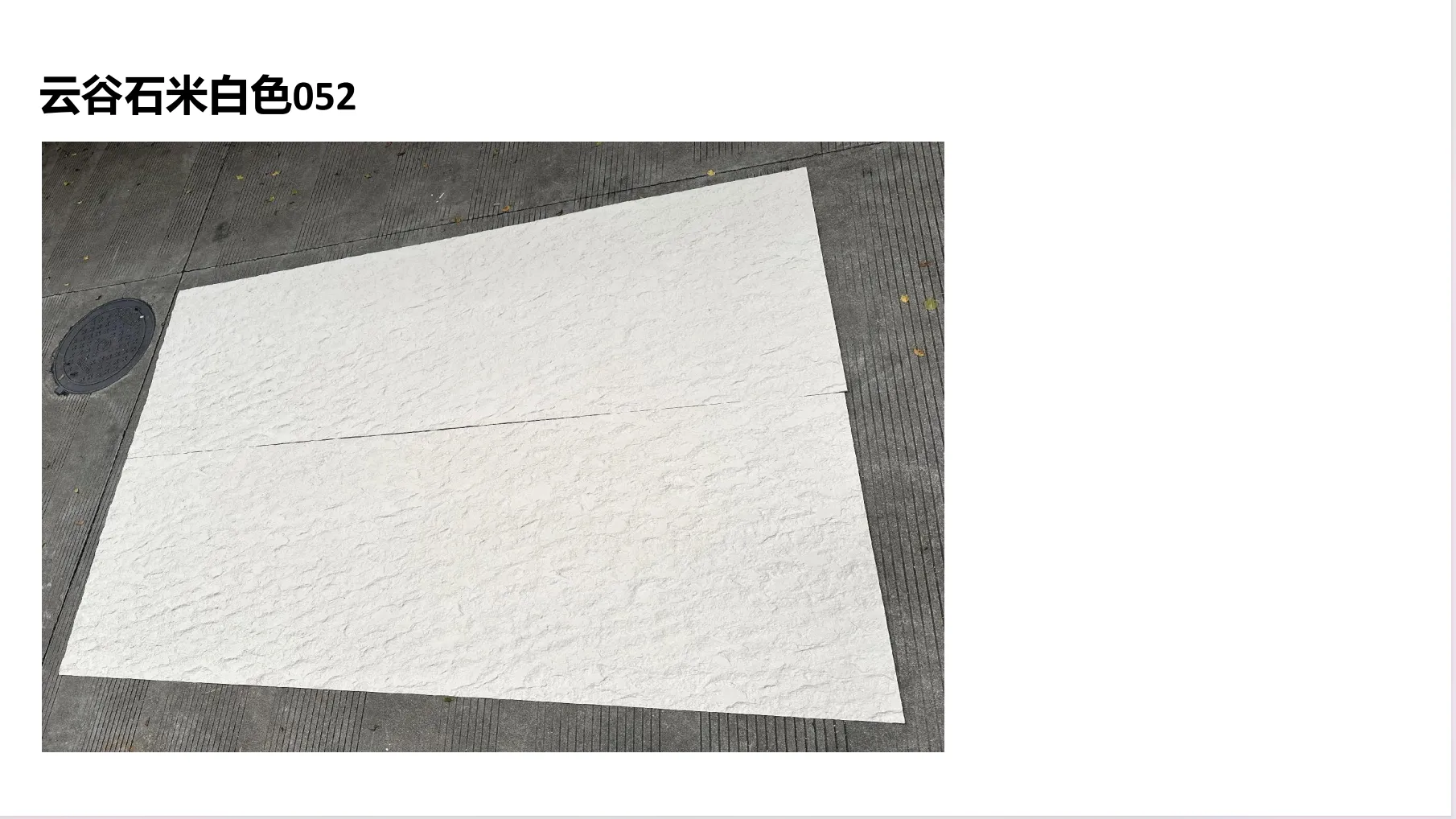
What sets Cloud Stone apart in a market flooded with generic cladding options? Start with its namesake quality: a texture that mimics the soft, billowy layers of clouds, yet retains the durability needed for high-traffic commercial settings. Unlike rigid natural stones that demand heavy structural support, Cloud Stone leverages the flexibility of mcm flexible stone technology—a composite material that bends without breaking, making it ideal for curved walls, custom fixtures, and even ceiling accents. Imagine a reception desk with a sweeping, cloud-like curve; where traditional stone would crack under the strain, Cloud Stone flows seamlessly, turning a functional piece into a work of art.
But its appeal isn't just tactile. Cloud Stone comes in a spectrum of hues and finishes, from the understated elegance of fair-faced concrete to the celestial shimmer of travertine (starry blue)—a variant that embeds tiny, iridescent particles, catching light like stars in a twilight sky. This versatility means it can play chameleon: in a minimalist tech office, it might don a matte, concrete-like finish to evoke sleek professionalism; in a wellness brand's retail space, it could shift to warm, earthy tones, pairing harmoniously with natural elements like bamboo mat board.
Why MCM Flexible Stone Matters Here
At the core of Cloud Stone's adaptability is mcm flexible stone, a modified composite material that combines natural stone powder with a lightweight, reinforced backing. This engineering breakthrough allows for installations that were once impossible: think accent walls wrapping around pillars, or custom-cut panels that follow the slope of a vaulted ceiling. For commercial projects, this translates to faster installation times (no heavy machinery required), reduced structural load, and the freedom to realize bold, architecturally ambitious designs without compromising on durability.
Compare this to traditional materials like fair-faced concrete, which, while prized for its industrial-chic aesthetic, lacks the same level of customization. Concrete's monochromatic palette and rigid form limit its ability to adapt to evolving design trends, whereas Cloud Stone's chameleon-like qualities ensure spaces remain fresh for years—even as brands pivot or offices expand.










