
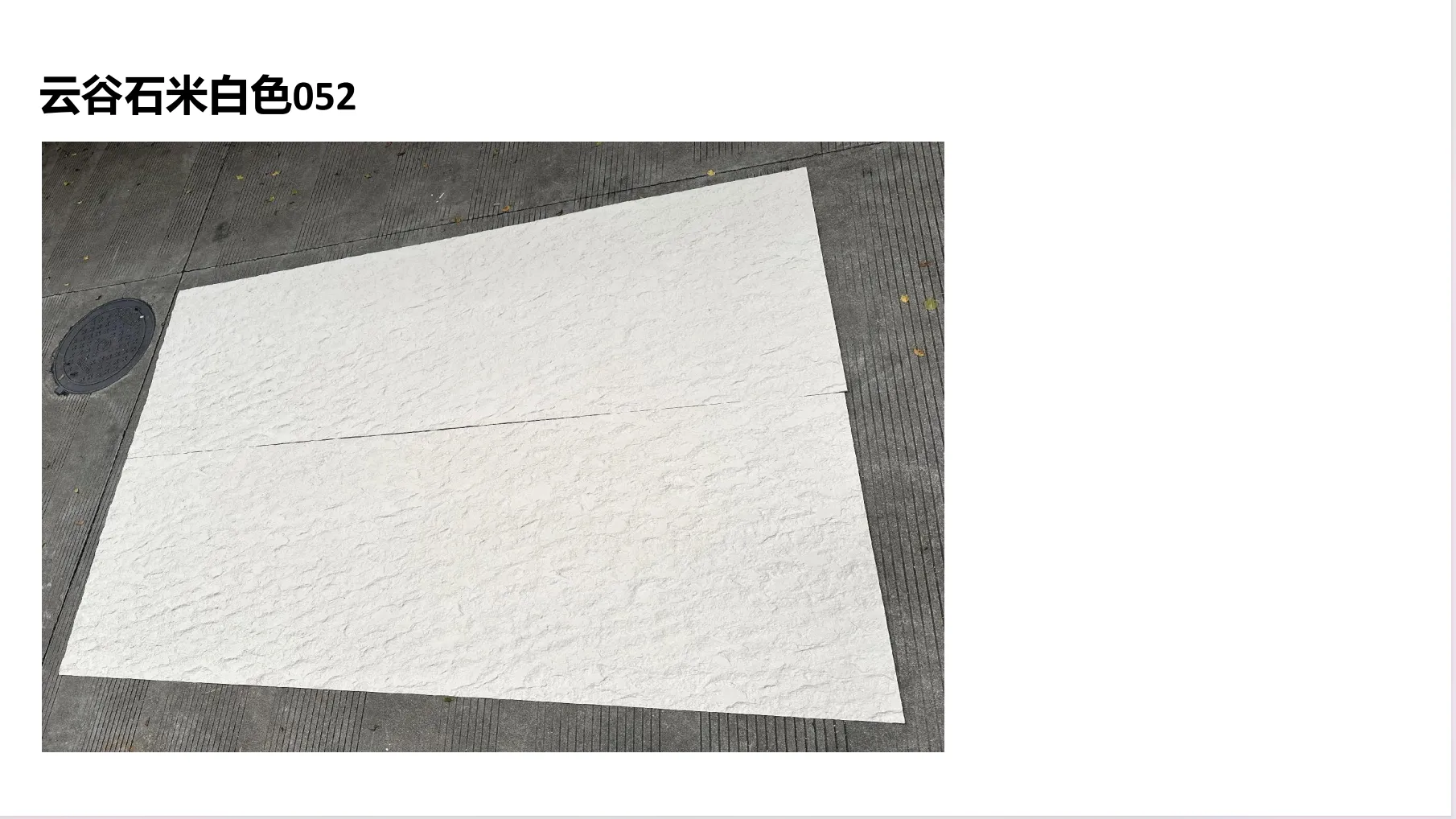
Step into a contemporary art gallery, and your eyes are drawn to the walls immediately. They rise in gentle, sweeping curves, their surface catching the light with a depth that feels both ancient and futuristic. Run a hand along them, and you'll notice something unexpected—they're cool like stone, yet there's a subtle give, a flexibility that seems to contradict everything you know about rigid building materials. This isn't marble, concrete, or even traditional stone veneer. This is Cloud Stone, a material quietly redefining how architects, designers, and builders approach space, texture, and function.
In an industry long dominated by heavy, unforgiving materials—think quarry-cut limestone blocks or dense concrete slabs—Cloud Stone arrives as a breath of fresh air. It's a material born from the question: What if building materials could be both strong and supple, durable and design-forward, rooted in nature yet unshackled by its limitations? Let's dive into the world of Cloud Stone, exploring its origins, composition, and the ways it's transforming the spaces we live, work, and gather in.
Architectural history is, in many ways, a story of materials. The pyramids rose from limestone blocks; Gothic cathedrals reached for the sky with flying buttresses and stone masonry; the 20th century brought us reinforced concrete and steel, enabling skyscrapers that defied gravity. But with each innovation came trade-offs: stone was beautiful but heavy, concrete was versatile but often cold, steel was strong but lacked warmth. By the early 21st century, a new challenge emerged: how to create materials that could keep up with bold, organic designs—curved facades, floating walls, dynamic interiors—without sacrificing durability or sustainability.
Enter MCM (Modified Composite Material) technology, a breakthrough that merged natural aggregates with modern polymers to create lightweight, flexible alternatives to traditional stone. Materials like MCM flexible stone began gaining traction, but Cloud Stone takes this concept further. It's not just a veneer or a decorative layer; it's a structural material designed to bridge the gap between nature's raw beauty and human ingenuity. To understand Cloud Stone, we first need to unpack what makes it so different from anything that came before.
At its core, Cloud Stone is a composite material, but that term barely scratches the surface of its complexity. Imagine blending the best of natural stone, high-performance polymers, and reinforced fibers into a single sheet—one that's thin enough to bend, light enough to install without heavy machinery, yet tough enough to withstand the elements for decades. That's the essence of Cloud Stone.
Its base starts with carefully selected natural aggregates: think crushed travertine particles (including unique variants like travertine (starry blue) for subtle, star-like flecks of color), fine sand, and mineral powders. These are bound together with a proprietary blend of polymers—synthetic resins that provide flexibility without compromising strength. To reinforce this mix, microscopic glass fibers are woven in, creating a matrix that resists cracking and adds tensile strength. The result? A material that's roughly 70% lighter than natural stone, 300% more flexible than standard concrete, and available in sheets as thin as 3mm or as thick as 20mm, depending on the application.
But Cloud Stone isn't just about numbers. It's about feel. Unlike cold, industrial fair-faced concrete, which often feels stark and uninviting, Cloud Stone carries the warmth of natural materials. Run your fingers over a slab finished in wood grain board texture, and you'll swear you're touching reclaimed oak—complete with knots and grain patterns—until you realize it's water-resistant and won't warp in humidity. Opt for a travertine (starry blue) finish, and the surface shimmers with tiny, iridescent particles, mimicking the night sky reflected on water. It's a material that engages multiple senses, turning walls, ceilings, and facades into experiences rather than just boundaries.
Great design means nothing if a material can't stand up to real-world use. Cloud Stone shines here, too, offering a laundry list of advantages that make it a favorite among professionals. Let's break down why it's quickly becoming the go-to choice for forward-thinking projects:
Traditional stone is rigid by nature—try to bend a slab of marble, and it will shatter. Cloud Stone, by contrast, can flex up to 30 degrees without cracking, making it ideal for curved surfaces, domed ceilings, or even furniture with organic shapes. Imagine a boutique hotel lobby where the reception desk curves like a river; with Cloud Stone, that vision doesn't require custom-cut stone blocks or expensive structural supports. It can be bent on-site, conforming to the designer's vision with minimal waste.
Weight is a constant headache in construction. A standard 1m² slab of natural travertine weighs around 25kg; Cloud Stone clocks in at just 4-6kg per m². This lightness reduces the load on building foundations, cuts transportation costs, and simplifies installation. Contractors no longer need cranes or teams of workers to hoist slabs into place—two people can carry and install a sheet in minutes. For renovation projects, this is a game-changer: Cloud Stone can be applied directly over existing walls (even drywall or plaster), eliminating the need for demolition and reducing downtime.
Don't let its flexibility fool you—Cloud Stone is tough. It's resistant to scratches, stains, and UV rays, meaning it won't fade in sunlight or discolor from spills. Unlike wood grain board, which can rot or attract pests, Cloud Stone is impervious to moisture and insects. In testing, it's held up to extreme temperatures (from -40°C to 80°C), making it suitable for both arctic climates and desert heat. Even in high-traffic areas like airports or shopping malls, Cloud Stone surfaces maintain their appearance for 20+ years with minimal maintenance—just an occasional wipe with a damp cloth.
In an era where sustainability is non-negotiable, Cloud Stone delivers. Its production process uses 60% less energy than quarrying and cutting natural stone, and up to 30% of its raw materials are recycled (including post-industrial stone dust and reclaimed polymers). Because it's lightweight, transportation emits fewer greenhouse gases, and its longevity reduces the need for frequent replacements. Unlike concrete, which relies on cement (a major carbon emitter), Cloud Stone's polymer binders have a lower carbon footprint. For eco-conscious builders, it's a material that aligns with LEED and BREEAM certifications without sacrificing aesthetics.
| Feature | Cloud Stone | Fair-Faced Concrete | Natural Wood Grain Board | Travertine (Starry Blue) |
|---|---|---|---|---|
| Weight (per m²) | 4-6kg | 22-24kg | 8-10kg | 20-25kg |
| Flexibility | Bends up to 30° without cracking | Rigid; prone to cracking under stress | Minimal flexibility; warps in moisture | Brittle; shatters under bending |
| Maintenance | Low (occasional wiping) | High (sealing every 2-3 years) | High (polishing, termite treatment) | Medium (sealing yearly to prevent staining) |
| Sustainability | Recycled materials, low energy production | High carbon footprint (cement production) | Depends on sourcing (may involve deforestation) | Quarrying disrupts ecosystems |
| Design Versatility | Curves, custom colors, textures | Limited to straight lines; uniform appearance | Natural variations but limited to wood tones | Natural beauty but fixed color/pattern |
Cloud Stone's versatility means it's popping up in projects of all scales, from cozy home renovations to sprawling commercial complexes. Here are a few examples of how designers are putting it to work:
In a minimalist apartment in Tokyo, the kitchen backsplash is clad in Cloud Stone with a wood grain board finish. The client wanted the warmth of wood but needed something resistant to oil splatters and heat. The result? A surface that looks like aged teak but wipes clean in seconds. In a beach house in Bali, the exterior walls use travertine (starry blue) Cloud Stone—its light weight prevented structural issues in a seismic zone, while its UV resistance ensures the vibrant blue won't fade under the tropical sun.
Restaurants and retail stores are embracing Cloud Stone for its ability to create memorable atmospheres. A coffee chain in London used curved Cloud Stone panels in a soft beige hue to line its walls, creating a cave-like, cozy feel that encourages customers to linger. A high-end boutique in New York opted for polished Cloud Stone in a marble-like finish, achieving the luxury look of Carrara marble at a fraction of the cost and weight. Even offices are getting in on the trend: a tech startup in Berlin installed Cloud Stone ceiling panels with integrated LED lighting, turning a plain workspace into a dynamic, light-filled environment.
Public buildings demand materials that can handle heavy use, and Cloud Stone delivers. A museum in Sydney used it for its interactive exhibit walls—children can touch and lean against them without damaging the surface. A subway station in Seoul chose Cloud Stone for its platform edges, citing its slip resistance and easy maintenance. Perhaps most impressively, a community center in Kenya used Cloud Stone for its outdoor amphitheater seats; the material's heat resistance keeps seats cool even in direct sunlight, while its durability stands up to daily use by locals.
As the world grapples with climate change, the construction industry is under pressure to reduce its environmental impact. Cloud Stone aligns with this shift in more ways than one. Its production process uses recycled aggregates, cutting down on quarrying and mining. Its lightweight nature reduces transportation emissions, and its longevity means less waste from replacements. Even better, at the end of its life, Cloud Stone can be recycled into new construction materials, closing the loop on sustainability.
But sustainability isn't just about materials—it's about designing spaces that connect people to nature. Cloud Stone excels here, too. Its ability to mimic natural textures—from the roughness of travertine (starry blue) to the grain of wood—brings the outdoors in, improving mental well-being. Studies have shown that spaces with natural elements reduce stress and boost productivity, making Cloud Stone a tool for creating healthier environments, not just prettier ones.
Cloud Stone isn't just a new material—it's a new way of thinking about construction. For too long, building materials have been chosen for their utility alone: "Will it hold up?" "Is it cheap?" "Can we install it quickly?" Cloud Stone asks a different question: "How will this make people feel?" It's a material designed with empathy—for the architect dreaming of a curved wall, for the builder struggling with heavy slabs, for the homeowner who wants beauty without the upkeep, and for the planet that bears the cost of our construction choices.
As we look to the future, Cloud Stone represents more than a trend. It's a glimpse of what building can be: flexible, sustainable, and deeply human. Whether you're renovating a bathroom, designing a skyscraper, or building a community center, Cloud Stone isn't just a material option—it's a partner in creating spaces that are as functional as they are felt. And in a world where we spend 90% of our time indoors, that's a revolution worth celebrating.
Recommend Products












