
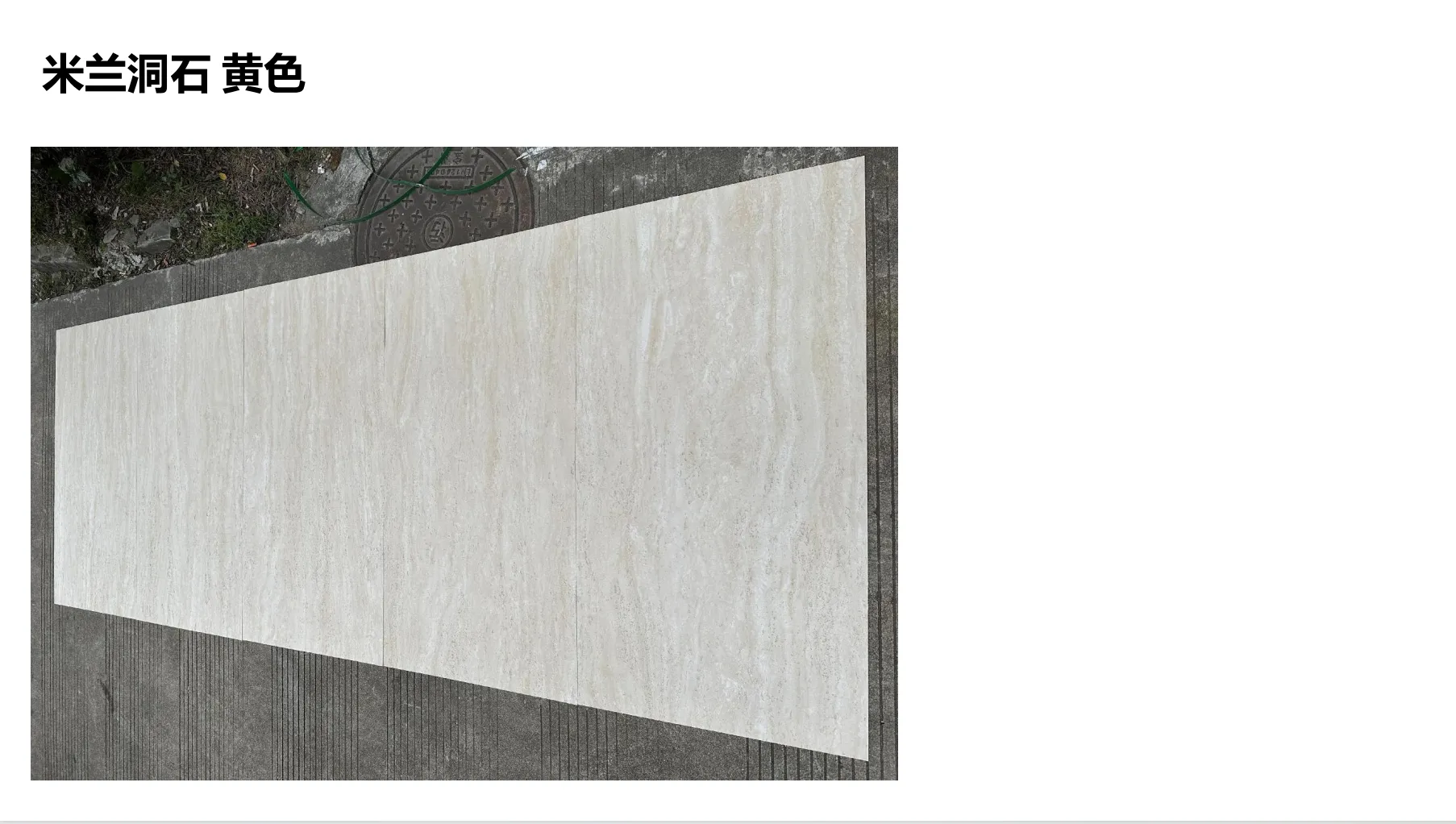
Standing in the atrium of a newly opened cultural center in Istanbul, I found myself drawn to the walls—not by art, but by the material itself. The surface, a blend of warm beige and soft gold, rippled with tiny, natural pores that caught the light like scattered stardust. A nearby architect, "That's Milan Travertine —COLORIA's signature. It's like bringing a piece of the Italian countryside here, but with a twist that feels right at home in the Middle East." That moment stuck with me: how a single stone could bridge continents, carrying the whispers of European craftsmanship and the bold spirit of Middle Eastern design. Today, we're diving into COLORIA's global journey, where materials aren't just building blocks—they're storytellers.
To understand Milan Travertine, you have to start in the quarries of Tuscany. For centuries, travertine has been the backbone of European architecture—think the Colosseum's weathered grandeur or the sleek lines of modern Milanese apartments. But COLORIA didn't just source this stone; they reimagined it. "We wanted something that felt alive," says Elena Rossi, COLORIA's lead designer. "Traditional travertine is beautiful, but we asked: What if it could glow differently under desert sun? What if it could soften the harsh edges of a minimalist space?"
The result is a material with depth. Run your hand over a slab, and you'll feel the contrast between smooth, polished surfaces and the gentle roughness of natural pores. In Parisian boutiques, it adds warmth to crisp, white interiors; in Dubai's luxury hotels, it balances the boldness of gold accents with earthy calm. And then there are the starry variants —like travertine (starry green) , where subtle mineral deposits create the illusion of a night sky reflected in stone. "A client in Beirut once told me it felt like 'holding a piece of the Levantine night,'" Elena recalls. "That's the magic—materials that evoke emotion, not just aesthetics."
*Imagine running your palm over Milan Travertine at dawn: the coolness of the stone warms as sunlight hits it, the pores catching light like tiny lanterns. By dusk, it shifts again, taking on a honeyed hue that makes a room feel like a hug.*
European and Middle Eastern architecture are often seen as opposites—one rooted in understatement, the other in opulence. But COLORIA's projects prove they're two sides of the same coin. Take, for example, the Lunar Peak series : lunar peak silvery , golden , and black . Inspired by the moon's phases over both the Alps and the Arabian Desert, these stones play with light in ways that resonate across cultures. In a Zurich office building, Lunar Peak Silvery adds a futuristic edge to glass and steel, while in a Riyadh villa, Lunar Peak Golden complements traditional mashrabiya screens, turning sunlight into a dance of shadows.
To visualize this balance, let's look at how COLORIA's materials adapt to regional needs:
| Architectural Need | European Context | Middle Eastern Context | COLORIA's Solution |
|---|---|---|---|
| Light Management | Soft, diffused light (e.g., overcast London days) | Intense, direct sunlight (e.g., Dubai summers) | Milan Travertine's porous surface diffuses harsh light; Lunar Peak Black absorbs glare without feeling heavy. |
| Cultural Identity | Nostalgia for heritage (e.g., Parisian Haussmannian architecture) | Celebration of bold color (e.g., Moroccan zellige tiles) | Travertine (starry red/orange/blue) adds subtle cultural nods; Rona Yellow brings vibrant warmth without clashing. |
| Sustainability | Focus on eco-friendly, low-maintenance materials | Durability in extreme heat/sand | MCM flexible stone —lightweight, crack-resistant, and made with 30% recycled content. |
While Milan Travertine steals the spotlight, COLORIA's lineup is a constellation of innovation. Let's zoom in on three standouts that have architects buzzing:
"I once thought stone was rigid—until I held a sheet of MCM Flexible Stone," laughs Omar Khalid, a Beirut-based architect. "It bends. It wraps around columns. It even curves over ceilings." Traditional stone panels are heavy and hard to install, but COLORIA's MCM (Modified Composite Material) version is game-changing. At just 4mm thick, it weighs 70% less than natural stone, making it perfect for retrofits—like cladding the exterior of a 1920s Cairo apartment building without compromising its structure.
In Abu Dhabi, it's used in a waterfront pavilion, where its flexibility allows the roof to slope gently, mimicking desert dunes. "It's not just about practicality," Omar adds. "It feels organic. Like the building itself is breathing."
If Milan Travertine is the "sunrise stone," the Lunar Peak series is its nighttime counterpart. Lunar peak silvery shimmers like moonlight on snow—ideal for a ski resort lobby in the French Alps. Lunar peak golden evokes the glow of a Middle Eastern sunset, used in a Jeddah restaurant where it pairs with copper fixtures to create a cozy, inviting atmosphere. And lunar peak black ? It's the darling of minimalist architects in Berlin, adding depth to all-white spaces without feeling stark.
"We tested 27 shades before finalizing the Lunar Peak colors," Elena says. "The goal was to capture that moment when day turns to night—different everywhere, but universally familiar."
Concrete might sound industrial, but COLORIA's fair-faced concrete is anything but. Stripped of harsh chemicals, it retains the material's natural texture—tiny air bubbles, subtle color variations—while feeling surprisingly warm. In Copenhagen's sustainable housing projects, it's used for walls and floors, proving eco-friendly can also be elegant. In Doha, it's paired with foamed aluminium alloy board (vintage silver) for a modern twist on traditional majlis spaces, where families gather to chat over coffee.
*Fair-faced concrete in a rainy Amsterdam morning: the stone darkens slightly, the texture becoming more pronounced, like the skin of a river stone smoothed by time.*
What sets COLORIA apart isn't just the materials—it's the people. In their Turkish factory, artisans spend weeks hand-finishing each slab, using techniques passed down through generations. "A machine can polish stone, but only a human can feel when it's 'right,'" says Mehmet Yilmaz, a master craftsman with 25 years of experience. "Take rough granite stone (medium grey) : we leave some edges, like the side of a mountain, to keep that wild, natural energy."
This attention to detail shines in projects like the "Historical Pathfinders Stone" installation in Madrid. Using reclaimed stone fragments from European castles and Middle Eastern forts, COLORIA created a wall that tells a story of shared history. "A teacher brought her students there last month," Mehmet smiles. "One kid asked, 'Is this stone from a palace in Baghdad or a castle in Scotland?' That's the point—it doesn't matter. It's all part of the same journey."
As cities grow more connected, the demand for materials that transcend borders will only rise. COLORIA is already ahead, experimenting with 3D printing series that allow architects to custom-design textures—like wave panel or thread patterns—tailored to a building's story. "We're not just selling stone," Elena says. "We're selling the ability to make a space feel like *yours*, whether you're in Lisbon or Kuwait City."
Back in that Istanbul cultural center, I noticed something else: a family from Syria, a couple from Italy, and a group of students from Japan, all pausing to touch the Milan Travertine walls. In that moment, it hit me: COLORIA's materials don't just build buildings—they build connections. They remind us that no matter where we are, we all crave spaces that feel rooted, alive, and uniquely human.
So the next time you walk into a building and find yourself staring at the walls, take a closer look. It might just be COLORIA's work—quietly weaving the world together, one stone at a time.
Recommend Products












