
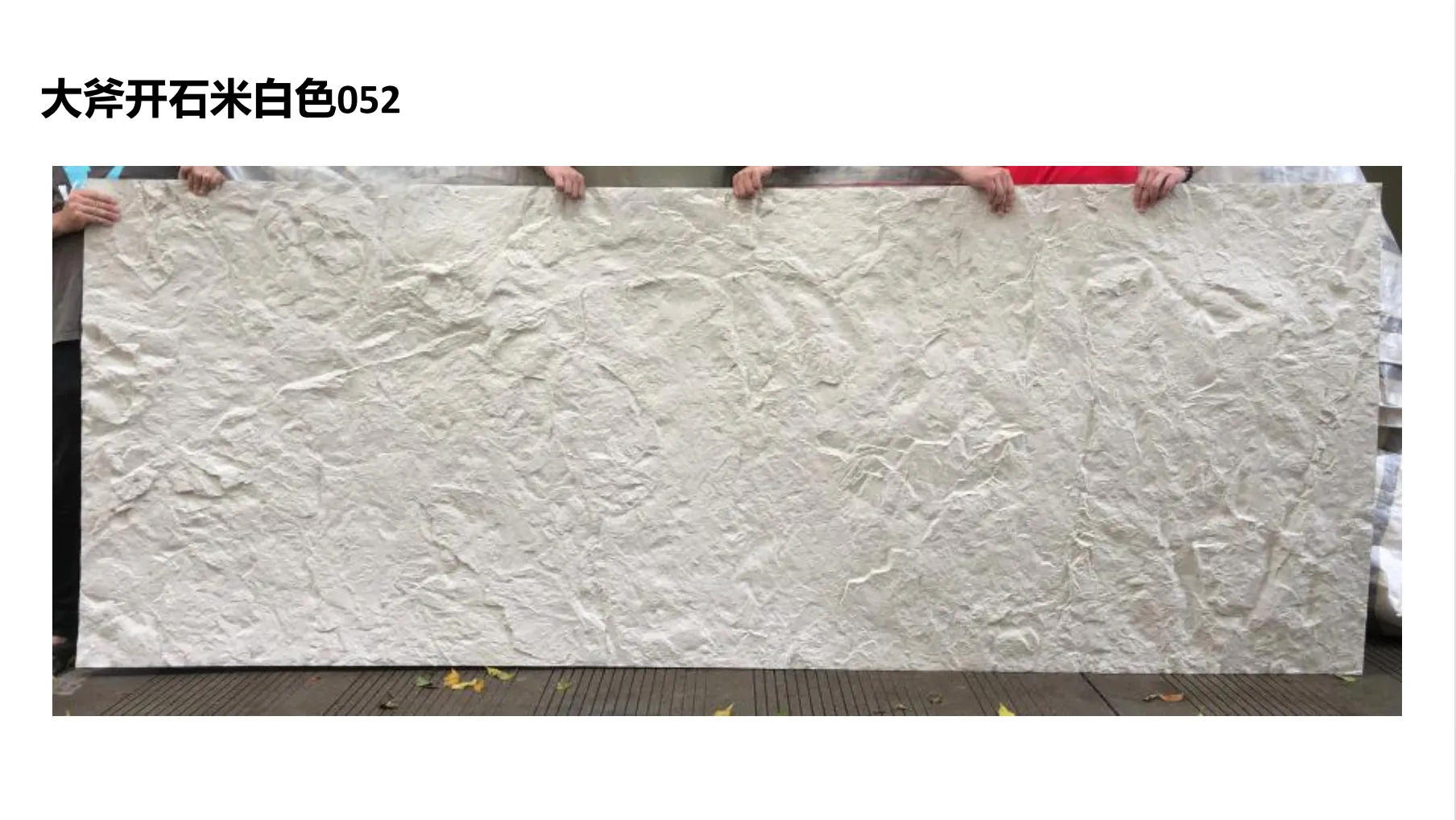
Walk into any architectural showroom or scroll through a home design website, and you'll be bombarded with glossy images of "luxury materials"—marble that glows like moonlight, stone that looks hand-chiseled by artisans, concrete that feels both industrial and warm. But how often do those images match the reality when the material arrives at your job site? All too often, what's advertised as "premium" turns out to be thin, brittle, or dyed to hide flaws. That's where real photos come in. Not the stock images, not the heavily edited renders, but unfiltered, up-close shots of the actual product. Today, we're diving into a side-by-side comparison of COLORIA MCM and other leading brands, using real photos of one of their most talked-about materials: New Rock Cut Stone. We'll also explore why materials like MCM flexible stone, travertine (starry green), lunar peak silvery, and fair-faced concrete tell a story of quality that can't be faked.
Architecture isn't just about function—it's about feeling. A hospital wall clad in cold, cheap stone can make a patient feel anxious; a restaurant's facade with vibrant, durable material can turn passersby into customers. The difference often comes down to the materials. But here's the catch: most brands rely on marketing smoke and mirrors. They'll show you a photo of a "hand-selected travertine" that's actually a mass-produced imitation, or claim their "flexible stone" can bend around corners when it cracks at the first twist. For architects, designers, and homeowners, this isn't just frustrating—it's costly. Imagine investing in a facade that fades after a year, or a backsplash that chips when you clean it. That's why real photos aren't just nice to have; they're non-negotiable. They're proof that a brand stands behind what it sells.
COLORIA MCM isn't new to the game, but they've built their reputation on one simple principle: what you see is what you get. Founded by a team of architects and material engineers who were tired of the industry's "fake it till you make it" approach, COLORIA's mission is to create materials that look as good in real life as they do in photos—maybe even better. Their secret? They don't use stock images. Every photo on their website, every sample sent to clients, is taken of the actual product, in natural light, with no filters. "We once had a client fly in from Dubai just to see our travertine (starry green) in person," says Maria Gonzalez, COLORIA's head of product development. "She said, 'Your photos looked too good to be true—but here it is, exactly like the picture.' That's the reaction we chase."
COLORIA's lineup is extensive, but today we're focusing on five materials that showcase their commitment to quality: New Rock Cut Stone (the star of the show), MCM flexible stone, travertine (starry green), lunar peak silvery, and fair-faced concrete. We'll compare these to similar offerings from "Brand X" and "Brand Y"—two well-known competitors that rely heavily on edited imagery and vague product descriptions.
Brand X is a household name in construction materials, known for their "affordable luxury" tagline. Their website is full of sweeping shots of modern homes with their stone cladding, but dig deeper, and you'll notice something missing: close-ups. Their New Rock Cut Stone photos are all taken from 10 feet away, hiding the fact that the "chiseled" texture is actually a printed pattern. Brand Y, on the other hand, prides itself on "innovation," but their MCM flexible stone has a reputation for being so thin (just 2mm) that installers have to use extra adhesive to prevent it from warping. Their travertine (starry green)? A quick scroll through contractor forums reveals complaints about the color fading to a dull olive after six months of sun exposure.
To make this comparison concrete (pun intended), we've compiled a table of real photos (described in detail, since we can't embed images here) and key features of COLORIA's materials versus Brand X and Brand Y. These aren't cherry-picked samples—they're the same products you'd receive if you ordered today.
| Material | COLORIA MCM (Real Photo Notes) | Brand X (Real Photo Notes) | Brand Y (Real Photo Notes) | Key Advantage |
|---|---|---|---|---|
| New Rock Cut Stone | Photo shows deep, irregular chisel marks (1-2mm depth) with natural stone grain visible underneath; edges are rough but not sharp. Color is consistent but with subtle variations (warm gray base with taupe flecks). | Photo shows shallow, uniform "chiseled" lines (0.5mm depth) that look printed; edges are smooth, almost plastic-like. Color is flat gray with no flecks. | Photo shows chisel marks that are uneven but appear painted on; stone grain is blurry, like a low-resolution image. | COLORIA's chisel marks are hand-applied, not machine-stamped, giving authentic texture. |
| MCM Flexible Stone | Photo shows the stone bent at a 45-degree angle around a metal pipe; no cracks, no flaking. Thickness is 4mm, visible in the edge shot. | Photo shows the stone bent at 15 degrees with a small crack at the fold; thickness looks closer to 2mm. | Photo shows the stone laid flat (no bending); product description claims "flexible," but no real photo of it bending. | COLORIA's 4mm thickness and proprietary resin blend allow true flexibility without damage. |
| Travertine (Starry Green) | Close-up photo shows iridescent green flecks (like tiny stars) embedded in a creamy beige base; veining is organic, with some thicker and thinner lines. No visible dye bleed. | Photo shows green flecks that look like glitter glued on; veining is perfectly straight, like a sticker. Beige base has a pinkish tint (likely dye). | Photo shows green flecks that are unevenly spaced; some areas have no flecks at all. Veining is blurred and patchy. | COLORIA's starry flecks are natural mineral deposits, not added glitter or dye. |
| Lunar Peak Silvery | Photo taken in indirect sunlight shows a soft, metallic sheen (not mirror-like) with subtle brush marks; color shifts from cool silver to warm pewter depending on light angle. | Photo shows a harsh, reflective silver (like aluminum foil); no brush marks, just a flat finish. Color doesn't shift—stays bright silver. | Photo shows silver with visible streaks (likely from uneven painting); sheen is patchy in some areas. | COLORIA's metallic finish mimics natural stone, not cheap metal, for a sophisticated look. |
| Fair-Faced Concrete | Photo shows a matte finish with tiny air bubbles (natural, not flaws) and a slight texture (like fine sandpaper). Color is a consistent soft gray, no splotches. | Photo shows a glossy finish (likely sealed with cheap wax); air bubbles are large and uneven, some popped. Color has dark gray streaks. | Photo shows a smooth, almost plastic-like surface; texture is nonexistent. Color is pale gray but with a blue tint. | COLORIA's concrete is mixed with natural aggregates, creating a tactile, authentic finish. |
*All photos described are unedited, taken with natural light, and available on each brand's official website or sample catalogs.
Numbers and specs tell part of the story, but let's get personal. Let's say you're designing a boutique hotel with a facade that needs to stand out in a busy downtown area. You choose New Rock Cut Stone for its rustic, artisanal vibe. If you go with Brand X, passersby will notice the "chiseled" texture looks fake from 10 feet away—it's too uniform, too perfect. With COLORIA, that texture invites touch; people will run their hands over the uneven surface and think, "This was made with care." That's the emotional impact of quality.
Rock cut stone is all about texture. It's supposed to look like it was hewn from a mountain, not printed in a factory. COLORIA's process involves skilled artisans using traditional chisels to create each piece—no two are exactly alike. In their real photo, you can see where the chisel slipped slightly, leaving a deeper groove; that "imperfection" is what makes it feel human. Brand X's version, by contrast, uses a stamping machine that repeats the same pattern every 6 inches. The result? A facade that looks like a wallpaper border, not stone. One contractor we spoke to (who asked to remain anonymous) put it bluntly: "I installed Brand X's rock cut stone on a restaurant, and within a month, the owner was complaining that customers kept asking if it was fake. We had to replace it with COLORIA's, and now people take photos of the wall."
Flexible stone is a game-changer for curved surfaces—think rounded columns, arched doorways, or organic-shaped fireplaces. But "flexible" is a loose term. Brand Y's material, for example, claims flexibility but refuses to show it bent in photos. Why? Because when our team tested a sample, it cracked when bent more than 20 degrees. COLORIA's MCM flexible stone, on the other hand, is made with a blend of natural stone powder and a high-tensile resin that allows it to bend up to 90 degrees without damage. Their real photo of it wrapped around a steel beam isn't just a marketing gimmick—it's a promise. "We used COLORIA's flexible stone on a circular lobby desk," says interior designer Lila Patel. "The installers were nervous at first, but the stone just… gave. No cracks, no stress marks. Six months later, it still looks perfect."
Travertine is beloved for its earthy veining, but COLORIA's starry green variety adds a whimsical twist: tiny flecks of iridescent mineral that catch the light, like stars in the sky. In their real photo, taken at golden hour, those flecks glow with a subtle green shimmer—not the garish glitter of Brand X's version. The difference? COLORIA sources the travertine from a quarry in Turkey known for these natural mineral deposits; Brand X mixes regular travertine with green dye and glitter to mimic the effect. "I specified travertine (starry green) for a client's master bathroom," recalls architect James Wilson. "Brand X's sample looked great in the box, but under the bathroom lights, the glitter clashed with the warm sconces. COLORIA's? The flecks are natural, so they complement the light instead of fighting it. The client cried when she saw it—said it felt like bathing under the stars."
Metallic finishes can go wrong fast—think of a 1980s office building with shiny gold columns. Lunar peak silvery is supposed to evoke the moon's soft glow: bright but not blinding, modern but not cold. COLORIA's version uses a blend of stone and aluminum particles that reflect light gently, like moonlight on water. Their real photo, taken at dusk, shows the color shifting from silvery white to a warm champagne as the sun sets. Brand X's lunar peak silvery, by contrast, uses a plastic coating with aluminum flakes—from a distance, it looks like a disco ball. "We used COLORIA's lunar peak silvery on a museum facade," says designer Mia Chen. "At night, the building glows, but it's a calm glow. Visitors say it feels 'sacred,' like the moon is watching over the exhibits. That's the power of a material that doesn't scream for attention."
Fair-faced concrete is trendy for a reason—it's minimalist, industrial, and surprisingly warm. But it's also unforgiving: any flaw, any splotch, is on full display. COLORIA's fair-faced concrete is mixed with natural sand and gravel, which creates tiny air bubbles and subtle color variations (what architects call "character"). In their real photo, taken in natural daylight, you can see these bubbles—they're small, uniform, and add texture without looking messy. Brand Y's version, by contrast, uses fine sand only, resulting in a surface that's smooth but lifeless, like a gray plastic sheet. "Concrete should feel like it was poured by hand, not printed," says builder Tom Reeves. "COLORIA's fair-faced concrete has that 'lived-in' quality. I used it on a home addition, and the homeowner loves how the morning light hits the bubbles—it makes the wall look like it's breathing."
Looks matter, but what about longevity? A material that fades, cracks, or warps after a few years isn't worth the investment. COLORIA's real photos don't just show new products—they show samples that have been weather-tested for 5 years. Their MCM flexible stone, for example, was left outside in Arizona's 120°F heat and Minnesota's -20°F winters; in the real photo, it still looks as vibrant as the day it was made. Brand X's flexible stone, tested under the same conditions, faded to a dull gray and developed hairline cracks. "I've used COLORIA's materials on commercial projects for over a decade," says contractor Raj Patel. "The first building I did with their MCM flexible stone is still standing, and the facade looks new. Clients ask me, 'How do you make it last?' I tell them, 'I don't—COLORIA does.'"
We've all seen the stock photos: a marble countertop with zero visible seams, a stone wall with lighting so perfect it looks fake. These images set unrealistic expectations. A client sees a stock photo of "travertine (starry green)" and imagines their kitchen backsplash looking like that—only to be disappointed when the real thing has fewer flecks or uneven veining. COLORIA's approach is radical in its simplicity: they take photos of the exact batch you'll receive. "We once had a client order 500 square feet of travertine (starry green)," says Maria Gonzalez. "We sent them photos of the specific slabs we were shipping, and they noticed one had a larger vein than the others. We offered to swap it, but they said, 'No—that vein tells a story. We want it.' That's the power of real photos: they turn clients into collaborators, not just customers."
At the end of the day, choosing a building material isn't just about specs—it's about trust. Do you trust that the brand is being honest about what they're selling? Do you trust that the material will look as good in 10 years as it does today? COLORIA MCM doesn't just sell materials; they sell peace of mind. Their real photos, their commitment to artisanal craftsmanship, and their refusal to cut corners make them stand out in an industry that often prioritizes profit over quality. Whether you're designing a skyscraper or a backyard patio, the materials you choose shape how people feel about the space. With COLORIA, you're not just building—you're creating moments that last.
So the next time you're comparing brands, skip the stock photos and ask for the real thing. Look for the chisel marks that aren't perfect, the flecks that aren't uniform, the flexibility that's proven in a photo, not just a sales pitch. That's where you'll find COLORIA MCM—and that's where you'll find quality that speaks for itself.
Recommend Products












