
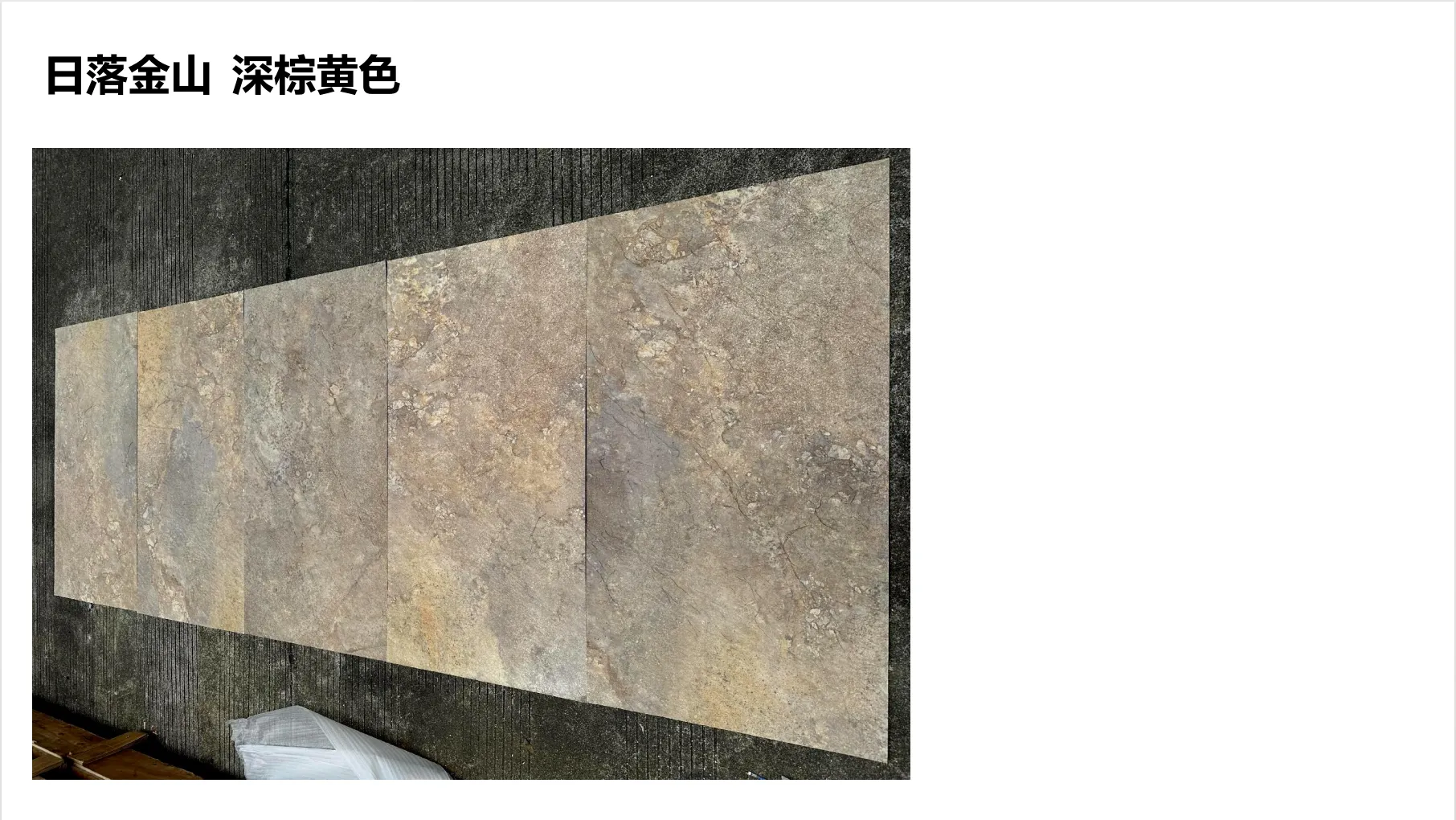
There's a magic in Saudi Arabia's sunsets—those fleeting moments when the sky bleeds gold, amber, and rose, turning the desert landscape into a canvas of warmth. For COLORIA's Saudi Arabia agency, this daily spectacle isn't just a backdrop; it's the heartbeat of their design philosophy. Over the past five years, they've made it their mission to translate that golden light into architecture, crafting spaces where buildings don't just stand—they breathe with the rhythm of the land. Today, we're diving into how their local installations, captured in stunning "golden sunset real photos," bring together innovation, tradition, and the raw beauty of materials like MCM flexible stone, lunar peak golden, and travertine (starry orange) to redefine Saudi Arabia's architectural skyline.
Walk into COLORIA's Riyadh office, and you'll find a wall lined with photographs: not just blueprints or product samples, but snapshots of Saudi sunsets. "We don't design in a vacuum," says Lina Hassan, the agency's lead designer. "Every material, every texture, is chosen to echo the way light moves here. A sunset in Riyadh isn't just light—it's a story. The way it hits the sand, the way it gilds the minarets, the way it fades into twilight… that's the emotion we want our installations to evoke."
This philosophy is why "golden sunset real photos" have become the agency's calling card. These aren't just marketing tools; they're proof of concept. Take, for example, the Al-Mansoora Cultural Center in Jeddah. During the day, its facade—clad in lunar peak golden stone—shimmers like polished amber. But as the sun dips toward the Red Sea, something extraordinary happens: the stone's metallic undertones catch the light, turning the building into a glowing monument, as if the sunset itself has been woven into its walls. A local architect, Omar Al-Farsi, put it best: "COLORIA gets it. They don't import 'global' designs—they translate Saudi light into materials."
At the core of these installations are materials that don't just look good—they perform under Saudi Arabia's unique climate. From scorching summers to sudden sandstorms, durability is non-negotiable. But COLORIA's team refuses to sacrifice beauty for brawn. Let's break down the stars of their golden sunset-inspired projects:
| Material | Aesthetic Appeal | Durability | Signature Project |
|---|---|---|---|
| MCM Flexible Stone | Lightweight panels with a natural stone texture; available in warm tones that mimic desert sand and sunset hues. | Resistant to UV rays, humidity, and sand erosion; lifespan of 50+ years. | Riyadh Tech Hub Facade |
| Lunar Peak Golden | Metallic-golden finish with subtle veining, designed to reflect low-angle sunset light. | Heat-resistant; maintains color integrity even in 50°C+ temperatures. | Al-Mansoora Cultural Center |
| Travertine (Starry Orange) | Porous stone with embedded "starry" flecks that sparkle like embers in golden light. | Naturally insulating; ideal for indoor spaces like lobbies and atriums. | Jeddah Marina Hotel Lobby |
| Fair-Faced Concrete | Raw, unpolished finish with a soft gray tone that contrasts beautifully with warm sunset colors. | High compressive strength; withstands sandstorms and heavy rainfall. | Dammam Eco-Park Pavilion |
What makes these materials truly special is their ability to evolve with the light. Take travertine (starry orange) , for instance. In the harsh midday sun, its porous surface appears matte, almost earthy—grounded, like the desert floor. But as the sun dips lower, those "starry" flecks (tiny mineral deposits) catch the golden light, turning the stone into a mosaic of tiny flames. It's a trick of nature, amplified by COLORIA's careful selection of quarry sources. "We work directly with Saudi stone suppliers to find pieces that have that unique sparkle," explains Hassan. "No two slabs are the same, which means every installation has its own sunset story."
"Golden sunset real photos" aren't just taken with a camera—they're choreographed . COLORIA's in-house photographer, Khalid Al-Saud, spends weeks scouting locations, tracking the sun's path, and waiting for that perfect 15-minute window when the light is just right. "It's not about getting the 'prettiest' shot," he says. "It's about capturing how the materials live in the space. A facade might look flat at noon, but at sunset, the shadows from MCM flexible stone panels create depth, like ripples in sand."
One of Al-Saud's most iconic shots is of the Riyadh Tech Hub, where MCM flexible stone panels in "desert rose" hue wrap around the building's curved facade. In the photo, the setting sun hits the panels at a 45-degree angle, casting long shadows that mimic the dunes outside the city. "Clients often tell us the photo doesn't do it justice," laughs Al-Saud. "But that's the point—we want them to visit, to stand there at sunset and feel it for themselves. The photo is just an invitation."
These photos have become more than marketing tools; they're a record of Saudi Arabia's architectural evolution. The Al-Mansoora Cultural Center, with its lunar peak golden spire, now features in local design textbooks, with educators pointing to the "golden sunset real photos" as a case study in blending modern materials with traditional Islamic geometric patterns. "The spire's angles are inspired by the minarets of old Madinah," Hassan notes, "but the lunar peak golden stone gives it a futuristic edge. When the sun hits it, it's like seeing the past and future meet in a single beam of light."
While all of COLORIA's materials shine, MCM flexible stone has emerged as a favorite among Saudi architects—and for good reason. Traditional stone cladding is heavy, expensive, and prone to cracking in extreme heat, but MCM (Modified Composite Material) panels are lightweight (just 3-5 kg per square meter), easy to install, and designed to flex with temperature changes. "We tested it in the Rub' al Khali desert," says engineer Ali Abbas, COLORIA's technical director. "Temperatures swung from 5°C at night to 50°C during the day, and the panels didn't warp. That's unheard of with natural stone."
But it's the aesthetic versatility that truly sells it. MCM flexible stone can mimic any texture—from rough-hewn desert rock to smooth marble—while retaining the durability of composite materials. For the Jeddah Marina Hotel, the design team opted for a "woven sand" finish, where panels are embossed with a pattern that looks like windblown dunes. Paired with travertine (starry orange) in the lobby, the effect is transportive: guests feel like they've stepped into an oasis, even in the heart of the city.
"Sustainability is another key factor," Abbas adds. MCM flexible stone is made with recycled materials, and its lightweight nature reduces transportation emissions—a big win in a country where construction sites can be hundreds of kilometers from material sources. "Saudi Arabia is committed to Vision 2030, and we're proud to align with that. These panels aren't just beautiful—they're kind to the planet, too."
COLORIA's success in Saudi Arabia isn't just about materials—it's about partnership. The agency works closely with local architects, many of whom are eager to break free from generic "international style" designs and create buildings that feel uniquely Saudi. "We don't just supply materials; we collaborate on ideas," says Hassan. "An architect might come to us wanting to capture the 'golden hour' in a hospital facade, and we'll suggest combining fair-faced concrete with lunar peak golden accents to balance calmness with warmth."
One such collaboration is the Dammam Eco-Park Pavilion, a community space designed by rising star architect Fatima Al-Zahrani. Al-Zahrani wanted the pavilion to feel like a "living extension of the desert," so COLORIA proposed fair-faced concrete for the main structure (its raw texture evoking sun-baked earth) and travertine (starry orange) for the interior walls. "At sunset, the light filters through the pavilion's glass roof and hits the travertine, and suddenly the whole space glows," Al-Zahrani says. "It's become a favorite spot for families—they call it 'the golden room.'"
These partnerships are shaping the next generation of Saudi architecture. "Young architects here are hungry for materials that tell stories," Hassan notes. "They don't want to build copies of buildings in Paris or Dubai—they want to build something that says, 'This is Saudi Arabia.' And with materials like MCM flexible stone and lunar peak golden, we're giving them the tools to do that."
As COLORIA's Saudi Arabia agency looks to the future, their focus remains on that golden light. Upcoming projects include a luxury resort in Al Ula, where MCM flexible stone will be used to recreate the texture of ancient Nabataean rock carvings, and a public library in Riyadh with a facade of lunar peak golden and travertine (starry blue) (a new addition to their lineup, inspired by the night sky that follows the sunset). "We're not just building buildings," Hassan says. "We're building memories—moments when someone pauses, looks up, and thinks, 'This is beautiful. This is home.'"
In the end, "golden sunset real photos" are more than just images—they're a promise. A promise that architecture can honor the land, the light, and the people who call it home. And in Saudi Arabia, where the sun sets on centuries of history and rises on a future of innovation, that promise is shining brighter than ever.
Recommend Products












