
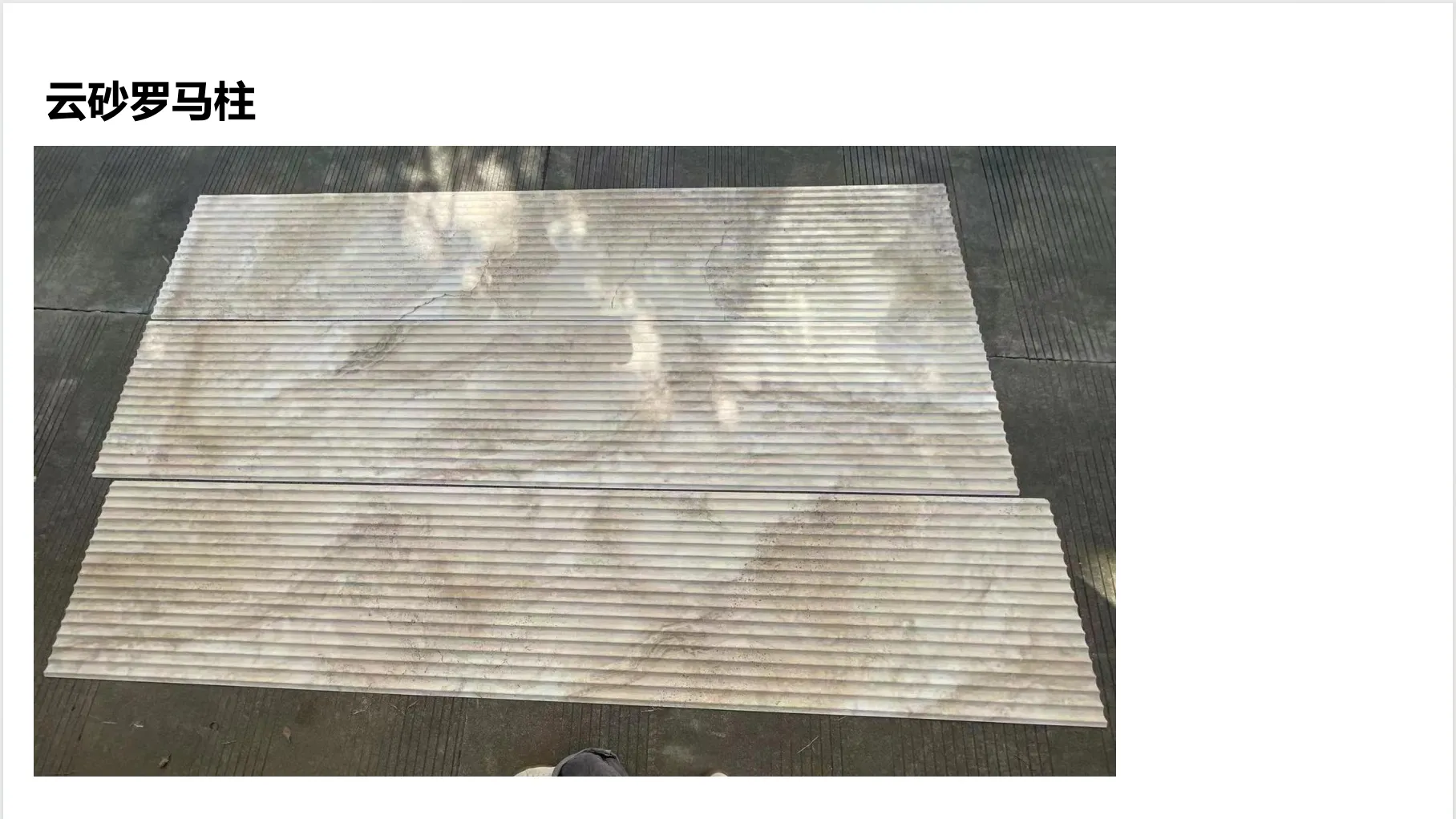
Walk into any shopping mall, and your eyes might drift to the storefronts, the lighting, or the bustling crowds. But pause for a moment—look up. The pillars holding up the ceiling aren't just structural necessities. They're silent storytellers, setting the mood, guiding your path, and even making you feel something. In modern retail design, marble pillars (and their creative counterparts) have become stars of the show, transforming mundane spaces into memorable destinations. And nothing captures their magic quite like real photos—images that don't just show a pillar, but the way light dances on its surface, how it interacts with surrounding colors, and the emotions it stirs in anyone who passes by.
Take, for example, a pillar wrapped in travertine (starry blue). It's not just stone; it's a slice of the night sky brought indoors. The deep blue base, swirled with lighter veins and dotted with iridescent flecks, catches the overhead lights and casts subtle glows on the floor below. Shoppers slow down, not just to window-shop, but to stare—suddenly, the mall feels less like a commercial space and more like a place of wonder. That's the power of intentional pillar design, and it all starts with choosing the right materials.
Gone are the days when pillars were limited to gray concrete or generic marble. Today's designers have a universe of options, each with its own personality. Let's dive into a few that are redefining retail spaces:
MCM flexible stone is a game-changer. Imagine a material that looks and feels like natural stone but bends, curves, and wraps around pillars with the ease of fabric. Traditional stone is heavy and rigid—great for straight lines, but not for the organic, flowing shapes modern malls crave. MCM flexible stone? It can mimic the texture of rough granite or the smoothness of marble, but it's lightweight enough to be shaped into spirals, waves, or even abstract forms. For a mall aiming for a futuristic vibe, this means pillars that twist upward like DNA strands or ripple like water—impossible with conventional materials.
And durability? It holds up to foot traffic, scuffs, and the occasional shopping cart bump, making it perfect for high-traffic areas. Designers love it because it's not just a material; it's a tool for creativity. One designer in Chicago used MCM flexible stone to create pillars that from deep gray at the base to light beige at the top, mimicking the transition from earth to sky. The result? A mall that feels open, airy, and uniquely "Chicago"—all thanks to a material that bends to the designer's vision.
The travertine starry series—think starry blue, starry red, starry orange—is like painting with the cosmos. These stones are engineered to have a base color (deep blue, fiery red, warm orange) swirled with contrasting veins and sprinkled with metallic or iridescent "stars." In retail, they turn pillars into focal points. A starry red travertine pillar in a luxury fashion section? It exudes energy and passion, mirroring the boldness of the clothing on display. Starry orange in a food court? It feels warm and inviting, making diners hungry (in the best way). And starry blue? It's calming, turning a busy mall corridor into a serene escape.
What makes these stones even more special is their texture. Travertine is naturally porous, which gives it a tactile, almost organic feel—run your hand over it, and you'll feel tiny indentations and ridges, a stark contrast to the sleekness of glass or metal. It's a reminder that even in a high-tech world, we crave connection with nature.
Fair-faced concrete might sound cold, but in the right hands, it's surprisingly cozy. Unlike polished concrete, which has a glossy finish, fair-faced concrete the raw, unrefined texture of the formwork—subtle imprints, tiny air bubbles, and variations in color that feel authentic. Pair it with wood grain board accents, and you've got a pillar that balances industrial edge with natural warmth. Imagine a mall targeting young professionals: fair-faced concrete pillars with thin wood strips running vertically, mimicking the look of a forest. It's modern yet grounded, making shoppers feel both energized and at ease.
Great pillar design isn't just about choosing one material—it's about how materials play together. Let's look at a few winning combinations, inspired by real projects:
A new mall in Seattle wanted to stand out in a city known for its rain and greenery. The design brief? "Bring the outdoors in, but make it modern." The solution? Pillars wrapped in MCM flexible stone (mimicking rough granite stone in medium grey) with wood grain board panels inset vertically. The gray stone provided the industrial backbone, while the wood added warmth—like a forest growing through concrete. To top it off, select pillars featured travertine (starry green) accents: small, circular insets that looked like moss-covered stones peeking through the "trees."
Marble pillar real photos were crucial here. The design team used high-res images to show the client how the wood grain would catch the light at different times of day, and how the starry green travertine would pop against the gray stone. "Clients can't always imagine texture from a sample," says lead designer Mia Chen. "But a photo? It shows the way the wood grain board's knots cast tiny shadows, or how the starry green flecks sparkle when the sun hits them. That's what sold the concept."
| Material Combination | Aesthetic Vibe | Best For | Why It Works |
|---|---|---|---|
| MCM Flexible Stone (Rust Square Line Stone) + Foamed Aluminium Alloy Board (Vintage Gold) | Industrial Luxury | Luxury Retail Zones | Rust's earthy texture balances gold's opulence—think old-world charm meets modern glitz. |
| Travertine (Starry Blue) + Fair-Faced Concrete | Celestial Industrial | Food Courts & Leisure Areas | Blue's calmness softens concrete's harshness, creating a space to relax and recharge. |
| Wood Grain Board + Lime Stone (Beige) | Warm Minimalism | Family-Friendly Malls | Wood's coziness and limestone's neutrality make kids and parents feel at home. |
Designers talk a lot about "vision," but translating that vision into a physical space is tricky—especially with pillars, which are often central to the layout. That's where marble pillar real photos (and real photos of all pillar materials) become indispensable. They're not just pretty pictures; they're problem-solvers, persuaders, and storytellers.
Consider a scenario: A client wants "elegant but not too formal" pillars for their mall's main atrium. The designer suggests travertine (Vintage Gold)—a warm, honey-toned stone with subtle veins. The client hesitates; they're used to white marble and worry gold will feel gaudy. Enter the real photos: close-ups of the stone in natural light, showing how the gold isn't brash but soft, with creamy undertones that complement the mall's existing beige tiles. Wide shots of a completed pillar in a similar space, showing how it reflects light without overwhelming the area. Suddenly, the client sees it—not as a material sample, but as part of their mall's story. "Real photos capture the 'vibe' that swatches can't," says photographer Jake Torres, who specializes in architectural interiors. "A sample tells you the color; a photo tells you how it makes you feel."
And it's not just for clients. Designers use real photos to collaborate with contractors, ensuring everyone's on the same page about texture and finish. A photo might highlight a specific veining pattern in dolomitic travertine (dark grey) that the designer wants centered on each pillar—a detail that could get lost in a written spec. For construction teams, it's a roadmap: "This is exactly how the stone should look when installed."
The future of mall pillar design is all about customization and sustainability. Enter MCM 3D Printing Series—a technology that lets designers create pillars with shapes and textures impossible to achieve by hand. Imagine a pillar that's not just smooth or curved, but covered in geometric patterns that interlock like puzzle pieces, or even 3D-printed "branches" that extend outward, holding planters or lighting fixtures. It's art, function, and sustainability rolled into one: 3D printing reduces waste by using only the material needed, and MCM's eco-friendly composition aligns with malls' growing focus on green building.
Another trend? Storytelling through color gradients. Lunar Peak series—silvery, golden, black—offers stones that shift hues depending on the angle, like moonlight on water. A pillar using Lunar Peak Silvery at the base, transitioning to Lunar Peak Golden at the top, could tell a story of dawn breaking, turning the mall into a space that "changes" throughout the day. Shoppers might visit in the morning and notice the silvery glow, then return in the evening to find the pillars bathed in warm gold—suddenly, the mall feels dynamic, like a living thing.
At the end of the day, commercial mall pillars are about more than holding up roofs—they're about holding up experiences. They guide us, inspire us, and make us feel connected to the space around us. Whether it's the celestial charm of travertine (starry blue), the versatility of MCM flexible stone, or the warmth of wood grain board, the right material can turn a ordinary pillar into a conversation starter.
And when it comes to bringing these visions to life, marble pillar real photos are the unsung heroes. They capture the texture, the light, and the emotion that make a design truly special. So the next time you're in a mall, take a second look at those pillars. Chances are, there's a story behind them—and it all started with a material, a vision, and a photo that made someone say, "Yes, that's it."
Recommend Products












