
There's a moment just before dusk when the world seems to hold its breath. The sun dips low, painting the sky in strokes of amber and rose, and suddenly, buildings—once static structures—come alive. Their facades, if chosen with intention, don't just reflect light; they breathe it. This is the magic of a well-designed commercial facade: it transforms brick and mortar into a storyteller, a silent narrator of mood, identity, and place. For architects and designers, capturing that golden-hour glow isn't just about aesthetics—it's about creating spaces that linger in memory. And in that quest, one material series has emerged as a quiet revolutionary: the MCM Project Board Series .
Walk through any modern city, and you'll notice a shift. Gone are the days of monotonous glass and steel monoliths. Today's commercial buildings crave character—texture that invites touch, colors that respond to light, and versatility that bends to a designer's vision. The MCM Project Board Series, with its diverse lineup of finishes and textures, wasn't just engineered to meet these demands; it was crafted to elevate them. From the rugged charm of rammed earth board to the sleek modernity of foamed aluminium alloy board , each panel is a study in balance—marrying the organic warmth of natural materials with the durability and precision of modern engineering. But among its many stars, one stands out for its ability to turn ordinary facades into golden-hour masterpieces: Golden Sunset .
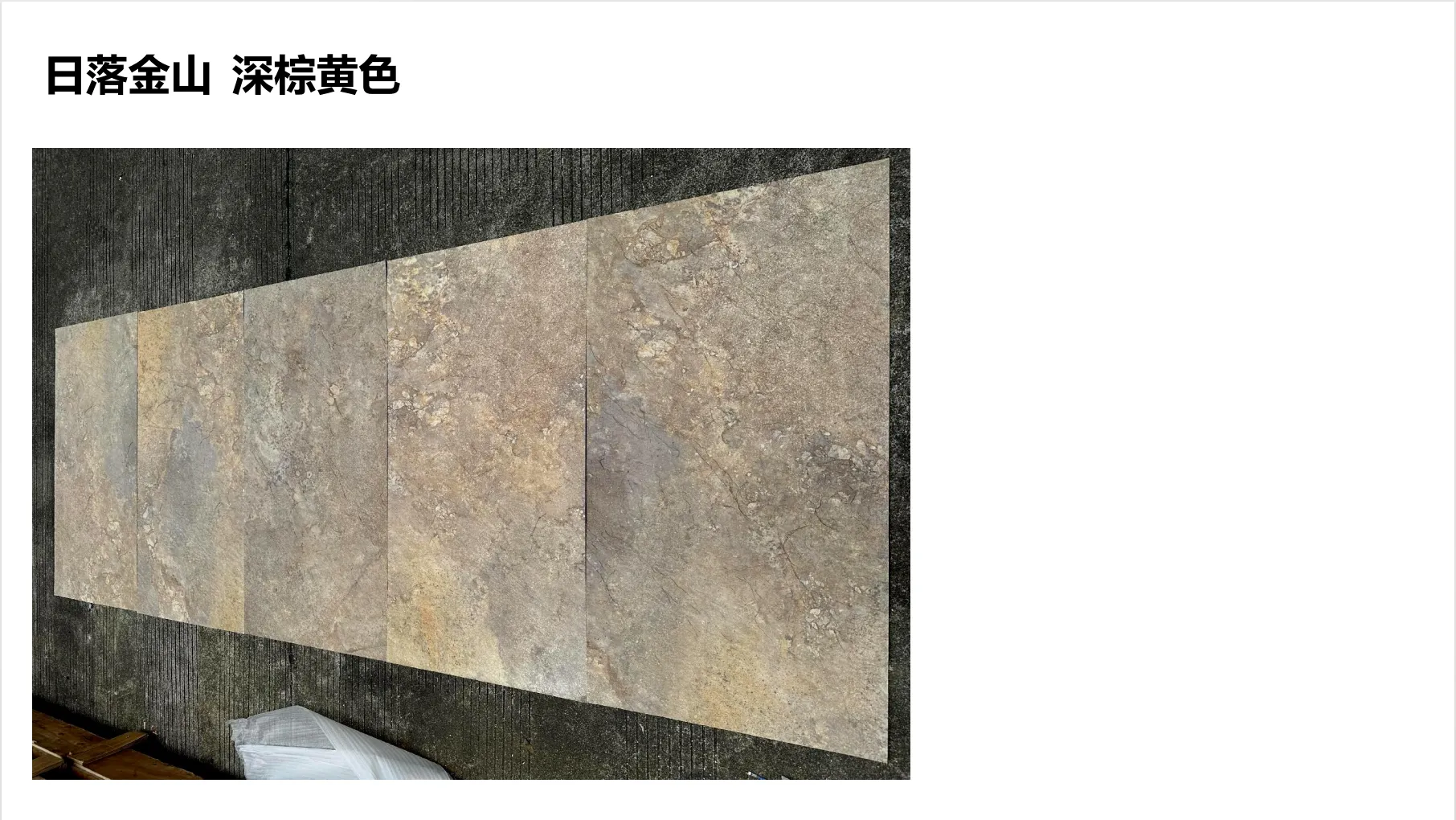
Golden Sunset isn't just a material—it's a phenomenon. To understand its allure, picture this: a boutique hotel perched on a coastal promenade. At noon, its facade shimmers with a soft, sunlit warmth, the panels' subtle grain catching the light like sand at low tide. By late afternoon, as the sun dips, the hue deepens—tinges of amber and honey seep through, making the building glow from within, as if lit by a thousand hidden lanterns. By twilight, it softens into a warm, burnished gold, a beacon against the darkening sky. This isn't just paint or pigment; it's a dance between texture and light, and Golden Sunset has mastered the steps.
What makes Golden Sunset unique? It starts with the base material: a composite core reinforced with natural minerals, engineered to mimic the depth of natural travertine but with none of the weight or maintenance headaches. The surface, however, is where the magic happens. Unlike flat, uniform panels, Golden Sunset features a multi-layered finish—subtle undulations, tiny mineral flecks, and a matte-to-satin gradient that reacts differently to light at every hour. Run your hand over it, and you'll feel the texture: not rough, but tactile, with a softness that belies its strength. It's the kind of surface that invites interaction, that makes passersby pause and think, "What is that?"
Take, for example, the recently completed Riverfront Arts Center in Portland. Designed by award-winning firm L&M Architects, the building's south facade is clad entirely in Golden Sunset panels. "We wanted the center to feel like it belonged to the river—like it was shaped by the same forces that carved the canyon," explains lead architect Maria Lopez. "Golden Sunset does exactly that. In the morning, it mirrors the mist over the water; at sunset, it becomes the sunset. People stop to take photos not just of the art inside, but of the building itself. That's the power of a material that doesn't just exist in space—it interacts with it."
Golden Sunset may be the showstopper, but the MCM Project Board Series is far from a one-trick pony. Its strength lies in its diversity—a range of textures and tones that let designers compose facades like artists with a full spectrum. For every project that craves warmth, there's a cooler counterpart; for every need for drama, a subtle complement. Let's explore a few standout members of the family, each with its own personality and purpose.
If Golden Sunset is the sun, then the Lunar Peak sub-series is the moon—cool, ethereal, and endlessly captivating. Available in silvery , golden , and black variants, Lunar Peak panels play with light in a different way: they absorb it, reflect it, and sometimes even seem to glow. The silvery finish, with its subtle metallic sheen, is a favorite for tech offices and innovation hubs, where it evokes precision and forward-thinking. The golden variant, warmer than silvery but cooler than Golden Sunset, adds a touch of luxury without overwhelming—perfect for high-end retail spaces or boutique law firms. And the black? It's drama personified. Imagine a sleek restaurant facade in downtown Chicago, Lunar Peak Black panels absorbing the city lights, turning the building into a canvas for the neon signs and street lamps around it. It's bold, it's modern, and it never fails to make a statement.
No discussion of MCM Project Board Series would be complete without mentioning travertine —a material so beloved for its organic beauty that it's been used in architecture for millennia (think the Colosseum, or the steps of the Lincoln Memorial). But traditional travertine is heavy, porous, and prone to staining—hardly ideal for high-traffic commercial facades. The MCM team set out to reimagine it, and the result is a lineup that honors the original's character while fixing its flaws. Take travertine (starry orange) : tiny, iridescent flecks embedded in a warm, earthy base mimic the look of travertine quarried from sunbaked Italian hillsides, but with a durability that can withstand harsh weather and urban pollution. Or travertine (vintage silver) , which ages gracefully over time, developing a patina that tells the story of the building's life. For designers craving that "old-world meets new-world" vibe, it's irreplaceable.
For projects that lean into minimalism, fair-faced concrete is the unsung hero of the MCM lineup. Stripped of excess, its beauty lies in its honesty: the subtle variations in color, the faint imprint of the formwork, the way it softens harsh shadows. It's not cold or industrial; it's warm in its simplicity, like a well-worn leather jacket. Pair it with Golden Sunset accents—a strip along the roofline, or a feature wall—and you get a contrast that's both striking and harmonious. A recent example is the Greenview Community Library in Seattle, where fair-faced concrete walls form the building's base, while Golden Sunset panels crown the upper floors. "It's about grounding the building in the earth while letting it reach for the light," says designer James Chen. "Fair-faced concrete gives it weight and purpose; Golden Sunset gives it joy."
Great materials don't just look good—they make designers' lives easier. The MCM Project Board Series was built with this in mind, blending innovation with practicality to solve some of the biggest headaches in facade design. Let's break down the "why" behind its popularity, beyond just aesthetics.
Traditional stone facades can weigh up to 50 kg per square meter, requiring reinforced structural support and driving up construction costs. MCM panels? Just 8–12 kg per square meter. That reduced weight means faster installation, lower shipping costs, and the ability to use them on older buildings or structures with weight restrictions. But don't let the lightness fool you: MCM panels are tough. Made with a fire-resistant core and a weatherproof outer layer, they're resistant to UV rays, saltwater, and even extreme temperatures—ideal for coastal properties or buildings in harsh climates. And sustainability? The composite core is made from recycled materials, and the manufacturing process uses 30% less energy than traditional stone cutting. For LEED-certified projects, it's a no-brainer.
Designers hate being boxed in, and MCM gets that. Need a specific size? Panels can be cut to order, from tiny 30x30 cm accents to massive 120x240 cm slabs. Want a unique color blend? The color-matching team can replicate everything from the hue of a desert sunset to the gray-green of ocean kelp. Even texture is customizable: choose from smooth, rough-hewn, or anything in between. Take the weaving (khaki) panel, for example—a customer favorite for hospitality projects. Its interlaced pattern mimics handwoven textiles, adding a soft, artisanal touch to lobbies and restaurants. It wasn't in the catalog until a designer asked, "Can you make something that feels like a blanket for the building?" MCM said yes.
Numbers and specs tell part of the story, but real impact lies in the projects themselves. Let's dive into three case studies where Golden Sunset didn't just clad a building—it defined it.
Nestled between the Pacific Ocean and the Santa Ynez Mountains, the Solstice Hotel was designed to be a retreat that "blends into the landscape, then elevates it," according to owner Elena Torres. The south-facing facade, which overlooks the ocean, is entirely Golden Sunset panels, while the north side uses Lunar Peak Silvery to reflect the mountain light. "At sunrise, the north side glows like snow; at sunset, the south side becomes the sky," Torres says. "Guests book rooms based on which 'view' they want—the mountain glow or the ocean sunset. We've even had couples take wedding photos in front of the Golden Sunset wall. It's become part of the hotel's identity."
Austin's tech scene is all about innovation, and Horizon Tech Campus wanted its headquarters to reflect that. The design team chose Golden Sunset for the main entrance facade, pairing it with fair-faced concrete for the rest of the building. "We wanted to balance warmth with edge," explains facilities director Mark Chen. "Golden Sunset adds that 'human' touch—tech can feel cold, but the panels make the campus feel welcoming. Employees say it's the first thing they notice when they arrive: that golden glow, like the building is happy to see them. It sounds silly, but morale has actually gone up since we moved in. People linger outside longer, chat by the entrance… it's created a sense of community."
In a city known for its historic brick buildings, Marigold Bistro wanted to stand out without clashing. Chef and owner Marcus Reed chose Golden Sunset for the restaurant's street-facing facade, pairing it with reclaimed wood accents and large picture windows. "I wanted the bistro to feel like a warm hug," Reed says. "The food is comfort food with a twist, and the facade should match that—familiar but surprising. Golden Sunset does that. It's earthy, like brick, but with this richness that makes people stop and look. We've had so many customers say, 'I walked by a hundred times and never noticed this spot until now.' That's the power of a facade that doesn't just sit there—it greets you."
| Material | Key Features | Best For | Light Interaction |
|---|---|---|---|
| Golden Sunset | Warm amber-gold hue, multi-layered texture, mineral flecks | Hotels, restaurants, hospitality | Deepens to honey/gold at sunset; softens at twilight |
| Lunar Peak (Golden) | Cooler gold with metallic sheen, smooth finish | Retail, corporate offices | Reflects light evenly; modern, sleek glow |
| Travertine (Starry Orange) | Earth-toned base with iridescent flecks, organic texture | Heritage buildings, cultural centers | Mimics natural stone; warm, sunlit glow |
| Fair-Faced Concrete | Raw, minimal finish, subtle color variations | Modern offices, art galleries | Absorbs light; soft, diffused warmth |
| Weaving (Khaki) | Textile-like interlaced pattern, soft texture | Boutiques, lobbies, hospitality | Creates shadow play; warm, inviting glow |
As cities grow denser and competition for attention fiercer, the role of the commercial facade is evolving. It's no longer enough for a building to be functional—it must be memorable , a landmark in its own right. The MCM Project Board Series, with its focus on texture, light, and customization, is leading that charge. Golden Sunset, in particular, represents the future of facade design: materials that don't just serve a purpose, but create emotion .
Imagine a skyline where every building tells a story—where a hospital's facade uses soft, calming Lunar Peak Black to evoke trust; where a school uses travertine (starry blue) to spark curiosity; where a community center uses rammed earth board (gradient) to celebrate diversity. That's the vision MCM is building toward: a world where architecture isn't just about shelter, but about connection—between people, place, and the passage of time.
So the next time you find yourself walking through a city at golden hour, pause and look up. Notice the buildings that glow, that seem to hum with life. Chances are, they're wearing MCM Project Board Series. And if they're wearing Golden Sunset? They're not just buildings anymore. They're storytellers, capturing that fleeting, perfect moment when the sun says goodbye—and turning it into something eternal.
Recommend Products












