
Exploring texture, versatility, and visual impact in modern architectural materials
Walk into any well-designed space—whether it's a bustling restaurant, a serene boutique hotel, or a cozy home office—and you'll notice something immediately: texture. It's the quiet force that shapes how we feel in a room. A rough-hewn stone wall might evoke warmth and earthiness, while a smooth concrete surface leans into modern minimalism. But in recent years, one texture has been stealing the spotlight in architectural circles: weaving patterns . There's something inherently inviting about the interplay of threads, the way light dances across raised and recessed lines, and how it bridges the gap between organic and structured design.
This is where MCM (Modified Composite Material) comes in. If you're not familiar, MCM is a game-changer for designers and architects. Lightweight yet durable, eco-friendly yet stunningly versatile, it's redefining what's possible with building materials. Today, we're zeroing in on two of its most popular lines: the MCM Project Board Series and the MCM Big Slab Board Series . Both promise to elevate weaving patterns, but how do they actually perform when the camera lens gets up close? Let's dig into their weaving real photos to find out.
Before we jump into the details, let's get clear on what makes MCM stand out. Traditional cladding materials—think natural stone or solid wood—are beautiful but often heavy, expensive, or high-maintenance. MCM flips the script. Made from a blend of minerals, resins, and fibers, it's engineered to be lightweight (up to 80% lighter than natural stone!), resistant to scratches, moisture, and UV rays, and surprisingly flexible. That flexibility is key when working with intricate patterns like weaving, where curves, angles, and custom shapes often come into play.
Now, within the MCM family, the Project Board and Big Slab Series cater to different needs. The Project Board Series is the "chameleon" of the bunch—designed for adaptability. Its smaller panel size (typically 300x600mm or 450x900mm) and flexible core make it ideal for tight spaces, curved surfaces, or projects that demand custom cuts. The Big Slab Series, on the other hand, is all about grandeur. With panels ranging from 600x1200mm to a whopping 1200x2400mm, it's built to make a statement in large, open areas where scale matters most.
But here's the question: when you print weaving patterns onto these two distinct series, how do they translate visually? That's where weaving real photos become invaluable. These aren't just pretty pictures—they're a window into how the material will behave in real life: how the weave will catch the light at noon, how the texture will feel under your fingertips, how the colors will shift from different angles. Let's compare.
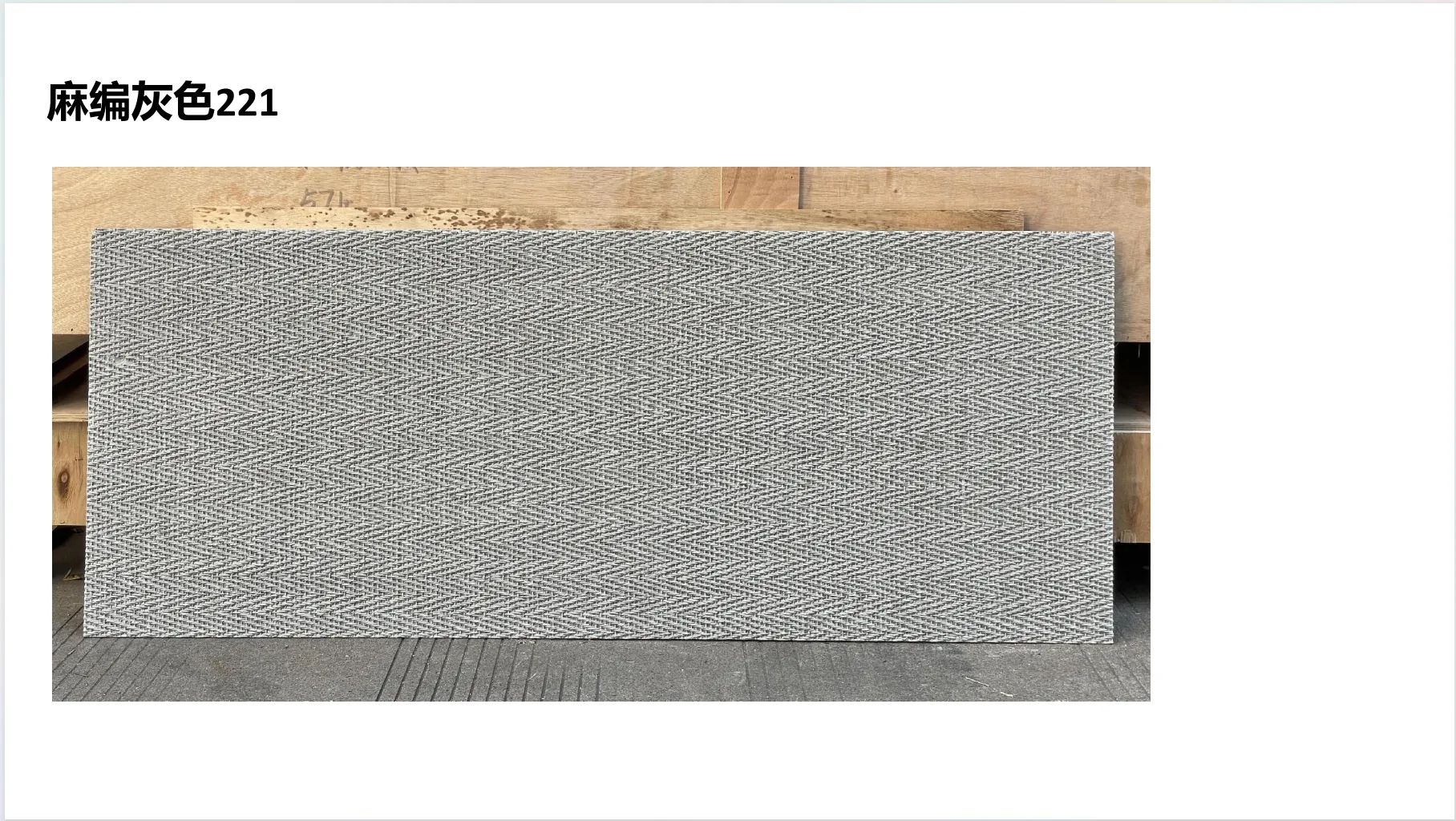
Let's start with the Project Board Series. If you're a designer who loves getting into the nitty-gritty of texture, this one might be your new favorite. Its smaller panel size means it can handle intricate weaving patterns with precision. Take a look at the weaving real photos of the Project Board in "weaving (khaki)" or "weaving (jacinth)"—you'll notice something striking: the individual threads of the weave are crisply defined. There's a level of detail here that feels almost handcrafted, like a textile artist spent hours looping each strand into place.
Why does this happen? The Project Board's surface is engineered with a slightly matte finish that softens harsh light, allowing the weave's peaks and valleys to stand out. In photos taken under natural light, you'll see subtle shadows between the "threads," creating depth that makes the pattern pop without feeling overwhelming. This is a big win for spaces where intimacy matters—think boutique clothing stores, cozy cafes, or residential accent walls. Imagine a reading nook with Project Board cladding in "weaving (beige)"; the texture would invite you to reach out and touch it, turning a simple wall into a conversation starter.
Another standout feature in the Project Board's weaving real photos is color consistency. MCM's manufacturing process ensures that the dye penetrates evenly, so even in larger installations, the weave pattern flows seamlessly from panel to panel. This is crucial for projects where the weaving is meant to be a cohesive design element, not a patchwork of mismatched tones. And because the panels are lightweight, installers can easily maneuver them around corners or over curved surfaces—meaning that beautiful weaving pattern you fell in love with in the photos? It can wrap around a column or follow the arch of a doorway without losing its integrity.
Now, let's shift to the Big Slab Series. If the Project Board is about detail, the Big Slab is about drama. These panels are bold, unapologetic, and designed to command attention. When you look at weaving real photos of the Big Slab Series—say, in "weaving (grey)" or "weaving (white)"—the first thing that hits you is the scale. The weaving pattern here isn't just a texture; it's a statement. The "threads" are wider, the spacing between them more generous, and the overall effect is almost sculptural.
This is intentional. Big Slab panels are meant for large, open spaces—hotel lobbies, convention centers, or corporate headquarters—where the goal is to create visual impact from a distance. In photos taken from 10 or 15 feet away, the weaving pattern reads as a cohesive, sweeping design that guides the eye across the room. But get closer, and you'll still find (surprises)—the same attention to detail as the Project Board, just (scaled up). Run your hand over a Big Slab in "weaving (jacinth)," and you'll feel the raised threads under your palm, a tactile experience that balances the panel's imposing size.
One thing to note in Big Slab's weaving real photos is how it handles light. Because the panels are larger, they can reflect light more dynamically. In a space with floor-to-ceiling windows, the weaving pattern will shift throughout the day—bright midday sun might make the threads glow, while soft evening light could turn the texture into a play of deep shadows. This versatility makes the Big Slab Series a favorite for designers who want their spaces to feel alive, changing with the time of day. It's not just a wall; it's a canvas that responds to its environment.
To really understand how these two series stack up, let's put their weaving real photos head-to-head. Below is a breakdown of key visual and practical differences based on real-world imagery and designer feedback:
| Feature | MCM Project Board Series | MCM Big Slab Series |
|---|---|---|
| Weave Detail | Fine, crisp threads with subtle shadow definition; ideal for close-up viewing. | Bold, sculptural threads with dramatic light/shadow contrast; impactful from afar. |
| Color Range | Rich, saturated tones (khaki, jacinth, beige) with matte finish to enhance texture. | Versatile palette (grey, white, black) with slightly glossy finish for light reflection. |
| Installation Flexibility | Excels on curved surfaces, small walls, or custom shapes (e.g., niches, columns). | Best for large, flat expanses (e.g., lobby walls, conference room backdrops). |
| Mood Evoked | Intimate, cozy, and artisanal—feels approachable and warm. | Grand, modern, and confident—feels expansive and forward-thinking. |
| Real Photo Standout | Macro shots reveal handcrafted-like precision in thread definition. | Wide-angle shots showcase the pattern's ability to transform large spaces. |
One of the most interesting takeaways from comparing the photos? Neither series is "better"—they're just better for different goals. If you're designing a yoga studio where calm and texture go hand in hand, the Project Board's "weaving (beige)" might be perfect. If you're creating a tech company's headquarters that needs to feel innovative and bold, the Big Slab's "weaving (grey)" could be the star of the show.
Of course, great weaving real photos mean nothing if the material can't stand up to real-world use. Here's where MCM truly shines—and where both series hold their own. Let's talk durability.
The Project Board Series, with its flexible core, is surprisingly tough. Its weaving pattern is embedded into the material during manufacturing, not just printed on top, so it won't scratch or fade easily. In high-traffic areas like restaurant corridors or retail fitting rooms, this is a game-changer. We've seen Project Board installations with weaving patterns hold up beautifully after years of wear, their texture still as defined as the day they were installed.
The Big Slab Series, meanwhile, benefits from its larger panel size in terms of structural stability. Fewer seams mean fewer weak points, and the material's resistance to moisture and temperature changes makes it suitable for both indoor and outdoor use. Imagine an outdoor patio with Big Slab cladding in "weaving (white)"—rain, sun, and even the occasional hailstorm won't dull its pattern. The weaving real photos of Big Slab after weathering tests are impressive: the threads still pop, the color remains true, and the texture doesn't degrade.
Both series also score points for low maintenance. Unlike natural stone, which might need sealing or polishing, MCM weaving panels just need a quick wipe with a damp cloth to stay looking fresh. That means more time enjoying the texture and less time worrying about upkeep—a win for busy designers and clients alike.
At the end of the day, weaving real photos aren't just for designers—they're for everyone involved in a project. Clients often struggle to visualize how a texture will look in their space, especially when they're looking at swatches or samples. But a high-quality real photo of the Project Board or Big Slab Series in their chosen weaving pattern? That's a bridge between concept and reality.
Take a client who's on the fence between "weaving (khaki)" and "weaving (jacinth)" for their boutique. Show them a real photo of the Project Board in both colors, installed in a similar-sized space, and suddenly the decision becomes clearer. They can see how the khaki warms up a room with soft light, or how the jacinth adds energy under bright fixtures. It's not just about the pattern—it's about how that pattern interacts with the space's unique lighting, furniture, and flow.
Designers, too, rely on these photos to push boundaries. Maybe you've never considered using weaving patterns on a ceiling before, but seeing a real photo of the Big Slab Series in "weaving (grey)" overhead might spark a new idea. Or perhaps you're worried that a weaving pattern will clash with existing wood elements—until you see a real photo of Project Board "weaving (beige)" paired with oak accents, and realize how beautifully they complement each other.
When it comes down to it, comparing the MCM Project Board Series and MCM Big Slab Series through their weaving real photos is about more than texture—it's about storytelling. Every space has a story to tell, and the right weaving pattern can help tell it.
The Project Board Series tells a story of craftsmanship and intimacy, of small details that make a space feel like home. The Big Slab Series tells a story of ambition and scale, of bold choices that leave a lasting impression. Both stories are powerful; it just depends on which one your project needs to tell.
So the next time you're flipping through weaving real photos of MCM materials, take a moment to look beyond the pattern. Ask yourself: How does this texture make me feel? What story does it tell? Whether you choose Project Board or Big Slab, one thing's for sure—you're not just choosing a material. You're choosing to add depth, warmth, and personality to a space. And in a world that often feels dominated by smooth, sterile surfaces, that's a choice worth celebrating.
Recommend Products












