
Exploring durability, design, and performance in moisture-prone spaces
Walk into any home improvement store or flip through a design magazine, and you'll be bombarded with options for wall and floor materials. But when it comes to spaces where water is a constant presence—bathrooms, kitchens, pool decks, or outdoor patios—one factor rises above all others: water resistance. It's not just about avoiding stains or mold; it's about longevity, safety, and preserving the beauty of your space for years to come. Today, we're diving deep into two popular contenders: MCM (Modified Composite Material) and traditional porcelain tiles. We'll compare their water resistance, real-world performance, and even take a peek at Golden Faith real photos to see how they stack up in actual projects. By the end, you'll know which material deserves a spot in your next renovation.
If you're not familiar with MCM, you're not alone. It's a relative newcomer to the building materials scene, but it's quickly gaining traction—and for good reason. MCM stands for Modified Composite Material, a blend of natural minerals, polymers, and fibers engineered to mimic the look of natural stone, wood, or concrete, but with supercharged performance. Think of it as nature's beauty, reimagined with modern science.
At the heart of MCM's appeal is its flexibility. Unlike rigid natural stone or porcelain, MCM flexible stone can bend without breaking, making it ideal for curved surfaces, uneven walls, or installations where weight is a concern (hello, high-rise facades!). But flexibility isn't its only trick. MCM is also lightweight—up to 80% lighter than traditional stone— which cuts down on installation time and structural stress. And yes, it's sustainable: most MCM products use recycled materials and require less energy to produce than fired ceramics like porcelain.
But let's get specific. MCM comes in a dizzying array of styles, each designed to cater to different aesthetic tastes. There's the travertine (starry green) line, which mimics the earthy pockmarks of natural travertine but with a subtle, star-like shimmer in deep green—a favorite for spa bathrooms. Then there's lunar peak silvery , a cool, metallic finish that evokes the surface of the moon, perfect for modern, industrial kitchens. And for those who love the raw, unpolished look, there's fair-faced concrete MCM, which captures the texture of poured concrete without the weight or porosity issues of the real thing.
Now, let's talk about the old reliable: porcelain tiles. For decades, they've been the go-to for wet areas, and it's easy to see why. Porcelain is a type of ceramic tile made from fine-grained clay fired at extremely high temperatures (around 1,200°C). This process creates a dense, hard material that's resistant to scratches, stains, and—you guessed it—water.
Traditional porcelain tiles are rigid, heavy, and come in standard sizes (think 12x12 inches or larger). They're installed with grout between each tile, which can be both a strength and a weakness. On one hand, the grout helps secure the tiles and create a uniform look; on the other, it's a potential weak spot for water if not sealed properly. Still, porcelain's low water absorption rate (typically less than 0.5%) has made it a staple in bathrooms, kitchens, and even outdoor spaces in mild climates.
Porcelain also offers design versatility, though it's often limited to mimicking natural stone or wood with printed patterns. You'll find everything from marble-look porcelain to subway tiles in classic white. But here's the catch: while porcelain is durable, its rigidity means it can crack if the subfloor shifts, and its weight can be a problem for upper floors or retrofits.
Okay, let's cut to the chase: how do these two materials really perform when water is involved? To answer that, we need to look at three key factors: water absorption, structural integrity in moisture, and long-term durability.
Water absorption is measured by how much water a material soaks up over time, expressed as a percentage of its weight. For wet areas, lower is better—less absorption means less risk of water seeping in, causing mold, warping, or cracking.
Porcelain tiles are known for their low absorption, typically around 0.5% or less. That's impressive, but MCM often outperforms here. Thanks to its composite structure—where polymers bind natural minerals tightly—MCM materials can have absorption rates as low as 0.3%, and some specialized lines (like fair-faced concrete MCM) even dip below 0.2%. To put that in perspective: if you spill a glass of water on MCM, it'll bead up and wipe away, whereas porcelain might absorb a tiny bit over time—especially if the glaze is worn.
Water doesn't just sit on the surface—it can seep into cracks, freeze (in cold climates), and expand, causing damage. Here's where MCM's flexibility becomes a game-changer. Porcelain tiles are rigid, so if the floor or wall shifts slightly (due to temperature changes, foundation settling, or moisture expansion), the tiles can crack. Once a tile cracks, water has a direct path to the subfloor, leading to rot or mold.
MCM, on the other hand, bends with movement. Take MCM flexible stone : it can flex up to 30 degrees without breaking, meaning minor shifts won't create cracks. This is a huge advantage in areas like basements (prone to moisture-related shifting) or outdoor patios (exposed to rain and freeze-thaw cycles).
Porcelain tiles require grout, and grout—even waterproof grout—isn't perfect. Over time, grout lines can crack, chip, or become porous, especially in high-traffic wet areas like showers. Once grout fails, water seeps underneath the tiles, and fixing it means regrouting or even replacing tiles.
MCM often comes in large panels (some up to 4x8 feet), which means fewer seams. Fewer seams mean less grout, and less grout means fewer opportunities for water to sneak through. Even when seams are needed, MCM's tight-fitting installation and flexible sealants reduce the risk of water penetration. Looking at Golden Faith real photos of MCM installations, you'll notice how seamless the surfaces look—no messy grout lines to worry about.
| Factor | MCM (e.g., Flexible Stone) | Porcelain Tiles |
|---|---|---|
| Water Absorption Rate | 0.2–0.3% | 0.5% or less |
| Flexibility | High (bends without cracking) | Low (rigid, prone to cracking on shift) |
| Seams/Grout | Fewer seams, minimal grout | Many seams, requires grout sealing |
| Freeze-Thaw Resistance | Excellent (flexibility prevents cracking) | Good, but risk of cracking if water seeps in |
| Mold Resistance | High (non-porous surface, no grout mold) | Moderate (grout lines can harbor mold) |
Numbers and specs are great, but nothing beats seeing materials in action. That's where Golden Faith real photos come in. Golden Faith is a leading supplier of building materials, and their project gallery is a treasure trove of MCM and porcelain tile installations in real homes, hotels, and commercial spaces. Let's take a closer look at two standout examples.
A boutique hotel in Bali wanted to create spa-like bathrooms with a natural, organic feel—without sacrificing durability in the humid, ocean-air environment. They chose travertine (starry green) MCM panels for the walls and floors. Golden Faith real photos show the space three years later: the panels still have their signature green veining and subtle shimmer, with no signs of water damage, mold, or discoloration. The hotel's maintenance manager, Wayan Putra, notes: "We expected some fading or warping near the showers, but the MCM has held up better than the porcelain tiles we used in our older wing. We clean it with a damp cloth once a week, and it looks brand new."
In contrast, a high-rise apartment in Chicago used large-format porcelain tiles for the kitchen backsplash and floor. Golden Faith real photos taken after two years show the tiles themselves are still intact, but the grout lines between them have darkened slightly, and there's minor discoloration near the sink. The homeowner, Maria Gonzalez, says: "I love the look of the porcelain, but I have to reseal the grout every six months to keep mold away. Last winter, when the pipes froze and leaked under the sink, the tiles stayed strong, but the subfloor got wet because water seeped through the grout. We had to replace a section of the floor."
These examples highlight a key takeaway: while porcelain is durable, MCM's lack of grout and flexibility give it an edge in long-term water resistance—especially in high-moisture or variable-climate environments.
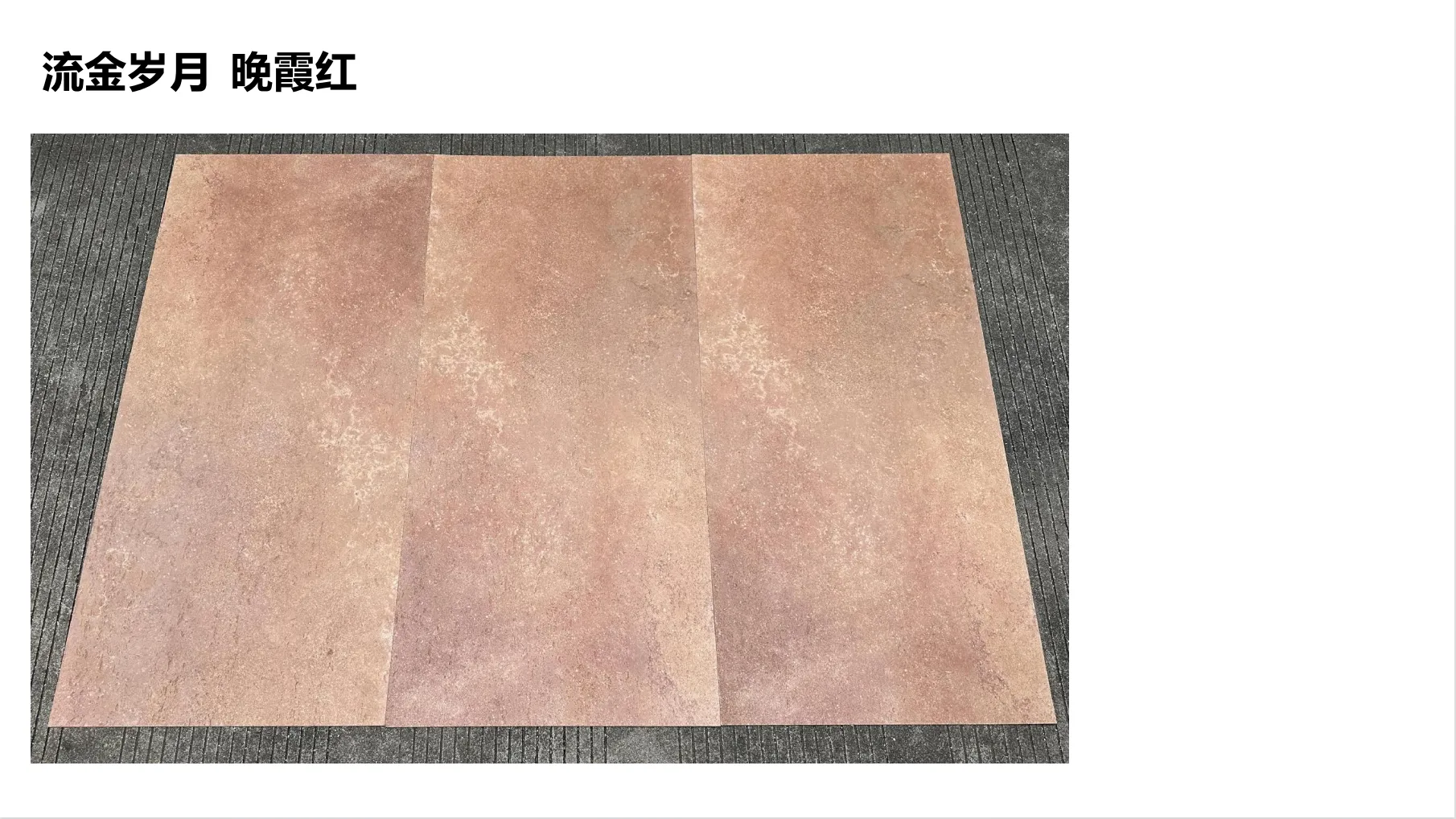
Let's be honest: no one wants a bathroom or kitchen that's "just" water-resistant—it should also look good. Here, MCM really shines. With options like lunar peak silvery , which has a metallic, almost iridescent finish, or travertine (starry red) with its bold, galaxy-like flecks, MCM lets designers get creative without compromising on performance.
Porcelain tiles, while versatile, often rely on printed patterns to mimic natural materials. The result can look flat compared to MCM's textured, three-dimensional surfaces. For example, fair-faced concrete MCM has the rough, tactile quality of real concrete, with subtle variations in color and texture that printed porcelain just can't replicate. And because MCM comes in large panels, it creates a seamless, modern look that's hard to achieve with small, grouted porcelain tiles.
Take the lunar peak golden line, for instance. Used in a restaurant bar area, its warm, metallic sheen catches the light, creating a luxurious vibe—all while standing up to spills, condensation, and daily cleaning. Porcelain tiles in a similar gold finish might look nice initially, but over time, the glaze can wear thin, dulling the shine.
Water resistance isn't just about the material itself—it's about how easy it is to install and maintain. MCM's lightweight nature (about 3–5 kg per square meter, compared to porcelain's 15–20 kg) makes installation faster and cheaper. You don't need heavy-duty tools or structural reinforcement, which is a big plus for retrofits or upper-floor installations.
Maintenance is where MCM really saves time and money. Because it's non-porous and has minimal grout, cleaning is simple: a quick wipe with mild soap and water. Porcelain tiles, on the other hand, require regular grout sealing (every 6–12 months) to prevent mold and staining. In commercial settings like restaurants or hotels, that adds up—both in labor costs and downtime.
As John Miller, a contractor with 20 years of experience, puts it: "Installing MCM takes half the time of porcelain tiles, and my clients love that they don't have to deal with grout maintenance. I recently did a bathroom renovation with MCM flexible stone for a client in Florida, and after a year of hurricanes and humidity, it still looks perfect. With porcelain, I'd be back there resealing grout by now."
In today's world, sustainability matters—and MCM has a clear edge here too. Most MCM products are made with recycled materials (like post-industrial minerals and polymers) and require less energy to produce than porcelain tiles, which involve high-temperature firing. MCM is also lightweight, reducing transportation emissions, and its longevity means less frequent replacement—lowering its overall carbon footprint.
Porcelain tiles, while durable, are energy-intensive to manufacture. The firing process releases CO2, and their weight increases fuel use during shipping. Additionally, when porcelain tiles crack or need replacement, they often end up in landfills, as recycling ceramic is limited. MCM, being a composite material, is easier to recycle and can sometimes be repurposed into new panels.
At the end of the day, both MCM and porcelain tiles have their place. Porcelain is a solid choice for low-moisture areas or budgets where upfront cost is a priority. But if you're looking for long-term water resistance, design flexibility, and lower maintenance—especially in high-moisture, humid, or variable-climate spaces—MCM is the clear winner.
From travertine (starry green) bathrooms that feel like a forest retreat to lunar peak silvery commercial facades that shine rain or shine, MCM proves that water resistance and beauty don't have to be mutually exclusive. And when you look at Golden Faith real photos of MCM installations, it's easy to see why more designers and homeowners are making the switch.
So, the next time you're planning a renovation, ask yourself: Do I want a material that just "resists" water, or one that thrives in it? For most of us, the answer is clear.
Recommend Products












