
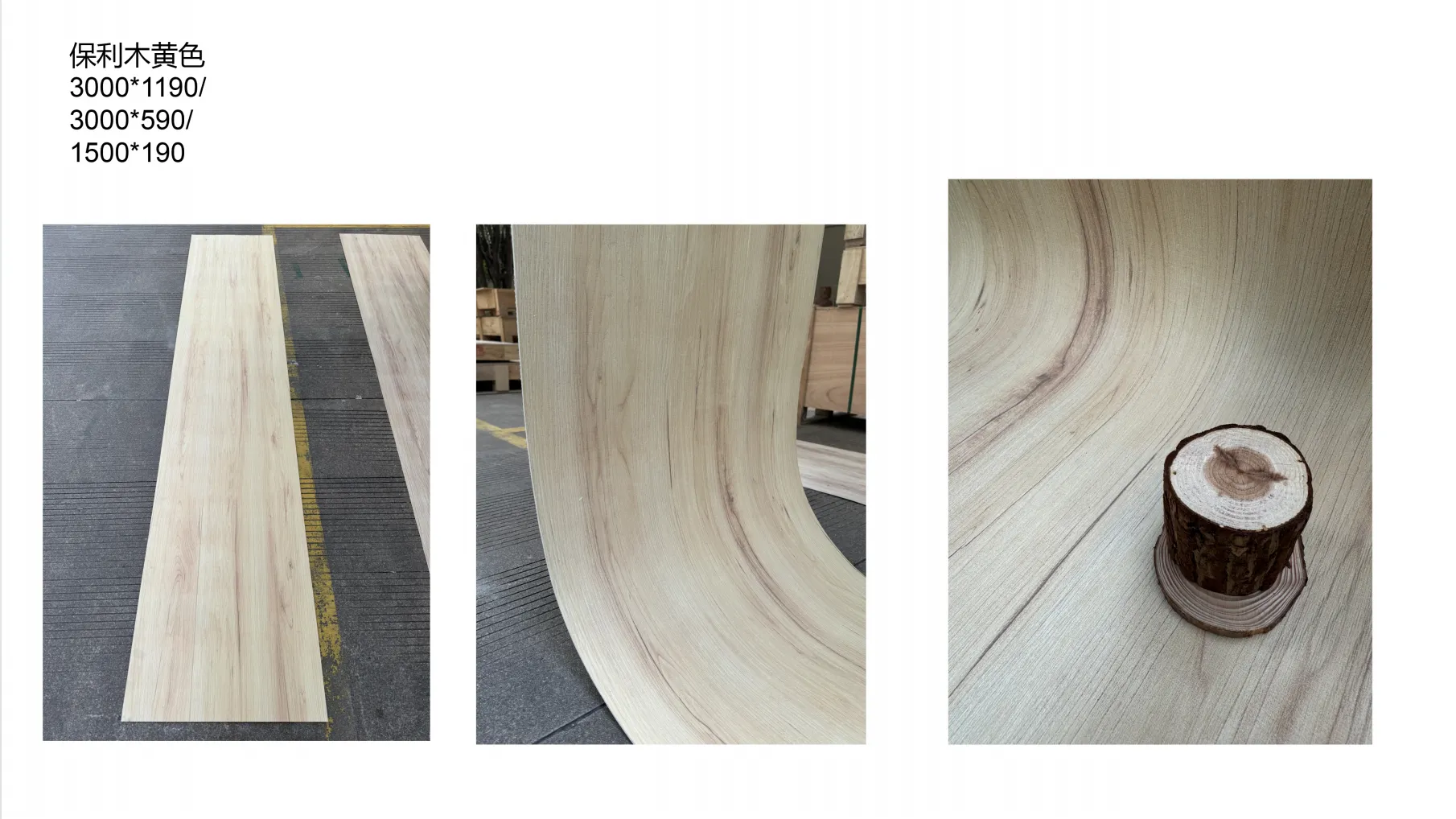
If you've ever sat in on a commercial project meeting—whether it's for a bustling restaurant, a sleek office space, or a trendy retail store—you know the conversation always circles back to the same trio: aesthetics , durability , and budget . Architects dream of striking visuals, contractors stress resilience, and project managers? They're stuck balancing it all without breaking the bank. Enter poly wood board: a material that's been gaining buzz for its "best of both worlds" appeal. But is it really the budget-friendly hero commercial projects need? Let's dive into the numbers, break down the costs, and see how it stacks up against alternatives like mcm flexible stone, wood grain board, and bamboo mat board.
Before we talk dollars and cents, let's get clear on what we're dealing with. Poly wood (short for "polyethylene wood") is a composite material made from recycled plastic (think milk jugs, plastic bags) and wood fibers. It's designed to mimic the look and feel of real wood—warm grains, natural textures—without the headaches: no rotting, no warping, no termites, and zero need for annual sanding or staining. For commercial projects, that's a big deal. Imagine a restaurant patio that stays pristine through rain and snow, or a retail store's accent wall that doesn't fade under harsh overhead lights. But all that durability comes at a cost—and we're here to unpack exactly what that cost looks like.
Let's start with the basics: how much does the material itself cost? On average, poly wood board runs between $3.50 and $7.50 per square foot. That's a wider range than, say, pine (which might start at $1.50/sq ft) but cheaper than high-end hardwoods like teak ($10+/sq ft). What drives the price up? Thickness (thicker boards for high-traffic areas cost more), finish (smooth vs. textured), and color (custom hues add a premium). For example, a 1x6-inch poly wood board with a wood grain finish might cost $4/sq ft, while a 2x8-inch board with a custom "vintage oak" stain could hit $7/sq ft.
Quantity matters, too. Ordering in bulk (500+ sq ft) can knock 10-15% off the per-unit price—manufacturers love large orders because they reduce production waste. So if you're planning a big project (like a mall food court with 2,000 sq ft of poly wood seating), negotiating a bulk discount could save you thousands upfront.
Materials are just one piece of the puzzle. Installation can add another $2 to $5 per square foot. Why the range? It depends on the project's complexity. Installing poly wood on a flat, level patio? That's straightforward—contractors can use standard screws and power drills, so labor might be closer to $2/sq ft. But if you're putting it on a curved accent wall or a rooftop deck with uneven substrate? You'll need specialized tools (like jigsaws for custom cuts) and extra prep work (waterproofing membranes, structural supports), which bumps labor up to $5/sq ft.
Pro tip: Don't skimp on the substrate. Poly wood hates moisture trapped underneath, so if the surface isn't properly sealed, you'll end up with warped boards down the line. That means adding $0.50-$1/sq ft for a moisture barrier—annoying in the moment, but critical for avoiding costly repairs later.
To really understand if poly wood is a good deal, we need to compare it to other materials commercial projects often consider. Let's pit it against four popular alternatives: mcm flexible stone (a lightweight stone-look cladding), wood grain board (a cheaper wood composite), bamboo mat board (a natural, eco-friendly option), and fair-faced concrete (the industrial-chic staple). Here's how they stack up in terms of upfront and long-term costs:
| Material | Material Cost (USD/sq ft) | Installation Cost (USD/sq ft) | Annual Maintenance Cost (USD/sq ft) | Est. Lifespan (Years) |
|---|---|---|---|---|
| Poly Wood Board | $3.50–$7.50 | $2–$5 | $0.10–$0.20 | 20–25 |
| MCM Flexible Stone | $4–$8 | $3–$6 | $0.30–$0.50 | 15–20 |
| Wood Grain Board | $2.50–$5 | $1.50–$3 | $0.50–$1 | 10–15 |
| Bamboo Mat Board | $2–$4 | $2–$4 | $0.75–$1.25 | 5–8 |
| Fair-Faced Concrete | $2.50–$5 | $4–$8 | $0.25–$0.40 | 30+ |
Let's parse this. Poly wood's upfront material cost is higher than wood grain or bamboo mat board, but its maintenance costs are a fraction of the latter two. Bamboo mat board, for example, needs annual sealing ($0.75/sq ft) and might need replacement after 5 years—so over 10 years, you're looking at $7.50/sq ft in maintenance alone. Poly wood? Maybe $2/sq ft over the same period. And while fair-faced concrete lasts forever, its installation cost ($4–$8/sq ft) can blow a project budget fast—especially if you need custom finishes.
Commercial projects aren't just about the first year—they're about 5, 10, 20 years down the line. Let's run the numbers for a hypothetical 1,000 sq ft project (say, a restaurant's outdoor dining area). If you choose bamboo mat board at $3/sq ft material + $3/sq ft installation, your upfront cost is $6,000. But with $1/sq ft annual maintenance and a 7-year lifespan, you'll need to replace it by year 7—another $6,000. Over 15 years, that's $12,000 total.
Poly wood, on the other hand, might cost $5/sq ft material + $3/sq ft installation = $8,000 upfront. With $0.15/sq ft annual maintenance and a 20-year lifespan, over 15 years you'll spend $8,000 + ($0.15 x 1,000 x 15) = $10,250. That's $1,750 cheaper than bamboo over 15 years—and you won't have the hassle of ripping out and replacing rotted boards in year 7.
Mcm flexible stone is another contender, often used for feature walls in lobbies or retail spaces. It looks stunning, but those $0.40/sq ft maintenance costs add up. A 500 sq ft accent wall would cost $4,000 upfront ($6/sq ft material + $2/sq ft installation) and $200/year in sealing and repairs. Over 10 years, that's $6,000—vs. poly wood's $5,500 for the same area (and poly wood won't crack if someone bumps into it with a shopping cart).
A bistro in downtown Chicago wanted an outdoor patio that could handle harsh winters and summer humidity. They considered three options: pressure-treated pine ($2/sq ft material), poly wood ($5/sq ft), and wood grain board ($3.50/sq ft). Pine was cheapest upfront ($8,000 total with installation), but the contractor warned it would need staining every year ($0.75/sq ft) and replacement in 5 years. Poly wood cost $16,000 upfront but required only annual soap-and-water cleaning ($0.10/sq ft). The bistro chose poly wood, and 8 years later, the patio still looks brand-new—they've saved $12,000 in maintenance and avoided a $8,000 replacement.
A clothing retailer in Miami wanted a "rustic meets modern" vibe for their store. They debated between mcm flexible stone ($7/sq ft material) and poly wood with a whitewash finish ($6/sq ft). The stone looked stunning, but installation would cost $5/sq ft (vs. poly wood's $3/sq ft) because it required specialized adhesives. Over 10 years, the stone wall would cost $7,200 upfront + $1,600 maintenance = $8,800. Poly wood? $7,200 upfront + $160 maintenance = $7,360. The retailer went with poly wood, and customers often comment on how "warm" the space feels—proving you don't need stone to make a statement.
So, you're sold on poly wood—now how do you keep costs in check? Here are a few pro moves:
At the end of the day, poly wood board isn't the cheapest option upfront—but it's one of the smartest long-term investments. For commercial projects that need to balance aesthetics, durability, and budget, it checks all the boxes: it looks great, stands up to wear and tear, and saves you money on maintenance and replacements down the line. Compare it to mcm flexible stone (higher maintenance), bamboo mat board (shorter lifespan), or fair-faced concrete (steeper installation), and poly wood emerges as the "goldilocks" choice—not too cheap, not too pricey, but just right for projects that need to last.
So, next time you're in that project meeting, armed with spreadsheets and samples, remember: the best budget isn't always the lowest upfront cost. It's the one that keeps your project looking great and your wallet happy—for years to come. And poly wood board? It's pretty hard to beat on both counts.
Recommend Products












