
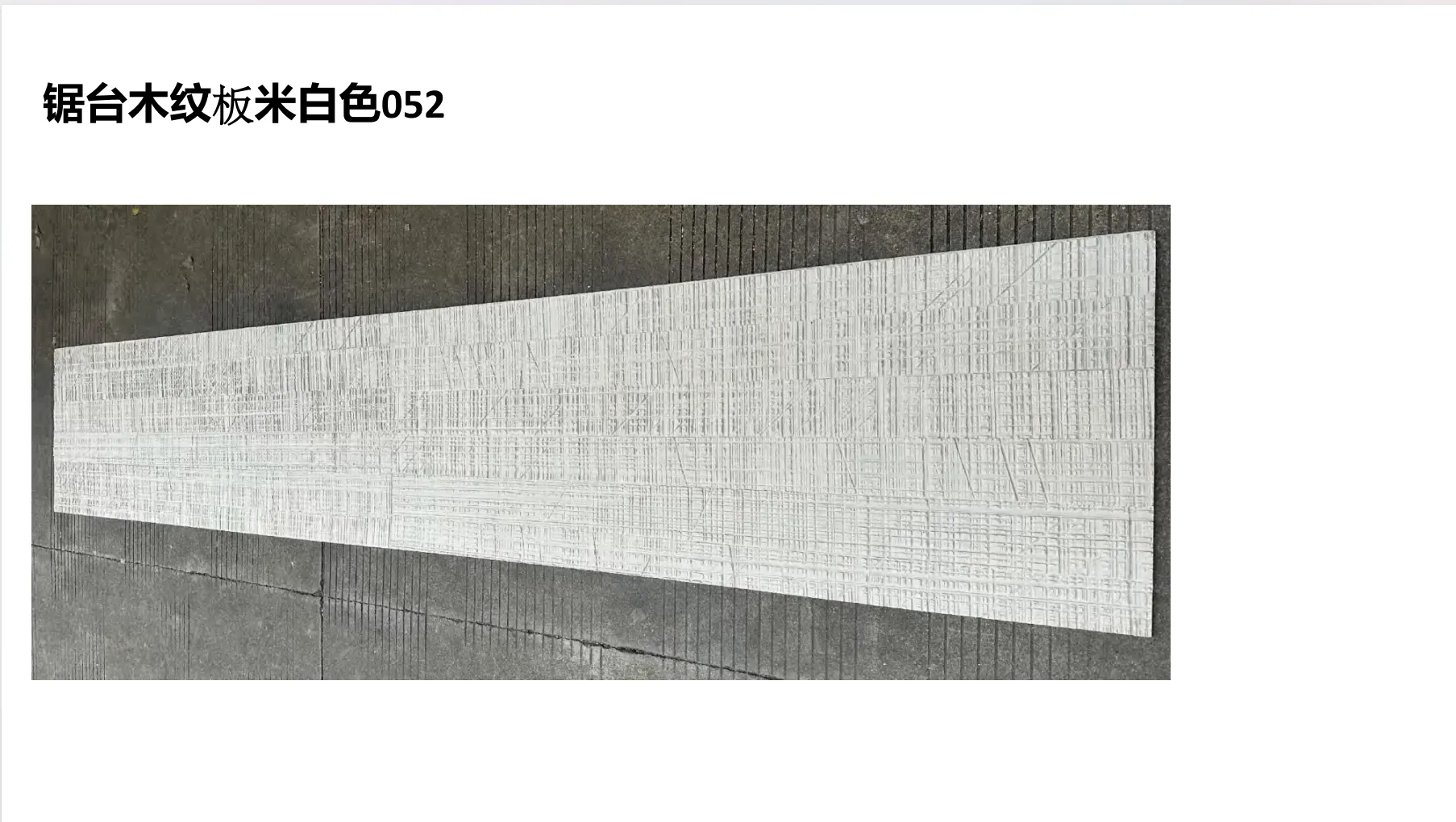
Every space tells a story, and the materials we choose to build it are the words that bring that story to life. From the cozy nooks of a family home to the soaring lobbies of commercial towers, the ability to customize materials—especially their lengths—can turn a generic design into something truly unique. For decades, sawing wood boards have been the go-to for craftsmen seeking that warm, organic touch. But in recent years, a modern contender has emerged: the MCM big slab board series. Blending cutting-edge technology with the beauty of natural materials like flexible stone, MCM big slabs are redefining what's possible in custom length design. Let's dive into the world of these two materials, exploring their strengths, limitations, and how they shape the spaces we love.
Sawing wood boards are as old as woodworking itself. Crafted by cutting logs into planks of various thicknesses and widths, then sawing those planks to specific lengths, these boards carry the inherent charm of natural wood—visible grain patterns, subtle color variations, and a tactile warmth that synthetic materials struggle to replicate. Think of the rough-hewn beams in a mountain cabin or the smooth, polished shelves in a boutique bookstore; chances are, sawing wood boards played a role in their creation. They're versatile, too, available in softwoods like pine and hardwoods like oak, each with its own personality.
While sawing wood boards offer unmatched aesthetic appeal, customizing their lengths isn't without hurdles. Wood is a living material, even after it's cut. It expands and contracts with humidity, warps over time, and can split if stressed. For projects requiring extra-long lengths—say, a 12-foot wooden countertop or a continuous wall panel—craftsmen often have to join multiple boards, creating seams that can weaken the structure or disrupt the visual flow. "You learn to work with wood's quirks," says Maria, a master carpenter with 20 years of experience. "If a client wants a 16-foot board, I might have to laminate three pieces and hope the grain lines up. It's doable, but it adds time, cost, and risk of warping down the line."
Despite these challenges, sawing wood boards remain irreplaceable in certain contexts. They shine in smaller-scale projects where their natural imperfections are part of the charm: a kitchen backsplash with 3-foot boards, a bedroom accent wall with varying lengths, or custom bookshelves. They're also ideal for spaces where warmth and tradition are priorities—think rustic restaurants or heritage homes. And let's not forget sustainability: when sourced from responsibly managed forests, wood is a renewable resource, appealing to eco-conscious designers.
Enter the MCM big slab board series—a game-changer in the world of building materials. MCM, short for Modified Composite Material, is an engineered product that combines natural minerals (like stone or wood fibers) with high-performance polymers. The result? Ultra-large slabs—often up to 16 feet long or more—that are lightweight, durable, and remarkably flexible. Unlike traditional stone slabs, which are heavy and brittle, MCM big slabs can bend slightly without breaking, making them easier to transport, install, and yes, customize to almost any length.
At the heart of many MCM big slab designs is flexible stone—a key component that bridges the gap between natural beauty and modern functionality. Flexible stone is made by grinding natural stone into a fine powder, then mixing it with binders to create thin, bendable sheets. When integrated into MCM big slabs, it retains the look and texture of real stone—whether it's the porous elegance of travertine or the rugged appeal of granite—without the weight or fragility. "Clients often can't tell the difference until they touch it," laughs Raj, an architect who specializes in commercial interiors. "It has the depth of natural stone but the versatility of a composite. For custom lengths, that's a game-changer."
When it comes to custom lengths, MCM big slab boards leave sawing wood in the dust. Thanks to their engineered composition, they can be produced in continuous lengths far beyond what's possible with solid wood. Need a 20-foot panel for a hotel lobby wall? MCM can do it in one piece, no seams required. This not only streamlines installation but also creates a sleek, uninterrupted visual effect that's hard to achieve with wood. And because MCM is resistant to moisture, UV rays, and temperature fluctuations, those long slabs stay stable over time—no warping, no splitting, no regrets. It's why custom MCM exterior panels have become a favorite for architects designing modern facades; they can clad an entire building with panels of identical length, creating a cohesive look that wood simply can't match.
MCM big slabs aren't just about length—they're about solving real-world problems. They're lightweight, which reduces structural load on buildings and cuts down on installation time (no need for heavy machinery to hoist 10-foot wood planks). They're also low-maintenance: unlike wood, which needs regular staining or sealing, MCM resists scratches, stains, and mold. "I specified MCM big slabs for a beach house project last year," says David, an interior designer. "The client wanted the look of travertine but didn't want to deal with sealing it every six months. MCM gave them that natural stone vibe with zero upkeep. And the best part? We could run the slabs from floor to ceiling in the living room—22 feet without a single seam. The view of the ocean through that wall? Stunning."
| Factor | Sawing Wood Boards | MCM Big Slab Board Series |
|---|---|---|
| Material Composition | Natural wood (softwood/hardwood) | Engineered composite with natural minerals (e.g., flexible stone) and polymers |
| Maximum Custom Length | Typically 8–10 feet (longer lengths require joins) | Up to 24+ feet (continuous, no joins needed) |
| Flexibility | Brittle; prone to warping/cracking under stress | Flexible; can bend slightly without breaking |
| Durability | Vulnerable to moisture, pests, and UV damage (needs regular maintenance) | Resistant to moisture, UV rays, and scratches; low maintenance |
| Sustainability | Renewable if sourced from FSC-certified forests | Often made with recycled materials; energy-efficient production |
| Aesthetic | Warm, organic, with unique grain and color variations | Mimics natural materials (stone, wood) with consistent patterns; modern/sleek |
In homes, the choice often comes down to emotion vs. practicality. For a home office with built-in desks, sawing wood boards might be perfect—their warmth makes the space feel inviting, and the shorter lengths (4–6 feet) avoid warping issues. But for a master bathroom with a freestanding tub surround? MCM big slabs are a smarter pick. "Bathrooms are humid environments," explains Maria. "Wood would swell and rot over time, even with sealing. MCM? It laughs at humidity. Plus, you can run a 10-foot slab around the tub for a seamless, spa-like look."
Commercial spaces—malls, airports, office buildings—demand scale and consistency. Imagine a 50,000-square-foot retail store wanting a cohesive wall design. With sawing wood boards, achieving uniform color and grain across hundreds of boards is nearly impossible. MCM big slabs, however, offer batch-to-batch consistency, ensuring every panel matches. "We used MCM big slabs for a hotel chain's lobby renovation," says David. "They wanted all 12 locations to have the same 'stone wall' aesthetic. MCM let us replicate the look perfectly, even for the 18-foot-tall feature walls. No wood could have pulled that off."
Outdoor spaces are the ultimate test for materials. A wooden deck might look beautiful, but after a few rainstorms and harsh winters, it'll start to splinter and fade. MCM big slabs, on the other hand, thrive outdoors. Take custom MCM exterior panels: they're used for facades, patio flooring, and even pool surrounds. "I designed an outdoor kitchen with MCM big slabs last summer," says Raj. "The countertop is a 14-foot MCM slab in 'lunar peak silvery'—it looks like polished stone, but it doesn't stain from barbecue sauce or fade in the sun. The client loves grilling out there without worrying about ruining the surface."
So, is one material replacing the other? Not exactly. Sawing wood boards will always have a place in design, cherished for their heritage and heart. But the MCM big slab board series offers a new tool for designers and builders—one that unlocks possibilities previously limited by wood's constraints. The future, it seems, is about balance: using wood for intimate, low-moisture spaces where its warmth shines, and MCM for large-scale, high-performance projects where custom lengths and durability are non-negotiable.
Manufacturers are even exploring hybrid options, like MCM boards with wood grain finishes, blending the best of both worlds. "We're seeing more requests for 'wood-look MCM'," notes a product developer at an MCM company. "Clients want the aesthetic of sawing wood but the performance of MCM. It's exciting—materials that can adapt to any vision."
Custom lengths aren't just about measurements—they're about freedom. The freedom to design a space without compromise, to let creativity lead, and to build something that feels uniquely yours. Sawing wood boards, with their timeless charm, will always be a symbol of craftsmanship and tradition. But for those who dare to dream bigger—longer, sleeker, more durable—the MCM big slab board series is a revelation. Whether you're a homeowner, designer, or builder, the choice between them ultimately comes down to your project's needs: warmth vs. performance, tradition vs. innovation, seams vs. seamless.
At the end of the day, both materials share a common goal: to turn a vision into reality. And in that shared purpose, there's room for both the old and the new. After all, the most beautiful spaces are those that honor the past while embracing the future.
Recommend Products












