
In the world of architecture, curves have always been more than just a design choice—they're a language. They whisper movement, embrace softness, and turn rigid structures into spaces that feel alive. But for decades, this language has been muffled by a stubborn problem: traditional building materials. Marble, granite, even concrete—they're tough, timeless, and… unyielding. Try to bend them, shape them into a sweeping arch or a gentle wave, and you're met with cracks, weight issues, or. That is, until flexible stone technologies like Dacite stepped in. Today, we're diving into how MCM flexible stone, paired with innovations like the 3D printing series, is finally letting architects speak the language of curves fluently.
Let's start with the obvious: curves are hard. Not conceptually—architects have been sketching them since Antoni Gaudí dreamed up Park Güell—but practically. Traditional stone, for all its beauty, is a rigid creature. A slab of marble might look stunning on a flat wall, but ask it to follow a 120-degree curve, and you're looking at a puzzle of small, chiseled pieces that never quite flow. The result? Seams that break the illusion of continuity, or worse, structural stress that leads to cracks over time. Even concrete, the "versatile" workhorse, often requires complex formwork, lengthy curing times, and ends up feeling heavy and industrial—hardly the warm, organic vibe most curve-loving designers aim for.
Take travertine, for example—a stone beloved for its porous, earthy texture. It's been used in ancient Roman amphitheaters and modern museums alike, but try to wrap it around a curved facade, and you'll quickly hit a wall (pun intended). Each piece is heavy, brittle, and unforgiving. Installers end up with a patchwork of cuts, each slightly off-kilter, because stone doesn't "give." The result? A curve that looks forced, not fluid. And let's not forget weight: a traditional stone slab can weigh 20-30 kg per square meter. On a tall, curved building, that adds up—straining foundations, limiting height, and hiking up construction costs.
It's not just about the physical struggle, either. Curves are meant to evoke emotion. A gently curving lobby wall should feel welcoming, like a hug. A spiral staircase should invite ascent, not intimidate with sharp edges. But rigid materials often read as cold, even authoritarian. They shout "structure" more than "story." For architects trying to create spaces that connect with people, that's a problem. We needed a material that could keep up with the creativity of the human mind—and Dacite, backed by MCM flexible stone technology, might just be that solution.
Picture this: a thin, lightweight panel that looks and feels like natural stone—rough-hewn, textured, with all the depth of quarried rock—but can bend like a sheet of plywood. That's Dacite in a nutshell. Part of the MCM (Modified Composite Material) family, it's a hybrid of natural stone aggregates and advanced polymers, engineered to be both flexible and tough. Think of it as stone with a "give"—not the kind that feels flimsy, but the kind that can curve around a 5-meter radius without cracking, all while weighing a fraction of traditional stone (we're talking 6-8 kg per square meter, compared to marble's 25 kg).
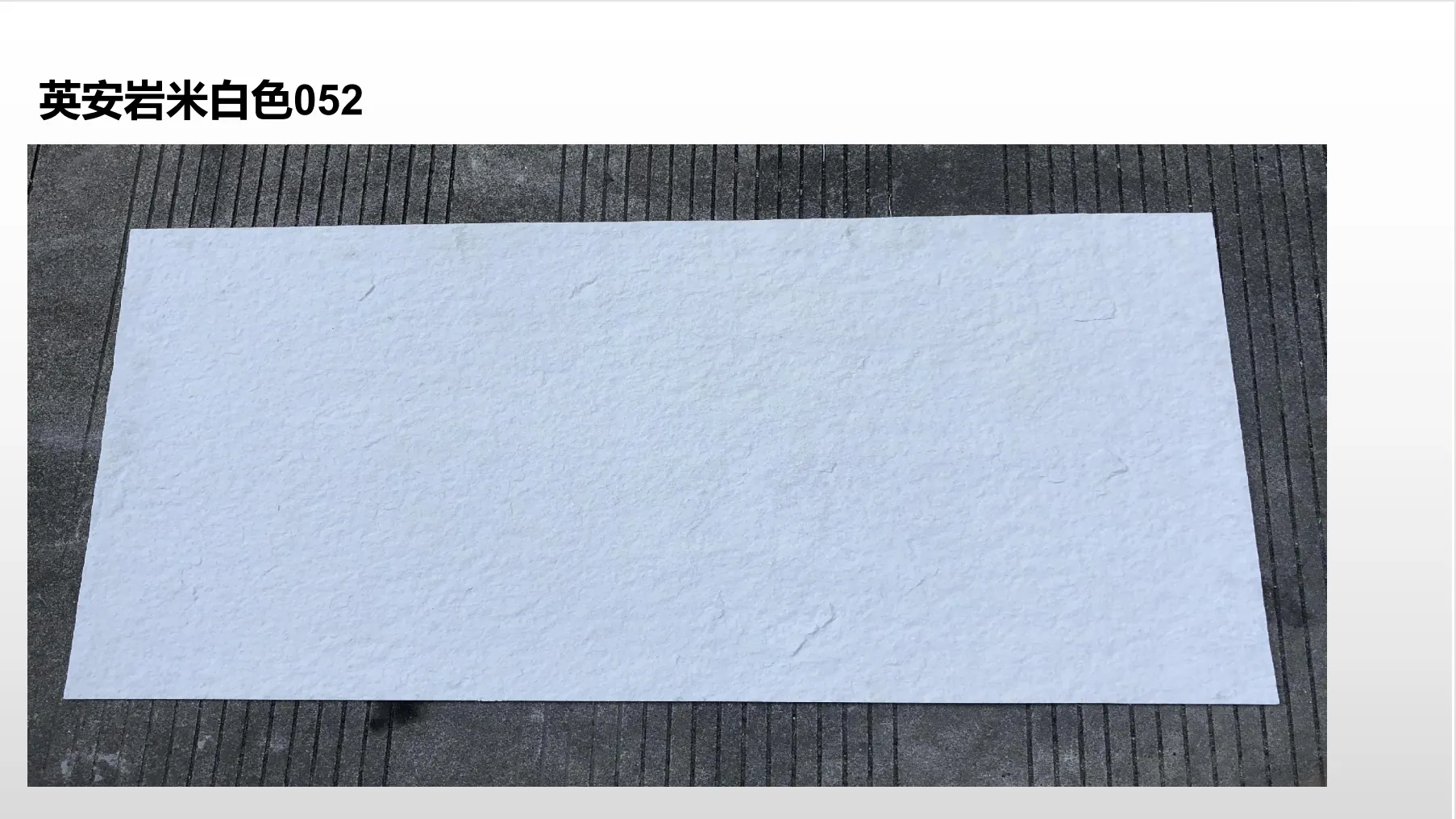
But Dacite isn't just about flexibility. It's about authenticity. Run your hand over a Dacite panel, and you'll feel the same granular texture as real travertine or slate. Look closely, and you'll spot the subtle variations in color and veining that make natural stone so charming—no two panels are identical. That's because it starts with real stone dust and fragments, mixed with binders that preserve the stone's natural character while adding tensile strength. It's the best of both worlds: the beauty of nature, the adaptability of modern engineering.
Take the "Starry Green" travertine finish, for example. With its deep, mossy hues and tiny, sparkly flecks that catch the light, it's designed to mimic the look of travertine quarried from ancient riverbeds. But unlike real travertine, which would shatter if you tried to bend it, Dacite's Starry Green can wrap around a curved wall, turning a flat surface into a landscape of texture and color. Or consider the "Lunar Peak Silvery" variant—cool, metallic, with a matte finish that evokes moonlight on stone. It's bold enough for a statement facade, yet flexible enough to follow the contours of a building's organic shape.
Dacite doesn't exist in a vacuum. It's part of a broader innovation: MCM flexible stone technology. MCM, or Modified Composite Material, is the secret sauce that gives Dacite its bendable superpowers. By combining natural stone particles with high-performance resins and fibers, manufacturers have created a material that's not just flexible, but also resistant to weather, fire, and impact. It won't fade in the sun, crack in freeze-thaw cycles, or warp in humidity—critical for exterior applications like curved facades or rooftop canopies.
But what really elevates Dacite is its pairing with the 3D printing series. Traditional stone cutting is limited by tools—you can carve a curve, but it's time-consuming, expensive, and often imprecise. 3D printing changes that. With MCM 3D printing, designers can digitize their curved designs, then print Dacite panels to exact specifications. Want a wall that undulates like a wave? 3D modeling software can map out the exact curvature, and the printer can layer the stone-polymer mix to match, ensuring every panel fits perfectly. It's like tailoring a suit for a building—precision meets creativity.
The 3D printing series also opens up new possibilities for customization. Need a panel with a specific pattern, like the "Wave Panel" or "Thread" texture? 3D printers can replicate intricate designs that would be impossible with traditional stone cutting. Imagine a curved lobby wall printed with a repeating "Gobi Panel" motif—evoking the ripples of desert sand—all in Dacite's warm, earthy tones. Or a residential balcony with "Bamboo Mat Board" finish, curved to mimic the organic shape of bamboo, but made from durable MCM stone. The 3D printing series turns "what if" into "what is."
| Feature | Traditional Stone (Marble/Granite) | MCM Dacite |
|---|---|---|
| Flexibility | Brittle; cracks under curvature > 10m radius | Can bend to radii as tight as 0.5m without damage |
| Weight (per sqm) | 20-30 kg | 6-8 kg |
| Installation Time | Slow; requires precise cutting and heavy lifting | Fast; lightweight panels can be installed with basic tools |
| Weather Resistance | Prone to fading, staining, and freeze-thaw damage | UV-resistant, waterproof, and freeze-thaw stable |
| Design Freedom | Limited to simple curves; complex shapes are cost-prohibitive | Unlimited; 3D printing enables custom curves and patterns |
Let's ground this in reality. What does Dacite look like in action? Take the "Riverside Arts Center" in Portland, Oregon—a building designed to celebrate the city's relationship with the Willamette River. The architect, inspired by the river's meandering path, wanted the facade to curve gently, like water flowing around a bend. Traditional stone was out of the question: the budget couldn't handle the cost of custom-cut marble, and the building's foundation couldn't support the weight. Enter Dacite's "Stream Limestone (Claybank)" finish—warm, earthy, with horizontal veining that mimics riverbed stone. The panels were 3D-printed to match the exact curvature of the design, installed in weeks (not months), and the result? A facade that looks like it's been shaped by water itself, softening the building's edges and making it feel part of the landscape.
Or consider the "Lunar Peak Observatory" in New Mexico, a stargazing center with a domed roof designed to blend into the desert sky. The dome's surface needed to curve smoothly, with a texture that reflected moonlight—hence the choice of Dacite's "Lunar Peak Black" finish, a deep, matte black with subtle silver undertones. Traditional concrete domes would have been heavy and prone to cracking; Dacite panels, lightweight and flexible, were installed in sections, each following the dome's curve precisely. Today, visitors stand beneath the dome and feel as if they're under a night sky made of stone—dark, vast, and full of wonder.
Even smaller projects benefit. A boutique hotel in Bali used Dacite's "Bali Stone" finish on its curved lobby walls, aiming to evoke the island's lush, organic landscapes. The panels, printed with a 3D "Wood Line" texture, curve around the reception desk, creating a cocoon-like space that feels both grand and intimate. Guests often comment on how the walls "feel alive"—a far cry from the cold, flat concrete of most hotels. That's the power of flexible stone: it doesn't just cover a surface; it transforms it into an experience.
Flexibility and aesthetics are the headline acts, but Dacite has more to offer. Let's talk about sustainability. Traditional stone quarrying is resource-intensive—bulldozers, dynamite, massive amounts of water. Dacite, by contrast, uses stone waste from existing quarries (dust, fragments that would otherwise be discarded) mixed with recycled polymers. It's a way to give new life to "waste" stone, reducing the environmental impact of building materials. Plus, its lightweight nature means less fuel is needed for transportation, and installation requires fewer workers and less heavy machinery—lowering the project's carbon footprint even more.
Then there's durability. Dacite isn't just bendable; it's tough. It's fire-resistant (rated Class A in most regions), water-resistant (no need for sealants that wear off over time), and scratch-resistant (important for high-traffic areas like lobbies or retail spaces). In coastal areas, where saltwater and humidity can corrode metal and degrade stone, Dacite holds up—its polymer binders act as a barrier against moisture. A hotel in Miami used Dacite's "Rusty Red" finish on its curved poolside walls; five years later, the color is as vibrant as day one, with no signs of salt damage.
Cost is another win. While Dacite panels may cost slightly more upfront than standard concrete, the savings add up quickly. Installation is faster (fewer workers, less time), so labor costs drop. The lightweight panels reduce structural requirements—no need for reinforced steel beams to support heavy stone, cutting down on foundation and framing costs. And because it's low-maintenance (no sealing, no repainting), long-term upkeep expenses are minimal. One study by a European architecture firm found that using Dacite on a curved facade reduced the total project cost by 15% compared to traditional marble, thanks to these savings.
As 3D printing technology advances, the possibilities for Dacite and MCM flexible stone are only growing. Imagine 3D printers that can print entire curved walls on-site, layer by layer, eliminating the need for transportation and storage of panels. Or AI-driven design tools that can generate curved patterns based on environmental data—like a facade that curves to maximize natural light in winter, printed in Dacite's "Golden Sunset" finish to reflect warmth into the building. The line between design and construction is blurring, and flexible stone is at the center of it.
There's also the rise of "tactile architecture"—spaces designed not just to look good, but to feel good. Curved surfaces, with their gentle transitions, are inherently tactile; they invite touch, exploration, and connection. Dacite amplifies this with its natural texture. A child running their hand along a curved Dacite wall in a playground, feeling the rough-hewn surface, or a senior resting against a curved bench made of Dacite's "Zen Wood Panel"—these moments turn buildings into memories. In a world dominated by screens and virtual interactions, the physicality of flexible stone matters.
Of course, no innovation is without challenges. Some architects worry that flexible stone might feel "less authentic" than real stone. But as projects like the Riverside Arts Center show, Dacite's natural aggregates and textures are indistinguishable from the real thing to the untrained eye. Others question its long-term performance, but accelerated aging tests—exposing panels to extreme heat, cold, and moisture for years—show Dacite holds up as well as, if not better than, traditional stone. It's not a replacement for stone; it's an evolution.
At the end of the day, architecture is about people. We build spaces to live, work, create, and connect—and curves, with their softness and flow, make those spaces feel more human. For too long, the materials we used held us back, forcing us to choose between beauty and practicality. Dacite, and the MCM flexible stone technology behind it, changes that. It's a material that speaks the language of curves fluently, letting architects design buildings that don't just stand—they move, breathe, and connect.
Whether it's a museum facade that curves like a wave, a home with walls that wrap around its inhabitants, or a public square with benches shaped to encourage conversation, Dacite is more than a building material. It's a tool for storytelling. It lets us build spaces that reflect the complexity and beauty of the human experience—spaces that don't just look good, but feel good. And in a world that often feels rigid and divided, that's a powerful thing.
So the next time you walk past a building with a curved facade, take a closer look. If it feels warm, textured, and somehow alive, chances are it's Dacite. And if not? Maybe it will be soon. Because when it comes to the future of architecture, the curve is calling—and flexible stone is answering.
Recommend Products












