
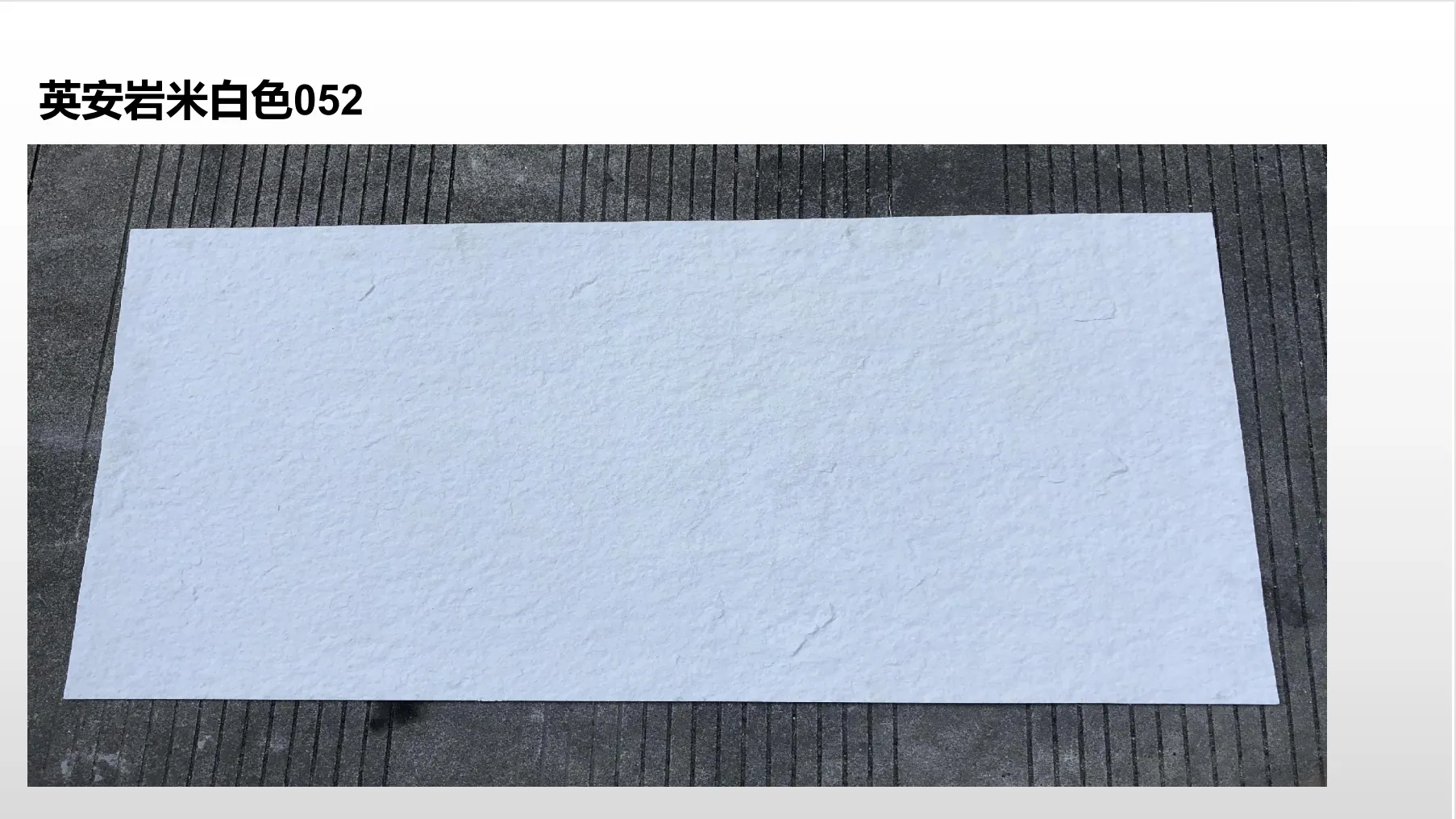
Picture this: You're standing in a sunlit room, your hand brushing over a wall cladded in what looks like weathered travertine—veins of cream and gold weaving through the surface, as if it was pulled straight from a Roman ruin. It feels solid, timeless, *real*. But what if I told you that "realness" might come with a hidden price tag? One that carves scars into mountains, pumps carbon into the air, and leaves ecosystems struggling to recover? For decades, natural stone has been the gold standard for designers chasing that "authentic" aesthetic. But as we grow more conscious of our planet's limits, that standard is starting to feel like a heavy burden.
Enter MCM—short for Modified Composite Material—a category of building materials that's quietly revolutionizing how we think about design and sustainability. It's not just about mimicking the look of natural stone (though it does that stunningly well); it's about reimagining what materials can be: lighter, more flexible, and far gentler on the earth. Today, we're diving into how MCM is rewriting the rulebook, with a spotlight on some of its most captivating offerings—from the celestial shimmer of travertine (starry green) to the soft serenity of rammed earth board (matcha green) —and why choosing them might be one of the most beautiful decisions you make for both your space and the planet.
Let's start with the basics: Natural stone—marble, granite, travertine—isn't just "dug up." Mining it is an industrial process, and its environmental toll is staggering. First, there's the extraction: massive quarries carve into landscapes, displacing wildlife, deforesting areas, and altering water tables. In some regions, illegal mining even leads to soil erosion and landslides, leaving communities vulnerable. Then there's transportation: a slab of marble from Italy to New York, or granite from Brazil to Dubai, racks up thousands of miles on cargo ships and trucks, belching CO2 all the way. By the time that "authentic" stone reaches your home or office, its carbon footprint is already sky-high.
And that's before we talk about waste. Quarrying is inefficient—for every ton of usable stone, up to 5 tons of waste rock is discarded, often dumped into nearby rivers or landfills. Cutting and shaping the stone adds more: water used in processing can pollute local ecosystems with chemicals, and offcuts often end up unused. Even durability, stone's biggest selling point, has a catch: heavy slabs require reinforced structures to support them, meaning more concrete, more steel, and more emissions in the building process itself.
For designers and homeowners who care about both beauty and the planet, this creates a painful dilemma: Do you sacrifice aesthetics for sustainability, or vice versa? MCM answers with a resounding "neither."
MCM isn't a single material; it's a family of composites engineered to capture the essence of natural elements while cutting out the environmental harm. Think of it as nature, reimagined with a conscience. At its core, MCM blends recycled minerals, plant-based fibers, and eco-friendly resins, bound together using advanced manufacturing techniques—like 3D printing—that minimize waste. The result? Panels that are 70% lighter than natural stone, infinitely customizable, and designed to last just as long (if not longer), without the need for destructive mining.
What truly sets MCM apart, though, is its soul. These aren't cold, synthetic imitations. Take the MCM flexible stone line, for example: it bends. Yes, bends. That means it can wrap around curved walls, archways, even furniture, turning rigid spaces into flowing, organic environments—something natural stone (which cracks under pressure) could never do. Or the MCM 3D printing series , which uses digital precision to create textures that mimic everything from rough-hewn cliff faces to delicate wood grains, all without a single tree felled or mountain drilled. It's innovation with intention: making beauty accessible *and* responsible.
But don't just take my word for it. Let's get up close with some of MCM's most enchanting creations—materials that don't just decorate spaces, but *tell stories* about our relationship with the earth.
If you've ever looked up at the night sky and wished you could bottle its magic, travertine (starry green) comes close. This MCM panel captures the classic pitted texture of natural travertine, but with a twist: tiny, iridescent flecks embedded in its surface that catch the light like distant stars. Run your hand over it, and you'll feel the subtle roughness of the stone—cool, tactile, *alive*—but unlike natural travertine, it didn't require dynamite to extract or a cargo ship to transport. Its green base, swirled with hints of teal and silver, evokes forest floors after rain, making it perfect for spaces where you want to bring the outdoors in without the environmental guilt.
Rammed earth has been used for centuries—think ancient Chinese fortresses or African mud-brick homes—for its warmth and durability. But traditional rammed earth is heavy, labor-intensive, and limited to certain climates. Rammed earth board (matcha green) reimagines it as a lightweight panel that's easy to install anywhere. Its soft, muted green hue (reminiscent of frothy matcha tea) is achieved using natural pigments, and its texture mimics the subtle layering of hand-packed earth, with tiny variations that make every panel unique. It's calm, grounding, and surprisingly versatile—use it in a minimalist bedroom for a spa-like vibe, or in a bustling café to add a touch of rustic charm without the carbon cost of importing real rammed earth blocks.
For spaces that crave a sleek, modern edge, foamed aluminium alloy board (vintage silver) is a revelation. Made by infusing aluminium with tiny air bubbles during manufacturing, it's feather-light (you could hang a panel with just a few screws) but incredibly strong. Its vintage silver finish has a soft, brushed texture that warms up industrial spaces, avoiding the coldness of raw metal. Imagine it in a loft apartment, paired with exposed brick and wooden beams—the contrast of old and new, raw and refined—all without the environmental impact of mining bauxite (the ore used to make aluminium) or the energy-heavy smelting process of traditional aluminium. It's proof that "industrial" doesn't have to mean "unsustainable."
Let's circle back to MCM flexible stone , because it deserves a moment in the spotlight. This isn't just a material—it's a design superpower. Imagine a fireplace with a curved surround, clad in stone that flows seamlessly from floor to ceiling, no gaps, no awkward joints. Or a retail display where the walls curve and dip, guiding customers through the space like a gentle river. Natural stone would shatter under the stress of that curvature, but MCM flexible stone bends up to 90 degrees without cracking. It's available in dozens of finishes, from the rough texture of rust square line stone to the smooth elegance of polish concrete , making it a chameleon for any aesthetic. And because it's so light, it reduces the need for structural reinforcement, cutting down on the carbon footprint of the building itself.
Last but never least, rammed earth board (gradient C) is for the dreamers—the ones who want their walls to tell a story of color. This panel fades from soft terracotta at the bottom to warm sand at the top, mimicking the way sunlight bleaches desert landscapes over time. It's a gradient so smooth, so natural, you'd swear it was painted by hand (but it's actually achieved through precision layering during manufacturing, with zero toxic paints). Run your eyes across it, and you'll feel a sense of calm, like watching a sunset. It's a reminder that sustainability doesn't mean boring—if anything, it unlocks *more* creativity, because you're not limited by what nature "naturally" provides. You can have the desert, the forest, the night sky—all without taking a single shovelful of earth from any of them.
Still on the fence? Let's break it down. The table below compares MCM (using the foamed aluminium alloy board (vintage silver) and travertine (starry green) as examples) with their natural stone counterparts. The differences are striking, and they go beyond just "being green"—they're about building a future where beauty and responsibility walk hand in hand.
| Category | MCM (e.g., Foamed Aluminium Alloy / Starry Green Travertine) | Natural Stone (e.g., Aluminium Ore / Natural Travertine) |
|---|---|---|
| Carbon Footprint (per sq.m panel) | ~2.3 kg CO2 (low-energy manufacturing + local production) | ~15 kg CO2 (mining + transportation + processing) |
| Resource Usage | 70% recycled materials; no mining required | 100% virgin materials; requires quarrying/drilling |
| Waste Generated | <5% waste during production (recyclable) | ~60% waste (quarry offcuts, transportation damage) |
| Installation Impact | Lightweight (5-8 kg/sq.m); no need for reinforced structures | Heavy (25-30 kg/sq.m); requires steel supports/concrete |
| Durability | 50+ year lifespan; resistant to cracks, moisture, and fading | 50+ year lifespan but prone to chipping; requires sealing |
The numbers speak for themselves: MCM cuts carbon emissions by over 80%, slashes waste by 90%, and eliminates the need for destructive mining. And yet, it doesn't compromise on what matters most—how it makes you feel. When you touch rammed earth board (matcha green) , you feel the same warmth as real rammed earth. When you look at travertine (starry green) , you see the same depth as natural stone. The only difference? You can feel good about where it came from.
At the end of the day, the materials we choose for our homes, offices, and public spaces aren't just about aesthetics—they're about identity. They say something about what we care about. Do we value "tradition" at the expense of the planet? Or do we choose to honor the future by reimagining the past? MCM isn't just a "sustainable alternative"—it's a new tradition, one where innovation and respect for nature go hand in hand.
Imagine walking into a café clad in weaving (khaki) MCM panels, their texture mimicking handwoven textiles, knowing no cotton fields were watered to make them. Or stepping into a hotel lobby with lunar peak silvery walls, shimmering like moonlight, and realizing no mountains were mined to get that glow. These spaces don't just look beautiful—they *feel* meaningful. They tell a story of progress, of choosing to do better, of believing that we can have both the world we want and the world we need.
And that's the real magic of MCM: it doesn't ask us to choose between beauty and sustainability. It shows us that they're the same thing. When you select travertine (starry green) for your living room wall, you're not just picking a pretty panel—you're casting a vote for a future where mountains stay whole, forests stay standing, and the night sky stays clear enough for the real stars to shine. And isn't that the most beautiful view of all?
As designers, homeowners, and creators, we have the power to shape the world—one wall, one floor, one space at a time. For too long, we've been told that "the best" materials come with a hidden cost to the planet. MCM is here to rewrite that narrative. It's proof that we can have the warmth of natural stone, the elegance of metal, the softness of wood—all without taking more than we give back.
So the next time you're dreaming up a space, ask yourself: What story do I want my walls to tell? If the answer is one of beauty, creativity, and care for the earth, then MCM isn't just an option—it's the beginning of something extraordinary. From the celestial sparkle of travertine (starry green) to the earthy calm of rammed earth board (matcha green) , these materials aren't just building blocks—they're bridges to a future where design and sustainability dance together, seamlessly, beautifully, and unapologetically.
And isn't that the kind of future we all want to live in?
Recommend Products












