
In the world of architecture, curves are more than just a design choice—they're a statement. From the sweeping arcs of modern art galleries to the soft bends of boutique storefronts, curved facades have become a hallmark of innovative, human-centric spaces. But behind every stunning curved wall lies a critical question: what material can bend without breaking? Today, we're diving into two contenders that often top the list for architects and designers: Dolomitic Travertine, a natural stone with timeless appeal, and MCM Flexible Stone, a cutting-edge man-made material engineered for adaptability. Let's explore how they stack up when flexibility, functionality, and beauty collide.
Before we jump into the materials themselves, let's talk about why flexibility matters. Curved facades aren't just aesthetic—they serve practical purposes too. A gently curved wall can redirect wind flow, reduce noise pollution, or create a more inviting entrance by softening sharp angles. But to achieve these benefits, the material used must be able to conform to non-linear shapes without compromising structural integrity. Imagine a 50-foot-tall curved facade for a community library; if the material cracks under the stress of bending, the result isn't just an eyesore—it's a safety risk. Flexibility, in this context, isn't just about "bendability"—it's about balance: the ability to curve while maintaining strength, durability, and visual consistency.
For decades, natural stones like marble and granite dominated high-end architecture, but their rigidity made them poor fits for curves. Then came innovations like MCM (Modified Composite Material) Flexible Stone, which promised the look of stone with the flexibility of a sheet material. Meanwhile, Dolomitic Travertine, a variation of the classic travertine stone, emerged as a natural alternative with slightly more give than traditional stones. So, which one truly delivers when the design calls for curves?
Let's start with the natural contender: Dolomitic Travertine. Travertine itself is a type of limestone formed by mineral-rich water flowing through hot springs, leaving behind layers of calcium carbonate. Dolomitic Travertine, however, has a twist—it contains dolomite, a mineral that adds a touch of magnesium to the mix. This subtle difference gives it a slightly harder, denser structure than standard travertine, while retaining the stone's signature porous surface and warm, earthy tones (think claybank or dark grey, as seen in variants like Dolomitic Travertine (claybank) or Dolomitic Travertine (dark grey)).
Mined primarily in regions like Italy, Turkey, and Iran, Dolomitic Travertine carries the allure of natural stone: each slab is unique, with organic veining, pits, and color variations that tell a story of millions of years of geological activity. Architects often gravitate toward it for projects aiming for a "timeless" or "earthy" vibe—think luxury resorts, heritage buildings, or cultural centers where the goal is to blend with nature.
But here's the catch: natural stone, by its very nature, is rigid. While Dolomitic Travertine is slightly more flexible than, say, granite, it's still a product of the earth's crust—formed under pressure, not designed for bending. So, can it handle curves? Let's just say it comes with caveats.
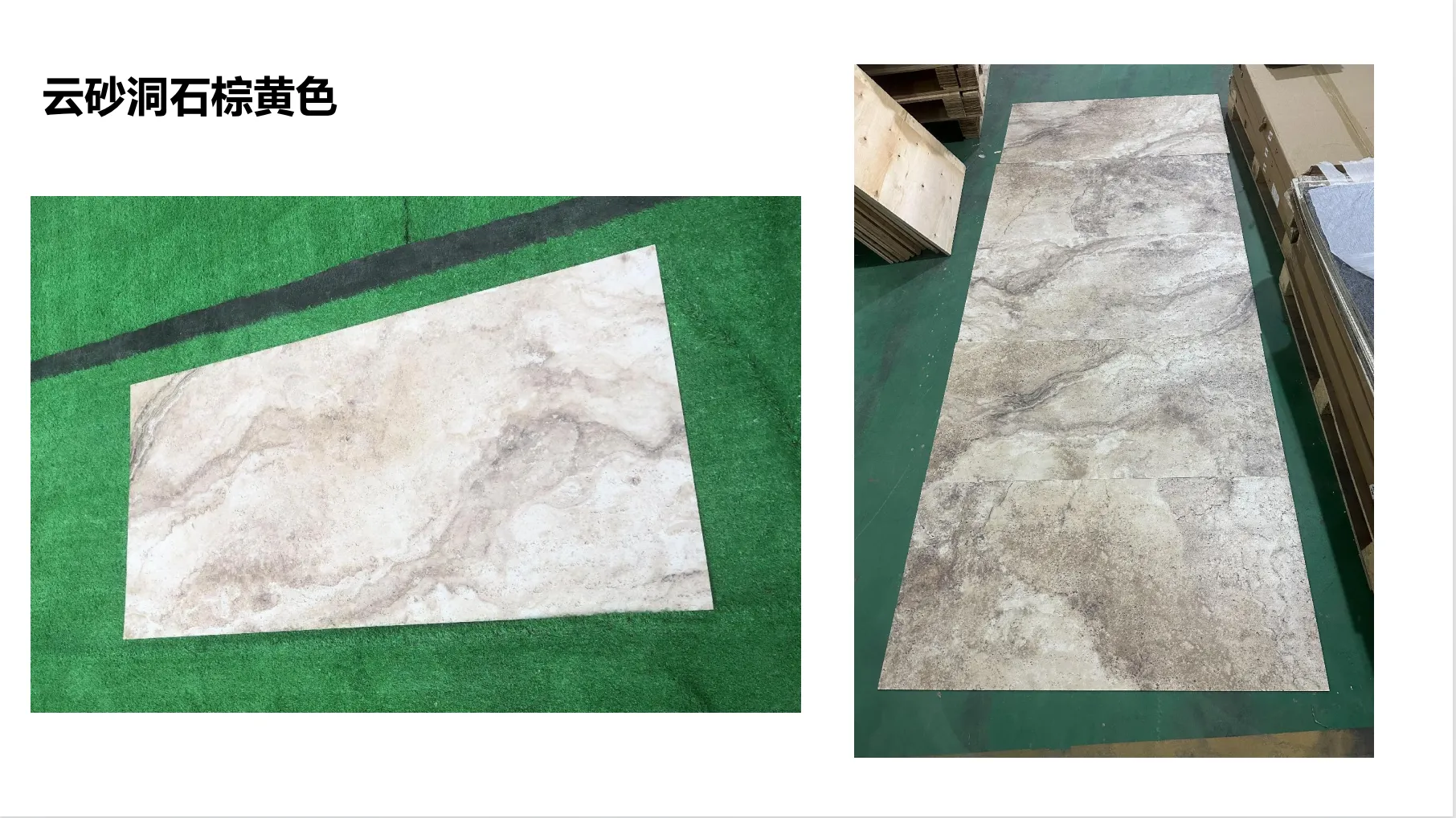
Now, let's shift to the modern challenger: MCM Flexible Stone. MCM, short for Modified Composite Material, is a category of engineered cladding that combines natural stone particles with a polymer resin binder, creating thin, lightweight sheets that mimic the look of natural stone. Unlike Dolomitic Travertine, MCM Flexible Stone isn't mined—it's manufactured, which means its properties can be fine-tuned for specific needs. Companies like those behind the MCM Big Slab Board Series have perfected the art of balancing stone-like aesthetics with industrial-grade flexibility.
The magic of MCM lies in its composition. By grinding natural stone into fine particles and embedding them in a flexible resin matrix, manufacturers can create panels as thin as 3-5mm—about the thickness of a credit card—while still retaining the texture and color of natural stone. This thinness is key to its flexibility: a typical MCM panel can bend to a radius as tight as 30cm (about 12 inches) without cracking, depending on the product line. Compare that to a slab of Dolomitic Travertine, which might shatter if bent even a few degrees.
MCM Flexible Stone also comes in a dizzying array of styles, from the rustic charm of Travertine (Starry Blue) to the sleek modernity of Foamed Aluminium Alloy Board (Vintage Silver). This versatility makes it a favorite for projects where the design demands both curve appeal and customization—like a tech startup's headquarters wanting a futuristic, curved facade that still feels "natural."
To really understand how these materials perform in curved applications, let's break down their flexibility characteristics side by side. The table below compares key factors architects and contractors care about when designing for curves:
| Feature | Dolomitic Travertine | MCM Flexible Stone |
|---|---|---|
| Material Type | Natural stone (calcium carbonate + dolomite) | Engineered composite (stone particles + polymer resin) |
| Typical Thickness | 20-30mm (for cladding) | 3-8mm (varies by product line) |
| Maximum Bend Radius* | 5m+ (very limited; often requires custom cutting for shallow curves) | 30cm-1m (tight radii possible with thin panels) |
| Weight per m² | 40-60kg (heavy; requires robust structural support) | 6-12kg (lightweight; reduces load on frames) |
| Installation for Curves | Requires specialized cutting (water jet or diamond saw) to fit curves; high risk of breakage during cutting | Can be bent on-site with minimal tools; panels conform to curves without cutting |
| Consistency in Curves | Natural variation may cause unevenness in curved lines | Uniform thickness and flexibility ensure smooth, consistent curves |
| Risk of Cracking Under Bending | High (natural fractures in stone can propagate under stress) | Low (resin binder distributes stress evenly across the panel) |
*Bend radius = the smallest circle a material can curve around without damage. Smaller radius = tighter curve.
Let's zoom in on that "maximum bend radius" number. For a gentle, sweeping curve—say, a facade with a 10-meter radius (think the curve of a large semicircle)—Dolomitic Travertine might just work, but it's a gamble. Each slab is unique, and a hidden fracture or a particularly dense section could crack when pressure is applied. MCM Flexible Stone, on the other hand, laughs at tight radii. Take the MCM 3D Printing Series, for example: some panels in this line can bend to a 30cm radius, making them perfect for spiral staircases, rounded columns, or even curved ceilings.
Consider a hypothetical project: a boutique hotel in Bali wanting a curved lobby wall that mimics the shape of ocean waves. The design calls for a 1.5-meter bend radius to create those rolling, organic curves. Dolomitic Travertine would require each stone slab to be custom-cut into wedge shapes, like pieces of a puzzle, to approximate the curve. Not only is this labor-intensive, but the joins between slabs would create visible seams, breaking the illusion of a smooth wave. MCM Flexible Stone, by contrast, could be rolled out over the curved frame, with panels overlapping slightly to create a seamless, wave-like surface—no cutting, no seams, no stress.
Flexibility isn't the only player in the game, of course. A material that bends beautifully but falls apart in the rain isn't worth much. Let's talk about how these two stack up in real-world conditions.
Natural stone is famous for durability—think of ancient Roman structures built with travertine that still stand today. Dolomitic Travertine, with its dolomite content, is slightly more resistant to weathering than standard travertine. It holds up well against rain, snow, and UV rays, and its porous surface can be sealed to prevent staining (though sealing needs reapplication every 3-5 years). However, its rigidity becomes a liability in seismic zones or areas with extreme temperature fluctuations. A sudden freeze-thaw cycle can cause cracks in natural stone, and in a curved application, those cracks could spread quickly due to the stress of the bend.
MCM Flexible Stone might be man-made, but it's no lightweight when it comes to durability. The polymer resin binder makes it resistant to water absorption, so it won't crack in freezing temperatures. It's also UV-stable, meaning colors won't fade in harsh sunlight—important for facades that face south or west. Some product lines, like the MCM Big Slab Board Series, even include fire-retardant additives, making them suitable for high-rise buildings. The tradeoff? While MCM is tough, it's not indestructible. Sharp impacts (like a stray rock from a lawnmower) can chip the surface, though repairs are easier than with natural stone—just sand down the chip and apply a color-matched sealant.
Even the most flexible material won't shine if installing it is a nightmare. Let's talk logistics. Dolomitic Travertine, being heavy and rigid, requires a team of experienced stone masons. Each slab must be carefully measured, cut (often with water jets for precision), and secured with mechanical anchors or mortar. For curved facades, this process becomes exponentially more complex. Shallow curves might be possible by cutting the stone into wedge-shaped pieces, but each piece must align perfectly to avoid gaps. Deep curves? Often impossible without custom-carving, which adds weeks to the timeline and thousands to the budget.
MCM Flexible Stone, by contrast, is a contractor's dream for curves. Its lightweight nature means it can be installed by a smaller crew—no need for heavy lifting equipment. Panels come in large sheets (some up to 1.2m x 2.4m), reducing the number of seams. For curved surfaces, installers can use a heat gun to gently warm the panels, making them even more pliable for tight radii. The adhesive backing (common in many MCM products) allows for quick bonding to metal or wooden frames, cutting installation time by 30-50% compared to natural stone. For a project on a tight deadline—say, a retail store opening before the holiday season—this speed can be a game-changer.
Let's get down to brass tacks: cost. Dolomitic Travertine is a premium natural stone, so it comes with a premium price tag. Material costs alone range from $80-$150 per m², and that's before installation. Add in custom cutting for curves, specialized labor, and structural reinforcements (to support the weight), and you're looking at $150-$250 per m² total. For large projects, this can quickly escalate into six figures.
MCM Flexible Stone is generally more budget-friendly upfront, with material costs of $40-$80 per m². Installation is cheaper too, thanks to faster labor and lighter structural requirements, bringing total costs to $80-$120 per m². Over time, MCM also saves money on maintenance—no sealing, fewer repairs, and lower replacement costs if damage occurs. For schools, hospitals, or affordable housing projects where budget is a priority, MCM often wins out. That said, some clients are willing to pay a premium for the "authenticity" of natural stone, viewing it as a long-term investment in property value.
At the end of the day, the choice between Dolomitic Travertine and MCM Flexible Stone depends on your project's priorities. If you're designing a luxury villa in Tuscany, where the goal is to blend with the natural landscape and evoke timeless elegance, Dolomitic Travertine's unique veining and organic texture might be worth the extra cost and effort—just keep curves shallow and structural support robust. But if you're building a cutting-edge cultural center with sweeping, 360-degree curved walls, or a commercial complex in a busy urban area where speed and durability matter, MCM Flexible Stone is the clear front-runner. Its flexibility, lightweight design, and low-maintenance profile make it the material of choice for architects who refuse to choose between form and function.
Curved architecture is about pushing boundaries, and the materials we use should push boundaries too. Whether you lean into the natural beauty of Dolomitic Travertine or the engineered ingenuity of MCM Flexible Stone, the most important thing is to choose a material that bends with your vision—not against it. After all, the best curved facades don't just look good—they feel like they were always meant to be there.
Recommend Products












