

Close your eyes and picture a luxury villa in Bali. What do you see? Perhaps it's the tranquil infinity pool, lined with a cool, greenish stone that shimmers under the tropical sun. Or maybe it's the serene spa-like bathroom, where walls of dark, textured volcanic rock create an atmosphere of earthy calm. This is the magic of Bali stone—a material that instantly transports us to a world of natural beauty and peaceful luxury. For decades, architects and designers have sought to capture this essence, using authentic Balinese stone to imbue their projects with a sense of organic sophistication.
But there's a side to this story we don't often see. The journey of that heavy, beautiful stone from a quarry in Indonesia to a wall in a different part of the world is fraught with environmental and logistical challenges. The reality of quarrying, the immense carbon footprint of transportation, and the difficulties of installation present a significant dilemma in an age where sustainability is no longer a choice, but a necessity. How can we achieve the breathtaking aesthetic of natural stone without compromising the health of our planet? The answer lies not in imitation, but in innovation. It's time to explore a new generation of building materials that offer the best of both worlds: stunning natural beauty and true environmental responsibility.
The appeal of natural stone is primal. Whether it's the cool smoothness of marble, the rugged texture of slate, or the porous charm of travertine, these materials connect us to the earth. Bali stone, which often refers to types like Green Sukabumi stone (a quartzite) or Black Lavastone (a form of andesite), is particularly coveted for its unique colors and textures that evoke a tropical paradise. Green Sukabumi is famous for its emerald hue that deepens in water, making it a favorite for high-end swimming pools. Black Lavastone, with its porous and naturally rough surface, is used for feature walls and pathways, grounding a space with its raw, powerful presence.
However, our love for this natural beauty comes at a price. The process of extracting stone from the earth is an invasive one. Quarrying can lead to:
The environmental impact doesn't end at the quarry. Stone is incredibly heavy. Transporting it across continents via cargo ships, trains, and trucks generates a colossal carbon footprint. Once on-site, installation is a labor-intensive and costly process, requiring specialized equipment to lift and place the heavy slabs, and skilled masons to cut and fit them. All of these factors—environmental damage, logistical complexity, and high costs—have pushed the construction industry to seek a better way forward.
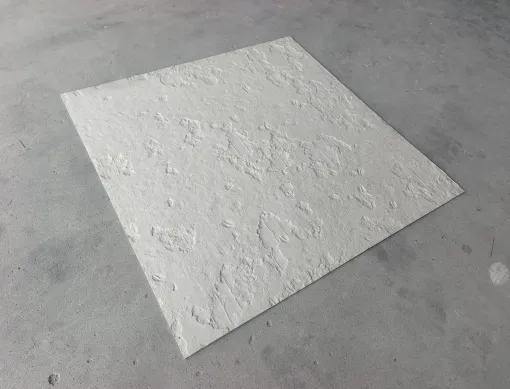
This is where visionary companies like COLORIA GROUP step in. With decades of experience in the global building materials market, COLORIA GROUP has established itself as a one-stop solution provider dedicated to pioneering the next wave of construction materials. Their focus isn't on creating cheap substitutes, but on engineering superior, sustainable alternatives that honor the aesthetic of natural materials while eliminating their drawbacks. The cornerstone of this revolution is a remarkable technology known as MCM, or Modified Cementitious Material.
So, what is MCM? Forget the synthetic plastics or resins of the past. Think of MCM as a form of "re-engineered earth." It is primarily composed of natural, widely available materials like soil, sand, and stone powder. Through a proprietary process, these raw materials are modified and then fired at a low temperature (around 120°C). This is a critical distinction. Traditional ceramics and porcelain tiles are fired at temperatures exceeding 1200°C, consuming enormous amounts of energy. The low-temperature production of MCM results in an energy saving of over 80%, drastically reducing its embodied carbon.
COLORIA GROUP's philosophy is simple: to provide high-quality, customizable, and green building solutions for a global clientele. By harnessing the power of MCM technology, they are making sustainable design accessible, practical, and beautiful.
Now, let's return to our Balinese villa. Imagine being able to create those stunning, natural-looking walls without a single piece of quarried rock. This is precisely what's possible with COLORIA GROUP's MCM Flexible Stone . This product line is a game-changer for architects and designers aiming to replicate the organic beauty of materials like Bali stone.
Through advanced digital texturing and coloration techniques, MCM Flexible Stone can flawlessly mimic the appearance and tactile feel of Green Sukabumi, Black Lavastone, and countless other natural stones. The surface isn't just a printed image; it has the authentic texture, the subtle color variations, and the natural imperfections that make stone so appealing. But the real magic lies in its physical properties.
From a feature wall in a living room to the entire facade of a commercial building, MCM Flexible Stone provides the timeless look of stone with the performance and sustainability credentials of a 21st-century material.
While the flexibility of MCM is perfect for intricate designs and capturing the feel of rustic stone, modern architecture often demands a different scale. Grand hotel lobbies, expansive corporate headquarters, and sleek residential towers call for large, seamless surfaces that convey a sense of monumentality and sophistication. This is where other products in COLORIA GROUP's MCM portfolio demonstrate their versatility.
For projects that require the dramatic impact of large-format stone or marble, the MCM Big Slab Board Series offers an unparalleled solution. Sourcing, transporting, and installing a single, massive slab of natural marble is an immense undertaking, both financially and logistically. These slabs are prone to cracking and require massive structural support. The MCM Big Slab Board Series delivers that same breathtaking, monolithic appearance in a lightweight, durable, and easy-to-install format. These large boards can be used to create stunning, nearly seamless feature walls that look and feel like they've been carved from a single block of stone, but without the environmental and practical burdens.
For large-scale commercial, residential, and institutional developments, consistency, cost-effectiveness, and reliable performance are paramount. The MCM Project Board Series is engineered specifically to meet these demands. When cladding an entire apartment complex or a sprawling business park, it's crucial that the material is uniform in color and quality from the first panel to the last—a consistency that can be difficult to achieve with natural stone, which varies from one batch to the next. The MCM Project Board Series guarantees this uniformity, while also providing all the inherent benefits of MCM technology: lightweight construction, weather resistance, and rapid installation. This makes it an ideal choice for large-scale projects across the globe, including in demanding markets like Saudi Arabia, where COLORIA GROUP has a strong presence and where durability against sun and sand is essential.
Together, these product lines showcase how COLORIA GROUP functions as a true one-stop solution provider. Whether a project requires the organic texture of flexible stone, the grandeur of large slabs, or the reliable consistency for a massive development, the underlying MCM technology provides a sustainable, high-performance answer.
To truly appreciate the revolutionary nature of MCM, it's helpful to see a direct comparison with the materials it's designed to replace. Let's break down the key differences between COLORIA GROUP's MCM products, natural stone, and traditional ceramic tiles.
| Feature | COLORIA GROUP MCM | Natural Stone (e.g., Marble, Granite) | Ceramic / Porcelain Tile |
|---|---|---|---|
| Raw Material | Modified soil, sand, stone powder (abundant, often recycled). | Quarried stone (finite, resource-intensive). | Clay, feldspar (quarried). |
| Carbon Footprint | Very low. Low-temperature firing (≈120°C) and lightweight transport. | Very high. Energy-intensive quarrying and heavy transport. | High. High-temperature firing (>1200°C). |
| Weight | Extremely light (approx. 4-8 kg/m²). | Extremely heavy (approx. 50-80 kg/m²). | Heavy (approx. 20-30 kg/m²). |
| Flexibility | High. Can be bent to fit curved surfaces. | None. Completely rigid and brittle. | None. Completely rigid and brittle. |
| Installation | Fast and easy. Cut with a knife, applied with adhesive. Low labor cost. | Slow and difficult. Requires heavy machinery and skilled masons. High labor cost. | Moderate. Requires wet saws and skilled tilers. |
| Application | Interior/exterior walls, ceilings, columns, curved surfaces. | Primarily flat walls and floors. Limited on curved surfaces. | Primarily flat walls and floors. |
| Customization | Highly customizable in color, texture, and shape. Capable of digital printing. | Limited to what is available in the quarry. | Limited customization, primarily surface glazes. |
This table makes the advantages clear. MCM isn't just a minor improvement; it represents a fundamental shift in how we think about cladding materials. It is a holistic solution that addresses aesthetics, performance, cost, and environmental impact simultaneously.
Perhaps the most exciting aspect of COLORIA GROUP's MCM technology is its capacity for customization. We are moving away from a one-size-fits-all approach to design and into an era of personalization. Architects and designers no longer have to be limited by the constraints of a quarry or the standard offerings of a tile catalog.
With MCM, it's possible to create completely bespoke materials. Need a stone finish that's a slightly different shade to match a corporate color? It can be done. Want to embed a subtle pattern or logo into a wall texture? Possible. The technology even extends to advanced applications like the MCM 3D Printing Series, where intricate, three-dimensional patterns can be created, adding depth and shadow play to a facade. This empowers designers to be true creators, not just selectors. They can dream up a unique surface and, with COLORIA GROUP, bring that exact vision to life.
This level of customization means that every project can have its own unique identity, perfectly tailored to its environment and purpose, while still being rooted in the principles of sustainable construction.
The allure of a Bali stone wall is undeniable. It speaks of nature, luxury, and tranquility. For too long, achieving this look came with a heavy environmental price tag. But as we have seen, innovation has provided a powerful new path forward. You no longer have to choose between a beautiful aesthetic and a responsible building practice.
COLORIA GROUP, through its pioneering work with Modified Cementitious Material (MCM), has successfully decoupled beauty from destruction. Their product lines, from the versatile MCM Flexible Stone to the grand MCM Big Slab Board Series and the efficient MCM Project Board Series , offer a complete toolkit for the modern, eco-conscious designer and builder. These materials deliver the stunning look of natural stone and other premium finishes while offering superior performance, reduced costs, and a genuinely minimal environmental footprint.
The future of architecture and construction will be defined by our ability to build beautifully, efficiently, and sustainably. It will be shaped by materials that are smarter, lighter, and kinder to our planet. By embracing solutions like those offered by COLORIA GROUP, we can continue to create inspiring spaces that evoke the timeless beauty of the natural world, while ensuring that world remains healthy and vibrant for generations to come.
Recommend Products












