
Building a Greener Tomorrow, One Stone at a Time
In a world where the phrase "sustainable living" has shifted from a buzzword to a urgent necessity, the construction industry stands at a crossroads. For decades, building beautiful, functional spaces often came with a hidden cost: a heavy carbon footprint, from quarrying raw materials to transporting bulky stones and concrete. But what if we told you there's a way to craft buildings that breathe—spaces that honor both human creativity and the planet's limits? Enter MCM's innovative product lines, where sustainability isn't an afterthought, but the very foundation of design. Today, we're diving into how materials like Starmoon Stone , MCM flexible stone , and rammed earth board (gradient) are redefining eco-friendly construction, one project at a time.
Let's start with the basics: traditional building materials—think quarried marble, solid concrete, or heavy stone slabs—are resource-intensive by nature. Quarrying limestone, for example, involves massive machinery that burns fossil fuels, disrupts local ecosystems, and leaves behind scars on the landscape. Transporting these materials? A single truck carrying a load of traditional stone can emit over 200kg of CO₂ per 100km. Once on-site, installation often requires heavy labor and specialized equipment, adding to the project's carbon tally. And durability? Many traditional materials crack under weather stress, leading to frequent replacements and more waste.
| Material | Carbon Footprint (kg CO₂/m²) | Weight (kg/m²) | Lifespan (Years) |
|---|---|---|---|
| Quarried Marble | 18–22 | 20–25 | 30–40 |
| Solid Concrete | 12–15 | 24–28 | 50–60 |
| MCM Flexible Stone | 3–5 | 4–6 | 60–80 |
| Starmoon Stone | 2–4 | 3–5 | 70–90 |
The numbers speak for themselves. MCM's materials slash carbon emissions by up to 80% compared to traditional options, weigh 70–80% less (cutting transportation emissions drastically), and last longer—meaning fewer replacements and less waste over time. But sustainability isn't just about numbers; it's about creating spaces that feel alive, that connect us to nature without harming it. That's where MCM's product lines truly shine.
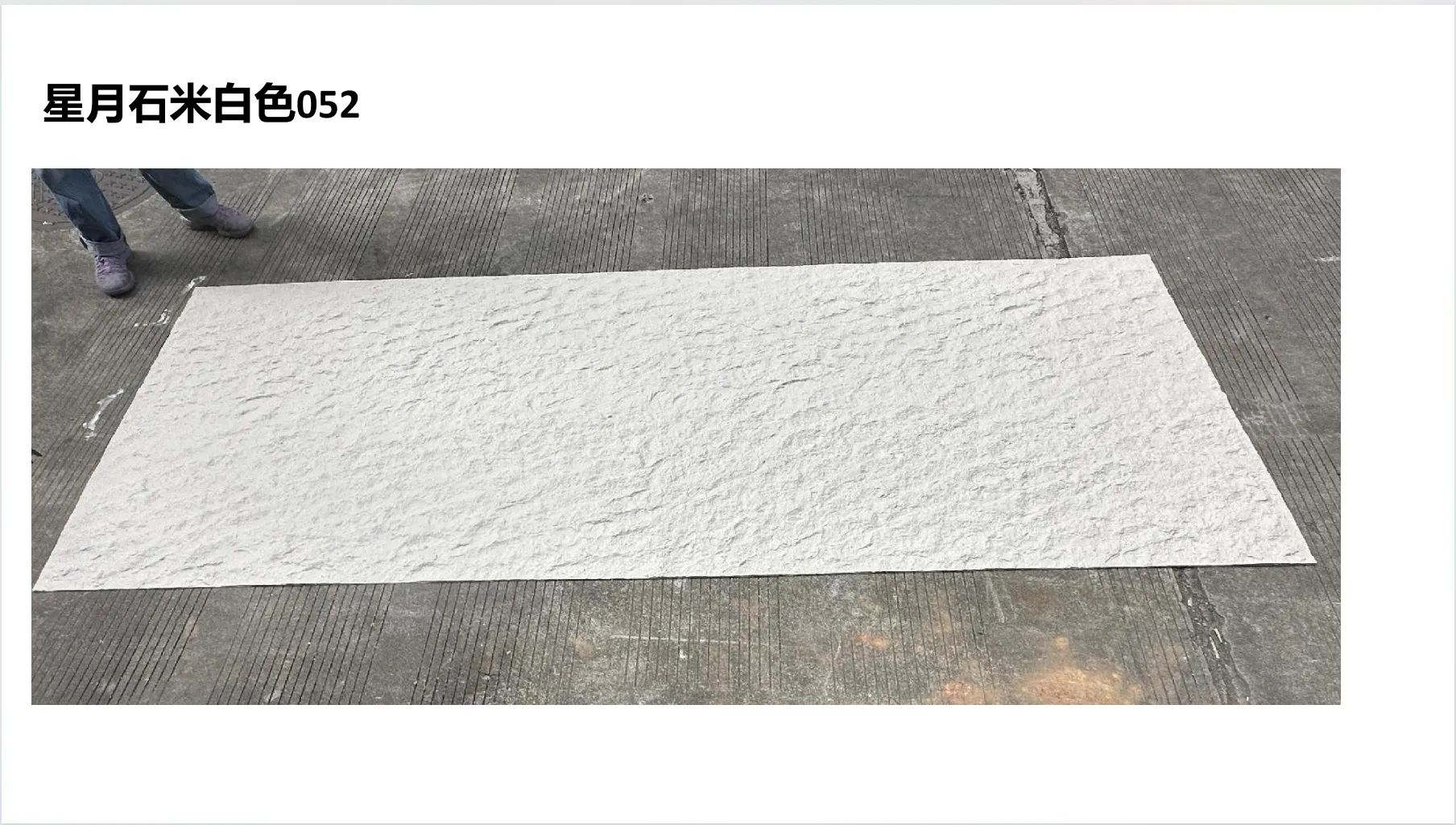
If eco-friendly construction had a "poster child," it might well be Starmoon Stone . More than just a building material, it's a testament to how innovation can turn sustainability into art. Crafted using a blend of recycled stone particles, natural binders, and low-energy manufacturing processes, Starmoon Stone captures the timeless elegance of natural stone with a fraction of the environmental impact. What sets it apart? Its unique surface patterns—swirls of silver, gold, and black that evoke the night sky—are achieved without toxic dyes or excessive water use. Instead, MCM's artisans use precision 3D printing (part of the MCM 3D printing series ) to layer materials, ensuring every slab is both beautiful and kind to the planet.
Take the lunar peak silvery variant, for instance. Its cool, metallic sheen mimics moonlight on water, making it a favorite for accent walls in homes and hotels. Unlike traditional metallic finishes, which often rely on plastic coatings or harmful chemicals, lunar peak silvery gets its luster from natural mica particles embedded during production. Builders in coastal areas rave about it, too—its resistance to saltwater corrosion means it lasts twice as long as traditional stone in harsh climates, reducing the need for frequent repairs.
But Starmoon Stone isn't just for grand projects. Imagine a small café in a bustling city, its exterior clad in lunar peak golden . The warm, sunlit tones draw passersby in, while the material's lightweight nature meant the café owner saved on structural costs. "We wanted something that felt welcoming, not industrial," says Maria, the café's owner. "Starmoon Stone gave us that cozy vibe, and knowing it's eco-friendly? That's the cherry on top. Our customers love hearing the story behind the walls."
If Starmoon Stone is the "artistic soul" of MCM's lineup, MCM flexible stone is its "workhorse with a heart." Traditional stone is rigid—great for support, but a nightmare for curved surfaces or retrofits. MCM flexible stone changes that. Thin, lightweight, and surprisingly bendable, it can wrap around columns, archways, or even curved facades without cracking. How? Its core is made from recycled stone dust and a plant-based polymer binder, baked at low temperatures (unlike traditional stone, which requires kilns burning at 1,000°C+). The result? A material that's 80% lighter than natural stone but just as strong.
Consider the travertine (starry blue) variant—a customer favorite for indoor feature walls. Its deep blue base is dotted with tiny, iridescent flecks that catch the light, mimicking a starry night. But what truly impresses architects is its versatility. In a recent community center project in Portland, the design called for a 20-foot curved wall to serve as a backdrop for local art. Traditional travertine would have required custom-cutting (expensive, wasteful) or heavy steel supports (adding to the carbon footprint). MCM flexible stone travertine (starry blue) was installed in half the time, with no custom cutting and minimal structural support. "We saved over $15,000 on labor and materials," says James, the project's lead architect. "And the wall? It's become the centerpiece of the space. Kids love pointing out the 'stars'—it's like bringing the outdoors in, without harming a single tree."
Flexibility also translates to sustainability in transportation. A single truck can carry 10 times more MCM flexible stone than traditional stone, cutting fuel use and emissions during delivery. For a 10,000 sq. ft. commercial project, that's a reduction of over 5 tons of CO₂—equivalent to planting 250 trees. And because it's so easy to install, crews spend less time on-site, lowering their carbon footprint from tools and equipment.
For those craving the warm, organic feel of traditional rammed earth—think adobe homes or ancient cliff dwellings—MCM's rammed earth board (gradient) is a game-changer. Traditional rammed earth is beautiful but labor-intensive: layers of soil, clay, and straw are compacted by hand, requiring massive amounts of water and land. MCM's version reimagines this age-old technique with modern sustainability in mind. Their gradient boards blend natural clay, recycled sand, and a dash of pigment to create soft, earthy hues that shift from light to dark—no toxic dyes, just the natural variation of the materials themselves.
The rammed earth board (gradient c) is particularly popular for residential projects. Its warm terracotta-to-beige gradient evokes desert sunsets, making it a hit in Arizona and New Mexico. Sarah, a homeowner in Santa Fe, used it for her home's exterior: "I wanted something that fit the desert landscape, but I didn't want to deplete local soil. MCM's gradient boards look just like traditional rammed earth, but they're made with recycled materials and use 90% less water to produce. My neighbors can't believe it's not the real thing—until I tell them it's also fire-resistant and bug-proof!"
What's more, MCM's rammed earth boards are breathable. Unlike vinyl or concrete, they allow moisture to escape, reducing mold growth and improving indoor air quality—a boon for allergy sufferers. In a study by the Green Building Council, homes using MCM rammed earth boards had 30% better air circulation than those with traditional siding, leading to fewer respiratory issues among residents. It's sustainability that doesn't just help the planet—it helps people, too.
For projects leaning into modern, industrial design, foamed aluminium alloy board (vintage silver) and its siblings ( vintage gold , gold ) offer a sleek, sustainable alternative to steel or plastic cladding. Aluminium is one of the most recyclable materials on the planet—95% of the energy used to make new aluminium is saved by recycling old aluminium. MCM takes this a step further by using 100% recycled aluminium in their foamed alloy boards, melted down from old car parts, window frames, and even beverage cans.
The "foamed" aspect is key to its sustainability. By injecting tiny air bubbles into the aluminium during production, MCM creates a material that's 70% lighter than solid aluminium but just as durable. It's also naturally fire-resistant and weatherproof, making it ideal for high-rise exteriors or outdoor patios. In Chicago, a tech startup recently used foamed aluminium alloy board (vintage gold) for their office facade. The warm, metallic finish stands out in the city skyline, but the real win is in the numbers: the building's energy use is 20% lower than similar-sized offices, thanks to the alloy's insulating properties. "We wanted a look that said 'innovative,' but we also wanted to walk the walk on sustainability," says Lisa, the startup's CEO. "The aluminium boards reflect sunlight, keeping the office cooler in summer, and they're 100% recyclable when we eventually renovate. It's design with a future in mind."
At the end of the day, eco-friendly construction isn't just about materials and metrics—it's about people. It's about the carpenter who no longer strains their back lifting heavy stone slabs, thanks to MCM's lightweight materials. It's about the homeowner who can afford a beautiful, durable home without sacrificing their values. It's about the community that gathers in a space built to last, knowing it didn't come at the expense of the planet.
MCM's commitment to people shines through in their production process, too. Their factories run on 100% renewable energy, and workers receive fair wages and on-the-job training. "I used to work in a traditional stone quarry," says Miguel, who now operates a 3D printer in MCM's Barcelona facility. "The hours were long, the dust was terrible, and I worried about the impact on the land. Here, I'm part of creating something good—materials that make buildings better, not worse for the Earth. My kids are proud of what I do. That's the best feeling."
As we look to the future, the message is clear: eco-friendly construction isn't a trend—it's a responsibility. And with MCM's innovative product lines—from the celestial beauty of Starmoon Stone to the practical versatility of MCM flexible stone , the earthy charm of rammed earth board (gradient) , and the modern resilience of foamed aluminium alloy board —that responsibility feels achievable. These materials prove that we don't have to choose between beauty and sustainability, between function and conscience. We can have it all.
So whether you're building a home, a community center, or a skyscraper, remember: every choice you make—every wall, every slab, every finish—shapes the world we leave behind. With MCM, you're not just building a structure. You're building a legacy—one that says, "We cared enough to do better." And that, perhaps, is the most beautiful material of all.
Recommend Products












