
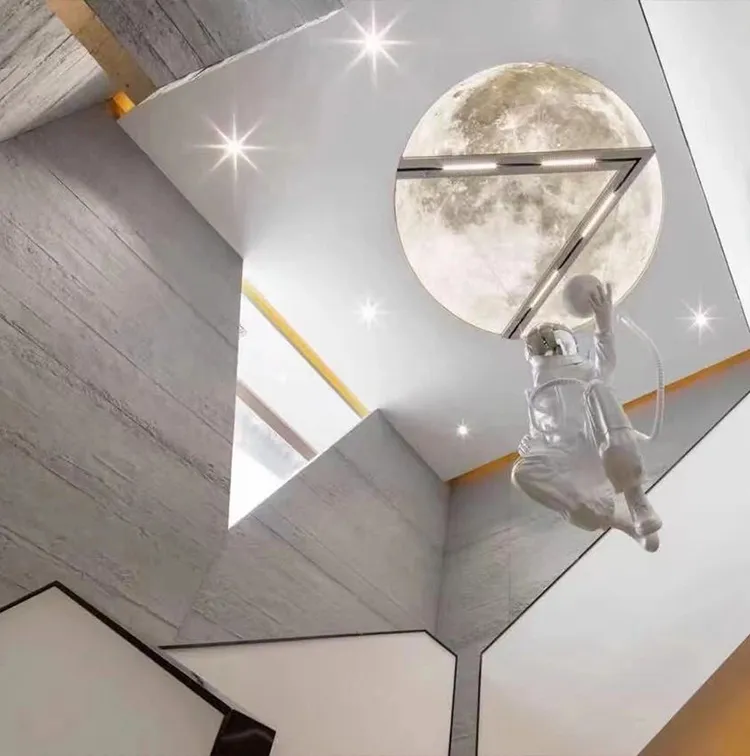
Walls have always been more than just structural boundaries. They are the silent storytellers of a space—shaping how we feel, move, and experience our surroundings. In recent years, a quiet revolution has been unfolding in architecture and interior design: the rise of the curved wall. No longer confined to sharp angles and rigid lines, designers are embracing curves to infuse spaces with softness, flow, and a sense of organic harmony. But for decades, this vision was hampered by a critical challenge: traditional building materials simply weren't built to bend. Enter flexible cement board —a material that's not just changing how walls are made, but redefining what's possible in design.
Walk into any cutting-edge hotel, boutique restaurant, or luxury home today, and you'll likely encounter a curved wall. These gentle arcs aren't just aesthetic choices—they're rooted in psychology and functionality. Studies show that curved spaces trigger a sense of calm; our brains associate soft edges with safety and comfort, as opposed to the tension often felt around sharp corners. Curves also guide the eye naturally, creating a flow that makes large rooms feel cozier and small spaces feel more expansive. Think of the Guggenheim Museum's spiral ramp or the sweeping facade of Zaha Hadid's Heydar Aliyev Center—curves here aren't just beautiful; they're intentional, transforming static structures into dynamic, living environments.
Yet, for all their appeal, curved walls have long been a designer's headache. Traditional materials like rigid concrete, natural stone, and solid wood are stubbornly inflexible. To create a curve, contractors would often resort to labor-intensive workarounds: cutting rigid materials into tiny pieces and piecing them together like a puzzle, or using heavy steel frames to support brittle stone slabs. The result? High costs, long lead times, and often, a compromise in the smoothness of the curve. It was a problem that begged for a solution—and flexible cement board answered.
To appreciate the breakthrough of flexible cement board, it helps to understand the limitations of the materials that came before. Let's start with rigid concrete: durable, yes, but heavy and unyielding. Bending it requires extreme force, often leading to cracks or structural weakness. Natural stone, while stunning, is inherently brittle; even the most skilled craftsmen struggle to shape it into tight curves without risking breakage. Wood, a favorite for warm, organic textures, warps with moisture and temperature changes, making it unreliable for long-term curved applications. And let's not forget drywall—lightweight, but prone to sagging and damage when bent beyond a gentle curve.
The result? Curved walls were often reserved for high-budget projects, where time and money were no object. For most designers, they remained a "someday" idea—something to admire in magazines but too impractical to implement. That is, until the development of modified composite materials that prioritized flexibility without sacrificing strength.
Flexible cement board is the product of decades of innovation in material science. At its core, it's a modified composite material panel —a blend of cement, reinforced fibers (like glass or carbon), and polymers that work together to create a material that's both strong and pliable. Unlike traditional cement board, which is dense and rigid, this newer variant undergoes a specialized manufacturing process that aligns fibers in a way that allows bending without breaking. The result? A board that can curve to radii as tight as 30cm (depending on thickness) while retaining the fire resistance, moisture resistance, and durability that make cement a staple in construction.
But what truly sets flexible cement board apart is its versatility. It's not just a "one-trick pony" for curves—it's a blank canvas for texture and style. Manufacturers have perfected techniques to mimic the look of other premium materials, from the rough-hewn charm of fair-faced concrete to the warm grain of wood grain board . This means designers can achieve the aesthetic of natural materials without their limitations—curving a "wood-like" wall in a bathroom, for example, without worrying about warping, or creating a curved fireplace surround that looks like stone but won't crack under heat.
To understand why flexible cement board is becoming a go-to for designers, let's break down its most compelling features:
The beauty of flexible cement board lies in its adaptability—it works as seamlessly in a cozy home as it does in a grand public space. Let's explore some of its most impactful applications:
| Space Type | Application | Why Flexible Cement Board Works |
|---|---|---|
| Residential | Curved accent walls in living rooms or bedrooms | Creates a focal point with softness; lightweight enough for upper floors; moisture-resistant variants work in bathrooms. |
| Commercial | Hotel lobbies and restaurant interiors | Guides guest flow with natural curves; durable enough for high foot traffic; customizable textures (e.g., wood grain) add warmth. |
| Public Spaces | Museum exhibit walls or airport terminals | Fire-resistant and impact-resistant; large, seamless curves enhance wayfinding and reduce noise echo. |
| Exteriors | Curved facades or outdoor seating walls | Withstands weather (rain, UV rays, temperature swings); mimics stone or concrete for a high-end look without the weight. |
Flexible cement board rarely works alone—and that's part of its charm. Designers are increasingly pairing it with other innovative materials to create layered, multidimensional spaces. One standout partner is MCM flexible stone —a lightweight, bendable stone veneer that shares flexible cement board's "bend without breaking" ethos. Imagine a curved wall where the lower half is clad in rough-hewn MCM flexible stone, transitioning smoothly into a smooth, polished flexible cement board upper half—the contrast of textures adds depth, while the shared flexibility ensures the curve remains seamless.
For warmer spaces, wood grain board (a variant of flexible cement board with a printed wood texture) pairs beautifully with woven elements or soft textiles. In minimalist designs, combining flexible cement board with foamed aluminium alloy board (vintage silver) creates a sleek, industrial-chic look—think curved walls in a modern office, where the cool metallic sheen balances the warmth of the cement's texture.
In an era where sustainability is non-negotiable, flexible cement board holds its own. Unlike natural stone, which requires heavy mining and transportation, it's manufactured using recycled materials (like fly ash, a byproduct of coal power) in many cases. Its lightweight nature also reduces transportation emissions—trucks can carry more boards per trip compared to rigid stone or concrete. And because it's so durable, it has a long lifespan, reducing the need for frequent replacements. For projects aiming for LEED or BREEAM certification, flexible cement board checks multiple boxes: low VOC emissions, energy-efficient manufacturing, and recyclability at the end of its life.
As technology advances, flexible cement board is only getting better. Manufacturers are experimenting with 3D art concrete board variants, where 3D printing allows for even more intricate curved patterns—think undulating walls that mimic the movement of water or the ripples of sand. Digital printing techniques are also evolving, enabling designers to print custom graphics, gradients, or even replicas of rare stone textures directly onto the board.
We're also seeing integration with smart home technology: flexible cement board can be embedded with sensors or LED strips, turning curved walls into interactive elements. Imagine a bedroom wall that curves gently around your bed, doubling as a soft light source that dims with your sleep cycle, or a restaurant wall that changes color to match the time of day. The possibilities are as limitless as the curves themselves.
Flexible cement board isn't just a material—it's a catalyst for creativity. It's the answer to the designer who once said, "I wish this wall could curve," and the homeowner who dreamed of a space that feels less like a box and more like a hug. By marrying strength with flexibility, durability with design freedom, it's opening doors to a world where walls don't just enclose us—they embrace us.
As we look to the future, one thing is clear: the curved wall revolution is just beginning. And at the heart of it all will be materials like flexible cement board—quietly bending, adapting, and proving that sometimes, the most innovative ideas are the ones that know how to go with the flow.
Recommend Products












