
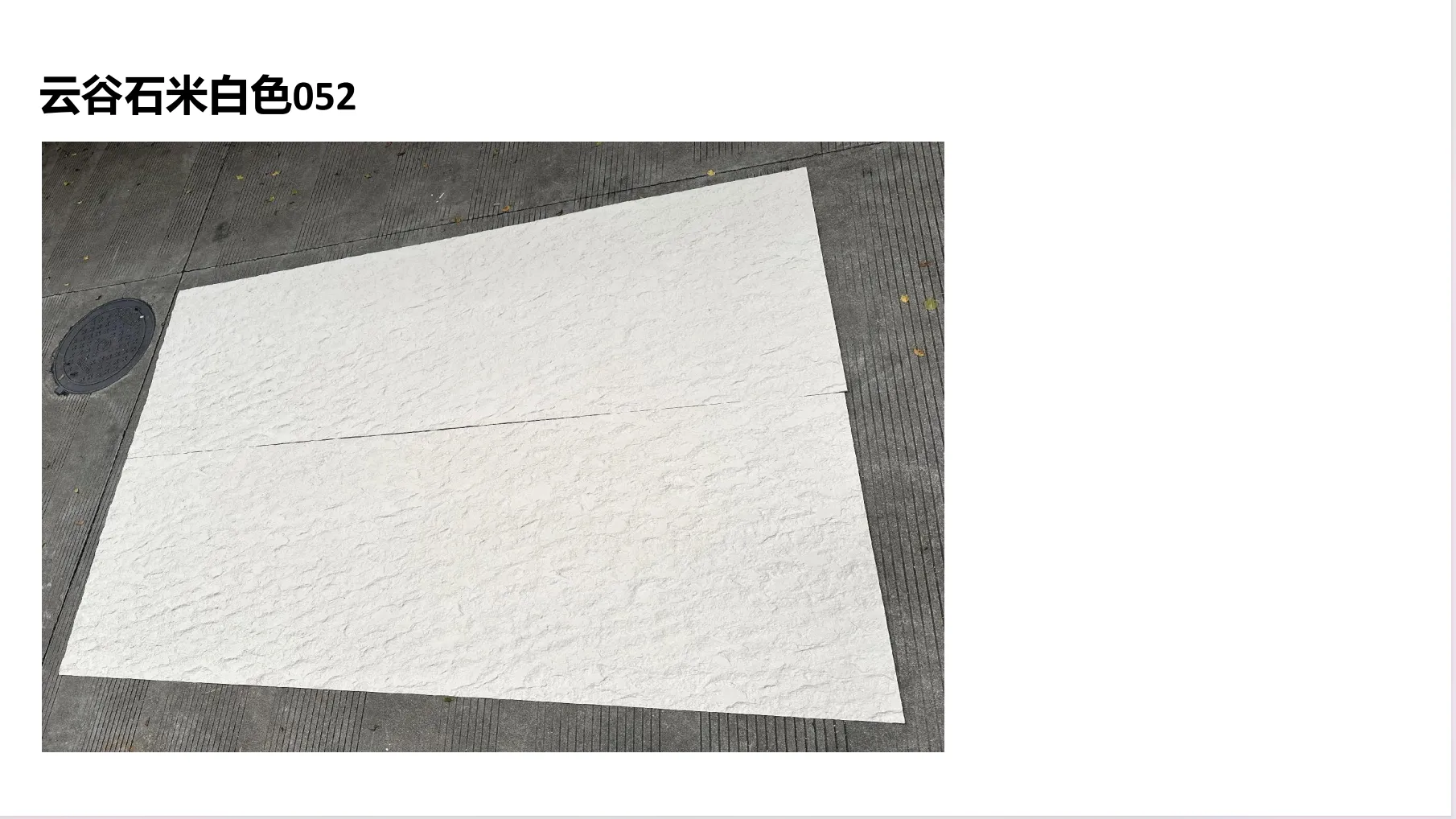
Walk into a tea house in Kyoto, and you'll feel it immediately—the soft texture of bamboo underfoot, the earthy scent of rammed earth walls, the way light filters through shoji screens to cast patterns on the floor. Now step into a luxury hotel lobby in Dubai, and the atmosphere shifts: cool travertine underfoot, walls shimmering with metallic lunar peak finishes, sunlight bouncing off surfaces that feel both ancient and futuristic. What connects these two spaces, separated by continents and cultures? More than you might think. Building materials are the silent storytellers of our environments, and few materials tell a more compelling tale of cross-cultural collaboration than cloud stone. From the traditional villages of Asia to the opulent skylines of the Middle East, cloud stone—encompassing innovations like MCM flexible stone, travertine variants, and lunar peak series—has become a bridge, blending heritage with cutting-edge design. Let's journey through its applications, exploring how it shapes spaces, honors traditions, and redefines what's possible in architecture.
Asia's relationship with building materials has always been rooted in harmony—harmony with nature, with history, and with the rhythms of daily life. For centuries, craftsmen relied on locally sourced materials: bamboo for its flexibility, rammed earth for its thermal mass, wood for its warmth. Today, that ethos endures, but it's evolving. Architects and designers across the continent are now reaching for materials that honor those traditions while meeting the demands of modern construction—materials like MCM flexible stone and bamboo mat board, which marry the old and new in stunning ways.
Take, for example, the renovation of a 200-year-old machiya (traditional wooden townhouse) in Kyoto. The owners wanted to preserve the home's historic charm but needed to update its structure for safety and energy efficiency. Enter MCM flexible stone. Unlike rigid traditional stone, MCM (Modified Composite Material) is lightweight, flexible, and can be cut to mimic the texture of aged wood or weathered stone. The designers used it to clad the exterior walls, matching the original wooden latticework's color and grain so seamlessly that visitors often mistake it for the home's original timber. Inside, bamboo mat board lines the ceilings—its natural weave softening the light and adding a tactile warmth—paired with polished concrete floors that echo the coolness of traditional tatami rooms. "We didn't want to erase the past; we wanted to give it a future," says the project's lead architect. "MCM flexible stone let us do that. It's durable enough to withstand Kyoto's humid summers and cold winters, but it feels as organic as the bamboo and wood around it."
In China, similar innovations are transforming urban spaces. The "Green Corridor" project in Shanghai, a network of pedestrian walkways connecting parks and cultural sites, uses rammed earth board in gradient colors—soft beiges blending into warm terracottas—to evoke the layered landscapes of the country's rural north. Rammed earth has been used in China for millennia, but modern manufacturing techniques have refined it into a more consistent, weather-resistant material. Here, it's paired with line stone board (white), whose thin, vertical striations mimic the tall reeds that once grew along the city's historic canals. The result? A space that feels both rooted in China's agricultural heritage and perfectly at home in a bustling metropolis. "People walk through and say it reminds them of their grandparents' villages, but with the clean lines they expect in a modern city," notes the project manager. "That's the magic of these materials—they speak to multiple generations."
In Tokyo's Shibuya district, where glass and steel dominate the skyline, the "Urban Oasis" office building stands out for its use of natural materials. The facade features a mix of bamboo mat board (used for sunshades, its porous texture reducing heat gain) and MCM flexible stone in a light grey travertine finish. The stone's subtle pitting and veining mimic the look of ancient Japanese limestone, while its flexibility allowed the architects to create curved surfaces that soften the building's edges. Inside, common areas use rough granite stone (medium grey) for accent walls, its uneven texture contrasting with smooth wood grain board desks. Employees report feeling more connected to nature, even in the heart of the city—a testament to how materials can influence mood and productivity. "We wanted to counteract the sterility of typical office spaces," says the design team. "Bamboo and MCM stone bring the outdoors in, and people notice. Meetings in the lobby, which has a wall of rammed earth board (matcha green), always feel more relaxed, more creative."
If Asia's approach to cloud stone is about tradition meeting modernity, the Middle East's is about redefining luxury—blending opulence with the region's harsh climate demands. Here, building materials must withstand scorching sun, occasional sandstorms, and the expectation of timeless elegance. Travertine (starry green), lunar peak silvery, and fair-faced concrete have emerged as stars in this context, offering both durability and a visual language that speaks to the Middle East's rich cultural heritage.
Dubai's latest cultural center, the "Desert Rose," is a stunning example. Designed to celebrate the UAE's Bedouin history and contemporary art scene, its exterior is clad in travertine (starry green)—a material with a unique, crystalline surface that shimmers like desert stars under the sun. The stone's natural porosity helps regulate temperature, keeping the building cool even in summer, while its green hue evokes the rare oases that have sustained life in the desert for centuries. Inside, the main hall features a sweeping staircase wrapped in lunar peak silvery, a metallic-finished stone that reflects light like polished silver. "We wanted a material that felt both luxurious and rooted in the desert landscape," explains the center's curator. "Travertine (starry green) does that—it's bold but not flashy, and it ages beautifully. The lunar peak silvery, meanwhile, adds that touch of modernity, like the desert sky at night."
In Saudi Arabia, the expansion of Riyadh's King Khalid International Airport uses fair-faced concrete in its new terminal, paired with travertine (vintage gold) accents. Fair-faced concrete, with its raw, uncoated finish, speaks to the region's industrial growth, while the warm gold travertine nods to the country's historic trade routes—once lined with caravans carrying gold and spices. The terminal's ceiling, a series of undulating waves made from foamed aluminium alloy board (vintage gold), mimics the movement of sand dunes, creating a sense of calm in a bustling space. "Travelers often comment on how the terminal feels 'grounded' despite its size," says the airport's design director. "That's intentional. Materials like fair-faced concrete and travertine (vintage gold) have weight—literal and metaphorical. They make people feel secure, connected to the land, even when they're far from home."
Luxury hospitality in the Middle East also leans heavily on these materials. The "Azure Sands" resort in Oman, perched on the edge of the Arabian Gulf, uses travertine (starry blue) for its poolside cabanas. The stone's deep blue tones, flecked with iridescent crystals, mirror the sea and sky, blurring the line between man-made and natural spaces. Nearby, the spa features walls of lunar peak black, whose dark, matte surface absorbs light and creates a sense of intimacy, while the treatment rooms use travertine (beige) for its soft, neutral palette—calming guests and enhancing the feeling of relaxation. "In the Middle East, luxury isn't just about being expensive; it's about creating experiences," says the resort's interior designer. "Travertine (starry blue) doesn't just look beautiful—it makes you feel like you're part of the landscape. That's priceless."
What makes materials like MCM flexible stone, travertine variants, and lunar peak series so versatile across Asia and the Middle East? It comes down to innovation. These aren't just "pretty stones"—they're the result of decades of research into making traditional materials lighter, stronger, and more adaptable. Nowhere is this more evident than in MCM flexible stone, which has revolutionized how architects approach cladding and design.
Traditional natural stone is heavy and rigid, limiting where it can be used. A single slab of marble or granite can weigh hundreds of pounds, requiring reinforced structures and making it impractical for retrofits or high-rise buildings. MCM flexible stone changes that. Made by bonding natural stone particles with a polymer resin, it's up to 80% lighter than traditional stone. This means it can be applied to existing buildings without reinforcing walls, used on curved surfaces (like the facade of Dubai's "Twisted Tower"), or even integrated into furniture and decorative elements. "We once used MCM flexible stone to clad a floating restaurant in Bangkok," recalls a materials engineer. "Traditional stone would have sunk the structure. MCM? It weighed almost nothing, but looked exactly like the teak wood the owners wanted. The restaurant now floats on the Chao Phraya River, and the stone has held up perfectly against the water and humidity for five years."
Flexibility is another key advantage. MCM can be bent to a radius of as little as 30cm, allowing for organic, flowing designs that were once impossible with rigid stone. In Tokyo's "Wave Building," a cultural center dedicated to marine conservation, the exterior is clad in MCM flexible stone shaped to mimic ocean waves—each panel curved and textured to catch the light like water. Inside, ripple board (grey) lines the auditorium walls, its undulating surface enhancing acoustics and creating the illusion of being underwater. "Before MCM, we would have had to use expensive, custom-molded concrete for those curves," says the architect. "MCM let us be more creative and stay on budget. And because it's flexible, we could install it in sections, adjusting as we went to get the wave pattern just right."
Sustainability is also driving MCM's popularity. Traditional stone mining can be environmentally destructive, requiring heavy machinery and leaving large quarries. MCM, by contrast, uses recycled stone particles and requires less energy to produce. It's also recyclable at the end of its life. In Singapore, the "Eco-Hub" office complex achieved LEED Platinum certification in part due to its use of MCM flexible stone cladding. "We wanted to reduce our carbon footprint without sacrificing aesthetics," explains the project's sustainability consultant. "MCM was a no-brainer. It's made with 40% recycled content, and its lightweight nature meant less fuel was used to transport it to the site. Plus, it reflects sunlight, reducing the building's cooling needs. It checked every box."
| Material | Key Properties | Common Applications | Regional Popularity |
|---|---|---|---|
| MCM Flexible Stone | Lightweight (80% lighter than natural stone), flexible, weather-resistant | Exterior cladding, interior accent walls, furniture | Asia (urban retrofits), Middle East (high-rises) |
| Travertine (Starry Green) | Crystalline surface, heat-resistant, natural insulation | Luxury hotels, cultural centers, outdoor spaces | Middle East (UAE, Oman) |
| Lunar Peak Silvery | Metallic finish, scratch-resistant, low maintenance | Lobby interiors, elevator panels, decorative accents | Middle East (luxury projects), Asia (modern offices) |
| Bamboo Mat Board | Sustainable, natural texture, acoustic properties | Ceilings, partitions, furniture | Asia (Japan, China, Southeast Asia) |
| Rammed Earth Board (Gradient) | Thermal mass, natural color variation, fire-resistant | Residential walls, public walkways, cultural centers | Asia (China, India), Middle East (sustainable housing) |
Materials don't just look good—they influence how we feel and interact with spaces. In Asia and the Middle East, where community and tradition are central to daily life, the choice of building materials becomes even more meaningful. Cloud stone variants, whether MCM flexible stone in a Tokyo café or travertine (starry red) in a Beirut marketplace, are designed to foster connection—between people, between generations, and between cultures.
In Seoul, South Korea, the "Community Canvas" project transformed a neglected alleyway into a vibrant public square using travertine (vintage black) and wood line panels. Travertine's dark, smooth surface was etched with local residents' stories and artwork, turning the square into an outdoor museum. Wood line panels, with their warm, linear texture, line the seating areas, encouraging people to sit and chat. "Before, the alley was a place people avoided," says the project organizer. "Now, kids draw on the travertine with chalk, elders play chess on the wood benches, and tourists take photos of the artwork. It's become the heart of the neighborhood. The materials made that possible—they're durable enough to handle daily use, but inviting enough to make people want to stay."
In Cairo, Egypt, the "Heritage Bazaar" uses travertine (starry orange) for its market stalls. The stone's warm, golden-orange hue evokes the color of the desert at sunset, while its non-slip surface makes it safe for crowds. Vendors sell spices, textiles, and handmade crafts from stalls lined with lunar peak golden, whose metallic sheen catches the light and makes the merchandise sparkle. "The bazaar feels alive now," says a spice seller who's worked there for 30 years. "Before, the stalls were made of cheap wood that rotted in the rain. Now, the stone feels permanent, like our traditions. Customers stay longer because it's more beautiful, and that means more business for all of us."
Even in private homes, these materials are fostering connection. In Tehran, Iran, a family renovated their basement into a gathering space for extended family using rough granite stone (dark grey) and weaving (khaki) panels. The granite's rugged texture reminds the family of their mountain hometown, while the weaving panels—handmade by the grandmother—add a personal touch. "We host weekly dinners with 20+ people down there," says the homeowner. "The granite is easy to clean, even with kids spilling food, and the weaving makes it feel cozy, like being in my grandmother's old house. It's not just a room; it's where we make memories."
Dubai's "Global Village" is a sprawling complex celebrating cultures from around the world, and its architecture reflects that diversity. The Asian Pavilion uses bamboo mat board and rammed earth board (gradient b) to recreate the feel of a traditional Chinese courtyard, while the Middle Eastern Pavilion features a grand hall clad in travertine (starry green) and lunar peak silvery. The connecting walkways, however, are where the magic happens: they're lined with MCM flexible stone printed with patterns from both regions—Japanese cherry blossoms interwoven with Arabic calligraphy. "We wanted people to feel like they're walking through a shared story," says the center's director. "The MCM stone let us merge those patterns seamlessly. Kids run their hands over it, pointing out the cherry blossoms and the letters. It starts conversations. That's the power of design—when materials become a language."
As Asia and the Middle East continue to lead in architectural innovation, cloud stone materials are evolving to meet new challenges: climate change, urbanization, and the growing demand for personalized spaces. Future iterations may include self-cleaning MCM flexible stone (coated with a photocatalytic layer that breaks down dirt when exposed to sunlight), or travertine embedded with LED lights for dynamic, nighttime displays. In Japan, researchers are experimenting with MCM that can absorb air pollutants, turning buildings into "green filters" for cities. In Saudi Arabia, engineers are developing lunar peak variants that can store solar energy, powering building lights and reducing reliance on the grid.
But perhaps the most exciting trend is the growing collaboration between Asian and Middle Eastern designers. A recent project in Doha, Qatar, the "East Meets West" cultural center, brought together a Japanese architect and a Lebanese interior designer to create a space that blends bamboo mat board, travertine (starry blue), and rammed earth board (matcha green). The result is a building where the precision of Japanese design meets the opulence of Middle Eastern aesthetics—a physical manifestation of cultural exchange. "We didn't just mix materials; we mixed philosophies," says the Japanese architect. "The bamboo represents harmony with nature; the travertine represents endurance. Together, they tell a story of two cultures learning from each other."
At the end of the day, cloud stone is more than a building material. It's a reminder that the spaces we create are reflections of who we are—and who we want to be. Whether it's MCM flexible stone preserving a Kyoto machiya, travertine (starry green) adorning a Dubai hotel, or bamboo mat board fostering community in Seoul, these materials are building bridges—between past and future, between East and West, and between people. As one designer put it: "Stone is forever, but the stories it tells change with each generation. That's the beauty of cloud stone—it lets us write new stories without forgetting the old ones."
So the next time you walk into a building—whether it's a tea house in Kyoto, a bazaar in Cairo, or an office in Dubai—take a moment to touch the walls, look at the floors, and notice the materials around you. Chances are, you're standing in a space shaped by cloud stone: a material that doesn't just build structures, but builds connections. And in a world that often feels divided, that's a powerful thing.
Recommend Products












