
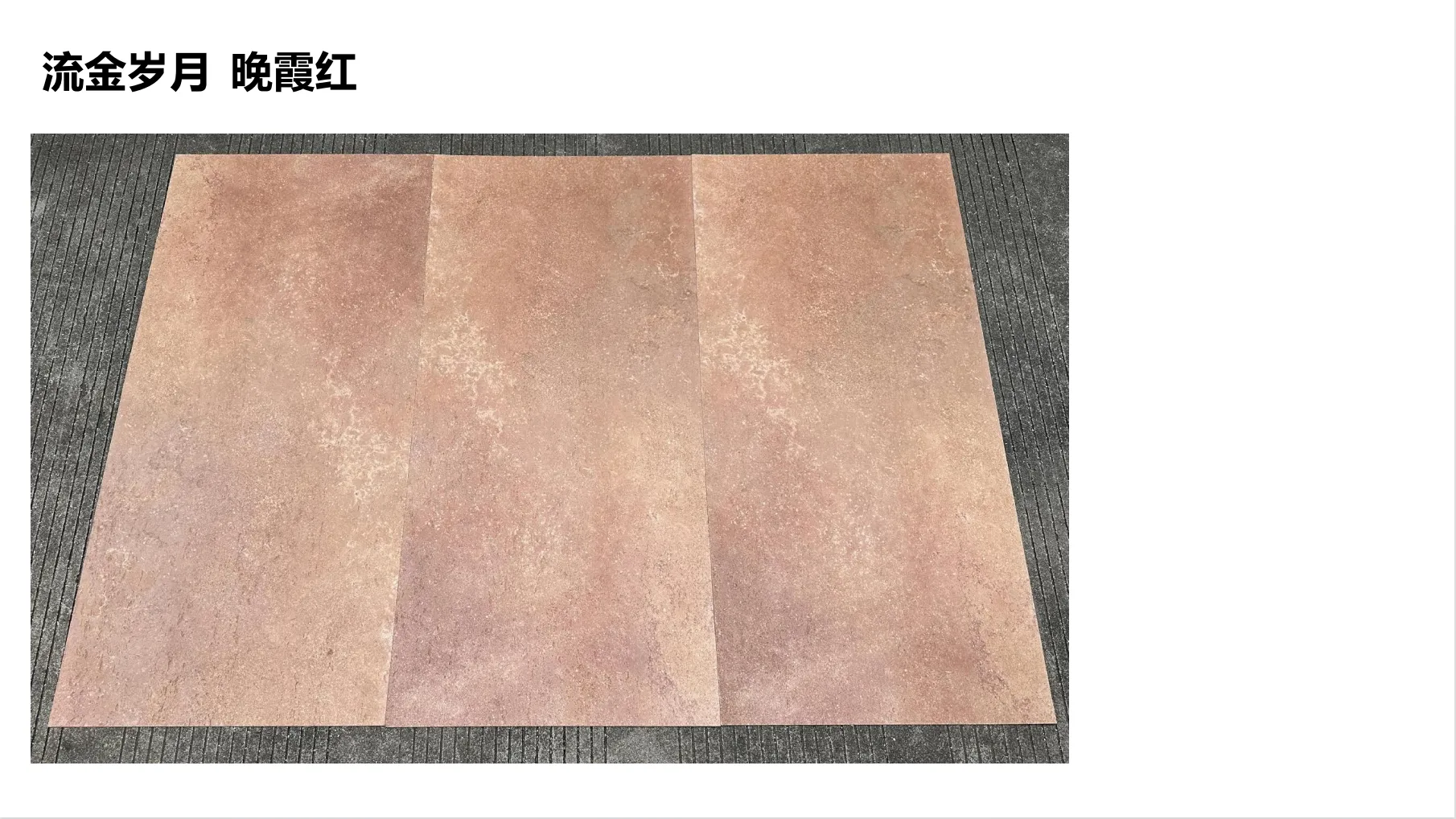
Imagine standing in a half-finished hotel lobby. The walls are bare, the air smells of fresh paint, and you're clutching a small sample of stone—smooth, veined, the perfect shade of warm beige. You ordered 500 square meters of this "Golden Travertine" for the accent wall, but as the first crates arrive, your heart sinks. The color is off. The veining is patchy. That small sample? It might as well be from a different planet. Sound familiar? For architects, designers, and builders, this gap between "sample promise" and "real-world delivery" is all too common. But what if there was a way to skip the guesswork? What if you could see exactly how a material would look—not in a glossy catalog or a filtered render, but on a real wall, in a real building, under real sunlight? That's where COLORIA's Golden Faith Real Photos come in. These aren't just marketing tools; they're windows into quality control, proof that what you see is what you get. Let's dive into how these unfiltered, unretouched images are redefining trust in the world of building materials.
You've probably flipped through a building materials catalog before. Shiny pages, perfectly lit samples, captions like "rich texture" and "timeless elegance." But here's the dirty little secret: those photos are often shot in controlled studios, with professional lighting, and sometimes even a little Photoshop magic. They're designed to sell, not to show you the material as it will exist in your project. That's where COLORIA's approach is different. The Golden Faith Real Photos aren't just snapshots—they're documentation. Taken on actual job sites, in real-time, with no filters or edits, they capture materials exactly as they appear when installed. Whether it's the way travertine (starry green) shimmers under a restaurant's pendant lights or how lunar peak silvery weathers a rainy day on a skyscraper facade, these images are a promise: "This is what you'll get."
Why does this matter for quality control? Let's break it down. When you're specifying materials for a project, consistency is everything. A single batch of stone with uneven coloring can throw off an entire design. A metal panel that fades under UV light? It turns a modern office into a dated eyesore in months. Real project photos act as a bridge between the factory and the field. They let you spot inconsistencies early—like a batch of foamed aluminium alloy board (vintage gold) that's slightly more brassy than the last run—or confirm that the texture of MCM flexible stone holds up even on a high-traffic retail wall. For COLORIA, these photos aren't optional; they're part of the quality control process. Every project, big or small, gets documented, and those images become a reference for future orders. It's transparency, plain and simple.
Enough about why—let's talk about the what . COLORIA's product lineup is vast, but today, we're zooming in on a few standout series, using their Golden Faith Real Photos to show you how quality control comes to life. These aren't just products; they're stories told through texture, color, and application. Let's walk through them.
Flexible stone sounds like an oxymoron, right? Stone is hard, rigid, unyielding. But MCM flexible stone is changing that. Made from modified composite materials, it's lightweight (so it won't weigh down walls), bendable (perfect for curved facades or custom shapes), and surprisingly tough (resistant to scratches, moisture, and even fire). But don't just take my word for it—look at the Golden Faith Real Photos from the "Azure Bay Resort" project in Bali. The resort's lobby features a sweeping, curved wall wrapped in MCM flexible stone in "Travertine (Beige)." The photo, taken at noon on a sunny day, shows the stone hugging the curve seamlessly—no cracks, no gaps, just a smooth flow of warm beige with subtle, natural veining. What's impressive? The same batch was used for both the curved section and the straight walls flanking it, and the color match is spot-on. In another photo, taken after a tropical downpour, the stone still looks fresh; no water spots, no discoloration. That's quality control in action: testing materials in real-world conditions and documenting the results.
You might be wondering: How does COLORIA ensure that flexibility doesn't mean sacrificing consistency? The answer is in their manufacturing process. Each sheet of MCM flexible stone is pressed using precision molds, and every batch is tested for color fastness and texture uniformity. The Golden Faith photos act as a final check—if a sheet looks off in the photo, it's flagged and reworked before shipping. For designers like Maria Gonzalez, who used MCM flexible stone on a museum's spiral staircase, that consistency was a game-changer. "I was worried the curves would make the stone look patchy," she says, "but the real photos from COLORIA's past projects gave me confidence. When our staircase went up, it looked exactly like the photos—even better, because it was our project."
Travertine is a classic, but COLORIA's "Starry" line takes it to another level. Travertine (starry green) isn't your grandma's beige stone—it's deep, moody, with flecks of iridescent green that catch the light like stars in a dark sky. It's bold, it's dramatic, and it's surprisingly versatile. Just look at the Golden Faith Real Photos from the "Eclipse Lounge" in downtown Chicago. The lounge's back bar is clad in Starry Green Travertine, and the photo, taken at dusk with the bar lights glowing, is breathtaking. The stone's dark base contrasts with the gold accents of the bar, while the green flecks twinkle like distant galaxies. But what's more telling is the close-up photo included in the Golden Faith gallery: a section of the stone under natural light, showing that the "stars" are evenly distributed, not clustered in one spot. No two sheets are identical—because nature isn't perfect—but the variation is intentional, controlled, and beautiful.
COLORIA's quality control for the Starry series is meticulous. Each slab is inspected for color consistency (no "blotchy" green patches) and fleck density (too many stars would look busy; too few, underwhelming). The real photos from the Eclipse Lounge project confirm that the balance is just right. In a follow-up photo taken six months after opening, the stone still looks as vibrant as day one—no fading, no loss of that starry sparkle. For the lounge's owner, Jake Patel, that longevity was key. "We wanted a material that would still look stunning five years from now," he says. "COLORIA's real photos of older projects—some dating back three or four years—showed us that Starry Green Travertine holds up. That's the peace of mind you can't get from a sample."
If Starry Green Travertine is for the dreamers, lunar peak silvery is for the minimalists. This line, part of COLORIA's "Lunar Peak" collection (which also includes golden and black variants), is all about clean lines, cool tones, and a futuristic sheen. Imagine a office building facade that looks like it's been carved from moonlight—that's Lunar Peak Silvery. The Golden Faith Real Photos from the "Nexus Tech Headquarters" in Seattle showcase this perfectly. The 12-story building's exterior is clad in large panels of Lunar Peak Silvery, and the photo, taken at dawn, shows the stone catching the first light of day, glowing with a soft, silvery-blue hue. What's striking is the uniformity: even across 12 stories, the color doesn't shift. No panel is darker or lighter than the next; it's a seamless blanket of modern elegance.
But Lunar Peak Silvery isn't just about looks—it's built to withstand the elements. Seattle's known for rain, and the Golden Faith photos include a shot taken during a downpour. The water beads up on the stone's surface, rolling off without soaking in—a testament to its water-resistant coating. Another photo, taken in winter, shows the stone dusted with snow; when the snow melts, there's no staining, no residue. COLORIA's quality control team tests each batch for weather resistance, exposing panels to simulated rain, snow, and UV light for weeks before they ever reach a job site. The real photos from Nexus Tech? They're the final test: proof that the lab results translate to real-world performance.
Metal panels can feel cold, industrial, but foamed aluminium alloy board (vintage gold) is here to change that. With a matte, brushed finish that mimics aged brass, it adds warmth and character to everything from restaurant facades to home accent walls. The Golden Faith Real Photos from "The Rustic Nook," a boutique café in Portland, Oregon, are a case study in how well this material works. The café's exterior features a mix of wood siding and vintage gold foamed aluminium panels, and the photo, taken at golden hour, is pure charm. The metal panels glow softly, complementing the warm wood tones, and the vintage finish looks authentically aged—not forced. Close-up, you can see the subtle texture of the brushed surface, which catches the light in a way that flat, shiny metal never could.
What's remarkable about this product is its consistency. Foamed aluminium alloy is prone to color variation if not mixed properly, but COLORIA's photos show that every panel on The Rustic Nook's facade matches. No "splotchy" areas, no panels that lean more yellow or more copper—just a uniform, rich vintage gold. And durability? The café's been open for two years, and a recent Golden Faith update photo shows the panels still look as good as day one. No rust, no peeling, just that same warm, aged glow. For the café's designer, Lila Chen, that was non-negotiable. "We wanted a material that would look old but act new," she says. "COLORIA's real photos of their vintage gold panels in high-traffic areas—like a busy downtown storefront—proved that it could handle the wear and tear. Now, when customers ask about the metal, I just show them the Golden Faith gallery. It sells itself."
| Product Name | Key Features | Project Application | Real Photo Highlight |
|---|---|---|---|
| MCM Flexible Stone (Travertine Beige) | Lightweight, bendable, scratch-resistant | Curved lobby wall, Azure Bay Resort (Bali) | Seamless curve with consistent veining; no gaps or cracks even after 6 months of use. |
| Travertine (Starry Green) | Dark base with iridescent green flecks, heat-resistant | Back bar, Eclipse Lounge (Chicago) | Even distribution of "stars" under both bar lights and natural light; no fading after 1 year. |
| Lunar Peak Silvery | Cool silvery-blue hue, weather-resistant, UV-stable | 12-story office facade, Nexus Tech (Seattle) | Uniform color across 12 stories; water beads off surface during rain, no staining post-snow. |
| Foamed Aluminium Alloy Board (Vintage Gold) | Matte brushed finish, rust-proof, authentic "aged" look | Café exterior, The Rustic Nook (Portland) | Consistent vintage gold tone; no discoloration after 2 years of high foot traffic. |
Real photos are the result of quality control, not the process . So what happens before the camera clicks? At COLORIA, quality control starts the moment raw materials arrive at the factory and doesn't end until the final panel is installed. Let's pull back the curtain.
First, material selection. For MCM flexible stone , COLORIA sources natural stone aggregates from quarries in Italy and Turkey, hand-picking batches that meet strict color and texture standards. A sample of each batch is sent to the lab, where it's tested for hardness, porosity, and chemical composition. Only the top 10% makes the cut. For foamed aluminium alloy board (vintage gold) , the aluminium is alloyed with magnesium and silicon to strength, then foamed using a proprietary process that creates tiny, uniform bubbles—this is what gives the material its lightweight feel and matte finish. Each alloy batch is tested for tensile strength and corrosion resistance before it's formed into panels.
Next, manufacturing. COLORIA uses 3D printing technology for some of its more intricate designs (part of the MCM 3D printing series ), which allows for precise control over texture and pattern. For example, the "Wave Panel" (a popular choice for feature walls) is 3D-printed with wave-like ridges that are identical in height and spacing across every panel. After printing or molding, each product goes through a multi-step finishing process: cleaning, sealing, coating (for water or UV resistance), and curing. At each step, inspectors check for flaws—tiny air bubbles in the alloy, uneven coating on the stone, inconsistent coloring. If a panel fails, it's rejected.
Then comes the real-world testing. Before a new product line launches, COLORIA installs test panels on a "mock project" wall at their factory. This wall is exposed to the elements—sun, rain, wind, even extreme temperatures (they use heaters and freezers to simulate desert heat or arctic cold). Over six months, the panels are photographed weekly, documenting how they age. These photos become part of the Golden Faith library, giving customers a preview of how the material will look years down the line. For existing products, every 100th panel off the production line is sent to the test wall for a "spot check," ensuring that quality stays consistent over time.
Finally, project documentation. When a customer orders materials for a project, COLORIA assigns a quality control specialist to oversee delivery and installation. This specialist takes photos during installation (to document proper application) and again 30, 90, and 365 days later (to track performance). These photos are added to the Golden Faith gallery, creating a living record of the product's lifespan. It's a lot of work, but for COLORIA, it's non-negotiable. "We don't just sell materials," says Elena Kim, COLORIA's Quality Control Director. "We sell confidence. And confidence comes from proof—proof that our products work, that they last, that they look as good in your project as they do in our catalog. That's what Golden Faith Real Photos are all about."
Don't just take COLORIA's word for it—ask the people who use their materials every day. We spoke to three architects and designers about how Golden Faith Real Photos have transformed their workflow.
"I used to dread material selection. You order based on a sample, and by the time the shipment arrives, it's like a bad blind date—nothing like you expected. Then I discovered COLORIA's Golden Faith Real Photos. For our 'Heritage Tower' project, we needed a stone that looked historic but was durable enough for a high-rise. We chose historical pathfinders stone , and the Golden Faith photos from a similar project in Boston showed exactly how it would weather over time—subtle fading, but in a way that added character, not wear. When the stone arrived, it matched the photos perfectly. Now, I start every project by browsing COLORIA's real photo gallery. It's not just inspiration; it's insurance."
"My clients are obsessed with texture. They want walls that feel as good as they look. For a recent luxury home project, the client wanted a weaving (khaki) panel for the living room accent wall—a material that's soft, tactile, and warm. I was nervous: woven materials can fray, or the pattern can shift during installation. But COLORIA's Golden Faith photos showed the weaving panel installed in a family home with kids and pets—no snags, no loose threads, just that same cozy texture. The client saw the photos and fell in love. When we installed it, it looked exactly like the photos. Now, I use the real photos in my client presentations—they're worth a thousand words."
"In Houston, we deal with humidity, hurricanes, and the occasional flood. Materials have to be tough. I started using MCM flexible stone for exterior walls after seeing Golden Faith photos from a project in New Orleans—an area that knows a thing or two about moisture. The photos showed the stone on a house that survived Hurricane Ida, with no water damage or mold. We've now used it on 12 homes, and it's held up beautifully. Last year, one of our clients had a pipe burst inside their home; the water ran down the wall, soaked the MCM stone, and when we dried it out, there was zero damage. I keep a folder of COLORIA's real photos on my phone—when clients ask, 'Will this hold up?' I show them the proof."
In a world of filtered Instagram posts and AI-generated renders, it's easy to feel skeptical about what you see online. But COLORIA's Golden Faith Real Photos aren't about hype—they're about honesty. They're a promise that the material you order is the material you'll get, that the texture you love in the sample will look the same on your wall, that the color won't fade when the sun hits it or bleed when it rains. They're proof that quality control isn't just a buzzword; it's a process, one that starts with raw materials and ends with a photo of your finished project, glowing with the same beauty as the day it was installed.
Whether you're an architect designing a skyscraper, a designer crafting a boutique hotel, or a homeowner remodeling your kitchen, you deserve materials you can trust. And trust, as they say, is earned—not given. COLORIA earns it by opening their process, documenting their projects, and letting the materials speak for themselves. So the next time you're scrolling through building materials, skip the glossy catalogs and ask for the real photos. Better yet, visit COLORIA's Golden Faith gallery. See the travertine (starry green) in a restaurant, the lunar peak silvery on an office tower, the foamed aluminium alloy board (vintage gold) on a café. See the wear, the weathering, the way the light hits the surface at different times of day. Because when it comes to building something that lasts, seeing is believing.
Golden Faith Real Photos aren't just about quality control—they're about building a partnership. A partnership where you know exactly what you're getting, where there are no surprises, and where your vision for the project can become a reality. So go ahead—explore the gallery. Your next project deserves nothing less than the real thing.
Recommend Products












