
Walk into any contemporary building today, and you'll likely be struck by more than just its height or layout. It's the details that linger—the subtle texture of a wall, the way light plays on a facade, the seamless flow of materials that feels both intentional and organic. Behind these moments lies a quiet battle of techniques: innovation versus tradition, digital precision versus artisanal craft. When it comes to Modified Composite Material (MCM), two methods stand out for their ability to turn raw materials into storytelling elements: the MCM 3D Printing Series and CNC carving. And there's no better way to witness their rivalry than through Golden Faith Real Photos —images that don't just show materials, but breathe life into them.
Imagine running your hand over a surface that looks like it was chiseled by wind over centuries, yet was printed layer by layer in days. Or a panel so precisely carved that every groove aligns perfectly, like a symphony of lines. These aren't just design choices; they're emotional triggers. They make spaces feel intimate, grand, nostalgic, or futuristic. Today, we're diving into how MCM 3D printing and CNC carving shape these emotions, using real photos as our guide and materials like travertine (starry green) , lunar peak golden , and foamed aluminium alloy board (vintage gold) as our muses.
Before we compare techniques, let's talk about the star of the show: MCM. Short for Modified Composite Material, MCM is the chameleon of the world. Flexible yet tough, lightweight yet durable, it mimics the look of natural stone, wood, or metal while outperforming many traditional materials in weather resistance and sustainability. It's the reason architects can dream of curved facades clad in mcm flexible stone or massive walls made of mcm big slab board series without worrying about weight or cracking.
But MCM isn't a one-size-fits-all solution. It's a family—with series tailored to every need. There's the MCM Project Board Series , the workhorse for large-scale commercial projects, designed to cover vast surfaces with minimal seams. The MCM 3D Printing Series pushes boundaries, turning digital designs into tangible textures. And let's not forget specialty lines like wave panel or star gravel , which add depth and whimsy to interiors. Today, though, our focus is on two techniques that elevate MCM from "material" to "masterpiece": 3D printing and CNC carving.
3D printing has revolutionized industries from healthcare to aerospace, and MCM is no exception. The MCM 3D Printing Series isn't just about "printing a panel"—it's about unlocking design freedom that was once impossible. Here's how it works: a digital model is sliced into layers, and a printer deposits MCM material (often blended with natural aggregates) layer by layer, bonding them into a solid, flexible sheet. The result? Textures so intricate, they look like nature's own handiwork—only with mathematical precision.
Take travertine (starry green) , a fan favorite for its earthy base and flecks of iridescent "stars." In traditional manufacturing, recreating the randomness of those stars would be tricky. But with 3D printing? Designers can program the printer to disperse the star-like aggregates exactly where they want—clustering them to mimic a night sky over a forest, or scattering them lightly for a subtle glow. Golden Faith Real Photos of this material reveal edges so crisp, you can almost count the layers, yet the surface feels soft, like polished river stone. It's the best of both worlds: digital control and organic warmth.
*Golden Faith Real Photo: A close-up of 3D-printed travertine (starry green) shows layers merging seamlessly, with starry flecks concentrated along the "valleys" of a wave pattern—proof that precision doesn't have to kill character.*
What truly sets 3D printing apart is its design flexibility . Want a wall that looks like rolling sand dunes? Print a gobi panel with undulating curves. Dream of a ceiling that mimics tree bark? The pine bark board in the 3D Printing Series can replicate every ridge and groove. And because there's no need for molds, custom designs go from concept to prototype in days, not weeks. For projects on tight deadlines or with unique aesthetic demands, this speed is a game-changer.
Sustainability is another win. 3D printing uses only the material needed, cutting down on waste—a stark contrast to traditional cutting methods that carve away excess. When paired with eco-friendly MCM blends, it's a choice that aligns with the growing demand for green building practices.
If 3D printing is the "future forward" technique, CNC carving is the "wise elder"—rooted in tradition but upgraded with digital smarts. CNC (Computer Numerical Control) carving uses computer-guided tools to carve MCM panels with pinpoint accuracy. Think of it as a high-tech chisel: instead of a human hand, a machine follows a digital blueprint, ensuring every cut, groove, and texture is identical across hundreds of panels. But don't mistake "machine-made" for "cold"—CNC carving retains the tactile depth that makes natural materials so appealing.
Consider lunar peak golden , a warm, amber-hued MCM that evokes the glow of a sunset over mountains. CNC carving takes this material to new heights by adding linear patterns that mimic mountain ridges. Golden Faith Real Photos of CNC-carved lunar peak golden show grooves so precise, they could be measured with a ruler—yet the edges have a slight "chisel mark" texture, as if a master craftsman spent hours refining them. It's this blend of digital accuracy and organic imperfection that makes CNC carving so beloved for spaces where tradition matters.
*Golden Faith Real Photo: A CNC-carved lunar peak golden panel reveals parallel grooves, each exactly 2mm deep, with a subtle "fuzz" along the edges—a deliberate nod to hand-carving techniques. The golden hue deepens in the grooves, creating shadow play that shifts with the light.*
CNC carving also excels with materials that demand consistency . Take foamed aluminium alloy board (vintage gold) , a sleek, metallic MCM used in high-end interiors. Carving a repeating geometric pattern across 50 panels? With CNC, every angle, every curve, is identical. No more "close enough"—it's "perfect, every time." This is why the MCM Project Board Series often relies on CNC carving for large-scale projects like hotel lobbies or office facades, where uniformity is key to making a bold statement.
And let's talk about texture. 3D printing creates texture through layers, but CNC carving cuts into the material, creating depth that you can feel with your fingertips. Run your hand over a CNC-carved rust square line stone , and you'll feel the sharp ridges of the squares and the smoothness of the recessed areas—a sensory experience that 3D printing, for all its innovation, can't fully replicate.
To truly understand how these techniques stack up, let's turn to the data—paired with insights from Golden Faith Real Photos. Below is a comparison of key factors that matter to architects, designers, and builders:
| Factor | MCM 3D Printing Series | CNC Carving |
|---|---|---|
| Design Flexibility | Excels at organic, complex shapes (e.g., wave panel , star gravel ). Can print undercuts and hollow structures. | Ideal for geometric patterns, linear textures (e.g., square line stone , linear travertine ). Limited by tool reach (no undercuts). |
| Precision Level | ±0.1mm layer accuracy. Perfect for replicating natural textures (e.g., travertine (starry green) stars). | ±0.05mm cutting accuracy. Superior for sharp edges and uniform depth (e.g., lunar peak golden ridges). |
| Material Compatibility | Works best with flexible MCM blends (e.g., mcm flexible stone , foamed aluminium alloy board (vintage gold) ). | Handles denser MCMs (e.g., rust board granite , boulder slab (vintage black) ) with ease. |
| Lead Time | Faster for custom designs (1-3 days for prototypes). Scales well for small batches. | Longer setup (needs tooling), but faster for large runs (e.g., mcm project board series for skyscrapers). |
| Sustainability | Minimal waste (only uses needed material). Energy-efficient printers. | More waste (cutting away excess material). Recyclable, but less eco-friendly than 3D printing. |
| Emotional Appeal | Evokes innovation, creativity, and "future nostalgia" (e.g., lunar peak silvery printed to look like moon dust). | Feels artisanal, timeless, and grounded (e.g., historical pathfinders stone carved to mimic ancient ruins). |
Numbers tell part of the story, but Golden Faith Real Photos tell the rest. These images don't just document MCM panels—they immortalize the moments where precision meets emotion. Let's walk through a few standout shots:
This photo captures a panel from the foamed aluminium alloy board (vintage gold) line, 3D-printed with a honeycomb pattern. The light hits the peaks of the honeycomb, turning them a bright, almost brassy gold, while the valleys fade to a warm amber. What's striking? The uniformity of the hexagons—each side exactly 1cm long—and the way the foam structure traps light, creating a soft glow. It's futuristic, yet the vintage gold hue keeps it from feeling cold. In a boutique hotel lobby, this panel would be more than a wall—it'd be a conversation starter.
Black is tricky to photograph, but Golden Faith nails it here. This lunar peak black panel was CNC-carved with a radial pattern, like ripples spreading from a drop of water. The carving depth varies—shallower at the edges, deeper at the center—so when light hits it, the ripples cast shadows that move as the sun shifts. Up close, you can see tiny "tool marks" along the edges of the ripples, a deliberate touch to mimic hand-carving. It's precision with a soul—a reminder that even the most advanced machines can honor tradition.
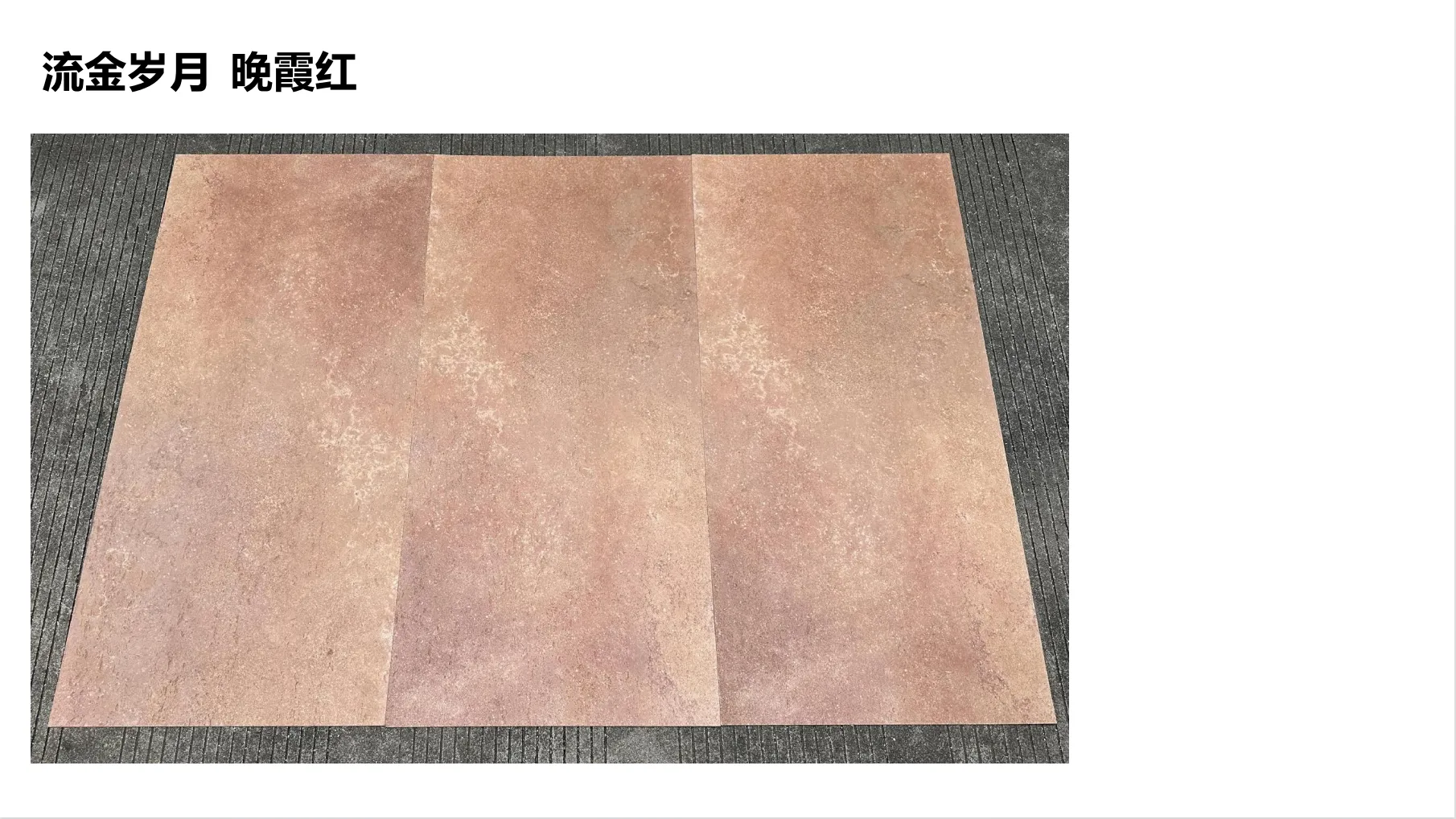
The most compelling Golden Faith Real Photo? A split image of travertine (starry red) —one half 3D-printed, the other CNC-carved. The 3D side has a flowing, cloud-like texture, with red "stars" scattered like embers. The CNC side has sharp, angular grooves, with stars concentrated in the recesses, making them pop against the matte red background. There's no "winner" here—only two different expressions of the same material. It's a visual metaphor for why MCM matters: it doesn't force you to choose between innovation and tradition. You can have both.
At the end of the day, the choice between MCM 3D Printing Series and CNC carving isn't about "better" or "worse"—it's about what you want your space to say . Are you designing a tech startup office that screams "forward-thinking"? 3D-printed gobi panel or 3d art concrete board might be your muse. Restoring a historic building that needs modern durability but old-world charm? CNC-carved historical pathfinders stone or muretto stone (beige) would honor the past while protecting it.
And let's not forget the MCM Project Board Series —the unsung hero that often combines both techniques. Imagine a hospital facade: 3D-printed travertine (beige) for a soft, calming base, with CNC-carved line stone board (white) accents to add structure. It's a marriage of comfort and order, designed to put patients at ease.
As we flip through Golden Faith Real Photos of MCM panels—3D-printed waves, CNC-carved peaks, starry travertines, and vintage foamed aluminium—one thing becomes clear: precision isn't just about measurements. It's about intention. It's about choosing a technique that doesn't just build a wall, but shapes an experience .
The MCM 3D Printing Series whispers, "What if?" It's for dreamers who want to push boundaries. CNC carving declares, "This matters." It's for craftsmen who honor the past while building the future. And MCM? It's the canvas that makes both possible—flexible, durable, and endlessly adaptable.
So the next time you walk into a space and feel that connection—whether it's the warmth of lunar peak golden or the cool sleekness of foamed aluminium alloy board (vintage silver) —take a closer look. Chances are, you're not just looking at a wall. You're looking at the result of a choice: 3D or CNC, innovation or tradition. And in that choice? That's where the magic lives.
Recommend Products












