
Let's start with a familiar scene: It's 7 a.m. on a Tuesday, and Maria, a project manager with 15 years of experience, is standing on a construction site, staring at a stack of granite slabs. Her team is supposed to finish cladding the lobby walls by Friday, but the crane operator just mentioned the slabs are heavier than anticipated—each 20mm-thick piece weighs nearly 50 kilograms. "We'll need two more workers per slab," he says, "and even then, we might fall behind." Maria sighs, scrolling through her emails. The client wants a timeless, natural stone look, but the logistics of granite are turning into a nightmare: delayed timelines, ballooning labor costs, and the constant worry that the building's older structure might not handle the weight. Sound familiar? For too many builders, designers, and dreamers, the beauty of natural stone has come with a heavy price—until now.
Enter the MCM Big Slab Series —a line of modified composite material panels that's quietly revolutionizing how we think about construction materials. Lightweight yet durable, flexible yet stunningly realistic, these panels are changing the game for projects where every kilogram matters. Today, we're diving deep into the weight showdown between MCM Big Slab and traditional granite, exploring why "lightweight" doesn't mean "light on quality," and sharing real-world stories of projects transformed by this shift. Whether you're a contractor wrestling with tight deadlines, a designer balancing aesthetics and practicality, or a homeowner dreaming of a stone feature without the structural stress, this is the comparison you've been waiting for.
Granite has long been the gold standard for luxury and durability. Its crystalline structure, formed over millions of years, gives it unmatched hardness and a timeless, earthy appeal. But here's the catch: that same density that makes it durable also makes it heavy . Let's break it down. A standard 20mm-thick granite slab weighs in at roughly 50–55 kilograms per square meter. To put that in perspective, that's like carrying two medium-sized dogs in each arm—while trying to align a slab perfectly on a wall 10 stories up. For high-rise projects, historic building renovations, or even residential homes with weaker structural support, this weight becomes a critical issue.
"We once had a project in a 1920s-era building where the original beams couldn't handle more than 20kg/sqm on the upper floors," recalls Tom, a structural engineer with a focus on heritage renovations. "The client wanted a granite backsplash in the penthouse kitchen, but even 15mm-thick granite was 38kg/sqm—way over the limit. We had to pivot to a cheaper, less attractive tile, and the client was devastated." Stories like Tom's are all too common. Granite's weight isn't just an inconvenience; it limits design possibilities, drives up costs, and adds layers of risk.
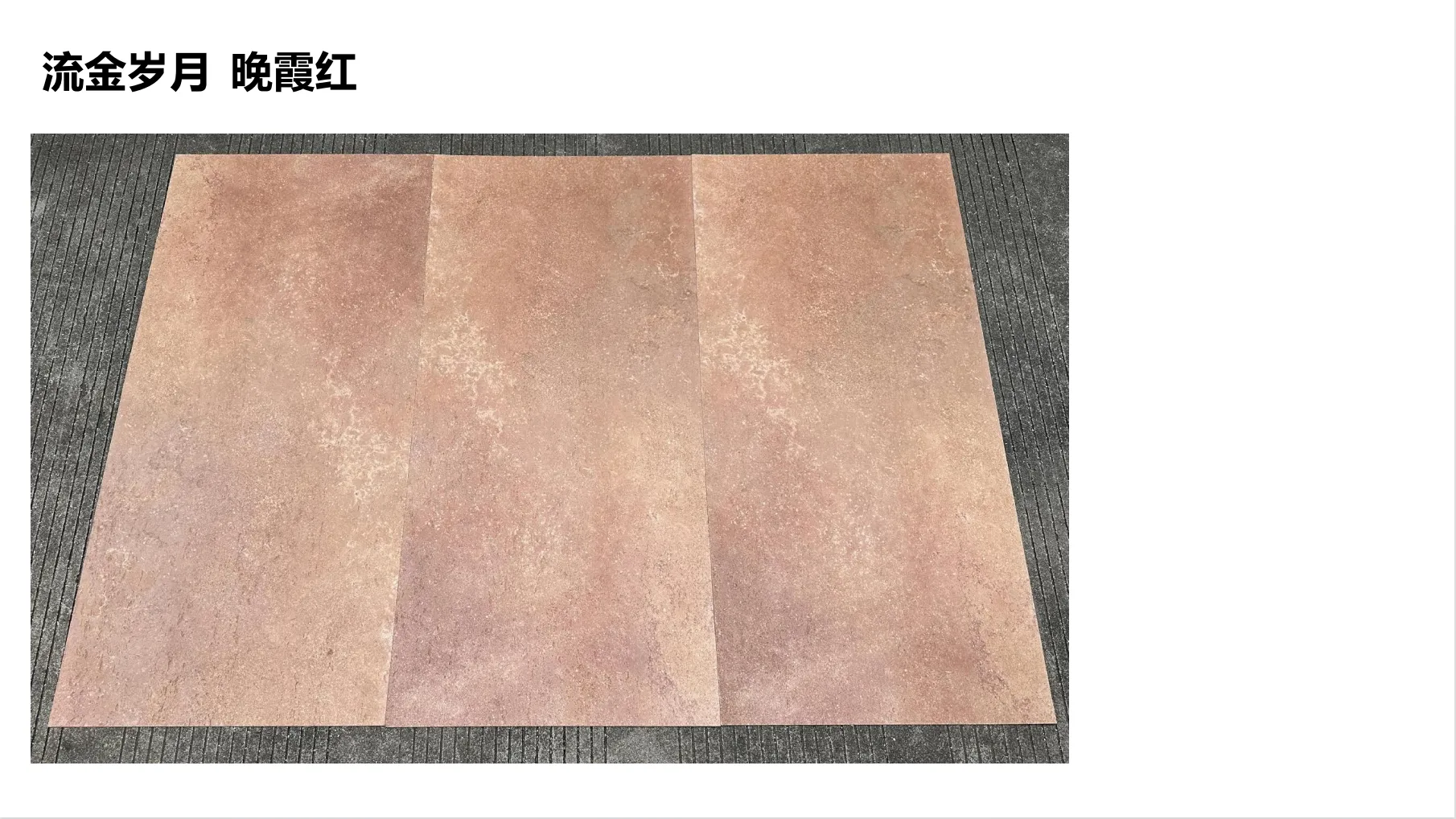
Now, contrast that with the MCM Big Slab Series . MCM, or Modified Composite Material, is engineered to mimic the look and texture of natural stone—think the warmth of travertine, the depth of marble, or the ruggedness of granite—without the density. How? By combining natural stone particles with a lightweight, flexible backing. The result? An 8mm-thick MCM Big Slab weighs just 12–15 kilograms per square meter. That's less than a standard carry-on suitcase. Suddenly, installing stone cladding isn't a Herculean task requiring cranes, forklifts, and a team of 10; it can be done with a small crew, basic tools, and a fraction of the time.
To visualize the difference, let's look at the numbers in black and white:
| Material | Thickness (mm) | Weight per Square Meter (kg) | Typical Application Challenges |
|---|---|---|---|
| Traditional Granite | 20mm (standard) | 50–55 kg | Requires heavy machinery, 4+ workers per slab, structural reinforcement often needed |
| MCM Big Slab (Granite Texture) | 8mm (standard) | 12–15 kg | Installed by 2 workers with basic tools, no structural reinforcement needed for most projects |
| Thin Granite (10mm) | 10mm (rare, fragile) | 25–30 kg | Prone to cracking during installation, still requires specialized lifting equipment |
| MCM Big Slab (Lunar Peak Golden) | 8mm | 13 kg | Lightweight enough for ceiling installations, easy to transport up narrow stairwells |
The numbers speak for themselves. MCM Big Slab weighs 75% less than standard granite while offering comparable (if not better) durability. But how does it hold up in real-world conditions? Let's dig into the benefits that go beyond the scale.
Weight reduction isn't just about making installation easier—it's a domino effect that impacts every stage of a project, from planning to completion. Let's break down the ripple benefits of choosing MCM Big Slab over granite:
Time is money in construction, and granite's weight is a major time-drain. A crew of 4 can install roughly 20 square meters of 20mm granite in a day, factoring in lifting, aligning, and securing each slab. With MCM Big Slab, that same crew can install 60–80 square meters in a day. "On a recent hotel renovation, we switched from granite to MCM Big Slab for the exterior cladding," says Lisa, a project manager for a commercial construction firm. "We cut the installation time from 12 weeks to 4, and the client was so impressed, they gave us a bonus for finishing early. That's unheard of in this industry."
Heavy materials mean more workers, bigger cranes, and specialized lifting gear. For a 500 sqm project, granite installation might require renting a boom lift ($1,500/day), hiring 6 workers instead of 2 ($400/day in extra labor), and adding insurance for heavy lifting ($500/week). Over 12 weeks, that's an extra $42,000—enough to upgrade fixtures, add custom lighting, or boost the landscaping budget. MCM Big Slab eliminates most of these costs. No boom lift? No problem—workers can carry panels up ladders or use simple pulley systems. Fewer workers? Absolutely—two people can handle MCM slabs with ease. "We saved $35,000 on labor and equipment for a 300 sqm retail space by choosing MCM," says Raj, a small business owner who recently renovated his restaurant. "I used the savings to install a better HVAC system, and now customers actually stay longer because it's more comfortable."
Heavy materials don't just strain buildings—they strain workers. Back injuries, falls, and equipment accidents are all too common in granite installation. The Bureau of Labor Statistics reports that material handling accidents cost the construction industry $15 billion annually, with overexertion (read: lifting heavy slabs) as the leading cause. MCM Big Slab's 12kg/sqm weight reduces this risk dramatically. "Since we switched to MCM, our workers' comp claims have dropped by 60%," says Mike, a safety officer for a mid-sized contracting company. "It's not just about avoiding fines; it's about coming home safe to their families. That matters more than any deadline."
For historic buildings or structures with aging foundations, MCM's lightweight design is a lifesaver. "We worked on a 1800s church conversion to luxury lofts," Tom, the heritage engineer, shares. "The walls were made of lime mortar, which crumbles under heavy weight. MCM Big Slab allowed us to add a stone accent wall in the lobby without reinforcing the entire structure—saving us $120,000 in structural repairs. The finished space looks like it's always had that stone wall, and the original architecture remains intact."
Granite slabs are not only heavy but also brittle. Transporting them requires specialized trucks with air-ride suspension, custom crates, and drivers trained in handling fragile cargo. A single cracked slab can cost $500 to replace, plus the delay of waiting for a new one. MCM Big Slab, on the other hand, is flexible and lightweight. Panels can be stacked flat in standard trucks, reducing shipping costs by 50%. "We once shipped 1,000 sqm of MCM from the factory to a remote mountain resort in Colorado," says Jake, a logistics coordinator. "With granite, that would have required a refrigerated truck to prevent cracking in the cold, and we would have needed two trucks. With MCM, we used one standard box truck, no special equipment, and the panels arrived in perfect condition. The client couldn't believe we pulled it off in 3 days instead of 2 weeks."
Numbers and stats tell part of the story, but real projects bring it to life. Let's explore three case studies where MCM Big Slab's lightweight design made the impossible possible:
The 1910s brick schoolhouse had beautiful bones but weak floor joists—original pine beams that couldn't handle more than 25kg/sqm on the upper floors. The client wanted a "rustic industrial" vibe, with stone walls in the common areas. Granite was off the table due to weight, and standard tiles felt cheap. Enter MCM Big Slab in Lunar Peak Golden —a warm, amber-hued panel that mimics the look of sunlit sandstone. "The Lunar Peak Golden panels added so much warmth to the space," says the client, Sarah, who owns the co-working company. "Members keep asking if it's real stone, and when I tell them it's MCM, they're shocked. The best part? We didn't have to reinforce the floors—saving $80,000 in structural work."
The developer wanted the exterior of their 40-story condo building to stand out—something more unique than glass. Granite was considered, but at 50kg/sqm, the added weight would have required thicker steel beams, increasing the building cost by $2 million. MCM Big Slab in Fair-faced Concrete texture solved the problem. The panels mimicked the raw, industrial look of poured concrete but weighed just 14kg/sqm. "We saved $2 million on steel, and the building now has this sleek, modern aesthetic that's become a Instagram hotspot," says the developer, Marcus. "Units sold 30% faster than projected, all because of that exterior design."
Homeowner Mia dreamed of a travertine backsplash in her kitchen but worried about the weight on her 1950s home's drywall. "My contractor said granite or even thick travertine could pull the drywall off the studs," she recalls. "I was heartbroken—until he showed me MCM Big Slab in Travertine (Starry Gold) . The panels are so light, they installed them with simple adhesive, no extra bracing. Now, I have this stunning, natural stone look, and I don't lie awake worrying about the walls caving in. Plus, it was 30% cheaper than real travertine!"
In the battle between MCM Big Slab and granite, weight isn't just a "nice-to-have" advantage—it's a transformative one. Granite, for all its beauty, is a relic of a time when construction prioritized durability over practicality. Today, projects demand more: faster timelines, tighter budgets, creative design, and a commitment to safety. MCM Big Slab delivers on all fronts, proving that "lightweight" can be strong, stylish, and smart.
Whether you're renovating a historic building, constructing a high-rise, or updating your home, the message is clear: don't let the weight of traditional stone hold you back. MCM Big Slab offers the best of both worlds—natural stone beauty without the natural stone hassle. As Tom, the structural engineer, puts it: "In 20 years, we'll look back at granite the way we look at lead pipes—functional for its time, but eventually replaced by something better. MCM is that 'something better.'"
So, the next time you're planning a project, ask yourself: Do I want to fight with heavy slabs, blow my budget on labor, and limit my design options? Or do I want to install a material that's lightweight, durable, stunning, and smart ? The answer, we think, is clear. MCM Big Slab isn't just a building material—it's a weight off your shoulders, and a step forward for construction.
Recommend Products












