
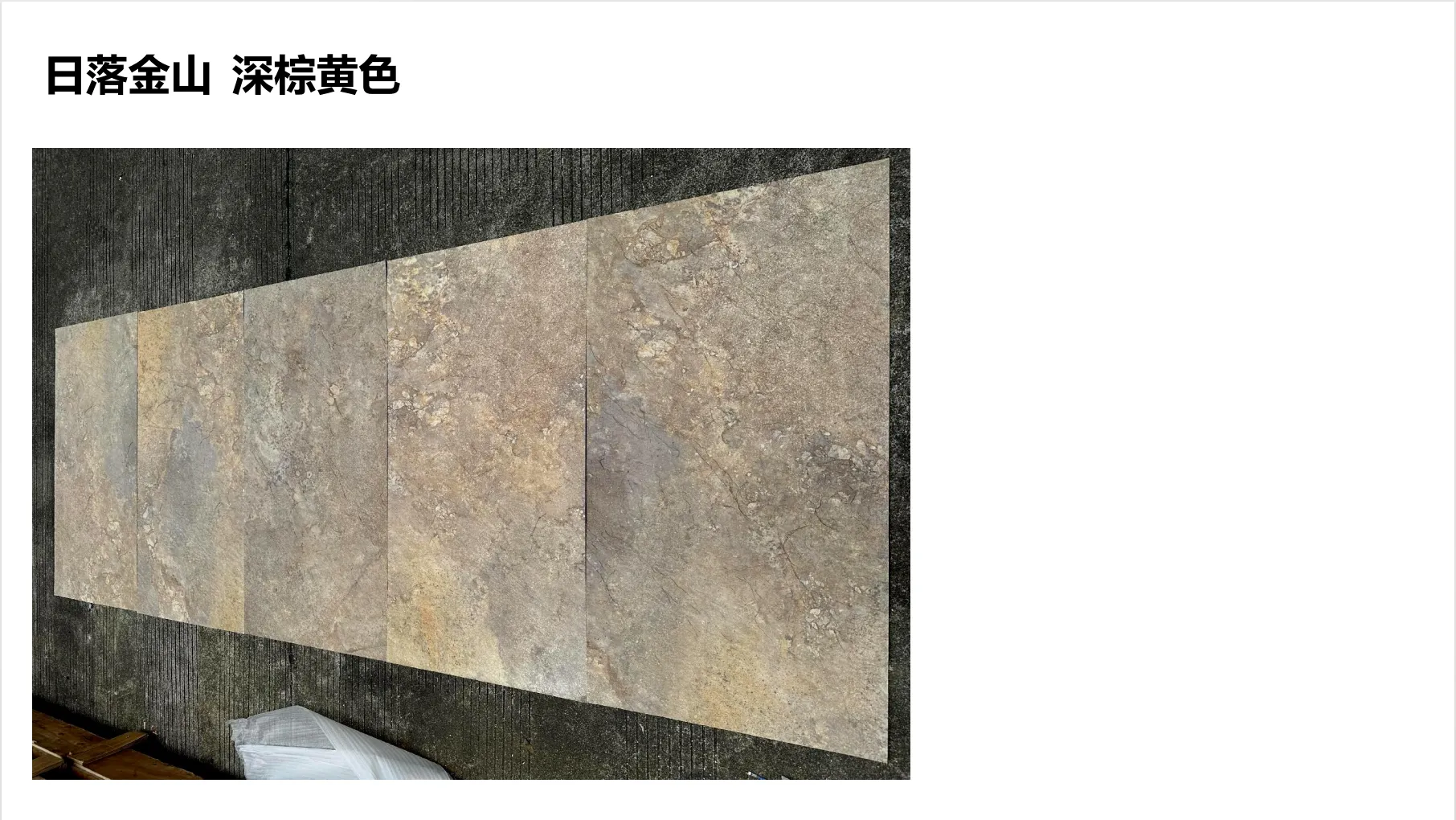
Elena stood in the lobby of the newly opened Azure Hotel, her shoes clicking softly against the polished terrazzo floor. It was 6:32 PM, and the late autumn sun was dipping low, casting slanted gold streaks through the floor-to-ceiling windows. What stopped her in her tracks, though, wasn't the view of the city skyline—it was the wall. Behind the reception desk, a sweeping curve of material that seemed to glow from within, as if lit by a hidden flame. The color shifted as the light faded: first a warm amber, then a soft rose, until finally settling into a deep, velvety taupe that felt like a hug. "Is that…?" she murmured, stepping closer. A small placard by the wall read: COLORIA Lunar Peak Golden, MCM Series .
Elena, an architect with 15 years of experience, had seen her share of building materials. But this—this felt different. It wasn't just stone or concrete or metal. It was a story. "It's like watching a sunset frozen in time," she thought, running her hand over the surface. Smooth, but with a subtle texture that whispered of craftsmanship, not machines. Later, she'd learn that this "Golden Sunset" effect wasn't an accident. It was the result of 30 years of COLORIA perfecting their MCM (Modified Composite Material) technology—turning raw elements into materials that don't just cover spaces, but elevate them. This is the story of that expertise: how COLORIA turned decades of curiosity, trial, and passion into materials that feel less like products, and more like partners in design.
In 1995, when COLORIA first opened its doors in a small workshop outside Milan, founder Marco Rossi had a simple goal: "Materials should tell stories." At the time, the construction industry was focused on efficiency—how quickly a material could be installed, how cheaply it could be produced. Marco, a former sculptor, saw something missing: heart. "Stone from a quarry doesn't just have color," he'd say. "It has memory. The way it weathers, the veins that twist like rivers—those are stories. Why should our buildings forget that?"
Thirty years later, that philosophy still guides COLORIA. Walk through their flagship showroom in Barcelona, and you won't see rows of samples labeled with technical specs. Instead, you'll find "rooms": a cozy reading nook clad in Bamboo Mat Board, where the air smells faintly of fresh-cut wood; a modern kitchen with Fair-Faced Concrete countertops that feel warm to the touch, not cold; a bathroom wall of Travertine (Starry Blue) that, under soft lighting, sparkles like a night sky reflected in water. Each space is designed to make you feel —not just see.
"We don't sell 'cladding' or 'panels,'" says Sofia Mendez, COLORIA's current design director, who joined the company as an intern in 2008. "We sell moments. The moment a homeowner walks into their living room and thinks, 'This feels like me .' The moment a hotel guest pauses in the lobby and pulls out their phone to take a photo—not of the chandelier, but of the wall. That's the 'Golden Sunset' we chase: that split second when a space stops being a structure and becomes a memory."
"Curves used to be the enemy of cladding," laughs Carlos, a project manager who's worked with COLORIA for over a decade. "You'd want a rounded facade, and the contractor would say, 'Stone doesn't bend. You'll have to use metal, or worse—vinyl.'" That changed in 2003, when COLORIA unveiled their MCM Flexible Stone series. Today, it's one of their most beloved innovations—and for good reason.
Traditional natural stone is heavy, brittle, and unforgiving. MCM Flexible Stone, by contrast, is a marvel of engineering: a thin layer of real stone veneer bonded to a lightweight, flexible composite backing. The result? A material that can bend up to 90 degrees without cracking, yet still looks and feels like the real thing. "We tested it on a curved wall in a concert hall in Lisbon," Carlos recalls. "The acoustics team was worried the material would warp with sound vibrations. Three years later, that wall still looks brand new. And the way the light hits it during evening performances? It's like the stone is dancing."
But it's not just about functionality. MCM Flexible Stone carries the same "memory" Marco Rossi cherished. Take the Travertine (Starry Red) variant: tiny flecks of copper oxide are embedded in the stone, catching light like embers. "A restaurant in Kyoto used it for their sushi bar counter," Sofia says. "At night, with the warm pendant lights, it looks like the counter is glowing from within. Diners don't just eat there—they experience it."
What truly sets COLORIA's MCM Flexible Stone apart, though, is its adaptability. "We had a client who wanted a facade that looked like a wave," Carlos adds. "Not a flat, painted wave—an actual, undulating surface. With traditional stone, that would have required custom-cut pieces, weeks of installation, and a budget that made the client wince. With MCM Flexible Stone? We bent the panels on-site, installed them in three days, and the client cried when they saw it. 'It's like the building is breathing,' they said."
In a world obsessed with "modern minimalism," there's a quiet rebellion happening: designers are craving texture. "People are tired of cold, sterile spaces," Sofia explains. "They want materials that feel lived-in —like they've been part of the world, not just manufactured." Enter two of COLORIA's most beloved textures: Bamboo Mat Board and Fair-Faced Concrete.
Bamboo Mat Board is a love letter to sustainability and tradition. Made from responsibly sourced bamboo (a grass that regrows in 3–5 years, unlike hardwood trees that take decades), the boards are woven by hand in small workshops in Vietnam, then treated with COLORIA's proprietary sealant to resist moisture and pests. The result? A material that looks like a handwoven mat, but feels smooth as silk—and lasts longer than solid wood. "A yoga studio in Portland used it for their walls," Sofia says. "The instructor told me students walk in and immediately sigh. 'It's the texture,' she said. 'It makes you want to slow down.'"
Then there's Fair-Faced Concrete—a material that sounds industrial, but in COLORIA's hands, is surprisingly warm. Traditional concrete is often gray, uniform, and dull. COLORIA's version? "We add natural pigments—ochre, sienna, even subtle hints of green—and vary the aggregate size," Sofia explains. "No two panels are exactly alike. It's like looking at a field of stones: each has its own personality." A boutique hotel in Copenhagen used it for their lobby floors, pairing it with fixtures. "At sunrise, the light hits the concrete and turns it honey-colored," Elena, the architect from the opening, recalls. "Guests sit on the benches just to watch it. It's not just a floor—it's a daily performance."
What unites these materials is COLORIA's commitment to balance: nature without the fragility, innovation without losing soul. "Bamboo Mat Board doesn't warp in humidity," Carlos notes. "Fair-Faced Concrete doesn't crack in cold climates. We take the best of the natural world and make it work for modern life. That's expertise—not just knowing how to make a material, but knowing how to make it live in the world."
To truly understand COLORIA's expertise, it helps to see how their materials solve real design problems. Below is a snapshot of three fan favorites, and why they've become go-to choices for architects and designers worldwide:
| Material | Key Feature | Emotional Impact | Ideal Application | Sustainability Note |
|---|---|---|---|---|
| MCM Flexible Stone (Travertine Starry Blue) | 90-degree bend capability; embedded glass flecks that reflect light like stars | Evokes calm, wonder—feels like bringing the night sky indoors | Curved accent walls, restaurant backdrops, hotel lobbies | Uses 70% less raw stone than traditional cladding, reducing quarry impact |
| Bamboo Mat Board | Handwoven texture; moisture-resistant sealant; warm, golden hue | Feels organic, grounding—invites relaxation and connection to nature | Yoga studios, home offices, bedroom accent walls | Made from fast-growing bamboo; weaving process supports local artisans |
| Fair-Faced Concrete (Ochre) | Varied aggregate size; natural ochre pigment; matte, velvety finish | Balances modern edge with earthiness—feels both bold and welcoming | Retail store facades, museum floors, outdoor patios | Low-carbon manufacturing process; pigment sourced from natural clay deposits |
In the coastal town of Dubrovnik, there's a boutique hotel called "The Lighthouse." Its exterior, once a drab gray concrete, now shimmers at sunset—a mosaic of Lunar Peak Silvery and Lunar Peak Golden MCM panels. "Before COLORIA, guests would check in and never look up," says the hotel's owner, Ana. "Now, they take photos of the facade. 'It looks like it's made of moonlight,' one guest told me. That's the power of these materials—they turn buildings into landmarks."
Or take the "Gobi Panel" project in Dubai. A tech startup wanted their office to feel like a desert oasis—cool, calm, and full of texture. COLORIA's Gobi Panel, with its rippled surface that mimics wind-swept sand, was the answer. "We paired it with foamed aluminium alloy board (vintage gold) for the reception desk," Carlos says. "The contrast—rough sand and smooth metal—feels like walking into an oasis at dawn. Employees say it's easier to focus there. They don't just work; they thrive ."
Perhaps the most touching example is a community center in Rio de Janeiro, built for kids in a low-income neighborhood. The walls are clad in Rust Mosaic Stone—a material that looks like weathered metal, but is actually MCM, lightweight and safe. "The kids call it the 'Robot Wall,'" Sofia laughs. "They run their hands over the mosaic patterns and make up stories about where the 'rust' came from. It's not just a building anymore. It's theirs."
So what is the "Golden Sunset" that COLORIA chases? It's not just a pretty phrase. It's the belief that great materials don't fade—they mature . "A sunset isn't just beautiful for a minute," Marco Rossi once said. "It's beautiful because it changes—softens, warms, then fades into something even richer. Our materials should do the same."
Take the Epoch Stone series, launched in 2010. Designed to mimic the look of ancient stone walls, it actually improves with age. "The surface oxidizes slightly, developing a patina that makes it look like it's been there for centuries," Sofia explains. "A winery in Tuscany used it for their tasting room. Ten years later, the owner says, 'It looks better now than the day we installed it. It feels like the stone has absorbed all the laughter and stories of our guests.'"
That's the expertise of COLORIA: not just creating materials that look good on day one, but materials that grow into the spaces they inhabit. It's why architects like Elena keep coming back. "I don't just specify COLORIA because their materials are high-quality," she says. "I specify them because they trust me to tell stories. With their MCM Flexible Stone, I can design a curved wall that feels like a hug. With their Bamboo Mat Board, I can create a space that whispers 'home.' That's the real magic—they don't just supply materials. They supply meaning ."
As the sun finally dips below the horizon at the Azure Hotel, Elena takes one last look at the Lunar Peak Golden wall. The light is now a soft pink, and the material glows like a memory. "Thirty years of expertise," she thinks. "And it all comes down to this: making spaces feel alive." For COLORIA, that's the golden sunset—decades of passion, poured into every panel, every texture, every story. And as long as there are designers who crave heart in their spaces, that sunset will keep shining.
Recommend Products












