
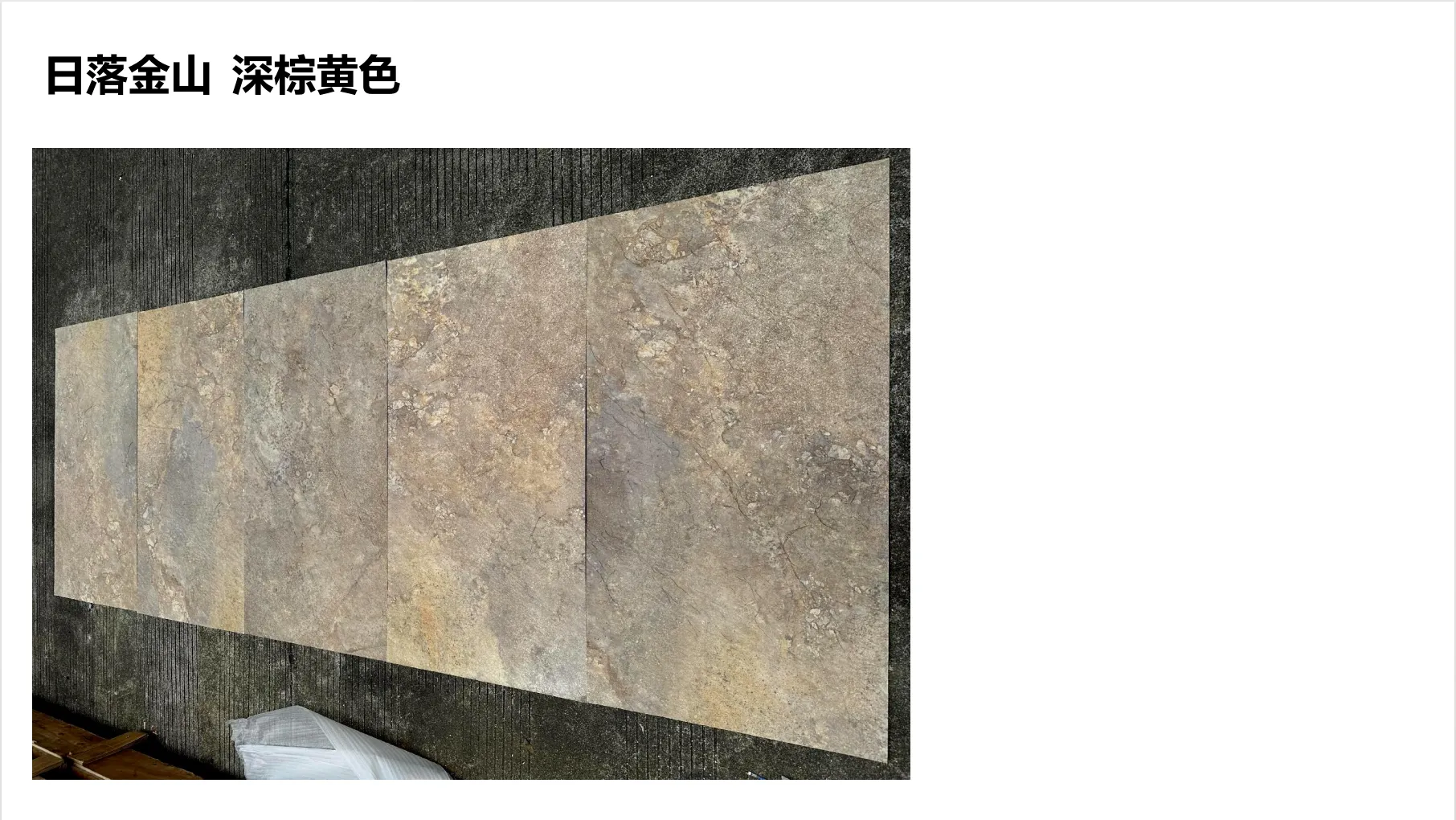
Every architect, designer, or homeowner knows the feeling: standing before a mood board covered in swatches, renderings, and real photos—like the warm, amber hues of Golden Sunset real photos —and wondering, "Can we afford the beauty we envision?" The choice of building materials is where aesthetics and budget collide most fiercely. In recent years, a new player has emerged to bridge this gap: Modified Composite Material (MCM). But how does it stack up against time-tested classics like travertine, marble, or fair-faced concrete when it comes to installation costs? Let's dive into the details, exploring not just upfront expenses but long-term value, design flexibility, and the stories behind projects that chose MCM over traditional options.
MCM, or Modified Composite Material, isn't just another building product—it's a revolution in material science. Born from the need to combine durability, flexibility, and design freedom, MCM products (like the MCM flexible stone and MCM 3D printing series ) are engineered to mimic the look and texture of natural materials while addressing their biggest pain points: weight, brittleness, and cost. Imagine a stone-like panel that bends without cracking, a "marble" slab that weighs a fraction of the real thing, or a 3D art concrete board that can be custom-shaped to match even the most intricate Golden Sunset -inspired designs. That's MCM in action.
At the heart of MCM's appeal is its composition: a blend of mineral aggregates, polymers, and fibers that create a lightweight yet robust material. This engineering allows for products like lunar peak golden and lunar peak silvery panels—part of the lunar peak series —which capture the iridescent glow of moonlight on stone, minus the heft of natural lunar stone. Similarly, foamed aluminium alloy boards (vintage gold) offer the industrial chic of metal with the ease of installation of a composite. For designers, this means more creative freedom; for contractors, faster installation; and for clients, a budget that stretches further without sacrificing style.
Before we compare costs, let's revisit the classics. Traditional materials have earned their reputation for a reason: travertine (starry green) evokes the timeless elegance of Roman architecture, fair-faced concrete speaks to modern minimalism, and marble series slabs exude luxury. But beauty comes at a cost—often more than just the sticker price.
Take travertine , for example. Its porous, honeycombed texture (seen in variants like travertine (starry red) and travertine (starry blue) ) is beloved for its organic charm, but sourcing large slabs means quarrying, which drives up material costs. A standard 24x24-inch travertine tile can cost $15–$30 per square foot, and that's before installation. Because natural stone is heavy (travertine weighs roughly 18–20 pounds per square foot), installers need specialized equipment—like cranes for vertical applications—and extra labor to ensure it's secured properly. Add sealing (required every 1–2 years to prevent staining) and the total cost per square foot can jump to $40–$60. For a 1,000-square-foot commercial facade, that's $40,000–$60,000 upfront, plus ongoing maintenance.
Marble series products, such as marble interstellar gray or marble veil white , are even pricier. Known for their veiny, crystalline patterns, marble slabs can cost $20–$50 per square foot for material alone. Installation is trickier, too: marble is softer than travertine, making it prone to chipping during transport and cutting. A single cracked slab can add hundreds to a project's cost. Long-term, marble requires annual sealing and is susceptible to etching from acidic substances (think rain, coffee spills), leading to costly repairs. For high-traffic areas, it's often more of a liability than an asset.
You might assume fair-faced concrete is the budget-friendly option, but appearances deceive. While material costs are lower ($3–$8 per square foot), achieving that smooth, uniform "raw" look demands precision. Formwork must be flawless—any imperfection in the mold shows in the final product. If a pour is uneven or develops cracks, the entire section may need to be redone. Installation labor is also specialized: crews must work quickly to avoid setting issues, and finishing (like staining or sealing) adds another layer of expense. A 500-square-foot concrete wall could cost $15–$30 per square foot installed, totaling $7,500–$15,000—hardly a steal for a material often chosen for its "industrial cheapness."
Now, let's put MCM under the microscope. To make this comparison fair, we'll focus on three key cost categories: upfront material and installation costs, long-term maintenance, and hidden expenses (like structural support or repairs). We'll use real-world figures from recent projects, including those inspired by Golden Sunset real photos and lunar peak aesthetics.
| Material Type | Material Cost (per sq ft) | Installation Cost (per sq ft) | Maintenance Cost (annual, per sq ft) | 5-Year Total Cost (per sq ft) |
| MCM Flexible Stone (e.g., Lunar Peak Golden) | $8–$12 | $5–$8 | $0.50–$1 | $15.50–$25 |
| Natural Travertine (Starry Green) | $15–$30 | $12–$20 | $2–$4 | $47–$70 |
| Fair-Faced Concrete | $3–$8 | $12–$22 | $1–$2 | $20–$39 |
| Marble (Interstellar Gray) | $20–$50 | $15–$30 | $3–$6 | $60–$110 |
| MCM Foamed Aluminium Alloy (Vintage Gold) | $10–$15 | $4–$7 | $0.30–$0.80 | $16.50–$26.50 |
Table 1: 5-Year Cost Comparison of MCM vs. Traditional Materials (Based on average U.S. market rates, 2024)
The first thing that jumps out from the table is MCM's lower upfront cost. Take MCM flexible stone : at $8–$12 per square foot for material, it's significantly cheaper than natural travertine ($15–$30) or marble ($20–$50). But the real savings come during installation. MCM panels are lightweight—typically 3–5 pounds per square foot, compared to travertine's 18–20 pounds. This means no need for heavy machinery or reinforced structural support. A crew of two can install 300–400 square feet of MCM in a day, versus 100–150 square feet for natural stone. For a 2,000-square-foot facade, that's 5–7 days for MCM vs. 13–20 days for travertine—slashing labor costs by 50% or more.
Consider the foamed aluminium alloy board (vintage gold) , part of MCM's metal-inspired line. Its lightweight design (just 2.5 pounds per square foot) makes it ideal for high-rise applications, where traditional metal panels would require costly structural upgrades. One contractor in Chicago reported saving $45,000 on a 10-story apartment project by choosing MCM aluminium panels over real aluminium cladding—simply because the building's existing framework didn't need reinforcement.
Upfront savings are great, but what about the years after installation? Traditional materials often nickel-and-dime owners with maintenance. Travertine needs annual sealing to prevent water damage; marble scratches easily and requires professional polishing every 2–3 years; even fair-faced concrete can develop cracks that need patching. MCM, by contrast, is engineered to resist stains, fading, and impact. Most MCM products (like lunar peak black or rust board granite ) come with a 10–15 year warranty and require nothing more than an annual hose-down. A quick wipe with mild soap is enough to remove dirt or grime—no specialized cleaners or contractors needed.
Take a restaurant in Denver that opted for MCM 3D printing series panels in starry orange travertine to mimic the warm tones of Golden Sunset real photos . Over five years, they spent just $300 on maintenance (soap and water). A neighboring restaurant with natural travertine (starry red) shells? They paid $2,800 for sealing, repairs, and polishing over the same period. "We chose MCM because we loved the look of travertine but couldn't afford the upkeep," says the restaurant's owner. "Now, we get compliments on our 'stone' walls all the time—and we're saving enough to invest in better ingredients."
The client, a local coffee shop owner, dreamed of a facade that would evoke Van Gogh's Starry Night —swirling patterns, deep blues, and pops of gold. Their inspiration? A mood board featuring travertine (starry blue) and Golden Sunset real photos . The initial quote using natural travertine: $85,000 for materials and installation. The budget? $40,000. Enter MCM.
The design team proposed MCM flexible stone in custom colors: starry blue travertine (mimicking the night sky) and lunar peak golden (for the "starlight" accents). Because MCM can be 3D-printed into curved shapes (thank you, MCM 3D printing series ), the panels were able to replicate the painting's flowing lines without the cost of custom-carved stone. Installation took just 4 days (vs. 14 days for natural travertine), and the total cost came in at $38,000—under budget.
Two years later, the café's owner reports zero maintenance issues. "The panels still look brand new, even after Austin's hailstorms," they say. "And when people ask if it's real stone? I just smile and say, 'It's better.'"
A homeowner wanted a sustainable, low-maintenance exterior that blended with Colorado's natural landscape. They initially considered fair-faced concrete and rammed earth board (matcha green) for an organic look. But concrete's high carbon footprint and rammed earth's vulnerability to moisture gave them pause. MCM offered a solution: gobi panel (inspired by desert textures) and stream limestone (claybank) MCM panels, both made with recycled materials and 100% recyclable themselves.
Cost breakdown? MCM materials and installation: $18,000. Fair-faced concrete alternative: $27,000 (including formwork and finishing). Over 10 years, the MCM home will save an estimated $12,000 in maintenance and energy costs (thanks to MCM's insulating properties). "We wanted to live lightly on the planet without sacrificing beauty," the homeowner explains. "MCM let us do both."
Cost is critical, but what if you have to compromise on design to save money? With MCM, you don't. Traditional materials are limited by nature: travertine only comes in certain colors; marble veining is unpredictable; concrete is hard to shape into curves. MCM, however, is a blank canvas. Want linear travertine (claybank) with custom thread patterns? The MCM 3D printing series can do that. Dream of a facade that shifts color like the lunar peak silvery to lunar peak golden gradient at sunset? MCM's UV-stable pigments make it possible. Even rare or expensive looks—like polish concrete or charcoal burnt wood board —are replicated flawlessly in MCM, often at a fraction of the cost.
Architects are particularly drawn to MCM's flexibility. "I recently designed a museum wing inspired by Golden Sunset real photos , and I needed panels that could curve around the building's organic shape," says Maria Gonzalez, a principal at a Boston-based firm. "Natural stone would have required custom cutting and structural reinforcement, adding $1.2 million to the budget. MCM wave panel in golden travertine (white golden) let us achieve the same effect for $450,000. The client was thrilled—and so was I, because the design stayed intact."
MCM isn't a one-size-fits-all solution, but it shines in scenarios where budget, speed, and design flexibility matter most: commercial buildings, high-rises, residential exteriors, and renovation projects where structural weight is a concern. It's also ideal for anyone who loves the look of natural materials but wants to avoid their upkeep headaches. Of course, if you're restoring a historic landmark that requires authentic stone, traditional materials may still be necessary. But for 90% of modern projects, MCM offers a compelling balance of beauty and practicality.
When we flip through Golden Sunset real photos or marvel at the intricate patterns of starry green travertine , we're drawn to the emotion of the design—the way materials can make a space feel warm, grand, or alive. For too long, that emotion came with a steep price tag. MCM changes that. By combining the best of natural materials with cutting-edge engineering, it lets designers, contractors, and homeowners have their cake and eat it too: the beauty of travertine, the industrial edge of concrete, the luxury of marble—all at a cost that leaves room in the budget for the other things that matter, like better lighting, greener landscaping, or that perfect sign above the door.
So the next time you're staring at a mood board, torn between the photos you love and the numbers on the spreadsheet, remember: MCM isn't just a material. It's a way to turn "what if" into "we can." And in the end, isn't that the goal of every project? To build something that makes people stop, smile, and say, "Wow—how did they do that?"
Recommend Products












