
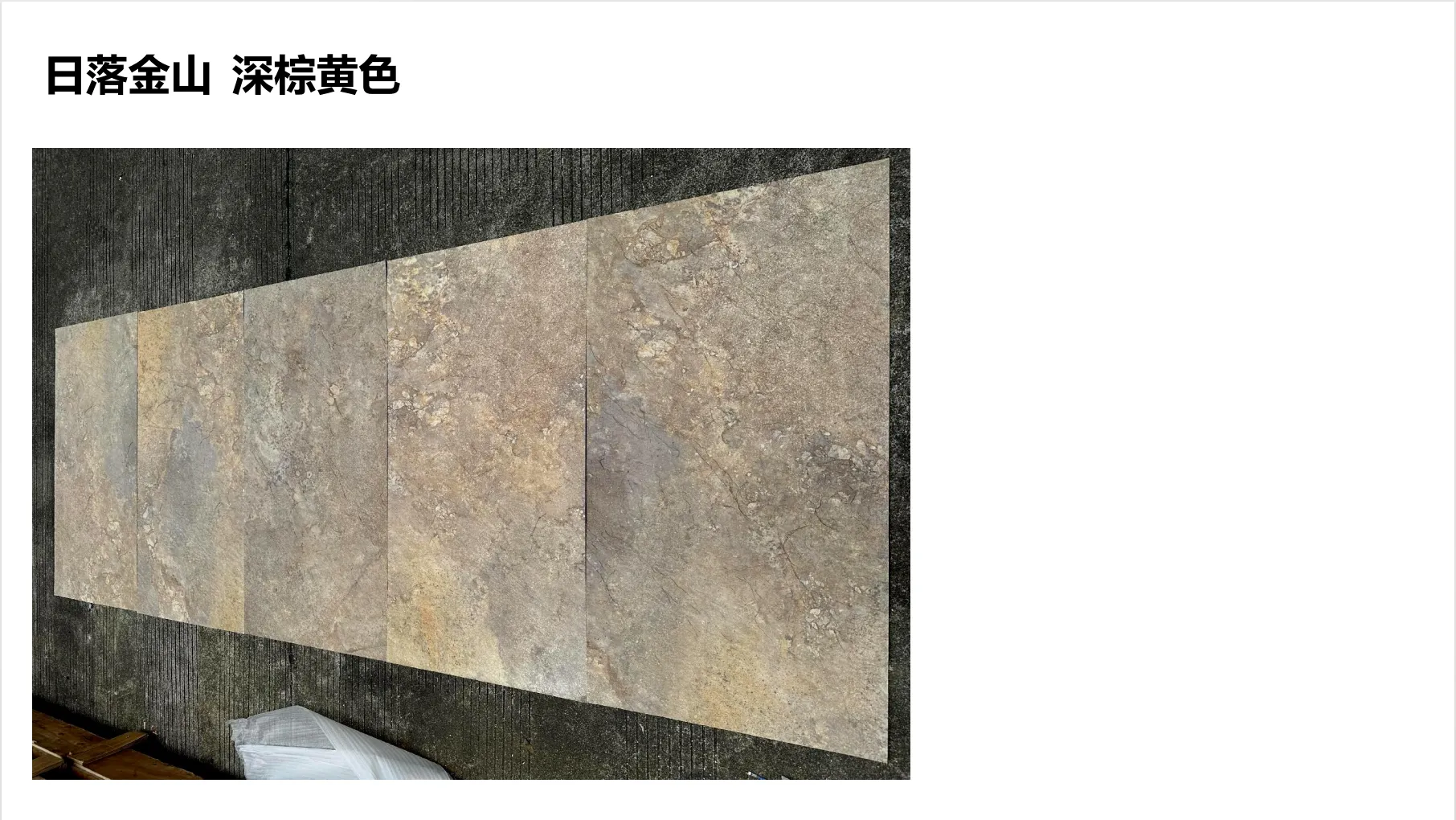
There's something almost magical about a golden sunset. It's that fleeting moment when the sky ignites in a blaze of oranges, pinks, and golds, turning ordinary landscapes into something extraordinary. For centuries, artists, poets, and dreamers have chased this beauty—capturing it in oil paintings, sonnets, and memories. But what if we could bring that same warmth, that same emotional resonance, into the spaces we live and work in? That's the question that sparked the creation of MCM's Golden Sunset collection—a line of architectural materials designed to bottle the essence of those precious twilight hours. And at the heart of this collection lies a game-changing innovation: MCM 3D printing series . Today, we're diving into how this technology transforms pixels into tangible emotion, and why the Golden Sunset real photos aren't just images—they're windows into a new era of design.
Before we talk about 3D printers and materials, let's pause and ask: why sunsets? What is it about that daily celestial performance that tugs at our heartstrings? Maybe it's the way the light softens, turning harsh edges into gentle gradients. Or perhaps it's the impermanence—the reminder that beauty is fleeting, making each moment feel precious. For the designers at MCM, sunsets are more than just a visual spectacle; they're storytellers. They speak of transition—day to night, work to rest, chaos to calm. And in a world that often feels fast-paced and disconnected, that story is one we crave to bring into our physical spaces.
"We wanted to create something that doesn't just look like a sunset—it feels like one," says Elena Marquez, lead designer of MCM's project board series . "Think about the last time you stood watching the sun dip below the horizon. Maybe you were on a beach, or a rooftop, or even just looking out your kitchen window. There's a quiet joy in that moment, a sense of peace. We wanted to bottle that and let people carry it with them, every day, in their homes, offices, hotels, and restaurants."
But translating the ephemeral into the tangible is no small feat. Sunsets are defined by movement—clouds drifting, light shifting, colors blending. How do you capture that dynamism in a stationary material? That's where MCM 3D printing series came into play. Unlike traditional manufacturing methods, which are limited by molds and uniformity, 3D printing allows for intricate, layered designs that mimic the organic chaos of a sunset's canvas. It's not just about printing a pattern; it's about printing a narrative .
One of the biggest hurdles in designing the Golden Sunset collection was avoiding the "flatness" that plagues many architectural materials. "A photo of a sunset can be stunning, but if you print that photo onto a wall panel, it still feels like a sticker," explains Marcus Chen, MCM's head of material science. "We needed the texture to breathe. To have depth. To make you want to reach out and touch it, as if you could feel the warmth of the sun on your fingertips." Enter flexible stone —a proprietary material developed by MCM that combines the durability of natural stone with the malleability of fabric. When paired with 3D printing, it allows for micro-level variations in texture: tiny ridges that mimic the ripples of clouds, subtle indentations that catch light like sunbeams, and color gradients that shift depending on the angle of view. "It's not just a surface," Chen adds. "It's a sensory experience ."
To understand why the Golden Sunset collection is a breakthrough, we need to first unpack what makes MCM 3D printing series different. Traditional 3D printing in architecture often focuses on structural elements—beams, panels, functional parts. MCM's approach is different: they use 3D printing as a tool for expression . Think of it less like building a wall and more like painting a masterpiece, but with concrete, stone, and alloy instead of oil and canvas.
The process starts with a digital canvas. Designers work with high-resolution images of real sunsets—some captured by MCM's in-house photographers during expeditions to locations known for breathtaking twilight scenes (think Santorini's caldera, the Serengeti plains, the Amalfi Coast). These images are then analyzed for color distribution, light intensity, and texture patterns. Using advanced algorithms, the team converts these 2D images into 3D models, adding depth maps that dictate where the printer will deposit more material (creating ridges) and where it will lay down thinner layers (creating valleys).
But here's where the magic happens: unlike standard 3D printers that use a single material, MCM's printers are equipped with multiple nozzles, each loaded with a different formulation of flexible stone or composite. This allows for in-situ color blending —meaning the printer can mix hues on the fly, just like a painter mixing paints on a palette. "If you look at a real sunset, you'll notice that the transition from orange to pink isn't a hard line—it's a gradient of hundreds of subtle shades," says Raj Patel, MCM's lead engineer for 3D printing. "With traditional manufacturing, you'd need multiple layers or separate panels to achieve that. With our 3D printers, we can blend those colors in real time, creating a single, seamless surface that looks like it's glowing from within."
Another key innovation is the use of big slab board series as the base material. These slabs—some as large as 2400x1200mm—provide a vast, uninterrupted canvas for the 3D printing process. "Imagine trying to paint a mural on tiny tiles versus a single large canvas," Patel explains. "The big slabs let the sunset pattern flow without breaks, preserving the continuity that makes sunsets so immersive." And because the slabs are made from flexible stone , they're lightweight and easy to install, even in large-scale projects. "We've had clients use these slabs in lobbies, where the entire wall becomes a sunset panorama. Walking into that space isn't just entering a room—it's stepping into a memory."
At the core of the Golden Sunset collection are the colors—the vibrant, shifting shades that mimic nature's most dramatic displays. While the name "Golden Sunset" evokes images of amber and gold, the collection is surprisingly diverse, drawing inspiration from sunsets around the world. Let's take a closer look at the star players:
| Travertine Variant | Key Color Notes | Emotional Tone | Design Scenarios |
|---|---|---|---|
| Travertine (starry orange) | Warm tangerine base with flecks of gold and burnt sienna; mimics desert sunsets in Arizona or Dubai. | Energetic yet cozy—like a crackling fire on a cool evening. | Residential living rooms, restaurants, or wellness spaces where warmth is prioritized. |
| Travertine (starry red) | Deep crimson gradients blending into soft pinks and coral; inspired by tropical sunsets over the Caribbean. | Passionate and romantic—adds a bold, artistic statement. | Hotel suites, boutique cafes, or feature walls in art galleries. |
| Travertine (starry blue) | Indigo and violet undertones with hints of teal; captures the "blue hour" just after sunset in coastal regions. | Calm and serene—evokes the quiet of twilight over the ocean. | Bedrooms, home offices, or spa interiors where relaxation is key. |
| Travertine (starry green) | Olive and emerald swirled with gold; inspired by rare "green flash" sunsets seen in polar regions. | Mystical and earthy—adds an unexpected, nature-forward twist. | Eco-friendly homes, botanical gardens, or yoga studios. |
Each of these variants is printed using MCM's 3D technology, but the star of the show is undoubtedly the Golden Sunset itself—a custom blend that leans into the warm, amber tones that give the collection its name. "We tested over 50 iterations of the 'golden' shade before landing on the final formula," says Elena Marquez. "It needed to be bright enough to feel like sunlight, but soft enough to avoid being overwhelming. We added tiny metallic particles—so small they're almost microscopic—that catch the light and create a subtle shimmer, like dust motes dancing in a sunbeam."
To truly appreciate the artistry of the Golden Sunset collection, you need to see the real photos —and not just glance at them, but study them. Let's zoom in on one of the most striking images: a 2400x1200mm big slab board series featuring the starry orange travertine. At first glance, it's a wash of warm orange, but step closer, and the details emerge. There's a "horizon line" where the color shifts from deep terracotta to pale peach—a deliberate nod to the sun touching the edge of the world. Above that, 3D-printed "clouds" ripple across the surface, their texture so realistic you half-expect them to drift. And if you tilt your head, you'll notice the metallic flecks catching the light, creating the illusion of the sun's last rays bouncing off water.
Another photo showcases the starry blue travertine in a residential bathroom. The slab covers the entire wall behind the bathtub, and when paired with soft, warm lighting, it transforms the space into a coastal retreat. The 3D-printed texture here is more subtle—gentle waves that mimic the ocean's surface at dusk. "A client once told us that taking a bath there feels like 'soaking in twilight,'" Marquez laughs. "That's the reaction we live for."
Perhaps the most photo, though, is a commercial project in a hotel lobby: a curved wall made of multiple MCM project board series slabs, seamlessly joined to create a 10-meter-wide sunset panorama. The starry red and golden hues blend at the center, fading into starry blue at the edges, mimicking the way the sky transitions from day to night. "We used 3D scanning to map the curvature of the wall first, then programmed the printer to adjust the pattern accordingly," Patel explains. "The result is a wall that doesn't just have a sunset—it wraps you in one."
While 3D printing is the technology that brings the design to life, the material that makes it possible is flexible stone . Traditional natural stone is beautiful but heavy, brittle, and hard to manipulate into complex shapes. MCM's flexible stone changes the game. Made from a blend of natural stone particles, recycled polymers, and reinforcing fibers, it's 70% lighter than traditional stone, yet just as durable. And, as the name suggests, it's flexible—able to bend up to 30 degrees without cracking. This opens up a world of possibilities for architects and designers.
"Imagine a curved wall, or a ceiling installation that sweeps like a wave—traditional stone would require expensive, labor-intensive cutting and support structures," says Chen. "With flexible stone, we can 3D print the design directly onto the curved surface, or even roll the printed slabs onto a cylinder for transport, then unroll them on-site. It's a game-changer for both aesthetics and practicality."
In the Golden Sunset collection, flexible stone's properties are put to full use. Take the wave panel sub-series, for example. These panels are 3D printed with a undulating surface that mimics the way sunlight dances on water during sunset. Because the stone is flexible, the waves can be more pronounced—deeper troughs, higher peaks—without sacrificing structural integrity. "We tested one panel by leaning a 10kg weight against the peak of a wave, and it didn't budge," Chen says proudly. "It's beauty with backbone."
Another material making waves in the collection is the foamed aluminium alloy board (vintage gold) , used as an accent in some Golden Sunset designs. The alloy's metallic sheen adds a modern twist to the organic sunset patterns, creating a contrast that feels both timeless and contemporary. "We wanted to balance the warmth of the travertine with something a little cooler, a little more industrial," Marquez explains. "The vintage gold alloy acts like the 'silver lining' of the cloud—adding depth and visual interest without overpowering the sunset palette."
At the end of the day, architectural materials are meant to be experienced in person. So what happens when you install a Golden Sunset slab in a real space? Let's explore a few case studies that bring the Golden Sunset real photos to life.
Case Study 1: The Coastal Villa Retreat
A luxury villa in Bali wanted to blur the line between indoor and outdoor living. The designers chose the starry orange travertine for the living room wall, which faces a large glass door opening to the ocean. During the day, natural light filters through the glass, hitting the 3D-printed texture and casting warm, dappled shadows across the room—like sunlight through palm leaves. At night, LED strips behind the slab illuminate it from within, making the orange hues glow softly, mirroring the sunset outside. "The told us that even on rainy days, the wall 'feels' like a sunny evening," Marquez says. "That's the power of emotional design."
Case Study 2: The Urban Restaurant
A trendy bistro in Tokyo's Shibuya district was looking to create a "third space"—somewhere between a casual cafe and a fine dining restaurant. They opted for the starry red travertine on the main dining wall, paired with
foamed aluminium alloy board (vintage gold)
accents. The red hues create an intimate, romantic atmosphere, while the gold alloy adds a touch of sophistication. "The 3D-printed texture on the travertine catches the restaurant's pendant lights, creating a warm, flickering effect—like candlelight," Patel notes. "Customers often comment on how 'cozy' the space feels, even though it's in the middle of a busy city."
Case Study 3: The Corporate Wellness Center
A tech company in Silicon Valley wanted to design a wellness center that helps employees decompress. The center features the starry blue travertine in the meditation room, paired with
flexible stone
benches printed with the same pattern. The cool blue hues and gentle wave texture of the walls, combined with soft, indirect lighting, create a space that feels like a calm ocean at dusk. "We've had employees say they use the meditation room twice as much now," Marquez shares. "It's not just a pretty wall—it's a tool for well-being."
In an industry where renderings often promise more than reality can deliver, the Golden Sunset real photos are a breath of fresh air. These aren't filtered, Photoshopped images; they're unretouched snapshots of actual projects, taken by independent photographers. "We want clients to trust that what they see is what they'll get," says MCM's marketing director, Sarah Johnson. "Too often, designers fall in love with a rendering, only to be disappointed when the final product looks flat or washed out. Our real photos are our commitment: this is the texture, this is the color, this is the feeling."
Take, for example, a photo of the starry blue travertine in a home office. The image shows a desk pressed against the wall, with a laptop and a potted plant on it. The light source is a desk lamp, casting a warm glow on the stone. What's striking is how the texture comes alive under that light—you can see the tiny ridges and valleys, the way the blue hue deepens in the shadows and lightens where the lamp hits. "That's not a studio setup," Johnson explains. "That's a real client's office, with their actual stuff on the desk. We wanted to show the material in context, doing what it's meant to do: enhance everyday life."
Another photo captures the starry orange travertine in a commercial kitchen. Yes, a kitchen—hardly the typical spot for a "decorative" wall. But the client, a celebrity chef, wanted the space to feel inspiring, even during early-morning prep. The travertine slab runs along the back wall, and the photo shows sunlight streaming in through a window, hitting the stone and reflecting onto the stainless steel counters. "The chef told us that chopping vegetables there feels 'like cooking at sunset,'" Johnson laughs. "That's the kind of feedback that makes all the late nights worth it."
The Golden Sunset collection is just the beginning. MCM's 3D printing technology is evolving, with plans to introduce even more intricate textures and color combinations. "We're experimenting with bioluminescent additives that glow softly in low light, mimicking the way sunsets fade into starry nights," Patel hints. "Imagine a wall that transitions from golden orange at dusk to a subtle, star-like glow as the room darkens. The possibilities are endless."
There's also a focus on sustainability. The flexible stone already uses 40% recycled materials, but the team is working to increase that to 70% by 2026. "We believe that beauty shouldn't come at the expense of the planet," Chen says. "Our goal is to create materials that not only look like nature—they respect it, too."
And as for the emotional impact? Marquez sums it up best: "At the end of the day, we're not just selling building materials. We're selling moments. Moments of calm, moments of joy, moments of connection. The Golden Sunset real photos are proof that those moments can be built into the walls around us. So the next time you walk into a space and feel that inexplicable warmth, that sense of peace—look around. It might just be a MCM 3D-printed sunset, working its magic."
In a world that often feels disconnected from nature's beauty, MCM's Golden Sunset collection is a reminder that we don't have to choose between modernity and emotion. With 3D printing series , flexible stone , and a little bit of sunset inspiration, we can build spaces that don't just shelter us—they nurture us. And really, isn't that the ultimate goal of design?
Recommend Products












