
Exploring how materials shape the soul of expansive interiors
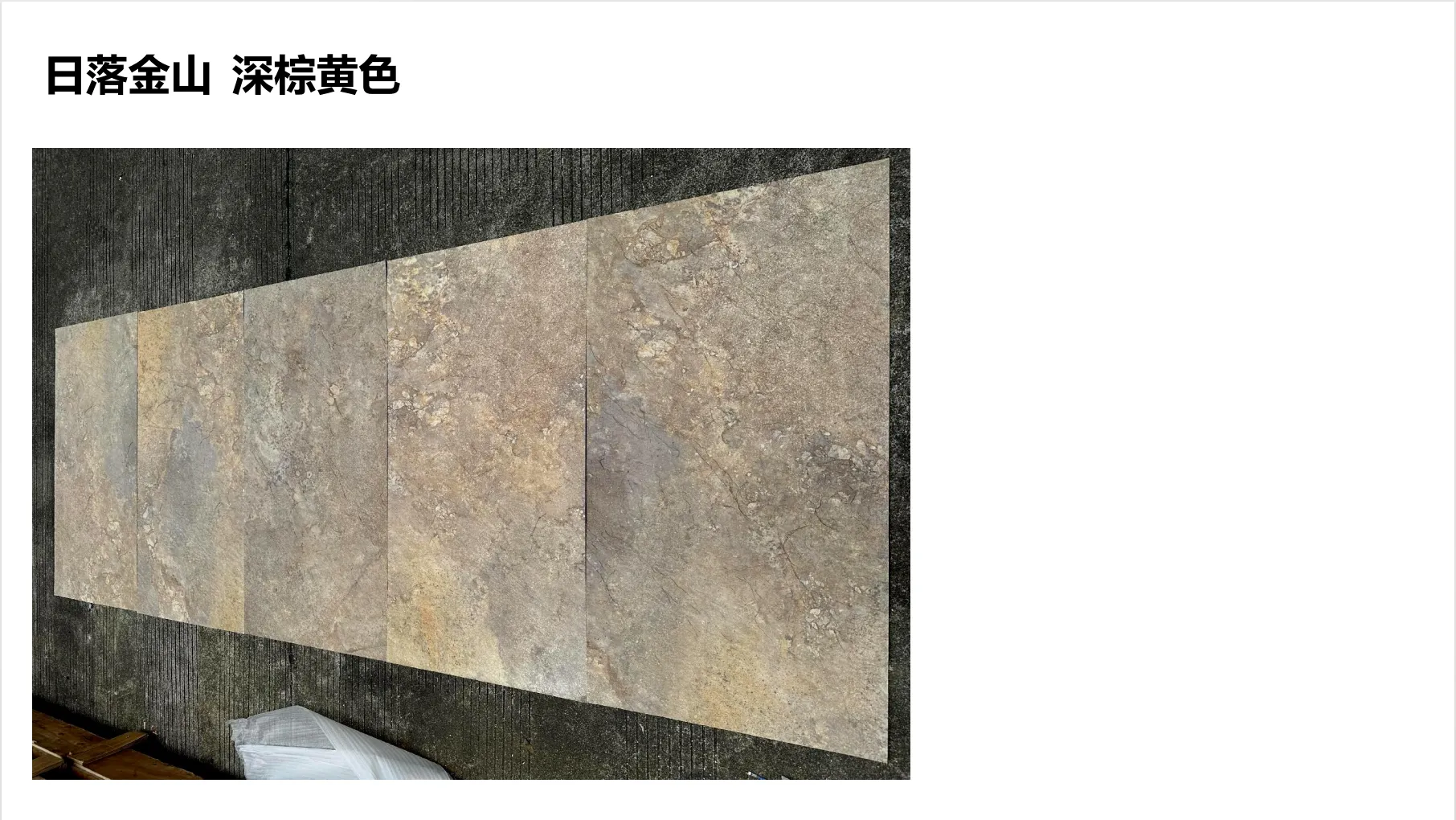
Walk into a grand hotel lobby, a sprawling corporate atrium, or a minimalist open-concept home, and you'll notice something immediately: the materials on the walls and floors don't just fill space—they define it. Larger spaces demand more than just coverage; they crave cohesion, personality, and a quiet confidence that doesn't shrink under scale. For decades, standard tiles have been the default, but in recent years, a new contender has emerged: the MCM Big Slab Board Series . Today, we're diving into this showdown, using the warm, golden hues of "Golden Sunset Real Photos" as our guide to see which material truly makes large spaces feel like home.
Picture this: A designer stands in an empty 2,000-square-foot loft, sunlight streaming through floor-to-ceiling windows. Their goal? To create a space that feels both vast and intimate, durable enough for daily life yet beautiful enough to stop guests in their tracks. On one screen, they have standard ceramic tiles—small, uniform, reliable. On the other, "Golden Sunset Real Photos" of MCM Big Slab Boards: sweeping, warm, with the texture of sunbaked earth and the glow of dusk. Which do they choose? Let's find out.
Designing for large spaces isn't just about "going bigger"—it's about solving a unique set of puzzles. "When you're working with 10-foot ceilings and 50-foot walls, every seam, every color shift, every texture choice becomes amplified," says Maria Gonzalez, an interior designer with 15 years of experience in commercial projects. "Standard tiles, which work perfectly in a 10x10 bathroom, can feel like a patchwork quilt in a lobby. All those grout lines? They chop up the visual flow, making the space feel busy instead of serene."
Then there's the practical side: weight. Traditional tiles, especially natural stone varieties, are heavy. Installing them on large vertical surfaces or over older subfloors can require costly structural reinforcements. "I once had a client who insisted on marble tiles for a 3,000-square-foot retail space," recalls Gonzalez. "By the time we factored in the extra support beams and labor, the budget ballooned by 30%. And within a year, a few tiles cracked—thanks to the building's slight settling. Seams became gaps, and suddenly that 'luxury' look felt fragile."
Durability is another hurdle. High-traffic areas like hotel lobbies or restaurant floors need materials that resist scratches, stains, and the wear of rolling luggage or chair legs. Standard tiles, with their grout lines, trap dirt and moisture, turning pristine floors into maintenance headaches. And let's not forget aesthetics: large spaces often crave natural textures—think the warmth of travertine, the depth of fair-faced concrete, the drama of lunar peak stone—but standard tiles rarely capture that organic, unbroken beauty.
Enter the MCM Big Slab Board Series —a line of materials engineered specifically for the challenges of larger spaces. These aren't just "big tiles"; they're a reimagining of what surface materials can be. Let's break down why they're turning heads:
To truly grasp their impact, look at the "Golden Sunset Real Photos." In one image, a restaurant dining area features MCM Big Slabs in warm, amber tones, stretching from floor to accent wall. The light from overhead pendants dances across the surface, highlighting veins that look like sunlight filtering through storm clouds. There are no grout lines to distract—just a single, glowing expanse that makes the room feel cozy despite its size. "Clients often say it feels like stepping into a sunset," says Gonzalez, who specified the material for that project. "It's not just a floor or a wall—it's an experience."
Let's be clear: standard tiles aren't "bad." They're affordable, widely available, and come in a rainbow of colors. For small spaces—kitchen backsplashes, bathroom floors—they shine. But in larger areas, their flaws become glaring:
A 500-square-foot space with 12x12-inch tiles requires over 400 individual pieces—each separated by grout. Over time, grout discolors, cracks, or collects mold, turning a fresh floor into a patchwork of fixes.
Heavy tiles demand reinforced subfloors and specialized labor. A 10x10-foot wall of 24x24-inch marble tiles can weigh over 500 pounds—risking structural strain in older buildings.
Take Sarah Chen, a homeowner who renovated her 1,800-square-foot open-concept living area with standard travertine tiles. "I loved the look in the showroom—warm, earthy, perfect for our modern-rustic vibe," she says. "But once installed, the grout lines made the space feel choppy. Now, every time I sweep, I'm staring at 300 little squares instead of one big, beautiful floor. And don't get me started on mopping—grout soaks up water, and we've already had to re-seal twice in two years."
It's not just standard tiles—other materials like fair-faced concrete and lunar peak stone are also in the mix. Let's see how MCM Big Slab Boards compare:
| Material | Visual Flow | Weight (per sq ft) | Maintenance | Warmth Factor |
|---|---|---|---|---|
| MCM Big Slab (Golden Sunset) | Seamless (6x10 ft slabs) | 3 lbs | Low (stain-resistant, no grout) | High (warm amber, natural texture) |
| Standard Travertine Tiles | Many seams (24x24 in max) | 10 lbs | High (grout sealing, stain-prone) | Medium (warm, but broken by grout) |
| Fair-Faced Concrete | Seamless | 12 lbs | Medium (sealing needed) | Low (cool, industrial) |
| Lunar Peak (Golden) | Seamless | 8 lbs | Low | Medium (metallic sheen, less organic) |
Fair-faced concrete, for example, offers seamless beauty but leans cold and industrial—great for a modern tech office, but not for a space aiming for the warmth of a golden sunset. Lunar peak stone, with its silvery or golden metallic finish, is eye-catching but can feel too "shiny" for cozy settings. MCM Big Slab Boards, however, blend the best of both worlds: the organic texture of travertine, the durability of concrete, and the warmth of sunset hues—all without the weight or seams.
Numbers and specs tell part of the story, but real projects show the heart of it. Take the renovation of The Horizon Hotel in Miami, a 1980s building with a lobby that felt cramped despite its size. Designer Lina Patel chose MCM Big Slab Boards in "Golden Sunset" for the floors and feature wall. "The original space had small, cream-colored tiles that made the lobby feel like a hallway," she says. "With the MCM slabs, the room opened up. Guests now linger—they take photos by the feature wall because it looks like the sunset is bleeding into the space. It's become a signature of the hotel."
Or consider a residential project: the Wong family's 3,500-square-foot home in Austin, Texas. They wanted an open kitchen and living area that felt connected to their backyard. "We were torn between standard wood-look tiles and something more unique," says Mr. Wong. "Then we saw the 'Golden Sunset Real Photos' of MCM Big Slabs. The color matched the way the sun sets over our oak trees, and the texture feels like walking on warm stone. Now, when we host barbecues, everyone ends up gathered in that space—it's like the material itself invites people to stay."
Standard tiles have their place, but for larger spaces that demand beauty, durability, and a cohesive soul, MCM Big Slab Board Series is in a league of its own. It's not just about fewer seams or lighter weight—it's about creating spaces that feel intentional, warm, and alive. As the "Golden Sunset Real Photos" show, these slabs don't just cover surfaces; they transform them into experiences.
So, back to our designer in the loft. Which did they choose? The MCM Big Slab Boards, of course. "Looking at the 'Golden Sunset' photos, I could already see how the light would move across the space throughout the day," they said. "Standard tiles would have been safe, but safe doesn't make people stop and say, 'Wow.' And in a large space, 'wow' is everything."
In the end, materials are more than just building blocks—they're storytellers. And when it comes to larger spaces, MCM Big Slab Boards tell a story worth remembering.
Recommend Products












