
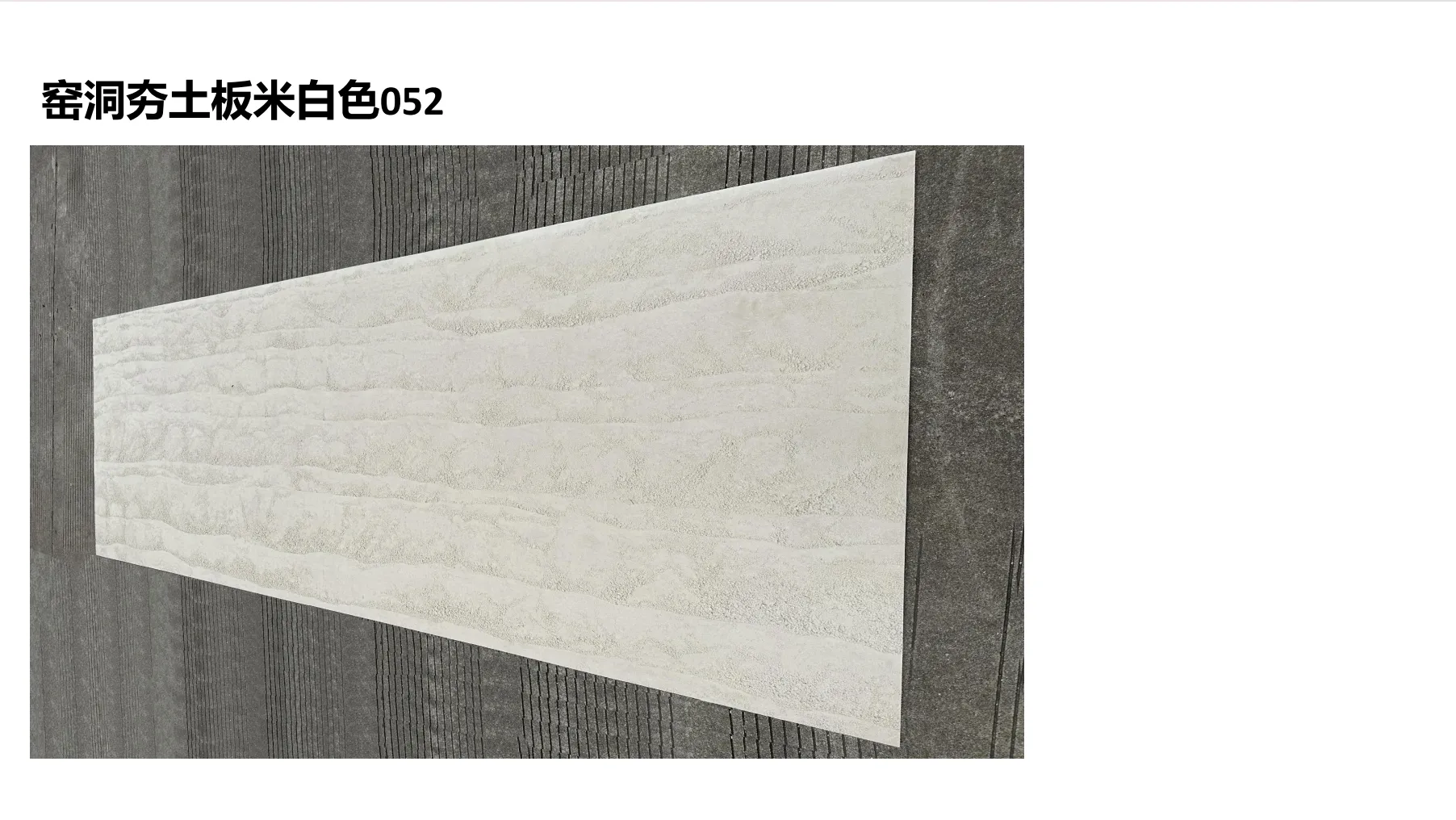
Walk into any modern architectural marvel today, and you'll likely notice a shift—sharp corners are softening, straight lines are yielding to gentle arcs, and rigid facades are blooming into organic curves. This isn't just a design trend; it's a response to how humans naturally connect with spaces. Curves feel inviting, like a hug from the built environment. But for decades, architects and designers have grappled with a stubborn challenge: how to clothe these flowing forms in materials that are both structurally sound and aesthetically alive. Enter gradient color rammed earth board—a material that marries the raw, earthy warmth of traditional rammed earth with a surprising superpower: flexibility. It's not just a building material; it's a storyteller, bending to the will of design while grounding spaces in nature's palette.
Think about the last time you stood in a room with curved walls. Maybe it was a museum with a sweeping atrium, or a boutique with a rounded display niche. How did it feel? Chances are, it felt less like a box and more like a breath of fresh air. That's because curves trigger something primal in us—they echo the natural world, from the bend of a river to the curve of a shell. Yet, for too long, the materials we used to build these spaces were at odds with this vision. Concrete, brick, and even traditional stone slabs are rigid by nature; they excel at straight lines but falter when asked to bend. You could carve curves into them, of course, but that's costly, wasteful, and often results in a surface that feels forced, not fluid.
This is where gradient color rammed earth board changes the game. Imagine (oops, scratch that—let's experience it) a material that starts as a blend of natural earth, minerals, and binders, compressed layer by layer to create rich, shifting hues—from soft terracotta to deep umber, or misty gray to warm sienna—all in a single panel. Now, imagine that panel isn't just stiff and flat, but supple enough to wrap around a column, arch over a doorway, or even form the undulating surface of a feature wall. That's the promise of gradient color rammed earth board: it doesn't fight the curve; it becomes the curve.
Why Gradient Color Matters: It's not just about flexibility. The gradient effect—subtle shifts in tone that mimic the way sunlight plays over a hillside or how soil changes color with depth—adds depth and movement to curved surfaces. A rigid material with a flat color might look stark when bent, but gradient rammed earth board? It comes alive. As light hits its curved surface, the colors shift, creating shadows and highlights that make the wall feel like it's breathing. It's the difference between a painting and a sculpture—one is static, the other dynamic.
To understand how gradient color rammed earth board bends, let's start with the basics of traditional rammed earth. Traditional rammed earth is made by packing damp soil (clay, sand, silt) into forms and compressing it to create dense, solid walls. It's durable, sustainable, and has a timeless appeal—but it's as rigid as a brick. So, what's different about the gradient version? The secret lies in the mix and the manufacturing process.
First, the ingredients. While traditional rammed earth relies heavily on soil, gradient color rammed earth board incorporates a proprietary blend of natural aggregates, mineral pigments, and a flexible binder (think of it as the "glue" that holds everything together, but with a bit of give). This binder is key—it's strong enough to maintain structural integrity but elastic enough to allow the panel to flex without cracking. Then there's the compression process: instead of being packed into thick, solid blocks, the material is layered into thin panels (typically 8–15mm thick) under controlled pressure. This thinner profile reduces brittleness, making the board more pliable. Finally, the gradient color effect is achieved by adding pigments in varying concentrations as each layer is compressed, creating a seamless transition from one hue to the next. The result? A panel that's not just thin and light, but inherently flexible.
But how flexible is "flexible"? Let's talk numbers. Most rigid cladding materials—like standard concrete panels or natural stone slabs—have a minimum bending radius (the smallest curve they can handle without breaking) of 500mm or more. That means they can manage gentle bends, but anything tighter—a sharp arch, a curved niche, or a spiral staircase—would crack them. Gradient color rammed earth board, on the other hand, boasts a minimum bending radius of just 300mm for standard panels, and some specialized versions can handle radii as tight as 200mm. For context, a 300mm radius is roughly the curve of a large dinner plate; 200mm is like wrapping the panel around a basketball. That's flexibility you can actually design with—not just in theory, but in practice.
| Material | Minimum Bending Radius (mm) | Typical Application | Durability Note |
|---|---|---|---|
| Gradient Color Rammed Earth Board | 200–300 | Curved walls, arches, column wraps | Resistant to cracking under repeated flexing |
| Standard Concrete Panel | ≥800 | Flat facades, straight partitions | Prone to cracking with tight bends |
| Natural Stone Slab (Marble/Granite) | ≥1000 | Flat countertops, floor tiles | Brittle; requires reinforcement for curves |
| Lunar Peak Silvery (Rigid Stone Series) | ≥600 | Accent walls, straight feature panels | Durable but limited curve capability |
What's even more impressive is that this flexibility doesn't come at the cost of strength. Gradient color rammed earth board has a flexural strength (the ability to resist bending forces) of around 8–12 MPa, which is comparable to many fiber-reinforced concrete panels. That means it can handle the weight of its own curvature, plus the stresses of weather and time, without compromising. It's like a gymnast—strong, yet supple.
Let's step out of the lab and into the field. How are architects and designers actually using gradient color rammed earth board's bending capabilities? The possibilities are as varied as the gradients themselves.
Curved Feature Walls: In a recent boutique hotel in Kyoto, the lobby is anchored by a 12-meter-long curved wall clad in gradient rammed earth board, shifting from soft cream at the base to warm terracotta at the top. The curve guides guests from the entrance to the reception desk, creating a natural flow, while the gradient mimics the colors of the surrounding mountains at sunrise. "It's not just a wall," the designer noted, "it's a journey through light and earth."
Archways and Niches: Traditional archways often require custom-cut stone or brick, which is time-consuming and expensive. With gradient rammed earth board, a contractor can simply bend a panel to the desired arc. A café in Barcelona used this to create a series of small, curved niches along its perimeter—each wrapped in a gradient from soft gray to deep brown—turning what would have been plain wall space into cozy seating nooks that feel like private caves.
Furniture and Sculptural Elements: Flexibility isn't limited to large-scale applications. Designers are using thinner gradient rammed earth panels to create curved furniture—think benches with gently sloped seats, or tables with rounded edges that feel more like natural boulders than man-made objects. One artist even created a sculptural screen for a public park, bending the panels into wave-like forms that cast shifting gradient shadows as the sun moves.
Complementary Pairings with Lunar Peak Series: For spaces that crave contrast, gradient color rammed earth board plays beautifully with rigid, metallic materials like the Lunar Peak series—Lunar Peak Silvery, Golden, and Black. Imagine a curved gradient wall (terracotta to umber) paired with a sleek Lunar Peak Silvery accent panel as a backdrop for a fireplace. The warm, earthy curve softens the cool, metallic edge, creating a balance that feels both modern and grounded. It's like pairing a wool sweater with a leather jacket—cozy meets bold.
In a world where "green building" is no longer a trend but a necessity, gradient color rammed earth board checks another crucial box: sustainability. Traditional rammed earth is already eco-friendly—it uses local soil, requires minimal energy to produce, and is fully biodegradable. The gradient version builds on this by using natural pigments (no harsh chemicals) and a manufacturing process that produces little waste. Even better, its flexibility reduces the need for cutting and shaping on-site, which means less material ends up in landfills. And because it's lightweight, it reduces the load on a building's structure, which can lower overall construction costs and carbon emissions from foundation work.
Compare that to synthetic flexible materials, which often rely on plastics or resins derived from fossil fuels. Gradient rammed earth board? It's as green as the hills it's made from. When a building reaches the end of its life, the panels can be crushed and reused as aggregate—closing the loop in a truly circular way.
No material is perfect, and gradient color rammed earth board has its own set of considerations. One common myth is that "flexible" equals "fragile." But as we've seen, its flexural strength is comparable to other cladding materials. That said, it's not indestructible. Like any earth-based material, it's sensitive to prolonged moisture. So, it's best used in covered or well-ventilated areas, or sealed with a breathable, natural coating for exterior use. Think of it like wood—with proper care, it lasts for decades.
Another challenge is cost. Because it's a specialized material, it can be pricier than standard concrete panels upfront. But proponents argue that the savings come later: less waste, faster installation (no custom cutting for curves), and lower maintenance costs. Plus, the aesthetic value—those gradient curves—can boost a building's appeal, whether it's a commercial space or a home.
As architects continue to push the boundaries of form, materials like gradient color rammed earth board will only grow in importance. We're already seeing experimentation with even tighter bending radii (some manufacturers are testing 150mm) and more complex gradient patterns (think ombre effects or even marbled gradients). There's also potential to combine it with other flexible materials—like foamed aluminium alloy boards or woven panels—to create hybrid surfaces that bend, reflect light, and add texture in new ways.
But perhaps the most exciting part is how this material reconnects us to the earth. In a world of glass and steel, there's a hunger for spaces that feel rooted, that remind us of our connection to the ground beneath our feet. Gradient color rammed earth board doesn't just cover walls—it tells a story of soil, sun, and the slow, beautiful process of creation. And when that story is wrapped in a curve? It becomes a narrative we can feel , not just see.
So, the next time you walk into a space with curved walls, take a closer look. If the surface shimmers with shifting earth tones and feels like it was shaped by nature itself, chances are you're standing before gradient color rammed earth board. It's not just bending to the curve of the design—it's bending to the curve of our desire for spaces that nurture, inspire, and feel like home.
Recommend Products












