
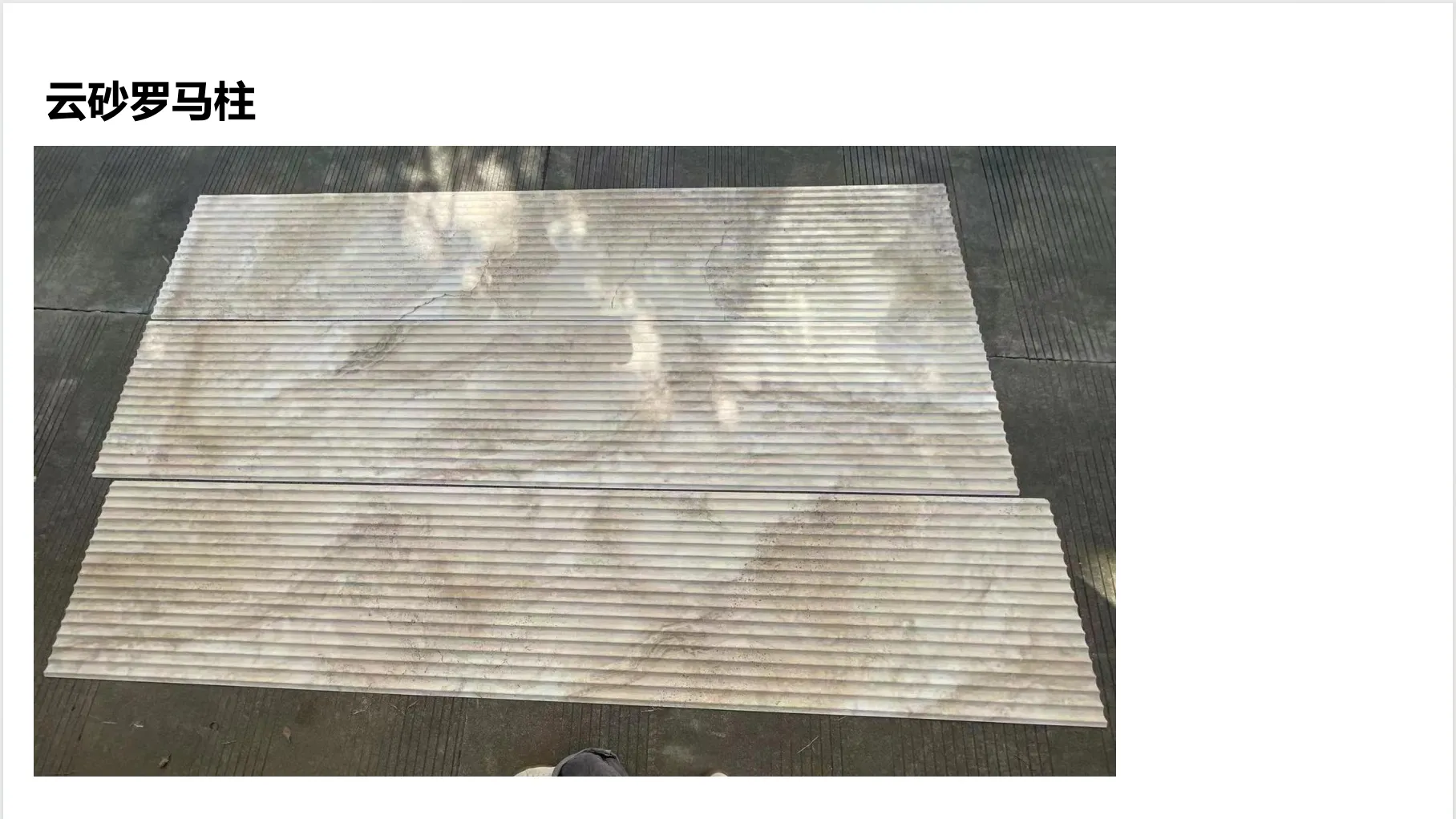
There's something almost sacred about a well-crafted pillar. It's not just a structural element— it's a storyteller. For centuries, marble pillars have stood as silent sentinels of grandeur, holding up temples, palaces, and public squares while whispering tales of empires, artisans, and the passage of time. Walk through the ruins of Rome, and you'll find them: weathered but unbowed, their fluted surfaces still bearing the marks of chisels wielded by hands long gone. Step into a Gothic cathedral, and they soar upward, reaching for the heavens, their marble veins like rivers of light guiding the eye toward stained glass and celestial ceilings. These pillars aren't just built—they're crafted , each curve and carve a testament to the human desire to create something that outlasts the moment.
But here's the thing about tradition: it's a living, breathing entity. As we move forward, we don't just want to copy the past—we want to honor it. We crave the warmth of natural stone, the depth of hand-carved detail, but we also need materials that fit the rhythm of modern life: lightweight enough for skyscrapers, durable enough for busy city streets, sustainable enough for a planet we're striving to protect. That's where MCM (Modified Composite Material) steps in—not as a replacement for history, but as a bridge. It's the craftsman's dream reimagined: the soul of classic architecture, wrapped in the innovation of today. And at the heart of this bridge? Pieces like the MCM Marble Pillar—a modern marvel that doesn't just mimic the look of heritage marble, but feels like it, too.
Let's talk about the elephant in the room: traditional marble is heavy. Stunning, yes, but heavy. So heavy that installing a single pillar might require cranes, reinforced foundations, and a small army of workers. And then there's maintenance—marble stains, etches, and wears down over time, especially in high-traffic areas. For all its beauty, it's a material that demands constant care, like a vintage car that turns heads but guzzles gas and breaks down when you need it most. That's not a knock on marble; it's just reality. Classic architecture deserves materials that can keep up with the chaos of modern life, not hold it back.
MCM flips that script. Born from a blend of natural minerals, polymers, and cutting-edge engineering, it's lightweight (up to 80% lighter than traditional stone), flexible (it bends without breaking, making it perfect for curved pillars), and surprisingly tough (resistant to scratches, moisture, and UV rays). But here's the magic: it doesn't sacrifice aesthetics for function. Run your hand over an MCM surface, and you'll feel the same cool, porous texture of natural travertine. Stare at a slab of Lunar Peak Silvery, and you'll swear you're looking at moonlight frozen in stone, with the same subtle veining that makes natural rock so mesmerizing. MCM doesn't just look like heritage material—it behaves like it, too, but with a resilience that lets it thrive in places traditional stone never could: on the facade of a bustling urban hotel, in a home with kids and pets, or in a coastal town where salt air would eat away at marble in years.
Take, for example, the MCM Marble Pillar. It's not just a "replica"—it's a reimagining. The team at MCM didn't just scan a block of Carrara marble and hit "print"; they studied the way light plays on marble, the way its veins twist and turn like rivers, the way it ages gracefully, gaining character with every passing year. The result? A pillar that has the same soft glow, the same depth of color, and the same sense of permanence as its natural counterpart, but without the logistical headaches. It's a material that lets architects and designers dream bigger: imagine a heritage museum with marble pillars that don't require reinforcing the 100-year-old foundation, or a boutique hotel lobby with curved marble columns that would've been impossible (or prohibitively expensive) with traditional stone. MCM isn't just making classic architecture easier to build—it's making it possible to build, even in a world that moves faster than ever.
While the Marble Pillar might be the star of the show, it's far from the only player in MCM's lineup of heritage-inspired materials. Classic architecture isn't just about pillars—it's about texture, color, and the way materials dance together to create a mood. A Gothic cathedral isn't defined by its marble alone; it's the contrast of smooth stone against rough-hewn walls, the warmth of wood against the coolness of stone, the play of light on surfaces that tell a story. MCM gets that, which is why their collection reads like a love letter to the materials that have shaped our built history—each one with a modern twist that makes them ready for today's world.
Travertine has always been the quiet romantic of natural stone—soft, porous, with a warmth that feels like a hug from the earth. But MCM's Travertine (Starry Green) takes that romance and cranks it up to 11. Imagine a surface that starts as a soft, muted green, like the moss on an ancient stone wall, but as light hits it, tiny flecks of iridescent green and gold begin to shimmer. It's not glittery or gaudy—think more like the way dew catches the first light of dawn on a forest floor, or the way stars twinkle through a thin layer of cloud. This isn't just a tile or a panel; it's a conversation starter. Use it for a fireplace surround in a cozy study, and suddenly every evening becomes a stargazing session, even indoors. Line a hallway with it, and walking from room to room feels like stepping through a forest at twilight, where the trees part just enough to let the sky peek through. It's travertine, but better—because MCM didn't just replicate the stone; they bottled its essence and added a dash of magic.
If Travertine (Starry Green) is the night sky, Lunar Peak Silvery is the moon itself—pale, luminous, and full of mystery. There's a quiet elegance to this material that feels both ancient and futuristic, like something you might find in a temple dedicated to the moon gods, or in a spaceship designed to blend in with the cosmos. Its surface is smooth but not slick, with subtle variations in tone that mimic the moon's craters and maria (those dark, flat areas we've been staring at since the dawn of time). Run your hand over it, and it's cool to the touch, but not cold—more like the surface of a stone that's been warmed by the sun all day and is now releasing that heat slowly, gently. It's the kind of material that pairs beautifully with both warm woods (think oak or teak) and cool metals (brass, copper), making it a chameleon in design. Use it for a kitchen backsplash, and suddenly your morning coffee feels like a ritual under the moon. Clad an accent wall in it, and your living room becomes a sanctuary where time slows down, and the world outside fades away. Lunar Peak Silvery isn't just a color—it's a mood: calm, contemplative, and infinitely timeless.
Not all heritage is about grandeur—some of it is about honesty. Fair-faced concrete (or "b" in Chinese, but we'll stick to its English name here) is the quiet philosopher of building materials: raw, unapologetic, and full of stories. It's the material of warehouses turned into lofts, of brutalist churches that feel more spiritual for their lack of ornament, of bridges that carry the weight of cities with stoic grace. MCM's Fair-Faced Concrete captures that honesty, but with a refinement that makes it feel less like a construction material and more like a work of art. Traditional fair-faced concrete can be unpredictable—air bubbles, uneven coloring, cracks that mar its surface. MCM's version? It's smooth, consistent, and surprisingly warm, with a texture that's just rough enough to feel organic, but not so rough that it feels unfinished. It's the kind of material that lets the "bones" of a building shine through, which is why it's perfect for spaces that celebrate simplicity: a minimalist home where the focus is on light and space, a café that feels like a workshop where good ideas are forged, or a library where the quiet hum of turning pages is the only ornament needed. Pair it with the Marble Pillar, and you've got a contrast that's pure magic—old-world elegance meeting industrial chic, like a 19th-century poet typing verses on a modern laptop. It's proof that heritage isn't just about the past; it's about the way the past and present can dance together, creating something new and wonderful.
One of the joys of working with MCM's heritage-inspired materials is that they're not one-trick ponies—they play well with others. Classic architecture has always been about balance: light and dark, smooth and rough, old and new. MCM's lineup makes it easy to strike that balance, whether you're restoring a historic building or building a new home that feels like it's been rooted in place for decades. Here are a few ideas to spark your creativity:
Your home's entrance is its first impression—make it count. Flank your front door with MCM Marble Pillars (their soft white and gray veining will echo the grandeur of classic porticos), then clad the surrounding walls in Lunar Peak Silvery. The silvery stone will act as a neutral backdrop, letting the pillars take center stage, while its subtle luminosity will make the entrance feel welcoming, even on the darkest nights. Add a wooden door with intricate carvings, and suddenly you've got a space that says, "This is a home with history—even if it's brand new."
Who says heritage has to be grand? Create a reading nook or a home office that feels like a secret library from a bygone era. Line the walls with MCM's Travertine (Starry Green)—its soft green base will calm the mind, while the starry flecks will add a touch of whimsy, like reading under a canopy of trees with fireflies dancing above. Pair it with warm, honey-toned wood shelves (think oak or cherry) and a leather armchair, and you've got a space that feels both timeless and incredibly comfortable. Add a vintage brass lamp, and suddenly every book you open feels like a portal to another world.
For those who prefer their heritage with a side of edge, try pairing Fair-Faced Concrete with rustic metals like iron or brass. Imagine a kitchen where the countertops are Fair-Faced Concrete (smooth, cool, and easy to clean), the backsplash is a mosaic of MCM's smaller stone tiles (maybe Travertine Beige for warmth), and the light fixtures are wrought iron with exposed bulbs. It's industrial, but not cold—like a blacksmith's shop that's been polished up for modern living. Add a few potted herbs on the windowsill, and suddenly it's a space where you can cook, create, and feel connected to the hands-on work of the past.
Heritage isn't confined to four walls—it spills outside, into gardens, patios, and courtyards. Use MCM's Travertine (Starry Green) for a patio floor, and suddenly your outdoor space becomes an extension of the night sky. Pair it with natural stone paths (maybe MCM's Rough Granite Stone in Beige for a earthy contrast) and wooden lounge chairs, and you've got a spot where you can sip wine under the stars and feel like you're in a villa in Tuscany, even if you're in the middle of a city. Add a water feature, and the sound of flowing water will complete the illusion—heritage, reimagined as your own personal oasis.
Let's step into the shoes of an architect named Clara, who was tasked with restoring the town hall of a small New England town. Built in 1923, the town hall was a gem of Colonial Revival architecture—white columns, a grand entrance, and a clock tower that had kept time for nearly a century. But by 2020, it was showing its age: the original marble pillars were chipped and stained, the stone walls were water-damaged, and the whole building felt heavy, like it was struggling to stand under the weight of its own history. Clara's brief was clear: restore the town hall to its former glory, but make it safe, functional, and ready for the next 100 years. Traditional marble was out of the question—the budget couldn't handle the cost of new pillars and the foundation work needed to support them. That's when she discovered MCM.
Clara started with the entrance. The original pillars were 12 feet tall, with fluted sides and Ionic capitals that had been carved by hand. MCM's team worked with her to create custom Marble Pillars that matched the original design exactly—same height, same fluting, same delicate carvings. But here's the kicker: each MCM pillar weighed less than 200 pounds, compared to the original marble pillars, which weighed over 2,000 pounds each. That meant no need for cranes or foundation reinforcement—two workers could carry them into place. When they were installed, Clara stood back and almost cried. "They looked exactly like the originals," she later said. "But when I touched them, they felt… alive. Not cold and lifeless like the old marble, which had been worn down by decades of rain and wind. These felt like they had a future."
Next, the interior walls. The town hall's main meeting room had once been lined with travertine, but years of moisture had turned it into a patchwork of stains and discoloration. Clara chose MCM's Travertine (Starry Green) for the replacement panels. "I wanted something that would honor the original travertine's warmth, but add a little something extra," she explained. "The starry flecks felt like a nod to the town's history of stargazing—there's an old observatory on the edge of town that's been around even longer than the town hall." The panels were installed in a week, and when the lights were turned on for the first time, the room erupted in gasps. The green flecks shimmered like distant galaxies, and the soft, porous texture of the travertine made the room feel cozy, not cavernous. "It was like the walls were telling a new story," one town council member said, "but it was a story that fit right in with the old ones."
Finally, the clock tower. The original stonework was crumbling, so Clara opted for Lunar Peak Silvery panels to replace it. "I wanted the tower to glow at night, like a beacon," she said. And glow it did. The silvery stone catches the moonlight and the town's streetlights, turning the clock tower into a landmark that can be seen for miles. "Kids now point to it and say, 'Look, Mom, the moon tower!'" Clara laughed. "That's the magic of MCM—it's not just about preserving the past; it's about giving the past a voice that speaks to the present."
Today, the town hall is thriving. Weddings are held in the meeting room, where the Starry Green Travertine walls set the mood for vows exchanged under "starlight." The Marble Pillars stand sentinel at the entrance, greeting visitors with the same elegance they did in 1923, but with a strength that will carry them through the next century. And Clara? She's already working on her next project—a historic theater in Boston—where she'll be using MCM's Fair-Faced Concrete to restore the lobby. "Why wouldn't I?" she says. "MCM gets it. Heritage isn't about being stuck in time. It's about taking the best of what was and making it better for what will be."
With so many options, it can be hard to choose the right material for your project. Here's a handy breakdown of some of MCM's most popular heritage-inspired materials, to help you find your perfect match:
| Material Name | Aesthetic Vibe | Best For | Key Feature |
|---|---|---|---|
| MCM Marble Pillar | Timeless elegance, soft veining, classic white/gray palette | Grand entrances, heritage restorations, formal spaces | Lightweight (80% lighter than natural marble) with hand-carved detailing options |
| Travertine (Starry Green) | Earthy, romantic, with iridescent green/gold flecks | Fireplace surrounds, accent walls, cozy nooks | Porous texture mimics natural travertine; flecks add depth and whimsy |
| Lunar Peak Silvery | Calm, luminous, with subtle crater-like texture | Exterior cladding, clock towers, spaces needing soft light reflection | Glows under moonlight/artificial light; resistant to UV damage and weathering |
| Fair-Faced Concrete | Raw, honest, industrial-chic with warm undertones | Lofts, cafes, minimalist homes, libraries | Smooth, consistent finish with organic texture; durable and low-maintenance |
At the end of the day, classic architecture isn't about marble pillars or stone walls or even grand entrances. It's about a feeling—the way a space can make you feel connected to something bigger than yourself, whether that's the craftsmen who built it, the stories it holds, or the generations who will walk through it after you. MCM gets that feeling because they're not just selling materials—they're selling a promise: that we don't have to choose between the past and the future. We can have both.
Imagine a world where every historic building can be restored without breaking the bank, where every new home can feel like it has roots, where every public space can tell a story that spans centuries. That's the world MCM is helping to build—one Marble Pillar, one Starry Green Travertine panel, one Lunar Peak Silvery wall at a time. It's a world where heritage isn't a museum piece, locked away behind ropes and "do not touch" signs. It's a living, breathing thing, accessible to everyone, and ready to adapt and grow with the times.
So the next time you walk past a grand building, take a closer look. Maybe the marble pillars aren't marble at all. Maybe the stone walls aren't stone. Maybe they're MCM—and maybe that's okay. Because what matters isn't the material itself; it's the feeling it evokes. The warmth, the history, the sense that this space was built with care, with intention, with love. That's the true heritage of architecture—and with MCM, that heritage is in good hands.
Whether you're an architect, a designer, a homeowner, or just someone who appreciates the beauty of a well-crafted space, MCM's heritage-inspired materials invite you to be part of the story. To build something that will make people stop, and stare, and say, "Wow—this feels like home." And isn't that what heritage is all about?
Recommend Products












