
Standing at street level in any major city, our eyes are drawn upward—toward the glass and steel giants that define modern skylines. But for architects and builders, high-rises are more than just pretty faces. They're puzzles: How do you balance jaw-dropping aesthetics with the unforgiving demands of height, weight, and Mother Nature? Traditional exterior materials like natural stone or solid marble have long been go-to choices for their timeless appeal, but they come with a heavy price tag—literally. Their weight strains structural systems, installation drags on for months, and weathering over time can turn a once-pristine facade into a maintenance nightmare.
Enter the MCM (Modified Composite Material) revolution. A blend of innovation and practicality, MCM has quietly been redefining what's possible for high-rise exteriors. Lightweight yet tough, flexible yet durable, these engineered materials offer a middle ground that traditional options can't match. Today, we're diving into a real-world case study—the Azure Heights project—to see how MCM marble series and complementary lines transformed a challenging high-rise vision into a skyline standout.
Nestled in the heart of Riverton, a city known for its mix of historic brick warehouses and cutting-edge architecture, Azure Heights was meant to be a bridge between eras. The client, a forward-thinking developer, wanted a 42-story tower that felt both grand and approachable—something that would turn heads but also feel like a "home" for its residents. The architectural team, led by award-winning firm Lumin Architects, had a bold vision: a facade that shifted with the light, combining sleek modernity with organic warmth. Early renderings showed sweeping curves, a gradient of neutral tones, and a striking feature wall that evoked a starry night sky.
But there was a problem. The initial material choice—natural Carrara marble for the main facade and travertine for accents—weighed in at a staggering 25 kg per square meter. For a building of Azure Heights' scale, that added hundreds of tons to the structural load, forcing engineers to revisit foundational plans and increasing construction timelines by months. Worse, the porous nature of natural stone meant frequent sealing and maintenance, a costly long-term burden for residents. "We loved the look, but the math just didn't add up," recalls Mia Chen, lead architect at Lumin. "We needed something that could deliver that same 'wow' factor without breaking the bank—or the building."
After weeks of research, the team stumbled on MCM. "At first, we were skeptical," Chen admits. "Engineered materials can feel… artificial. But when we visited the MCM manufacturing facility and saw the MCM flexible stone panels up close, we were blown away. The texture, the depth—you'd swear it was natural stone, but it weighed less than 5 kg per square meter."
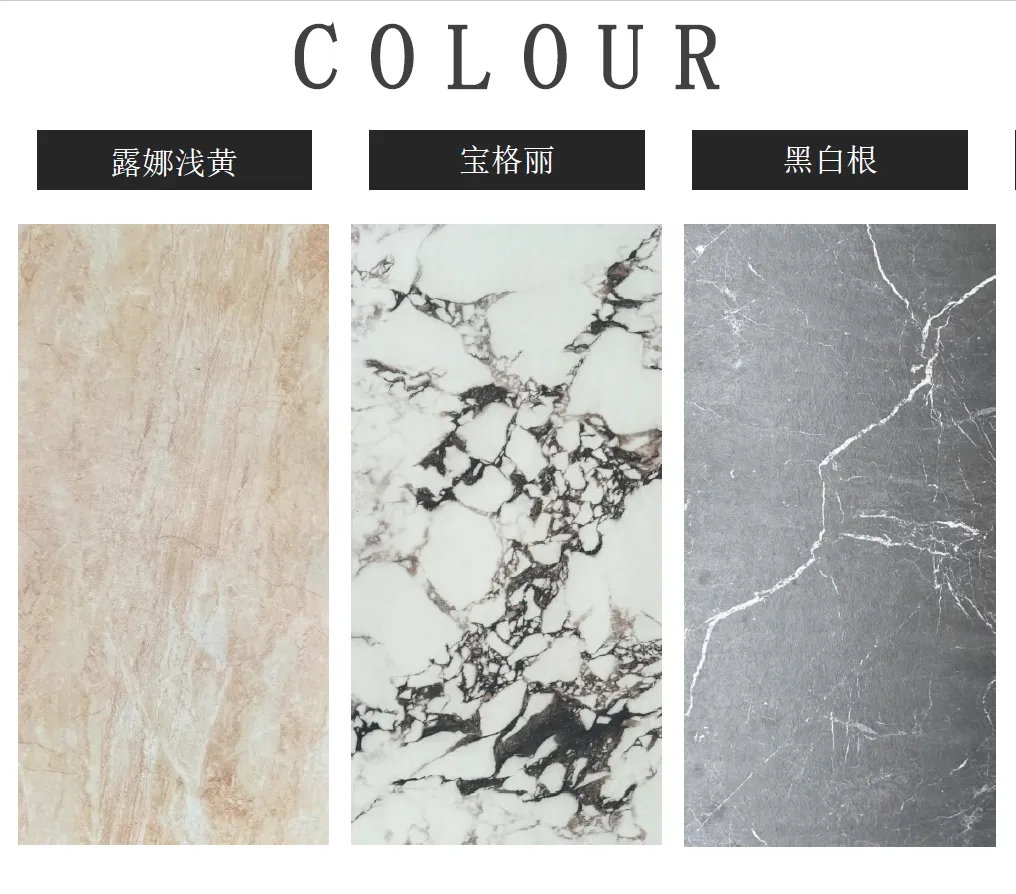
MCM, or Modified Composite Material, is crafted by bonding natural stone particles with a polymer resin, creating a thin, flexible sheet that retains the look and feel of quarried stone but with none of the bulk. For Azure Heights, three lines emerged as front-runners: the MCM big slab board series (for seamless, large-scale coverage), the marble interstellar gray line (to mimic the original Carrara marble vision), and the lunar peak silvery collection (for subtle metallic accents). Later, the team added travertine (starry blue) to the mix—a bold choice for the tower's 12th-floor amenity deck, designed to evoke the night sky over Riverton.
Choosing the right materials for a high-rise isn't just about aesthetics—it's about problem-solving. Here's how each MCM line addressed Azure Heights' unique needs:
The main facade needed to be sleek, uniform, and timeless. Marble interstellar gray delivered on all fronts. Its cool, neutral tone (think storm clouds at dawn) provided the modern backdrop the architects wanted, while subtle veining added depth without overwhelming the eye. "What sold us," Chen notes, "was how the color shifts with light. At sunrise, it has a warm, silvery hue; by afternoon, it deepens to a soft charcoal. Natural marble can do that too, but interstellar gray's consistency meant no unsightly color variations across the facade."
For the tower's setbacks and balcony edges, the team wanted a material that would catch the light and add dimension. Lunar peak silvery , with its fine metallic flecks embedded in a matte stone base, was perfect. "It's like adding a whisper of luxury," Chen explains. "From the street, you don't notice the flecks up close—just a soft shimmer that makes the building feel alive. And at 4.2 kg per square meter, we could install it on cantilevered sections without worrying about structural stress."
The 12th-floor amenity deck was always meant to be a showstopper—a space where residents could relax with city views. The architects originally considered custom-painted glass, but it felt too cold. Then they saw travertine (starry blue) , a MCM variant with iridescent blue and silver particles suspended in a creamy travertine base. "It's like looking up at the night sky," says Chen. "During the day, it's a soft blue-gray; at night, when the deck lights hit it, those particles glow. Residents call it their 'private planetarium.'"
If the material selection was a win, the installation process was a revelation. Traditional marble panels require cranes, specialized lifting equipment, and teams of workers to maneuver each heavy slab into place. MCM panels? "Two people could carry a 10-foot slab up a stairwell if they had to," jokes Raj Patel, construction manager for Azure Heights. "That's how light they are."
The MCM big slab board series panels, which measure up to 1.2m x 2.4m, were key here. Fewer seams meant a cleaner look, and the panels could be cut on-site with standard tools, allowing for last-minute adjustments to fit the building's unique curves. "We saved 40% on installation time compared to natural stone," Patel reports. "What would've taken 12 weeks took 7. And because the panels are flexible, we could wrap them around the tower's curved corners without cracking—something natural stone would've required custom fabrication for, at triple the cost."
Durability was another surprise. MCM panels are resistant to UV rays, moisture, and even graffiti (a big plus in urban areas). During testing, the marble interstellar gray panels withstood simulated 100-mph winds and freeze-thaw cycles without fading or chipping. "We expect these panels to look as good in 50 years as they do today," says Patel. "Natural stone would need resealing every 5-7 years. With MCM, we're looking at zero maintenance beyond an occasional power wash."
To put Azure Heights' success in perspective, let's compare the MCM materials used with their traditional counterparts. The numbers speak for themselves:
| Material | Weight (kg/m²) | Installation Time (per 1000m²) | UV Resistance | Est. Lifespan (years) | Maintenance Cost (10-year projection) |
|---|---|---|---|---|---|
| Marble Interstellar Gray (MCM) | 4.5 | 5 days | Excellent (no fading) | 50+ | $500 (power washing only) |
| Natural Carrara Marble | 25 | 12 days | Good (fades 20% in 10 years) | 20-30 | $12,000 (sealing, repairs, cleaning) |
| Lunar Peak Silvery (MCM) | 4.2 | 4 days | Excellent | 50+ | $450 |
| Travertine (Starry Blue) (MCM) | 4.8 | 6 days | Excellent | 50+ | $550 |
A year after completion, Azure Heights has become a Riverton icon. "We get compliments daily," says Chen. "People stop to take photos of the starry blue wall at sunset. Residents love how the building feels 'soft' compared to the glass towers nearby—the marble interstellar gray and lunar peak silvery warm up the facade, making it feel less like a corporate monolith and more like a community."
For residents like James Wilson, who moved into a 35th-floor unit last spring, the MCM facade has practical perks too. "My windows face west, and I was worried about sun glare and heat," he says. "But the marble interstellar gray panels reflect just enough light to keep the apartment cool in summer, without making it feel dark. And the view? The way the color shifts at dusk—from silvery gray to deep charcoal—it's like living in a piece of art."
Azure Heights isn't an anomaly. Across the globe, developers and architects are turning to MCM for projects big and small. "It's not just about cost or speed," Chen reflects. "It's about possibility. With MCM, we can design buildings that were once impossible—curves, cantilevers, bold colors—without sacrificing durability or aesthetics. And as sustainability becomes a bigger priority, MCM's eco-friendly credentials (recyclable materials, low-carbon manufacturing) make it a no-brainer."
Looking ahead, Lumin Architects is already incorporating MCM into three new high-rise projects, including a hotel in Dubai that will feature travertine (starry orange) and lunar peak golden panels. "The sky's the limit," Chen laughs. "Or rather, the skyline is."
Azure Heights' success story is a reminder that great architecture isn't just about vision—it's about adaptability. By swapping traditional stone for MCM marble series and complementary lines, the team turned a potential roadblock into a triumph. Today, the tower stands as proof that high-rises can be both beautiful and brainy—light enough to soar, tough enough to last, and stunning enough to leave a legacy.
For anyone building upward, the message is clear: Don't let tradition weigh you down. MCM isn't just a material—it's a new way to reach for the stars.
Recommend Products












