
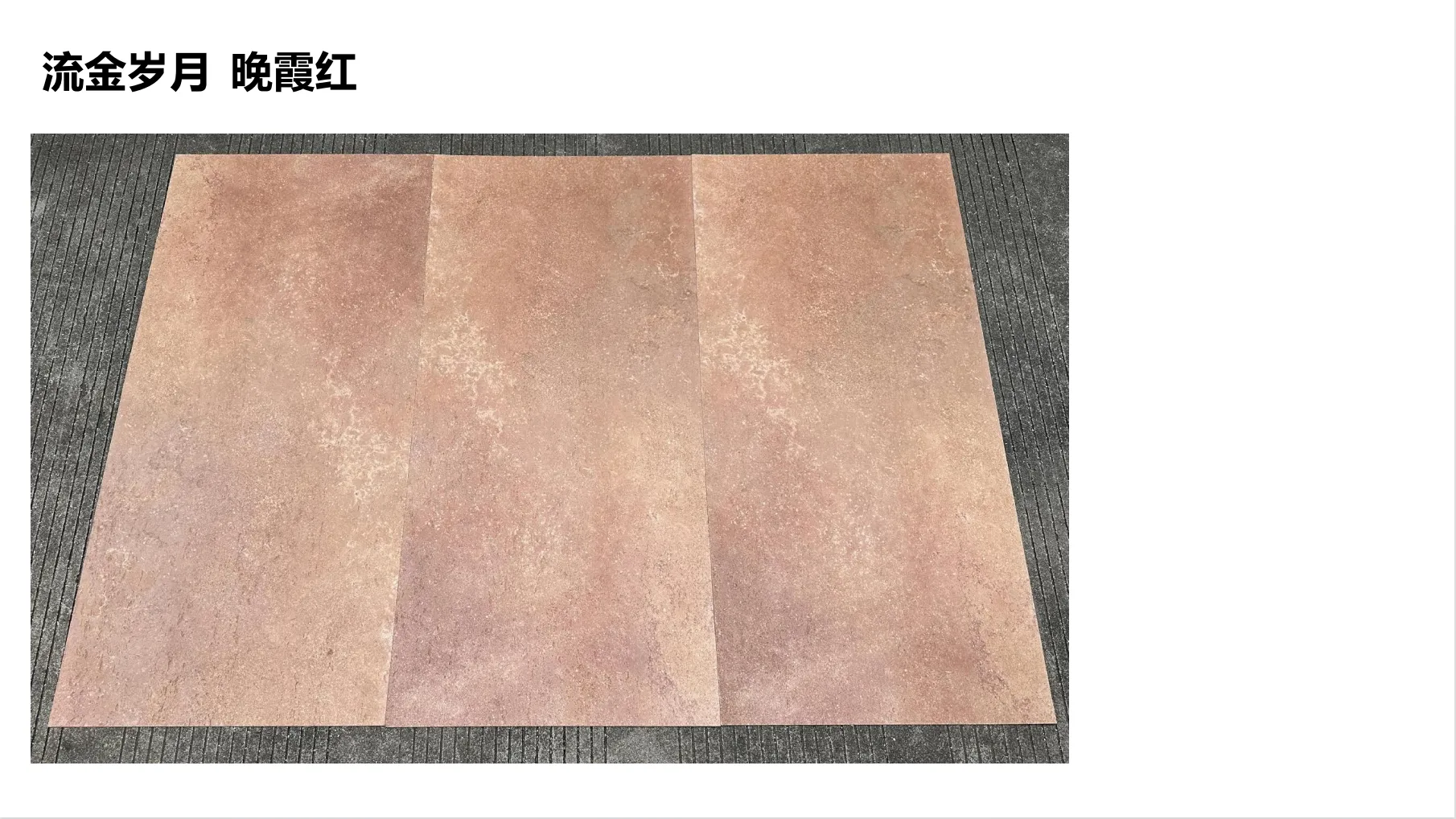
For architects and designers, few things sting more than anticipation turning to disappointment. Picture this: you've spent weeks poring over material samples, fallen in love with the warm, earthy texture of a travertine panel in the catalog, and eagerly awaited its arrival—only to open the crate and find panels that look faded, mismatched, or nothing like the photo. It's a scenario that derails timelines, blows budgets, and chips away at the trust between creators and suppliers. At COLORIA, we've built our reputation on eliminating that heartache. Our Golden Faith real photos MCM products aren't just about stunning visuals; they're a promise—one that every panel, every texture, and every shade will match the vision you fell in love with. So how do we keep that promise? Let's pull back the curtain.
Consistency starts long before a panel is pressed or a photo is snapped—it begins in the quarries, forests, and workshops where we source our raw materials. Take MCM flexible stone , the backbone of many of our collections, including Golden Faith. Unlike generic flexible stones that blend random aggregates, ours is crafted from a proprietary mix of natural minerals and polymers, sourced from partners we've worked with for decades. We visit these quarries personally, not just to inspect batches, but to understand the land they come from. A vein of travertine in Tuscany might carry subtle golden undertones, while another in Iran leans cooler—so we map these variations and batch materials by region to ensure uniformity.
Consider travertine (starry green) , a fan favorite in our decorative lineup. Its name comes from the tiny, iridescent flecks that catch the light like stars in a dark forest. To keep those "stars" consistent, we don't just buy any travertine—we select blocks from specific layers of the quarry where mineral deposits are most uniform. Our geologists test samples for fleck density, color distribution, and hardness, rejecting entire batches if the pattern strays even slightly from our standards. It's painstaking work, but it's why a designer in New York and another in Dubai can order travertine (starry green) and receive panels that could have been cut from the same stone.
Even materials like fair-faced concrete , often praised for its raw, industrial charm, get the same meticulous treatment. We source cement from a single supplier in northern Italy known for low iron content (which prevents unexpected discoloration) and aggregate from a riverbed in France with consistent particle size. By controlling these variables, we ensure that the smooth, gray finish of our fair-faced concrete panels doesn't veer into pink or yellow hues, even across large orders.
If sourcing is the foundation, manufacturing is the frame—where raw materials are shaped into the products you see. Here, technology and human expertise dance together, especially with our MCM 3D printing series . Traditional stone-cutting methods rely on manual labor, leaving room for tiny variations in texture or edge alignment. But with 3D printing, we program every detail—from the depth of a groove to the spacing of a pattern—into a digital blueprint. Each panel is printed layer by layer, with sensors checking dimensions 200 times per minute. If a layer is even 0.1mm off, the machine pauses, alerts a technician, and recalibrates. The result? A level of precision that's impossible to achieve by hand.
Take our Golden Faith line, which features a signature "sanded linen" texture—soft to the touch, with subtle horizontal grains that mimic aged wood. To replicate this texture across thousands of panels, we first scanned a vintage linen textile (yes, actual fabric) to create a 3D model. That model is then etched into the surface of every Golden Faith panel using a laser-guided tool, ensuring the grain depth (0.3mm, to be exact) and spacing (1.2mm between lines) are identical on every piece. Even the color is mixed in batches of 500 liters at a time, with a spectrophotometer checking the pigment ratio before it's applied. No more "this batch is a little lighter" surprises—just the same warm, honeyed tone you saw in the photo.
For products like epoch stone , which channels the weathered beauty of ancient ruins, we take a different approach. Instead of fighting aging, we simulate it— consistently . Each epoch stone panel undergoes a controlled "aging" process: first, a pressure wash with mineral-rich water to create natural-looking pitting, then a UV exposure treatment to fade the surface evenly, and finally, a hand-applied sealant that mimics the patina of time. We've refined this process over 12 years, logging data on temperature, water pressure, and UV intensity to ensure that a panel made today looks identical to one made five years ago.
If our production line is a symphony, our quality control lab is the conductor—ensuring every note hits perfectly. Walk through our facility in Milan, and you'll find a room filled with machines that look like they belong in a science fiction movie: spectrophotometers measuring color down to the nanometer, 3D scanners creating digital twins of panels, and climate chambers that simulate 20 years of rain, snow, and sun in just 72 hours. This is where we separate "close enough" from "COLORIA-worthy."
Color consistency is non-negotiable. For Golden Faith real photos, we use a metric called ΔE (Delta E), which measures how different two colors appear to the human eye. A ΔE of 1 or less is imperceptible—think of two white sheets of paper under the same light. Our goal? ΔE ≤ 0.8 for every batch. To achieve this, every panel is scanned within 10 minutes of production, and the data is compared to a master sample (a physical panel that matches our Golden Faith real photos exactly). If even one panel in a batch has a ΔE of 1.1, the entire batch is flagged for review. We've sent back shipments of travertine (starry green) because the flecks were 5% more sparse than our standard—costing us time and money, but preserving our promise to you.
Texture uniformity is just as critical. Our 3D scanners map the surface of each panel, creating a topographic "map" of its peaks and valleys. We then overlay this map with the master sample's map; any deviation larger than 0.2mm (about the thickness of a human hair) triggers a rejection. For tactile materials like our woven panels, we even bring in a panel of "sensory testers"—people with trained fingers who run their hands over samples to ensure the weave density and thread tension feel consistent. It's old-school, but effective: machines can measure, but humans feel.
Durability isn't an afterthought, either. A panel that looks perfect today but fades in sunlight or cracks in frost is a failure—no matter how consistent it was out of the box. That's why we subject samples to extreme tests: 1,000 hours of salt spray to mimic coastal environments, freeze-thaw cycles (from -20°C to 40°C) to test for cracking, and abrasion tests where a machine rubs sandpaper over the surface 10,000 times. Only materials that retain 95% of their original appearance and strength make it to market.
Let's talk about the star of the show: Golden Faith real photos . We've all seen catalogs with photos so heavily edited they might as well be paintings—vibrant colors, impossible textures, and lighting that makes cheap materials look luxurious. At COLORIA, we believe real photos should be just that: real . Ours aren't taken in a studio with fancy filters; they're shot in a dedicated light room with north-facing windows (to mimic natural, even daylight) and a fixed camera setup (24mm lens, f/8 aperture, ISO 100). Every photo is of an actual production panel—no prototypes, no "best of batch" samples. We even include a small ruler in the corner of each shot so you can judge scale accurately.
But we don't stop there. To bridge the gap between screen and reality, we provide "context photos" for every product. Want to see how travertine (starry green) looks at dusk? We shoot it under warm, low light. Curious about fair-faced concrete in direct sunlight? We take photos at noon on a cloudless day. These photos aren't just marketing—they're tools. A designer in Tokyo can zoom in on a Golden Faith real photo and know exactly how the panel will catch the light in a Osaka restaurant's atrium. It's transparency, not trickery.
We also know that screens lie. A photo on your phone might look different than on your laptop, which might look different than a printed catalog. That's why we include a physical "color calibration card" with every sample kit. It's a small swatch of the master Golden Faith panel, so you can hold it next to your screen and adjust your display until the colors match. No more guessing—just certainty.
| Product Series | Core Material | Key Aesthetic Feature | Consistency Guarantee |
|---|---|---|---|
| Golden Faith | MCM Flexible Stone (Natural Minerals + Polymer) | Warm, sandblasted texture with subtle grain patterns | Color ΔE ≤ 0.8; texture map overlap ≥ 98% |
| MCM 3D Printing Series | Composite Resin + Recycled Stone Dust | Intricate, customizable patterns (geometric, organic, or abstract) | Digital design replication accuracy ≥ 99.5% |
| Epoch Stone | Engineered Travertine with Controlled Aging | Weathered, "ancient ruin" appearance with uniform pitting | Aging consistency tested over 5,000 hours of UV/rain exposure |
| Travertine (Starry Green) | select Italian Travertine with Chromite Flecks | Deep green base with iridescent "star" flecks (0.5-1mm diameter) | Fleck density: 12-15 flecks per cm²; color variance ≤ 5% |
| Fair-Faced Concrete | Low-Iron Cement + Riverbed Aggregate | Smooth, matte finish with subtle aggregate exposure | Gray tone L* value (lightness) variation ≤ 2 units; no visible discoloration |
Numbers and machines tell part of the story, but the real proof is in the projects—spaces transformed by the reliability of COLORIA materials. Take the Azure Hotel in Santorini, a boutique property perched on the cliffs overlooking the Aegean Sea. The design team wanted the lobby to feel like a "cave of stars," using travertine (starry green) panels across the walls and ceiling. With 237 panels needed, even a slight variation in fleck density or color could have turned the space into a disjointed mess. Instead, every panel aligned perfectly, creating a seamless, immersive environment that guests now call "the most magical lobby in Greece." As lead architect Maria Kouris put it: "We didn't just build a lobby—we built an experience. COLORIA's consistency made that possible."
Or consider the Horizon Tower in Dubai, a 42-story commercial building wrapped in fair-faced concrete panels. The design called for a monochromatic facade, with sharp, clean lines—a look that would have been ruined by patchy or discolored concrete. COLORIA delivered 1,200 panels, each with the same smooth gray finish and aggregate exposure. "We expected some variation, honestly," says project manager Ahmed al-Mansoori. "But when we uncrated the first 100 panels, they looked like they'd been cut from a single block. It saved us weeks of sorting and matching."
Even smaller projects benefit. A family home in Portland, Oregon, used Golden Faith panels for a feature wall in the living room. The homeowners had fallen in love with the Golden Faith real photo online, worried that the physical panels might not live up to the image. When the installer finished, they sent us a photo: the wall, bathed in afternoon light, looked identical to the catalog. "We kept checking the photo on our phone against the wall," they wrote. "It's like the picture came to life."
At the end of the day, consistency isn't just a technical goal for us—it's a craft. It's the geologist in the quarry, the technician monitoring ΔE levels, the photographer adjusting the lighting for the 10th time to get the perfect shot. It's the decision to slow down, to check again, to say "no" to good enough so we can say "yes" to trust. Because when you choose COLORIA, you're not just choosing a panel—you're choosing peace of mind. You're choosing to believe that the vision in your mind (and in our Golden Faith real photos) will be the reality in your space.
In a world where so much feels unpredictable, we're proud to be the constant. So the next time you're scrolling through our catalog, pausing at that travertine (starry green) panel or lingering on a Golden Faith texture, know this: what you see is what you'll get. And that's a promise we'll keep—one panel, one project, one trust at a time.
Recommend Products












