
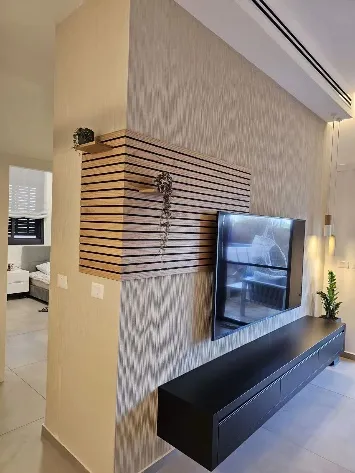
When a facade or an interior feature wall needs the look of natural stone without the weight, cost, and installation complexity of quarried slabs, two engineered alternatives usually come up: MCM flexible cladding stone wall panels and stone composite panels. Both are lighter than solid stone, but they are built in completely different ways and behave differently on site. This guide compares the two across material composition, weight, installation, durability, and design flexibility, so architects, contractors, and project buyers can choose the right system for their project.
What is an MCM flexible cladding stone wall panel?
An MCM (Modified Clay Material) flexible cladding stone wall panel is a thin, flexible stone veneer made from natural clay, mineral pigments, and a modified polymer binder. It reproduces the texture and appearance of natural stone — travertine, marble, granite, slate, and limestone — at a thickness of roughly 2–4 mm and a weight of about 3–6 kg per square metre. Because the material is flexible, it wraps around curved walls, columns, and arches, and it is bonded directly to the substrate with adhesive, with no mechanical anchoring. Panels are cut with scissors or a utility knife, producing no dust or water on site.
COLORIA GROUP manufactures this material in several series, including the MCM Big Slab Board Series, MCM Project Board Series, MCM 3D Printing Series, and MCM flexible stone, with a catalog of more than 40 textures ranging from travertine and marble to wood grain and rammed earth.
What is a stone composite panel?
A stone composite panel is a sandwich construction in which a thin slice of natural stone — typically 3–5 mm — is bonded to a lightweight core, most commonly an aluminium honeycomb, with a backing sheet. The finished panel is usually 10–20 mm thick and weighs roughly one-third to one-quarter of a solid stone slab of the same area. Stone composite panels are rigid, flat products that are fixed to a supporting frame with mechanical anchors or structural adhesive, and they are widely used for curtain walls, lobbies, and other large flat surfaces.
Side-by-side comparison
| Feature | MCM flexible cladding stone wall panel | Stone composite panel |
|---|---|---|
| Core material | Modified clay + mineral pigments | Natural stone veneer + aluminium honeycomb |
| Thickness | 2–4 mm | 10–20 mm |
| Weight per m² | 3–6 kg | About 1/3–1/4 of solid stone |
| Flexibility | Flexible, bends to curves | Rigid, flat panels |
| Curved surfaces | Yes — columns, arches, domes | No — flat surfaces only |
| Installation | Adhesive bonding, no anchoring | Mechanical anchoring or structural adhesive |
| Cutting | Scissors / utility knife, no dust or water | Saw cutting required |
| Water absorption | Low (≤8%) | Natural stone is porous |
| Freeze-thaw resistance | Tested through repeated cycles | Depends on stone type and core |
Weight and structural impact
The weight difference is often the deciding factor. A 100 m² MCM installation adds roughly 300–600 kg to the structure, so it can be applied directly to existing walls — drywall, plywood, concrete, or tile — without reinforcement. Stone composite panels are lighter than solid stone but still heavier than MCM, and large-format panels usually need a supporting frame and mechanical fixing, which adds to the wall build-up and the load on the structure.
Installation speed and labor
MCM panels are bonded with adhesive and cut with simple hand tools, so a general tiling crew can handle them. There is no mortar, no wet saw, no dust, and no weather barrier, and installation can proceed indoors year-round. Stone composite panels require precise cutting, edge finishing, and anchoring to a frame, which calls for experienced installers and more time on site. For retrofit and renovation work, the difference is especially noticeable because MCM needs no structural modification.
Durability and weather resistance
MCM is engineered for all-weather performance. Its dense modified-clay structure keeps water absorption low, mineral pigments resist UV fading, and the material has been tested through repeated freeze-thaw cycles without cracking or delamination. Because it contains no cement, it does not suffer from efflorescence. Stone composite panels inherit the properties of their natural stone face: the stone is porous and must be sealed, and long-term performance depends on the quality of the bond between the stone and the honeycomb core.
Design flexibility
MCM’s flexibility is its biggest design advantage. It bends around curved walls, round columns, arches, and domes, and it can even be applied to ceilings because it is so light. Stone composite panels are rigid and flat, so curved or organic forms require custom fabrication and visible joints. On flat surfaces, both materials deliver a premium stone look, but MCM offers a much wider range of textures and finishes within a single flexible sheet.
Cost considerations
MCM typically carries a lower installed cost because it eliminates structural reinforcement, heavy lifting, and skilled masonry labor, and it produces less waste on site. Stone composite panels have a higher material cost per square metre and require more labor and framing. For projects where budget and schedule matter, MCM is usually the more economical route; for very large flat curtain walls where a genuine stone face is required, stone composite panels remain a valid option.
Best use cases
Choose MCM flexible cladding stone wall panels when:
Choose stone composite panels when:
Frequently asked questions
Is MCM flexible cladding stone the same as a stone composite panel?
No. MCM is a 2–4 mm flexible veneer made from modified clay, while a stone composite panel is a rigid sandwich of natural stone bonded to an aluminium honeycomb core. They are different materials with different installation methods.
Which is lighter?
MCM is lighter, at roughly 3–6 kg per square metre. Stone composite panels weigh about one-third to one-quarter of solid stone, which is still considerably more than MCM.
Can MCM be used outdoors?
Yes. MCM is designed for exterior cladding, with low water absorption, UV-stable pigments, and proven freeze-thaw resistance.
Can stone composite panels follow curved surfaces?
No. They are rigid and flat. MCM is the better choice for curved or organic forms.
Conclusion
Both MCM flexible cladding stone wall panels and stone composite panels solve the problem of heavy, expensive solid stone. MCM wins on weight, flexibility, installation speed, and design freedom, while stone composite panels offer a genuine stone face on large flat surfaces. For most residential and commercial projects — especially those with curves, tight budgets, or retrofit constraints — MCM is the more practical choice.
COLORIA GROUP is a manufacturer of MCM flexible building materials in Foshan, China, supplying flexible stone cladding panels to residential and commercial projects around the world. To explore textures, request samples, or discuss your project, visit the product pages or contact the team at info@coloriaclaystone.com.
Recommend Products












