
Walk into a boutique hotel lobby, and your eyes might linger on a wall that seems to glow with the warm, earthy texture of ancient travertine. Run a hand along its surface, and you'll notice something surprising—it feels lighter than you'd expect, almost pliant. That's the magic of Huge Travertine MCM (Modified Composite Material), a material that's redefining how architects and designers bring natural stone aesthetics to life without the limitations of traditional stone. But how does a material that mimics the grandeur of 2,000-year-old travertine get made in a modern factory? Let's pull back the curtain on the modified cementitious process that turns raw ingredients into the lightweight, durable panels shaping today's most striking spaces.
Before diving into manufacturing, let's clarify what makes MCM different. MCM stands for Modified Composite Material, but when we talk about MCM flexible stone , we're referring to a category of engineered materials designed to replicate the look and feel of natural stone—think travertine, marble, or granite—while ditching the heaviness and brittleness that have long plagued traditional stone. At its core, MCM flexible stone is a hybrid: a blend of mineral aggregates, polymers, and a specialized binder (thanks to the modified cementitious process) that results in sheets thin enough to bend, light enough to float, and tough enough to withstand the elements.
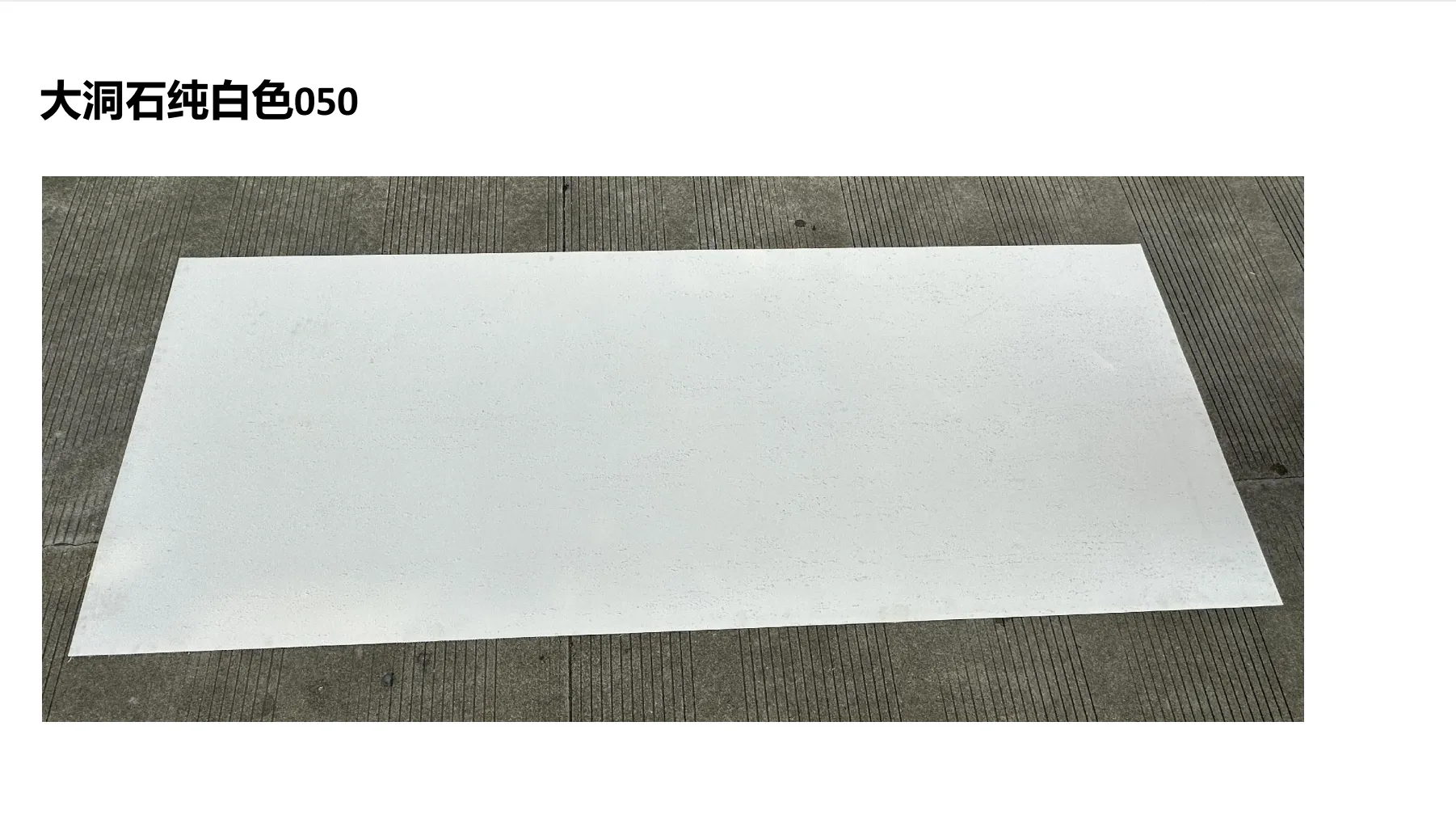
Huge Travertine MCM is a star player in this category. It's not just "travertine-looking"—it's engineered to capture the unique veining, pitting, and depth of natural travertine, the same stone used in iconic structures like Rome's Colosseum. But unlike its ancient counterpart, which can weigh upwards of 25 kg per square meter, Huge Travertine MCM clocks in at as little as 6 kg per square meter. That's a game-changer for architects aiming for architectural big slab solutions —imagine cladding a 50-story tower in "stone" that doesn't require reinforcing the building's entire structure.
The secret to MCM's magic lies in the modified cementitious process —a manufacturing method that reimagines how we bind materials. Traditional cement is strong but rigid; here, "modified" means tweaking the formula to add flexibility without sacrificing durability. Let's break down the journey from raw materials to finished panel.
Every great material starts with great ingredients. For Huge Travertine MCM, the team first selects mineral aggregates that mimic travertine's unique composition. Think crushed natural travertine fines (to capture that authentic texture), limestone, and silica sand—all sourced for their color consistency and particle size. These aggregates are the "DNA" of the stone; get them wrong, and the panel won't have that convincing travertine look.
Then comes the modified cementitious binder. This isn't your average Portland cement. Chemists tweak the mix with polymers and fibers—think of them as "flexibility boosters." These additives act like microscopic springs, allowing the material to bend without cracking. The goal? To create a binder that's strong enough to hold the aggregates together but pliable enough to roll into sheets.
Walk into the mixing room of an MCM factory, and you'll smell a earthy, slightly chemical aroma—like wet concrete mixed with a hint of plastic. Here, giant mixers combine the aggregates, modified cement, water, and a dash of polymers in exact ratios. It's a bit like baking: too much water, and the mix is runny; too little, and it won't bind. Operators monitor the consistency closely, aiming for a texture that's thick but malleable—think cake batter that holds its shape but isn't stiff.
This step is where the "modified" in modified cementitious really shines. The polymers in the mix coat the aggregates, creating a flexible network that will later allow the panel to bend. Without this, the panel would crack the first time you tried to curve it around a column—a non-starter for designers wanting organic shapes.
Next, the mix is poured onto large, flat molds—some as big as 3 meters by 1.5 meters (that's a lot of "stone" in one go). These molds aren't just flat sheets, though; they're etched with 3D patterns to replicate travertine's natural pits, veins, and texture. Imagine pressing a giant stamp into clay, but with the precision of a 3D printer. For lightweight flexible stone sheets , the mix is spread thin—usually 3-6 mm thick—before a hydraulic press applies pressure (up to 200 tons!) to compact the material. This removes air bubbles, ensures the aggregates bond tightly, and pushes the mix into every nook of the mold's texture.
Some molds are even designed for specialty finishes, like the "starry" variants of travertine (think Travertine Starry Blue or Starry Green), where tiny glass particles are sprinkled into the mix before pressing, catching light like constellations in the stone.
After molding, the panels need time to harden—but not in the sun, where they might crack. Instead, they're wheeled into curing chambers: humid, temperature-controlled rooms that mimic a tropical morning. Here, the modified cementitious binder undergoes a chemical reaction called hydration, where water molecules react with cement particles to form strong, crystalline structures. Curing takes 12-24 hours, and it's a delicate balance: too fast, and the panel dries out and cracks; too slow, and production grinds to a halt.
Fun fact: Operators sometimes refer to this step as "napping" the panels. "You don't rush a good nap, and you don't rush curing," one factory manager told me. "A well-cured panel bends like a yoga instructor; a bad one snaps like a dry twig."
Once cured, the panels are rough around the edges—literally. They're trimmed to size with diamond-tipped saws (no, not the kind you use for wood; these blades cut through stone-like material like butter). Then comes the finish: some panels get a honed look (matte, soft), others a polished sheen (glossy, reflective), and some even a "brushed" texture (like weathered stone). For Huge Travertine, the finish is key to mimicking natural travertine's warmth—operators often hand-sand the surface to soften edges, making the panel look like it's been touched by time, not a machine.
Finally, a protective sealant is applied. This isn't just for shine; it's a barrier against stains, water, and UV rays. Imagine it as sunscreen for stone: invisible, but critical for keeping the panel looking fresh for decades.
Before a panel leaves the factory, it has to pass a gauntlet of tests. Want to see flexibility in action? Technicians clamp a corner of the panel and bend it around a metal pipe with a 50 cm radius. If it cracks, it's rejected. They scratch the surface with a coin (no, really—if the finish chips, it's back to the drawing board). They weigh it (remember, 6 kg/m² is the target for lightweight panels). And they soak it in water for 24 hours to check for water absorption (too much, and it'll warp outdoors).
One of the most satisfying tests? The "drop test." A panel is lifted 1 meter off the ground and dropped onto concrete. If it shatters, it's out. If it bounces (yes, bounces!), it's a keeper. "We had a new intern once who asked if we were being too rough," a quality control tech laughed. "I told her, 'If it can't survive a drop, how will it survive a hurricane on a building facade?'"
Still wondering why anyone would choose MCM over real travertine? Let's put it side by side:
| Property | Traditional Travertine | Huge Travertine MCM |
|---|---|---|
| Weight (per m²) | 20-25 kg | 5-8 kg |
| Thickness | 20-30 mm | 3-6 mm |
| Flexibility | Brittle (breaks if bent) | Can bend to a 50 cm radius |
| Installation | Requires heavy machinery, 2-3 people per panel | Light enough for 1-2 people to carry; can be cut on-site |
| Durability | Prone to chipping, staining, and water damage | Resistant to scratches, UV rays, and moisture |
Let's talk about a recent project: a beachfront restaurant in Bali wanted a facade that looked like local stone but could withstand saltwater and high winds. Traditional stone was out—too heavy for the building's wooden structure, and too porous for the humid air. Enter Huge Travertine MCM panels in "Bali Stone" finish. The lightweight sheets (only 6 kg/m²) were installed in 3 days by a crew of 2, and the restaurant now has a stone-like exterior that bends slightly in strong winds (no cracks!) and wipes clean after rain. "It looks like we quarried stone from the nearby cliffs," the architect said, "but we didn't have to disrupt the ecosystem—or the budget."
The modified cementitious process isn't just about making "fake stone"—it's about reimagining what building materials can do. With MCM flexible stone, designers aren't limited by weight or size. Want a 10-meter-tall "travertine" wall in a home? No problem. Need to curve stone around a circular lobby desk? Easy. And because MCM uses less raw material than traditional stone (and no quarrying), it's a more sustainable choice, too.
Huge Travertine MCM is just the beginning. As the modified cementitious process evolves, we're seeing panels that mimic wood, metal, even concrete—all with the same lightweight, flexible benefits. It's a reminder that the most exciting innovations in construction aren't about inventing new materials from scratch, but about taking what nature gave us and making it work harder, smarter, and more beautifully for the way we live now.
So the next time you run your hand along a "stone" wall that feels surprisingly light, remember: it's not magic. It's the modified cementitious process—turning aggregates, polymers, and a little ingenuity into the building blocks of tomorrow's spaces. And that, in itself, is something worth celebrating.
Recommend Products












