
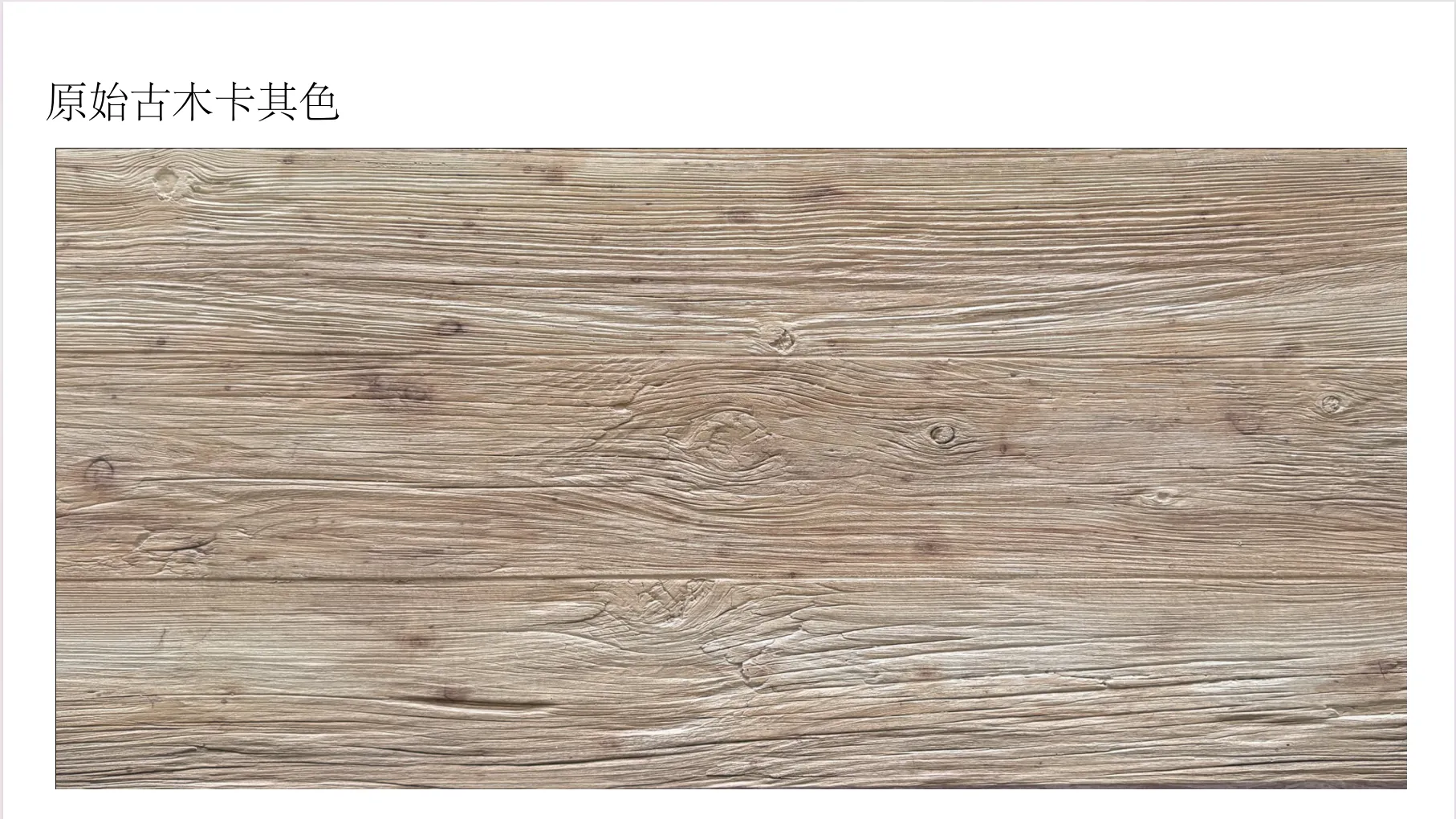
There's something almost magical about ancient wood. Picture walking into a centuries-old cottage in the English countryside: the floorboards creak softly underfoot, their edges worn smooth by generations of footsteps, and the grain spirals like secret maps, each knot and whorl telling a story of storms weathered and seasons passed. Or imagine the teak beams of a Balinese temple, their surfaces polished to a honeyed glow by time and tropical rains, holding up roofs that have sheltered prayers for hundreds of years. That's the allure of wood grain—it's not just a pattern. It's history, memory, and nature's artistry, all woven into one.
But here's the heartbreak: that same wood, the kind that makes our homes feel like sanctuaries and our buildings feel rooted in legacy, is disappearing. Ancient forests are felled for timber, old-growth trees—some older than our grandfathers—are cut down to satisfy our craving for that "authentic" wood look. Deforestation isn't just an environmental issue; it's a cultural one. When we lose these trees, we lose the chance to pass down their stories, and we rob future generations of the same awe we feel when we run a hand over a 200-year-old oak beam.
What if there was a way to keep that magic alive—without cutting down a single tree? Enter MCM: Modified Composite Material. It's not just a building material; it's a bridge between the past and the future, a way to replicate the warmth and character of ancient wood grain while honoring the planet we call home. Let's dive into how MCM is changing the game, one wood grain board at a time.
Before we talk about how MCM replicates wood grain, let's unpack why we love it so much. Wood grain isn't just pretty—it's human . Think about it: no two pieces of wood are identical. A pine tree grown on a windswept hillside will have tighter, more twisted grain than one sheltered in a valley. A teak tree that survived a drought will bear the marks of that struggle in its rings. This uniqueness makes wood feel alive, like it has a personality. It's why designers and homeowners alike chase that "imperfect" look—the knots, the color variations, the little cracks that say, "I've lived."
Ancient wood grain, in particular, carries weight. It's a link to our ancestors. When you touch a wooden beam from a 17th-century barn, you're touching the same surface that a farmer's hands touched, that a child ran their fingers along while hiding from chores. It's heritage in tangible form. Historical pathfinders stone, another texture in MCM's lineup, taps into this same idea—materials that feel like they've been part of history—but wood grain? It's personal. It's the smell of campfires, the sound of a axe splitting logs, the warmth of sunlight filtering through a wooden porch.
The problem, of course, is that real ancient wood is finite. Old-growth forests take centuries to regrow, and even young trees need decades to develop the depth of grain we crave. By the time a tree is old enough to have that "character," it's also old enough to be ecologically vital—providing habitat for birds, absorbing carbon, stabilizing soil. Cutting it down for a backsplash or a accent wall feels like a betrayal, both of the planet and of the tree's own story.
This is where the frustration sets in for designers. You want to create a space that feels timeless, that honors tradition, but you don't want to contribute to deforestation. You're stuck between aesthetics and ethics. And that's exactly the gap MCM was designed to fill.
Let's start with the basics: MCM stands for Modified Composite Material. Think of it as a high-tech blend of natural minerals, polymers, and fibers—engineered to mimic the look and feel of natural materials, but with superpowers. Unlike traditional composites, which can feel plastic-y or flat, MCM is designed to be authentic . It doesn't just look like wood; it acts like it, too—minus the downsides.
One of MCM's star players is MCM flexible stone . Despite the name, it's not just for stone textures. This flexible, lightweight material can be molded to replicate almost any natural surface—including wood grain. Imagine a thin, bendable panel that weighs a fraction of real wood but has the same depth and texture as a reclaimed oak board. That's MCM flexible stone in action. It's durable enough for exterior walls, lightweight enough for ceilings, and flexible enough to wrap around columns or curved surfaces. In short, it's a designer's dream.
But MCM isn't just about flexibility. It's about sustainability, too. Most MCM products are made with recycled or abundant materials—think ground stone, recycled polymers, and natural fibers. The production process uses less water and energy than mining stone or cutting timber, and since it's a composite, there's minimal waste. Plus, MCM panels are long-lasting—resistant to rot, pests, and weather—so they don't need to be replaced as often as real wood. Less replacement means less demand for new materials, which loops back to that whole "saving the planet" thing.
Here's the million-dollar question: How does MCM make a composite panel look and feel like 100-year-old wood? It's a mix of art, science, and a little bit of magic (okay, mostly science). Let's break it down step by step.
It all starts with the source: real ancient wood. MCM manufacturers work with historians, architects, and conservationists to get their hands on samples of old wood—think reclaimed barn planks, salvaged temple beams, or even fragments from historical ships. These samples are scanned using high-resolution 3D imaging technology, which captures every nuance: the depth of a knot, the direction of the grain, the tiny cracks that come from years of expansion and contraction, even the color variations caused by sun exposure or moisture.
This scanning process is meticulous. Some companies use lasers that can detect variations as small as 0.01 millimeters—that's thinner than a human hair. The goal? To create a digital "blueprint" of the wood's texture that's so accurate, even a carpenter with 40 years of experience would do a double-take.
Once the 3D scan is complete, it's time to turn that digital blueprint into a physical mold. MCM manufacturers use advanced CNC (Computer Numerical Control) machines to carve the scanned texture into a master mold, usually made of metal or high-density plastic. This mold isn't just a flat surface—it has the same peaks and valleys as the original wood. Run your finger over it, and you'll feel the same resistance, the same give, as you would on the real thing.
But here's where MCM gets clever: the mold isn't just for one texture. Manufacturers can tweak the digital file to create variations—so you might have a "rustic oak" mold with more knots, or a "sleek teak" mold with smoother grain. This means designers can choose the exact "personality" of wood grain they want, without being limited to whatever's available at the lumberyard.
Now comes the material science part. MCM panels are built in layers, like a cake. The base layer is usually a lightweight, rigid substrate—often made of recycled fibers or foam, which gives the panel strength without adding weight. On top of that, a layer of MCM flexible stone mixture is applied. This mixture is a blend of ground natural stone (like limestone or marble dust), polymers for flexibility, and pigments to mimic wood tones. The mixture is pressed into the mold under high pressure, which pushes it into every nook and cranny of the texture—ensuring that the final panel has the same depth and dimensionality as the original wood.
After pressing, the panel is cured (dried or heated) to set the mixture. Then, a protective topcoat is added—clear, but tough enough to resist scratches, stains, and UV rays. This topcoat is what makes MCM wood grain boards suitable for outdoor use, unlike real wood, which would warp or fade in the rain or sun.
The final step is the color. MCM manufacturers don't just slap on a uniform "wood brown" paint. Instead, they use a multi-step coloring process, layering different pigments to mimic the way real wood ages. For example, a "vintage oak" panel might have a base of warm honey, with darker streaks to mimic the natural oxidation of wood, and lighter highlights to replicate the way sunlight bleaches certain areas. Some panels even have subtle "stain" variations—like the way a real plank might have absorbed more moisture in one spot, leading to a slightly darker patch. The result? A panel that doesn't just look like wood—it looks like lived-in wood.
If MCM is the hero, then wood grain board is its trusty sidekick. This product is exactly what it sounds like: MCM panels engineered specifically to replicate wood grain, in all its varied glory. But don't let the name fool you—these aren't your average "faux wood" panels from the hardware store. Wood grain board is in a league of its own, and here's why:
But don't just take my word for it. Let's look at a real-world example. A few years back, a boutique hotel in (Dali), China, wanted to recreate the feel of a traditional Bai people's courtyard home, but with modern amenities. The original homes use massive cypress beams and pine floorboards—wood that's now protected due to deforestation in the region. The designers turned to MCM wood grain board. They chose a "vintage pine" finish for the ceiling beams and a "weathered oak" for the accent walls. The result? Guests rave about the "authentic" old-world charm, and the hotel owners sleep easy knowing they didn't contribute to deforestation. Win-win.
Still on the fence? Let's put traditional wood and MCM wood grain board head-to-head. Here's how they stack up:
| Aspect | Traditional Wood | MCM Wood Grain Board |
|---|---|---|
| Environmental Impact | Requires cutting down trees; contributes to deforestation and habitat loss. | Made with recycled materials; no trees cut; low carbon footprint. |
| Durability | Prone to rot, warping, pests, and fading; needs regular maintenance. | Water-resistant, pest-proof, UV-stable; minimal maintenance required. |
| Installation | Heavy and rigid; requires specialized tools and structural support. | Lightweight and flexible; easy to cut, drill, and install on any surface. |
| Cost (Long-Term) | Initial cost may be low, but high maintenance and replacement costs add up. | Slightly higher initial cost, but no maintenance or replacement costs for decades. |
| Aesthetic Variety | Limited by available wood types and cuts; no two pieces are identical (which can be a pro or con). | Unlimited variety; replicate any wood type, texture, or age—consistent or varied, your choice. |
| Applications | Best for indoor, dry environments; not ideal for exteriors or high-moisture areas. | Suitable for indoors, exteriors, bathrooms, kitchens, ceilings, and curved surfaces. |
The verdict? Traditional wood has its charm, but when it comes to sustainability, durability, and versatility, wood grain board wins hands down. And the best part? You don't have to sacrifice that "authentic" feel. In fact, most people can't tell the difference—until you tell them it's MCM, and they get that "whoa, really?" look on their face.
While wood grain board is stealing the spotlight, it's worth mentioning another MCM gem that ties into the theme of preserving history: historical pathfinders stone . This product is designed to replicate the look of ancient stone paths—think cobblestones from Roman roads, or the weathered flagstones of a medieval village square. But what does this have to do with wood grain? Everything, actually.
Historical pathfinders stone and wood grain board share the same core mission: to preserve the aesthetics of the past without harming the present. Just as ancient wood tells stories of human craftsmanship, ancient stone tells stories of civilizations—how people built, traveled, and lived. By replicating these textures with MCM, we're not just creating building materials; we're creating time capsules. We're letting future generations walk on "Roman roads" or touch "medieval beams" without eroding the real thing or contributing to resource depletion.
Imagine a museum dedicated to ancient trade routes. Instead of using real cobblestones (which would be heavy, expensive, and damaging to the original artifacts), they use historical pathfinders stone for the floors and wood grain board for the exhibit walls. Visitors get the sensory experience of walking through history, but the museum's carbon footprint stays low, and no ancient resources are disturbed. That's the power of MCM—it lets us participate in history, not just observe it.
Wood grain board isn't just for cozy cabins or boutique hotels. Its versatility means it can be used in almost any architectural or design project. Here are a few ways designers and architects are putting it to work:
Homeowners love wood grain board for its ability to add warmth without the hassle of real wood. Imagine a kitchen backsplash that looks like reclaimed barn wood but won't warp when you steam vegetables. Or a bathroom accent wall that mimics teak paneling but won't rot in the humidity. Wood grain board is also popular for flooring (yes, flooring!)—it's scratch-resistant, so it can handle kids and pets, and it's easy to clean, unlike real wood which requires special cleaners.
Restaurants, cafes, and retail stores are using wood grain board to create a specific vibe. A coffee shop going for a "rustic farmhouse" feel can line its walls with wood grain board that looks like aged pine, without worrying about termites or water damage from steam. A boutique clothing store aiming for "timeless elegance" might use wood grain board in a mahogany finish for its display shelves, giving the space a high-end look without the high-end price tag of real mahogany.
Parks, libraries, and community centers need materials that can stand up to heavy foot traffic and the elements. Wood grain board fits the bill. A park pavilion with a wood grain board ceiling looks warm and inviting, but won't warp in the rain or fade in the sun. A library reading room with wood grain board walls feels like a cozy study, but the panels are resistant to scuffs from book bags and easy to wipe clean if someone spills coffee.
This is where wood grain board really shines. When restoring a historical building—say, a 19th-century schoolhouse or a colonial-era church—architects often face a dilemma: they need to match the original woodwork, but real old-growth wood is either unavailable or too expensive. Wood grain board solves this by replicating the exact texture and color of the original wood, so the renovation stays true to the building's heritage. Plus, since it's more durable than real wood, it helps protect the building from future damage, ensuring it stands for another hundred years.
As we become more aware of our impact on the planet, sustainability isn't just a trend—it's a responsibility. But that doesn't mean we have to give up the things we love, like the warmth of ancient wood grain or the character of historical stone. MCM is leading the charge in what I like to call "sustainable heritage"—design that honors the past while protecting the future.
Looking ahead, MCM technology is only getting better. Manufacturers are experimenting with even more sustainable materials, like algae-based polymers or agricultural waste fibers, to make the panels even greener. They're also expanding their texture libraries, adding more rare and historical wood types to their catalog, so designers can replicate almost any "lost" wood grain from history.
But perhaps the most exciting thing about MCM is how it's changing the conversation. It's proving that sustainability and beauty don't have to be enemies. That we can have our "ancient wood" and save the forests, too. That we can build buildings that feel like they've been around for centuries, without costing the Earth centuries of resources.
I'll admit it: I'm a sucker for ancient wood grain. There's something about it that feels like coming home, like connecting to something bigger than myself. But I'm also a sucker for forests—for the way sunlight filters through leaves, for the sound of birds nesting in old trees, for the knowledge that those trees are cleaning our air and stabilizing our climate. For a long time, I thought I had to choose between those two loves.
MCM wood grain board changed that. It let me have both—the warmth of the past and the hope of the future. It let me design spaces that feel like they have stories, without writing a new story of deforestation. And that, to me, is the real magic of MCM.
So the next time you walk into a room with beautiful wood grain, take a closer look. Maybe it's real wood—and that's okay, if it's reclaimed or sustainably sourced. But maybe it's MCM. And if it is, know that behind that texture is a team of scientists, designers, and conservationists who care just as much about preserving history as they do about preserving the planet.
Here's to wood grain, to forests, and to the future—where we can have both.
Recommend Products












