
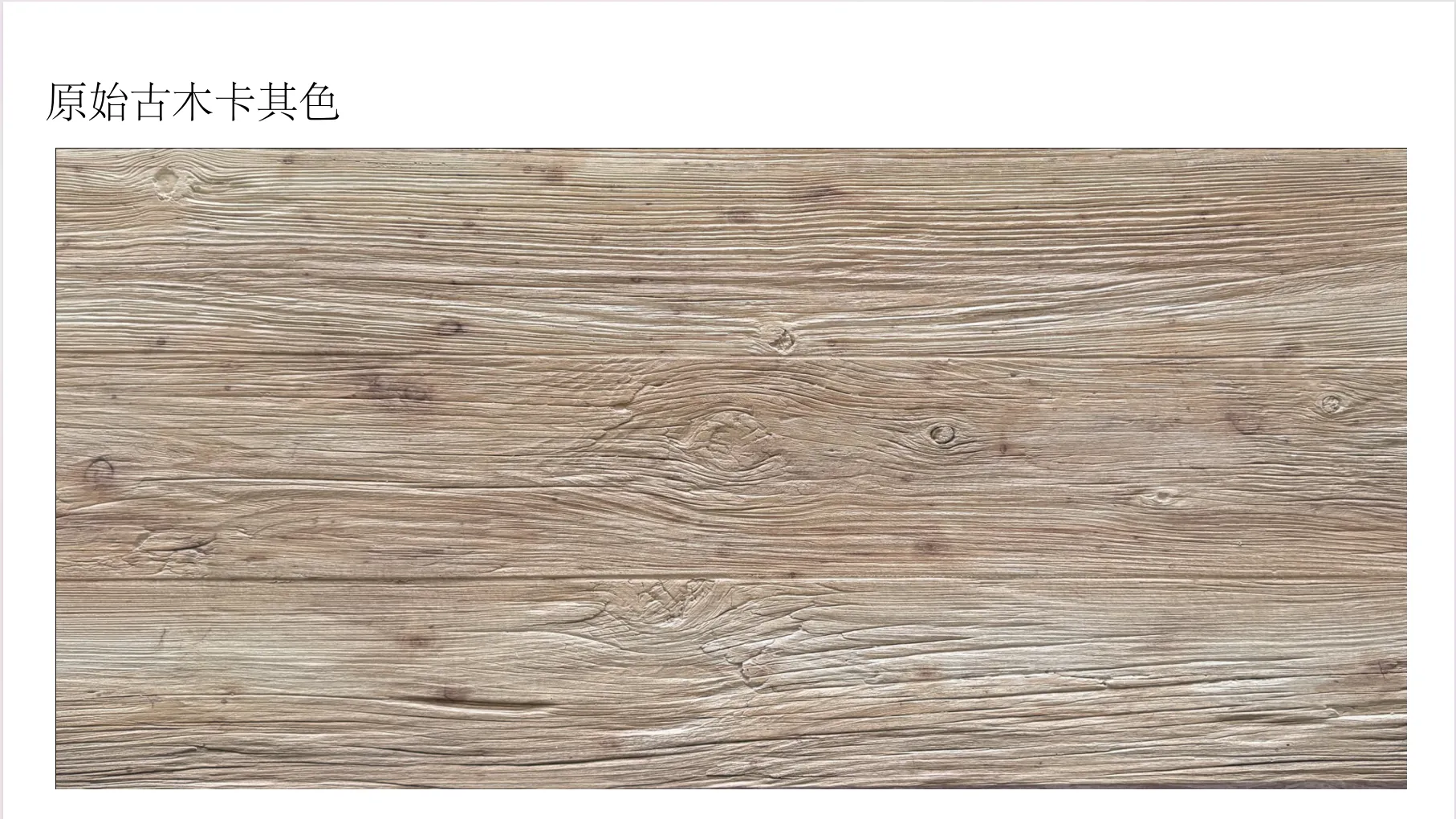
There's something almost magical about ancient wood. Think about the last time you ran your hand over a centuries-old wooden beam in a historic cottage, or traced the swirling grain of a reclaimed barn door. Each knot, each mineral streak, each shift in color tells a story—of seasons passed, of weather endured, of time itself. These variations are what make ancient wood irreplaceable; they're the fingerprint of nature, unique and unrepeatable. But here's the hard truth: real ancient wood is vanishing. Old-growth forests are scarce, reclaimed timber is finite, and preserving these pieces often means keeping them locked away in museums or private collections. So how do we keep that timeless beauty alive in our homes, offices, and public spaces without depleting our planet's most precious resources? Enter MCM.
You might have heard of MCM before—short for Modified Composite Material—but let's break it down simply: MCM is a revolutionary building material designed to mimic the look and feel of natural elements like stone, metal, and yes, wood, while offering durability, flexibility, and sustainability that natural materials often can't match. And when it comes to replicating the intricate, one-of-a-kind variations of ancient wood? MCM doesn't just copy the surface—it captures the soul of the material. Today, we're diving into how MCM pulls off this feat, focusing on products like wood grain board and MCM flexible stone that make consistent replication of ancient wood's magic possible.
Before we talk about replication, let's celebrate what we're trying to preserve. Ancient wood isn't "perfect"—and that's exactly why we love it. Real ancient wood boasts:
The problem? These variations are impossible to mass-produce with real wood. Each piece is a one-off, which makes scaling projects—say, cladding an entire restaurant wall or flooring a hotel lobby—either cost-prohibitive or environmentally unsustainable. And that's where MCM steps in, turning "impossible" into "everyday."
MCM isn't just a material; it's a marriage of art and science. At its core, MCM is made by combining natural minerals, polymers, and fibers into a lightweight, flexible sheet. But what sets it apart is how it's engineered to replicate natural textures and colors with stunning accuracy. For ancient wood, this means going beyond "wood-look" to "wood-feel"—capturing not just the visual patterns, but the subtle nuances that make wood feel alive.
Two stars of this replication process are MCM flexible stone and wood grain board . MCM flexible stone, as the name suggests, is designed to mimic stone textures, but its flexibility also makes it ideal for shaping around curves or intricate designs—perfect for recreating the organic, uneven edges of ancient wood. Wood grain board, on the other hand, is a specialized MCM product laser-focused on replicating the exact grain patterns, color shifts, and textural depth of wood, ancient or otherwise.
Replicating ancient wood's natural variations isn't about slapping a wood print on a panel. It's about studying the material at a microscopic level, then recreating those details with precision. Here's how MCM does it:
MCM starts with real ancient wood samples. Teams of artisans and material scientists travel the globe to study reclaimed timber, historic structures, and even museum pieces. They photograph, scan, and catalog every detail—from the angle of a grain line to the exact shade of a mineral streak. These samples become the "master templates" for replication.
Using high-resolution 3D scanners, MCM engineers create digital models of the wood's surface, capturing every bump, groove, and imperfection down to 0.1mm. These digital models are then used to carve physical molds—often made of silicone or metal—that mirror the wood's texture exactly. For complex patterns, MCM's 3D printing series comes into play, allowing for even more intricate molds that replicate the depth of ancient wood's knots or splits.
Color is where many "wood-look" products fail—they end up looking flat or artificial. MCM takes a different approach. Instead of using a single layer of paint, it layers pigments to mimic how wood absorbs and reflects light. For example, ancient wood often has a warm base color (think honey or chestnut) with cooler undertones (gray, green) in shaded areas. MCM mixes natural mineral pigments and applies them in thin, translucent layers, letting the colors blend and shift just like they do in real wood. The result? No two panels are identical, but they all feel cohesive—just like a forest of trees.
Ever run your hand over a "wood-look" laminate and thought, "That feels like plastic"? MCM avoids this by adding textural depth. During manufacturing, the MCM sheet is pressed into the 3D mold, embedding the wood's grooves, ridges, and grain into the material. Some products even add a thin layer of natural fibers to mimic the softness of aged wood, making the surface feel warm and organic to the touch.
Here's the paradox MCM solves: How do you create consistent products while preserving the "natural variation" that makes ancient wood special? The answer lies in controlled randomness. MCM doesn't produce identical panels—that would look fake. Instead, it uses a library of templates, colors, and textures, ensuring each panel has unique variations, but all fall within a cohesive "family" of looks. This way, a wall cladded with MCM wood grain board feels like a collection of reclaimed wood planks, not a mass-produced sheet.
To illustrate this, let's compare real ancient wood to MCM wood grain board side by side:
| Characteristic | Real Ancient Wood | MCM Wood Grain Board |
|---|---|---|
| Scarcity | Finite; often reclaimed or from protected forests | Unlimited; made from sustainable, abundant materials |
| Color Variation | Unique per piece; hard to match across batches | Controlled variation; panels blend naturally without clashing |
| Texture Depth | Deep, irregular, and tactile | 3D-molded to replicate depth; feels nearly identical to real wood |
| Durability | Prone to warping, rotting, and insect damage | Waterproof, fire-resistant, and pest-proof; lasts decades |
| Sustainability | Often requires deforestation or energy-heavy reclamation | Made with recycled materials; reduces demand for rare timber |
| Cost | High; $50–$200+ per square foot for rare varieties | Affordable; $10–$30 per square foot, depending on design |
The table tells the story: MCM doesn't just replicate ancient wood—it improves on it. It keeps the beauty, the variation, and the soul, while ditching the drawbacks.
Sure, MCM looks amazing—but its real superpower is how it performs in the real world. Let's break down why designers, architects, and homeowners are choosing MCM wood grain board and flexible stone over real ancient wood:
Ancient wood preservation often pits aesthetics against the environment. MCM flips that script. By using recycled minerals and polymers, it reduces the need to harvest rare timber or disturb historic structures. In fact, many MCM products are certified as "green building materials," meaning they meet strict standards for low VOC emissions and resource efficiency. Choosing MCM isn't just about getting a great look—it's about leaving ancient wood in the ground (or in museums) where it belongs.
Real ancient wood might look stunning in a dry, climate-controlled library, but put it in a bathroom, a kitchen, or an outdoor patio, and it won't last a decade. MCM? It's built to withstand the worst. Spills? Wipe them off—no staining. Humidity? No warping. Freezing temperatures? No cracking. Even direct sunlight won't fade its colors. This durability makes MCM perfect for high-traffic areas like restaurants, schools, and retail stores, where real wood would wear thin in years.
Ancient wood is rigid—you can't bend a 200-year-old beam into a curved wall or cut it into ultra-thin panels for a ceiling. MCM, though, is flexible (hence "MCM flexible stone") and lightweight, making it easy to install on curved surfaces, ceilings, or even furniture. Want a backsplash that looks like aged oak? MCM can do it. Dream of a headboard shaped like a wave, wrapped in "ancient wood"? MCM makes it possible. The only limit is your imagination.
For designers who want to take the replication a step further, MCM offers wood line —a series of trim, molding, and edge details that mimic the look of hand-carved wooden accents. These pieces, made from the same MCM material as the main panels, ensure every corner, joint, and edge feels cohesive. It's the little things, after all—like a wood line trim along a bookshelf—that make a space feel authentically "wooden."
Don't just take our word for it—MCM's wood replicas are already transforming spaces around the world. Here are a few examples of how designers are using MCM to bring ancient wood's warmth into modern projects:
A 1920s-era bistro in Chicago wanted to honor its roots with "reclaimed wood" walls, but the original wood was too fragile to reuse. The solution? MCM wood grain board in a "vintage oak" finish, paired with wood line trim. Today, diners swear the walls feel like they've been there for a century—even though the panels were installed last year. And best of all, the restaurant can easily replace a panel if it gets scratched, without hunting for a matching piece of real reclaimed wood.
A coastal home in California needed exterior cladding that looked like weathered driftwood but could withstand salt spray and high winds. MCM wood grain board in "driftwood gray" was the answer. The lightweight panels were installed in days (instead of weeks), and three years later, they still look as weathered and charming as the day they went up—no peeling, no rotting, no need for repainting.
A luxury hotel in Tokyo wanted a showstopping lobby wall that felt "timeless" but fit with its modern aesthetic. The design team chose MCM wood grain board in a mix of "ancient teak" and "vintage pine" finishes, arranged in a herringbone pattern. The result? A wall that draws the eye with its natural variation, feels warm to the touch, and requires zero maintenance—even with thousands of guests passing through daily.
Ancient wood isn't just a material; it's a connection to our history. It reminds us of simpler times, of craftsmanship, of the quiet beauty of nature. MCM doesn't replace that connection—it preserves it, making it accessible to everyone, everywhere. Whether you're renovating a home, designing a commercial space, or just dreaming of a warmer, more natural environment, MCM's ability to replicate ancient wood's variations consistently means you can have the beauty of the past without sacrificing the sustainability or practicality of the future.
So the next time you walk into a space and think, "This wood feels alive," take a closer look. It might just be MCM—proving that innovation and nature don't have to be enemies. Sometimes, they're the best of friends.
Recommend Products












