
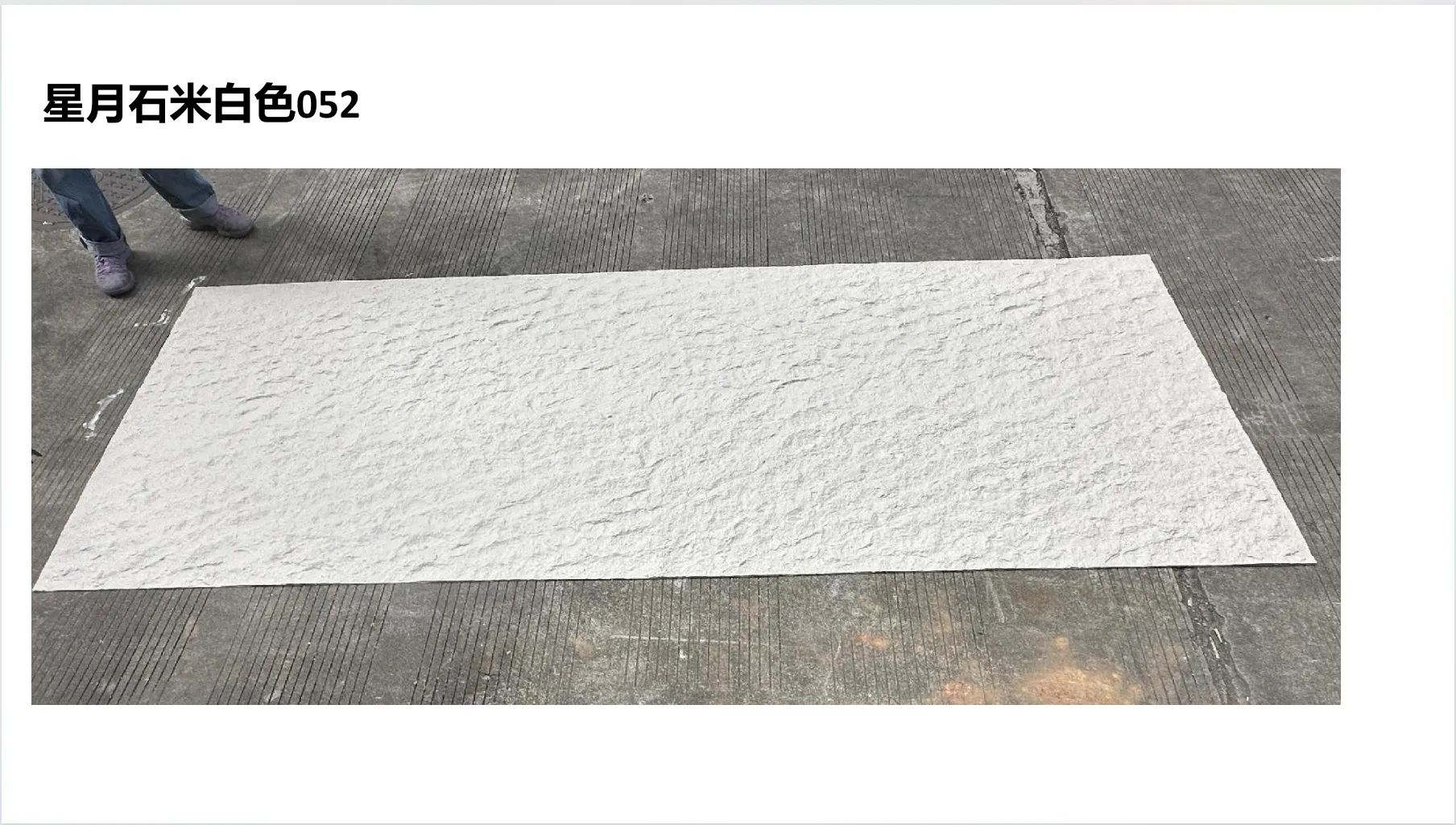
Walk onto a typical construction site, and you'll likely see piles of discarded stone fragments, leftover concrete slabs, and scraps of metal—remnants of a process that's long been wasteful by design. The construction industry, responsible for nearly 40% of global waste annually according to the United Nations Environment Programme, has long struggled with inefficiency. From quarries extracting more natural stone than needed to on-site cutting that leaves heaps of unusable scraps, traditional building materials have contributed to a cycle of waste that's costly for both budgets and the planet. But what if there was a material that flipped the script? Enter Starmoon Stone, part of the broader MCM (Modified Composite Material) family, which is quietly revolutionizing how we build—one low-waste project at a time.
To understand why Starmoon Stone is a game-changer, let's first unpack the waste problem with traditional building materials. Take natural stone, for example—marble, granite, or travertine. Quarrying these materials involves blasting rock faces, which often yields only 30-40% usable stone; the rest becomes rubble. Then, transporting these heavy slabs to job sites leads to breakage, adding more waste. On-site, cutting natural stone to fit specific dimensions is imprecise at best—contractors often over-order to account for errors, leaving excess slabs to gather dust or end up in landfills. A single commercial project using natural marble might generate tons of waste before the first wall is even finished.
Concrete, another staple, is no better. Mixed on-site, it's notoriously hard to get the quantity exactly right. Leftover wet concrete can't be stored, so it's often dumped. Even pre-cast concrete panels, while more controlled, suffer from rigid sizing—if a design changes mid-project, those panels become obsolete. And let's not forget weight: traditional concrete and stone are heavy, requiring more structural support, which means more materials (and more potential waste) in the foundation and framing.
Then there's installation. Traditional materials like fair-faced concrete or solid wood panels demand skilled labor to cut, shape, and fit. Mistakes happen, and each mistake translates to wasted material. A mismeasured window opening, for instance, might mean an entire stone slab is scrapped. Over time, these inefficiencies add up—costing contractors money in disposal fees, material overages, and labor hours spent cleaning up.
Starmoon Stone, developed by MCM, wasn't just designed to look good—it was built to eliminate waste at every stage. Let's break down how:
Unlike natural stone, which is extracted and then shaped, Starmoon Stone is engineered in a controlled factory setting using advanced 3D printing and molding techniques (part of the MCM 3D Printing Series). This precision allows for exact sizing—no more guesswork. If an architect specifies a panel 120cm x 80cm with a custom wave pattern, the factory prints it to those exact dimensions. There's no over-ordering "just in case" because the margin for error is near-zero. In fact, MCM reports that their manufacturing process produces less than 5% waste, compared to the 60-70% waste from natural stone quarrying and cutting.
Take the "Starry Green" Travertine variant of Starmoon Stone, popular for its celestial-inspired texture. Traditional travertine, with its porous structure, often cracks during cutting, leading to waste. But Starmoon's composite formula—blending natural minerals with recycled polymers—eliminates brittleness. The result? Panels that cut cleanly, with edges that fit together seamlessly, reducing the need for filler materials or extra cuts.
One of the biggest hidden waste sources in construction is transport damage. Traditional stone slabs, weighing 20-30kg per square meter, are prone to chipping or breaking during transit. Starmoon Stone, by contrast, weighs just 8-10kg per square meter. That's a 60% reduction in weight, which means fewer broken panels en route to the site. Contractors report up to 95% of Starmoon panels arrive intact, compared to 70-80% for natural stone. Less breakage equals less waste—and fewer emergency orders to replace damaged materials.
Installation is where the lightweight advantage really shines. Traditional stone requires heavy machinery to lift and position, and misalignment during placement often leads to cracked slabs. Starmoon Stone, however, can be handled by two workers with basic tools. Its interlocking edge system (think of a puzzle piece design) ensures a snug fit on the first try, minimizing the need to trim or adjust panels on-site. A recent hotel project in Dubai, which used Starmoon's Lunar Peak Silvery panels for its facade, reported a 40% reduction in installation time and zero waste from broken or misfit panels—a first for the project's lead contractor.
Waste isn't just about the construction phase—it's also about longevity. Traditional materials degrade over time: natural stone etches from rain, concrete cracks in freeze-thaw cycles, wood rots. When these materials fail, they're torn out and replaced, creating a second wave of waste. Starmoon Stone, though, is built to last. Its composite core resists water, UV rays, and temperature fluctuations. In accelerated aging tests, it showed minimal wear after 50 years—comparable to natural stone but without the vulnerability to chipping or staining.
Consider a school in Arizona, where extreme heat and monsoon rains take a toll on exteriors. The original brick walls needed repainting every 5 years and replacement every 20. When the school renovated with Starmoon's Travertine (Vintage Gold) panels, the maintenance team estimated the new facade would last 60+ years with only occasional cleaning. That's three times the lifespan of traditional brick—meaning three times less waste from replacement cycles.
Even the most durable materials eventually reach the end of their useful life. But unlike natural stone, which is crushed and landfilled, Starmoon Stone is recyclable. At the end of a building's life, panels can be stripped, ground down, and reprocessed into new MCM products. MCM's closed-loop recycling program has already diverted over 2,000 tons of material from landfills since 2020. Compare that to traditional concrete, which is rarely recycled (only 10-15% globally) and often ends up in landfills, leaching chemicals into the soil.
To put these benefits into perspective, let's look at a side-by-side comparison of Starmoon Stone with two common traditional materials: natural marble and standard concrete.
| Metric | Starmoon Stone | Natural Marble | Standard Concrete |
|---|---|---|---|
| Waste During Manufacturing | 5% or less (precision 3D printing) | 60-70% (quarrying and cutting inefficiencies) | 15-20% (over-mixing and curing defects) |
| Transport Breakage Rate | 5% or less (lightweight, impact-resistant) | 20-30% (heavy, brittle) | 10-15% (heavy, prone to cracking) |
| On-Site Installation Waste | Almost none (interlocking design, pre-cut to size) | 15-20% (cutting errors, misalignment) | 10-25% (mismatched pours, formwork waste) |
| Replacement Cycle (Years) | 50+ | 20-30 (with maintenance) | 15-25 (cracking, spalling) |
| Recyclability | 90%+ (closed-loop recycling program) | 30% (crushed for aggregate, limited use) | 60% (recycled as base material, low-value) |
Starmoon Stone is just one star in MCM's constellation of sustainable materials. The brand's MCM Flexible Stone series, for example, takes waste reduction a step further. Unlike rigid panels, these flexible sheets can bend to curved surfaces—think rounded columns or organic-shaped facades—eliminating the need to cut and piece together rigid materials (a process that typically generates 25-30% waste). A museum in Tokyo used MCM Flexible Stone in its undulating entrance hall, and the design team noted that not a single sheet was wasted during installation.
Then there's the Foamed Aluminium Alloy Board (Vintage Silver), another MCM standout. Made from recycled aluminum, it's 70% lighter than solid aluminum and 100% recyclable. Its honeycomb core design uses less material without sacrificing strength, and like Starmoon Stone, it's precision-cut to avoid on-site waste. A tech campus in California recently swapped traditional metal cladding for MCM's foamed aluminium boards and saw a 50% drop in waste from metal scraps.
Even MCM's Fair-Faced Concrete, a modern take on the classic material, is engineered to minimize waste. Unlike traditional fair-faced concrete, which requires multiple pours and often results in uneven surfaces (leading to grinding and waste), MCM's version is cast in controlled molds with fiber reinforcement, ensuring a smooth finish on the first try. A residential developer in Berlin reported using 30% less concrete per project after switching to MCM's formula—saving money and reducing carbon emissions from concrete production, which is a major global polluter.
For contractors, waste isn't just an environmental issue—it's a bottom-line problem. Disposal fees, material overages, and labor hours spent cleaning up cost time and money. Take a mid-sized office building project: using traditional stone might generate 50 tons of waste, costing $10,000+ in landfill fees alone. Starmoon Stone, with its 5% waste rate, would cut that to 2.5 tons, saving $9,500. Multiply that across hundreds of projects, and the savings add up. Small wonder that contractors like Miami-based BuildSmart now require MCM materials on all their green-certified projects.
Communities benefit, too. Construction waste often ends up in landfills near low-income neighborhoods, contributing to air and water pollution. By reducing waste, Starmoon Stone and other MCM products help ease that burden. In Portland, Oregon, a affordable housing development using Starmoon's Bali Stone panels diverted 98% of its construction waste from landfills, earning it a LEED Platinum certification and praise from local environmental groups.
As the construction industry shifts toward sustainability, materials like Starmoon Stone are leading the charge. They prove that we don't have to choose between beauty, durability, and eco-friendliness. By reimagining how materials are made, transported, installed, and recycled, MCM is turning the "wasteful by design" narrative on its head.
Imagine a world where construction sites are cleaner, budgets stretch further, and buildings stand the test of time without leaving a trail of waste. It's not a distant dream—it's here, and it's built with materials like Starmoon Stone. For architects, contractors, and homeowners who care about the planet, the choice is clear: when you build with intention, you build better.
So the next time you pass a construction site, take a closer look. If you see smooth, lightweight panels going up with minimal fuss and even less waste, chances are, you're looking at the future—and it's wearing Starmoon Stone.
Recommend Products












