
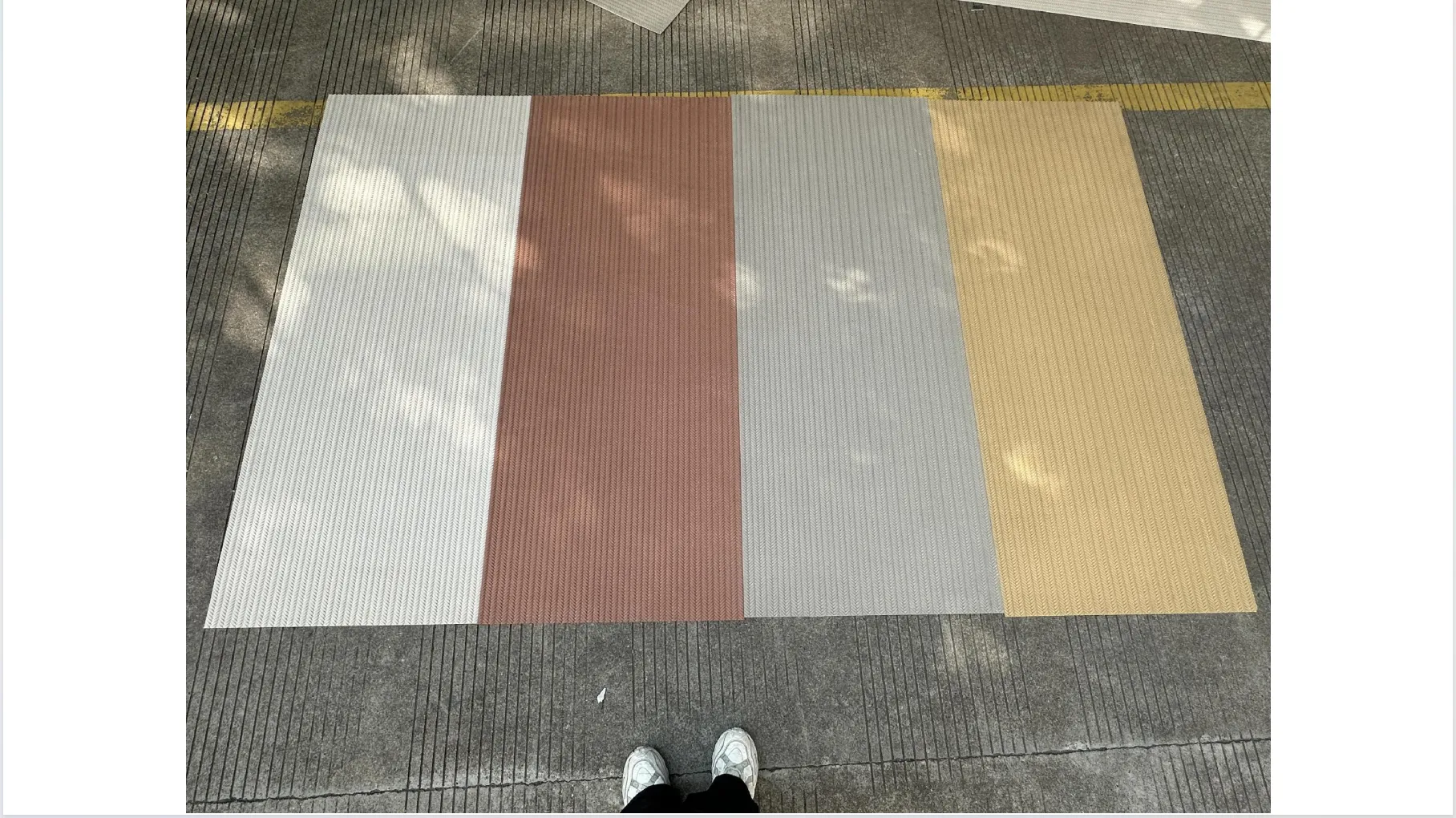
If you've ever held a sample of Modified Composite Material (MCM) and traced your finger over its woven texture, you know there's something deeply tactile about it. But what if that texture isn't just a design choice? What if the way it looks in a real photo holds clues to how well it will stand up to rain, foot traffic, or the harsh glare of the sun? For designers, contractors, and homeowners alike, woven real photos of MCM aren't just pretty pictures—they're windows into durability. Let's unpack how to read these images like a pro, so you can choose materials that look good and last.
MCM, with its blend of polymers, fibers, and natural materials, is beloved for balancing aesthetics and resilience. But here's the thing: durability isn't always obvious from a spec sheet. A material might claim to be "weather-resistant," but if its woven pattern is loosely bonded or unevenly textured, that resistance could crumble over time. Woven real photos—high-resolution, unedited shots of the material in natural light—capture the tiny details that specs miss: the tightness of a thread, the consistency of a weave, the way color holds at the edges. These details aren't just about looks; they're about longevity.
Think of it like inspecting a wool sweater before buying. A blurry online photo might hide loose stitches or patchy dye, but a clear close-up? You'd spot those flaws immediately. The same logic applies to MCM. Whether you're eyeing a travertine (starry green) panel with a natural stone vein weave or a weaving (khaki) thread-based design, the photo tells a story about how that material was made—and how it will age.
First, let's clarify: "woven" in MCM doesn't always mean thread-based. It can refer to natural stone veins that mimic a weave (like travertine ), fiber-reinforced patterns in wood-cement board , or even metallic mesh layers in foamed aluminium alloy board (vintage silver) . What ties these together is texture—repeating patterns that add depth. And where there's texture, there's potential for wear. A poorly executed weave might trap moisture, fray at the edges, or fade unevenly. A well-executed one? It becomes part of the material's strength, distributing stress and repelling damage.
So, when you look at a woven real photo, you're not just admiring a pattern—you're evaluating engineering. Let's break down the key elements to focus on.
Run your eyes across the photo. Does the woven pattern look consistent, or are there spots where it's suddenly looser, denser, or off-kilter? Consistency is king here. Take weaving (beige) , for example: in a durable sample, the threads should be spaced evenly, like a well-tended garden. If you notice a section where threads bunch up or gaps widen, that's a red flag. Those irregularities can become weak points—places where moisture seeps in, or foot traffic snags and pulls.
Natural stone weaves, like travertine (starry blue) , have a different rhythm. Their "weave" is the flow of mineral veins. A durable piece will show veins that follow a logical, unbroken pattern—no abrupt stops or jagged turns. Why? Because those veins are part of the stone's structure; breaks can mean hidden fractures that worsen over time.
Color in woven MCM isn't just about matching your decor—it's a durability indicator. Sunlight, rain, and even indoor lighting can cause dyes or pigments to fade, but a photo can hint at how well a material resists this. Look for areas where the weave meets the edge of the panel, or where light hits it most directly (like the top of a boulder slab (vintage gold) ). If the color looks slightly washed out there compared to the center, that might mean poor UV resistance.
Metallic weaves, such as foamed aluminium alloy board (vintage gold) , have their own color clues. The gold tone should be consistent across the weave—no patchy dullness or brassy spots. Dullness can signal oxidation, which accelerates corrosion. A photo that shows uniform sheen? That's a material that's been treated to stand up to the elements.
MCM is a composite, so its woven texture is often bonded to a base material (think wood-cement board with fiber weaves, or travertine glued to a polymer backing). In a real photo, you should barely notice this bond—it should look seamless. If the weave seems to "lift" at the edges, or if there's a visible gap between the weave and the base, that's trouble. Poor bonding leads to peeling, especially in humid climates or high-traffic areas like hallways or outdoor patios.
Take wood concrete board (light grey) : its woven wood fibers should look like they're "growing" out of the concrete, not just sitting on top. A photo showing fibers sticking up or pulling away? That's a sign the wood and concrete didn't bond properly—over time, those fibers could rot or snap.
Edges are the unsung heroes of durability. A woven MCM panel with crisp, tight edges resists chipping and fraying; a ragged edge? It's an open invitation for damage. When analyzing a photo, zoom in on the corners and sides. For thread-based weaves like weaving (jacinth) , the edges should look "locked in"—no loose threads dangling or frayed ends. For stone weaves, like dolomitic travertine (dark grey) , the edge of the weave should blend smoothly into the panel's border, with no crumbling or flaking.
Hold your hand up to a light: if your palm looks translucent, it's thin; if it blocks the light, it's dense. The same logic applies to woven MCM. Shine a "mental light" on the photo: how does the weave interact with light? A dense weave (like the metallic mesh on foamed aluminium alloy board (gold) ) will block light evenly, with minimal (translucency). A sparse weave might let light through in spots, indicating lower density—and lower strength. Density matters for impact resistance; a dense weave is less likely to dent or scratch.
Let's put this into practice with three popular MCM materials. Grab your imaginary magnifying glass—we're diving in.
Travertine's woven texture is all about its natural pitting and veining. In a real photo of travertine (vintage silver) , look for two things: the size of the pits and the direction of the veins. Pits should be small and evenly distributed, like tiny footprints in sand. Large, irregular pits can trap dirt and water, leading to staining. Veins should flow gently, like a river—no sharp angles or sudden stops. Those veins are mineral deposits that strengthen the stone; breaks mean weaker areas.
Wood-cement board blends wood fibers with cement for a warm, woven look. In a photo, the wood fibers should be visible but not overwhelming—like sprinkles in a cake, not clumps. If fibers are bunched together, the board might crack where they're sparse. Also, check the color transition between wood and cement: it should be gradual, not stark. A stark line can mean poor mixing, which weakens the bond.
Metallic weaves here are about precision. The foam base is lightweight, but the woven alloy layer adds strength. In a photo, the weave should look like a fine mesh—no gaps between the alloy strands, and no dents or warping. If the mesh looks "wavy" in places, that could mean the alloy was stretched unevenly during manufacturing, leading to weak spots that bend or break under pressure.
| MCM Material | Type of Woven Texture | What to Look for in Photos (Durability Clues) |
|---|---|---|
| Weaving (khaki) | Thread-based weave | Even thread spacing, consistent khaki color, no frayed edges at panel borders |
| Travertine (Starry Red) | Natural stone vein "weave" | Red starry veins follow a smooth pattern; no abrupt gaps or darkening at vein intersections |
| Wood-Cement Board (Dark Grey) | Fiber-reinforced weave | Wood fibers spread evenly; no clumping or "bald spots" in the cement base |
| Foamed Aluminium Alloy Board (Vintage Gold) | Metallic mesh weave | Mesh strands are uniform in thickness; gold tone doesn't fade where mesh overlaps |
| Boulder Slab (Vintage Black) | Textured linear weave | Black lines are straight and even; no smudging or lightening at line crossings |
Not all woven real photos are created equal. Some are taken with harsh, direct flash to hide flaws; others are heavily filtered to boost color. Here's how to spot the tricks:
Analyzing woven real photos isn't about becoming a materials scientist—it's about trusting your eyes. The next time you're scrolling through MCM options, pause on that travertine (starry orange) or weaving (grey) photo. Ask: Is the texture consistent? Does the color hold strong? Are the edges tight? Those answers will guide you to MCM that doesn't just elevate your space today, but stands tall tomorrow.
After all, durability isn't just about surviving the elements—it's about looking good while doing it. And with woven real photos as your guide, you'll choose materials that do both.
Recommend Products












