
Walk into any well-designed space—a cozy café with exposed wooden beams, a sleek office lobby with polished surfaces, or a residential home with warm wall cladding—and you'll notice something instantly: the finish of the materials. It's the unsung hero of design, turning raw planks and slabs into stories. For decades, the go-to method for achieving that perfect finish has been traditional sawing wood board techniques. But in recent years, a new player has entered the ring: MCM pre-coated solutions. Today, we're diving into both worlds—exploring the grit of the old ways and the innovation of the new—to help you decide which path is right for your next project.
Let's start with the familiar: sawing wood board finishing. For generations, this process has been the backbone of carpentry and construction. It's the method your grandfather might have used to build a bookshelf, and it's still used today for projects that crave that "handcrafted" feel. But what does it actually entail? Let's break it down, step by step, through the eyes of a contractor I spoke with recently—let's call him Mike, who's been in the business for 30 years.
"First, you pick your lumber," Mike explains. "Not just any wood—you've got to check for knots, splits, and grain direction. A single warped plank can throw off the whole project." Once the wood is selected, the real work begins: sawing. Using table saws, miter saws, or even hand saws for precision, the goal is to cut the wood into uniform boards. But sawing is just the start. "Then comes sanding—hours of it," Mike says. "80-grit to smooth out the rough edges, 120-grit for finer texture, 220-grit to make it feel like silk. Miss a spot, and the stain will catch there, leaving a dark blotch."
After sanding, there's staining. You mix the stain (hoping the batch matches the last one), apply it with a brush or rag, wait 15 minutes, then wipe off the excess. "But wood is alive," Mike laughs. "One board might soak up stain like a sponge, the next repel it. You end up with a patchwork quilt of colors if you're not careful." Then sealing: polyurethane, varnish, or wax to protect the wood. Each coat needs 24 hours to dry, and you'll need 2-3 coats. "So for a, you're looking at 2-4 weeks just for finishing," Mike sighs. "And that's if the weather cooperates—humidity can stretch drying times to days per coat."
The result? When it works, it's magical. A wood grain board with rich, varied tones, each knot and grain telling a story. But here's the catch: it rarely works perfectly. Mike recalls a recent project where he spent three weeks finishing sawing wood boards for a restaurant's accent wall. "We had a batch of oak that looked perfect in the shop, but once it was installed, the humidity in the space made half the boards warp. We had to tear it out and start over. The client was frustrated, the crew was exhausted, and we ate the cost."
And that's not all. Even when the finish holds, wood demands constant care. "Annual sanding and re-sealing, at minimum," Mike adds. "Spills? They stain. Scratches? They show. Water? It warps. For high-traffic areas, it's a losing battle. I've seen beautiful wood grain board walls in offices that look beat up after a year—scuffed by chairs, faded by sunlight, and starting to peel at the edges."
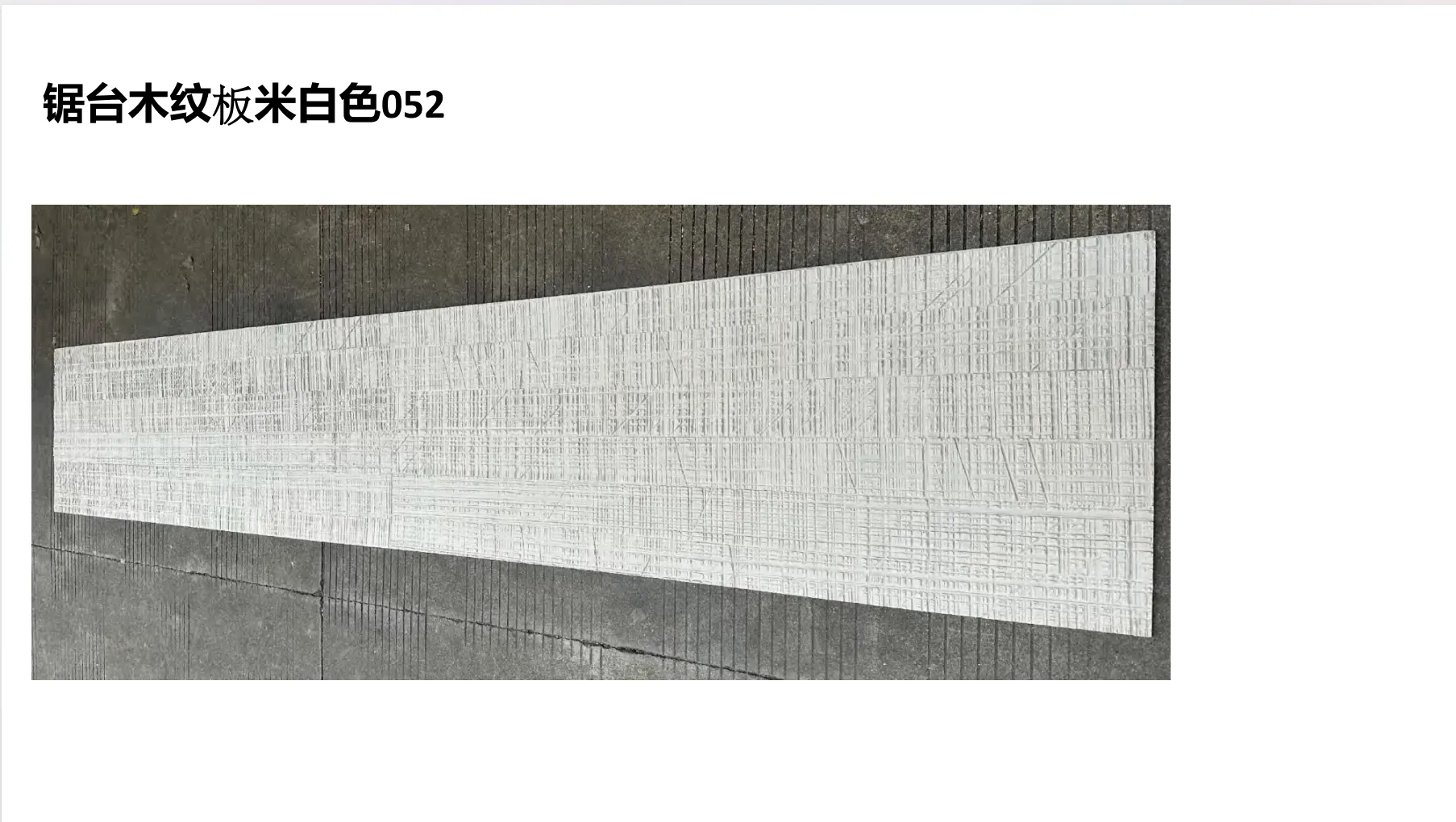
Enter MCM pre-coated solutions. If traditional sawing wood board finishing is a handwritten letter, MCM is a sleek email—efficient, consistent, and designed for the modern world. But what exactly is MCM? Short for Modified Composite Material, it's a blend of natural minerals (like stone dust and fiberglass) and high-performance polymers, engineered to mimic the look of natural materials—wood, stone, concrete—without the hassle. And the "pre-coated" part? That means the finish—color, texture, sheen—is applied at the factory, under controlled conditions, so every panel arrives ready to install.
Let's zoom in on two standout stars of the MCM family: MCM flexible stone and MCM big slab board series . MCM flexible stone is exactly what it sounds like: thin, lightweight panels that bend without breaking. "I used it on a curved accent wall last year," says Sarah, an interior designer who specializes in commercial spaces. "Traditional wood would have required custom bending, which is expensive and risky. MCM flexible stone just… wrapped around the curve. No cracks, no stress marks. It was like working with a giant sticker, but durable as stone."
Then there's the MCM big slab board series—panels that come in sizes up to 12 feet long and 4 feet wide. "Seamless is the name of the game in modern design," Sarah explains. "With traditional sawing wood boards, you're limited by the size of the lumber—usually 8 feet max. That means more seams, more grout lines, more visual clutter. MCM big slab boards? You can cover an entire wall with just a few panels. It's clean, it's bold, and it makes the space feel larger."
But the real magic of MCM pre-coated solutions is the finish itself. Unlike sawing wood boards, which rely on human hands (and human error) for staining and sealing, MCM finishes are applied in factories with precision equipment. "Every panel gets the same amount of coating, the same curing time, the same UV protection," says Raj, a product engineer at an MCM manufacturer. "We test for color consistency across batches, so a panel from January matches one from June. No more 'oops, this batch is darker' surprises."
And durability? MCM laughs at the problems that plague wood. "I installed MCM wood grain board in a busy hotel lobby three years ago," Sarah says. "It gets bumped by luggage carts, spilled on by coffee cups, and baked by sunlight through floor-to-ceiling windows. To this day, it looks brand new. No warping, no fading, no scratches. I just send a crew to wipe it down with soap and water every quarter. That's it."
| Factor | Traditional Sawing Wood Boards | MCM Pre-Coated Solutions (e.g., MCM Big Slab Board Series, MCM Flexible Stone) |
|---|---|---|
| Installation Time | 2-4 weeks (including drying, sanding, staining, and sealing) | 1-3 days (pre-finished, ready to install out of the box) |
| Labor Requirements | Skilled craftsmen for sawing, sanding, and coating; 3-5 workers per project | Basic installation crew; no specialized finishing skills needed |
| Consistency | High variability in color, grain, and texture; depends on wood quality and craftsman skill | Factory-calibrated; every panel matches in color, texture, and finish |
| Durability | Prone to warping, rotting, and scratches; requires annual sanding and re-sealing | Resistant to moisture, UV rays, and impact; low maintenance (occasional cleaning) |
| Design Flexibility | Limited by wood size (typically 8ft max); rigid, hard to bend | Large slabs (up to 12ft) for seamless looks; flexible options for curves and angles |
Let's talk about a project that perfectly illustrates the shift from traditional sawing wood boards to MCM: the renovation of a 10,000-square-foot boutique hotel in downtown Portland. The design called for a warm, rustic aesthetic, with wood grain board cladding in the lobby and guest rooms. The contractor initially planned to use traditional sawing wood boards—until they ran the numbers.
"We estimated 3 weeks of labor just for finishing the wood," says James, the project manager. "That included 5 workers sanding, staining, and sealing. Then we got a quote for MCM wood grain board from the MCM big slab board series. The material cost was higher upfront, but the labor cost dropped by 70%. And instead of 3 weeks, installation took 2 days. We finished the entire lobby cladding in a weekend. The client was thrilled—we stayed under budget and ahead of schedule."
But what about the "feel"? Did guests notice it wasn't real wood? "Not a single comment," James laughs. "In fact, one guest asked where we sourced such 'beautiful, uniform oak.' When I told her it was MCM, she was shocked. She thought it looked more authentic than the wood in her own home, which has inconsistent coloring from years of sun exposure."
I'll admit, when I first heard about MCM, I wondered the same thing: Does it feel cheap? Does it lack the warmth of real wood? Let's tackle those concerns head-on.
"It looks fake." Early composite materials had this problem—shiny, plastic-like finishes that screamed "artificial." But modern MCM uses advanced printing and texturing techniques that mimic natural materials down to the smallest detail. Run your hand over MCM flexible stone, and you'll feel the same rough, pitted texture as real travertine. Run it over MCM wood grain board, and you'll swear you can feel the grain ridges. "We did a blind test with clients once," Sarah says. "We put a real wood sample and an MCM wood grain board sample side by side. 8 out of 10 couldn't tell the difference."
"It's not as durable as real wood." This is a myth. Real wood is organic—it swells when wet, shrinks when dry, and is a snack for termites. MCM, on the other hand, is inorganic. It doesn't absorb water, so it won't warp or rot. It's treated with UV inhibitors, so it won't fade in sunlight. And it's scratch-resistant—Raj, the engineer, showed me a video of a steel wool pad scrubbing an MCM panel; not a mark left behind. "I've seen MCM panels in outdoor patios that have weathered rain, snow, and 100-degree heat for 5 years," he says. "They look the same as the day they were installed."
"It's too expensive." Yes, MCM materials cost more per square foot than raw lumber. But when you factor in labor, time, and long-term maintenance, the math flips. "A traditional wood project might cost $5 per square foot for materials, but $20 per square foot for labor," James explains. "MCM might be $10 per square foot for materials, but only $5 per square foot for labor. Over 1,000 square feet, that's $25,000 vs. $15,000. And you're not paying for annual maintenance."
At the end of the day, the choice between sawing wood boards and MCM pre-coated solutions comes down to what matters most for your project. If you're building a heirloom piece—a custom dining table, a handcrafted bookshelf—traditional sawing wood boards might be worth the time and labor. There's a romance in the imperfections, a story in the knots and grain that can't be replicated.
But for commercial projects, large-scale renovations, or spaces that demand consistency and durability, MCM pre-coated solutions are hard to beat. They're a testament to how far material science has come—offering the beauty of natural materials without the headaches. Whether it's the flexibility of MCM flexible stone, the seamless scale of MCM big slab board series, or the low-maintenance reliability of MCM wood grain board, these solutions are changing the way we build and design.
So the next time you're standing in front of a pile of raw materials, ask yourself: Do I want to spend weeks fighting with sawdust and stain, or days installing a finish that's ready to shine from the start? For most of us, the answer is clear. The future of material finishing isn't about abandoning tradition—it's about honoring it with smarter, more efficient tools. And MCM pre-coated solutions are leading that charge.
Recommend Products












