
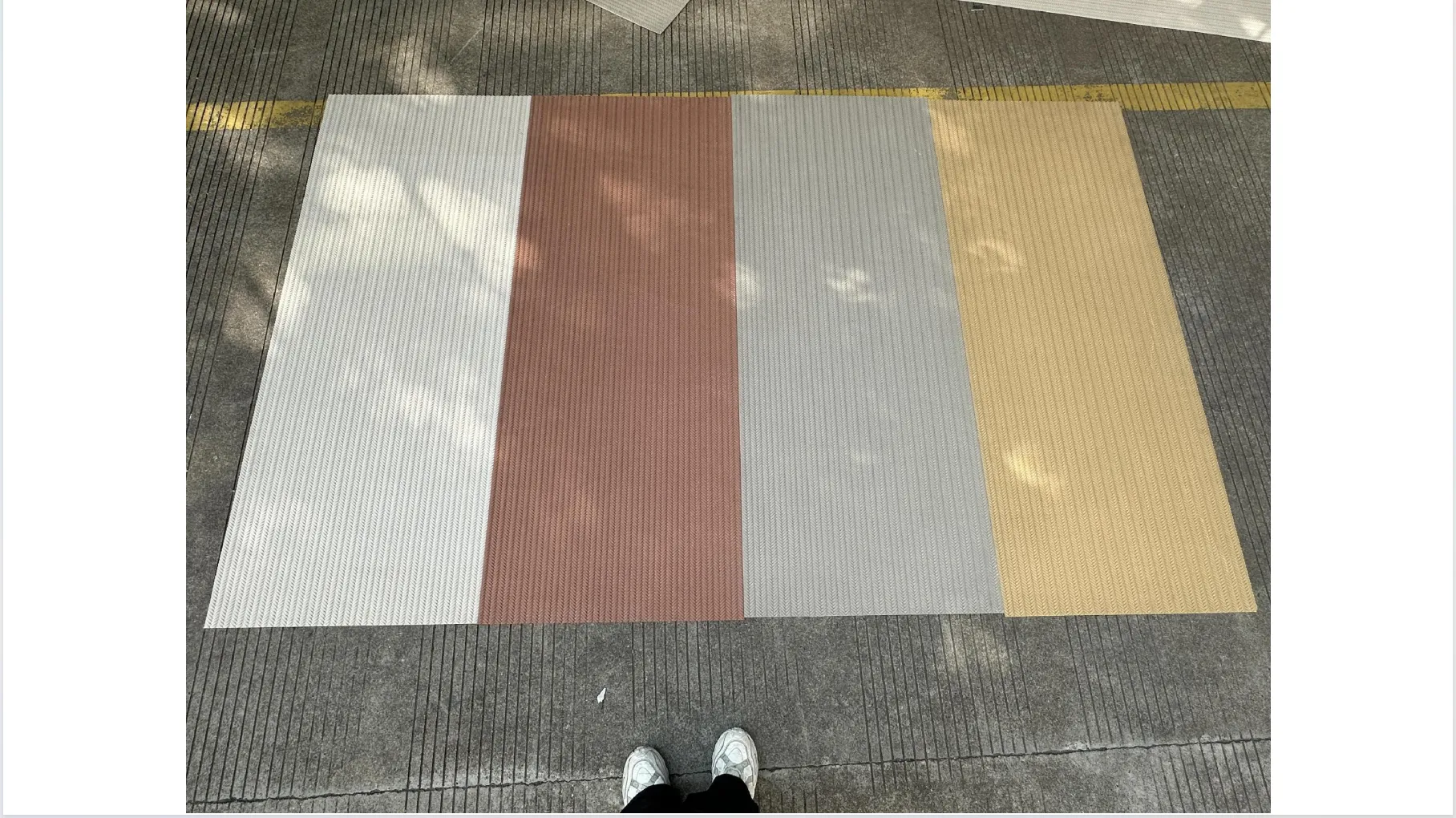
Walk into any modern architectural marvel these days, and you'll likely notice something different about the walls, the facades, the accents that shape the space. They feel lighter—almost as if the stone itself has learned to breathe. For decades, architects and designers have grappled with a quiet battle: the tension between beauty and weight. Traditional stone, with its timeless elegance, often comes with a heavy price—literally. Transporting slabs that weigh hundreds of pounds, reinforcing structures to bear their load, limiting creative designs to what the materials can handle. It's a dance with gravity that too often ends with compromise. But then came MCM Flexible Stone , and suddenly, that dance got a whole lot more graceful. And the best part? Woven real photos are here to show us exactly how light, and how beautiful, that grace can be.
Think about the last time you visited an old cathedral. The stone walls are thick, imposing, built to stand for centuries—but they also dictate the space. High ceilings feel necessary to offset the heaviness; windows are small, not out of choice, but because the walls can't support larger openings. Fast forward to today, and we want the opposite: open, airy spaces, curved walls that flow like rivers, facades that seem to float above the street. We want the warmth of stone without the weight that chains us to the ground. Traditional materials haven't kept up. A standard marble slab weighs around 150 pounds per square meter. Granite? Even more. Trying to wrap that around a curved retail storefront? You'd need steel reinforcements, cranes, and a budget that balloons faster than a construction timeline.
Designer Maria Gonzalez, who specializes in boutique hotels, put it bluntly: "I once had a client who fell in love with a travertine finish for their lobby. We ordered the slabs, and when they arrived, the delivery crew had to use a forklift just to get them through the door. The structural engineer later told us the second floor couldn't support the weight of the feature wall we'd planned. We had to scrap the design. It felt like breaking up with a friend—you know it's for the best, but it still hurts."
Let's start with the basics. MCM stands for Modified Composite Material, a blend of natural minerals, polymers, and fibers that's engineered to mimic the look and texture of stone—without the heft. Imagine taking the essence of travertine, the grain of granite, the softness of limestone, and compressing it into a sheet that's thin enough to bend, light enough to carry, and tough enough to weather rain, wind, and time. That's MCM Flexible Stone. It's not a "fake" stone; it's a reimagined stone. And at just 4-6 kilograms per square meter, it weighs a fraction of traditional stone (which can hit 150 kg/m² or more). To put that in perspective: a 10-square-meter slab of traditional marble would need a team of people to move. A 10-square-meter sheet of MCM Flexible Stone? You could carry it yourself.
Why does lightweight matter so much? Let's count the ways. For starters, installation becomes a breeze. No more cranes blocking city streets or workers straining under heavy loads. A crew can install MCM panels in a day, where traditional stone might take a week. Then there's structural freedom: suddenly, that curved wall Maria Gonzalez dreamed of isn't just possible—it's affordable. Overhead installations? A restaurant ceiling clad in travertine (starry blue) that looks like a night sky? No problem. MCM's flexibility means it can conform to almost any shape, turning flat surfaces into stories. And let's not forget sustainability: lighter materials mean less fuel used in transport, less energy in manufacturing, and fewer carbon emissions overall. It's a win for design, a win for budgets, and a win for the planet.
But here's the thing about innovation: it's easy to talk about "lightweight" or "flexible" in a brochure. It's another thing entirely to see it. That's where woven real photos come in. These aren't stock images or CGI renderings. They're candid, close-up, unfiltered shots of MCM Flexible Stone in action—textures so detailed you can almost feel them, installations so dynamic they make you question if what you're seeing is even possible. Woven real photos don't just show the material; they document its lightness. Let's break down how they do it.
Take a woven real photo of travertine (starry green) under natural light. Look closely: the surface has the same pitted, organic texture as traditional travertine, but there's a subtle difference. Hold a traditional travertine slab, and the weight makes the texture feel dense, almost solid. In the photo, though, the light plays differently. The grooves catch sunlight like tiny pools, and the edges—thin, crisp—hint at how easy it would be to lift. There's a delicacy to the texture that traditional stone, with its bulk, can't convey. Another example: weaving (khaki) MCM panels. The woven pattern, usually reserved for fabrics, looks soft, pliable—you can almost see the material bending under the photographer's hand, no cracking, no strain. These photos don't just show texture; they tell a story: "This is stone, but not as you know it."
One of the most powerful woven real photos I've seen was taken on a construction site in Tokyo. Two workers are installing a 10-foot-tall MCM panel on the facade of a boutique hotel. One holds the bottom edge with one hand, steadying it; the other adjusts the top, smiling. No harnesses, no machinery—just two people, (qīngsōng, "easily") positioning a material that would, in traditional stone, require a crane and a team of four. The photo isn't staged; the worker's glove has a smudge of mortar, the panel's edge has a tiny scratch from transport. It's real, and that's the point. Woven real photos capture these "aha!" moments—when the myth of "stone = heavy" shatters, and what's left is possibility.
Sometimes, numbers tell the story best. Woven real photos often include side-by-side shots of MCM Flexible Stone next to traditional materials, but for clarity, let's put it in a table. Below is a comparison of MCM Flexible Stone with two common alternatives: traditional granite and foamed aluminium alloy board (vintage silver) (a lightweight metal option). The difference in weight? Staggering.
| Material | Weight (per square meter) | Flexibility | Typical Use Case |
|---|---|---|---|
| MCM Flexible Stone (e.g., Travertine Starry Green) | 4-6 kg | Can bend up to 90° without cracking | Curved walls, overhead installations, facades |
| Traditional Granite (e.g., Granite Portoro) | 150-200 kg | Brittle; minimal flexibility | Flooring, countertops (fixed, flat surfaces) |
| Foamed Aluminium Alloy Board (Vintage Silver) | 8-10 kg | Moderate flexibility; prone to dents | Accent panels, industrial-style interiors |
Look at that first row again: 4-6 kg per square meter. That's lighter than a bag of flour. And yet, in woven real photos, MCM Flexible Stone stands next to fair-faced concrete (itself a champion of understated strength) and holds its own, visually. The texture of lunar peak silvery MCM, with its moon-like craters, looks just as rugged as concrete, but in the photo, you can see a worker leaning against the panel without it budging—no need for reinforcement underneath. That's the magic of these photos: they make the abstract "lightweight" concrete (pun intended).
Critics used to ask: "If it's that light, is it strong enough?" Woven real photos answer that, too. Take a photo of rust square line stone MCM panels on a coastal building in Miami. The material has been up for three years, facing salt spray, hurricane-force winds, and the harsh Florida sun. The photo shows the panels up close: no rust (despite the name), no fading, no cracks. MCM isn't just light—it's tough. Its composite structure resists water, fire, and impact, making it suitable for both indoor and outdoor use. Another photo: a restaurant in Barcelona where the bar top is clad in rough granite stone (medium grey) MCM. A patron sets down a heavy glass, and the surface doesn't so much as scratch. Lightweight, yes—but also built to last.
And let's talk design freedom. Woven real photos of bamboo mat board MCM panels in a Bali resort bathroom: the material curves around the shower, mimicking the shape of a bamboo grove. The texture is so realistic, you half-expect to see leaves rustling. Or travertine (starry red) in a retail store, where the panels are cut into irregular shapes and arranged like a constellation across the wall. Traditional stone would require custom-cutting each piece, driving up costs; MCM, with its flexibility, bends to the design, not the other way around. Woven real photos don't just show these designs—they make you want to reach out and touch them.
It's one thing to talk about MCM Flexible Stone in theory. Woven real photos ground it in reality. Take the new office tower in Singapore, where the facade is clad in lunar peak golden MCM panels. From the street, it shimmers like sunlight on water—but unlike traditional gold-leafed stone, the panels weigh so little that the building's foundation didn't need extra reinforcement. Or the tiny coffee shop in Portland, Oregon, where the owner wanted a rustic vibe without the cost of real wood. They chose wood grain board MCM, and woven real photos show customers leaning against the counter, running their hands over the texture, none the wiser that it's not solid wood. "We saved $10,000 on installation alone," the owner told a local design blog. "And the photos? They went viral on Instagram. People come in just to take pictures of the walls."
Even heritage projects are getting in on the action. A 1920s theater in Paris, undergoing restoration, needed to replace damaged stonework but couldn't use traditional materials (the building's structure, weakened by time, couldn't handle the weight). They opted for historical pathfinders stone MCM panels, which matched the original stone's color and texture perfectly. Woven real photos of the finished lobby show the new panels next to the old—you can't tell the difference. The theater's architect called it "a love letter to the past, written with the materials of the future."
As I flip through a album of woven real photos— gobi panel MCM on a desert retreat, foamed aluminium alloy board (vintage gold) accents in a Tokyo penthouse, fair-faced concrete paired with travertine (beige) in a Copenhagen library—I realize something: these photos aren't just marketing tools. They're time capsules. They capture a moment in architecture where we stopped fighting gravity and started dancing with it. MCM Flexible Stone didn't just change the materials we use; it changed the questions we ask. "What if?" "Why not?" "How light can we go, and still be bold?"
And the answer, as woven real photos so beautifully show, is: lighter than we ever imagined. So the next time you walk into a space that takes your breath away—whether it's a soaring lobby, a cozy café, or a museum wall that seems to float—take a closer look. Chances are, you're looking at MCM Flexible Stone. And if you're lucky, there's a woven real photo out there that tells the story of how it got there: light, easy, and unapologetically beautiful.
In the end, architecture is about more than buildings. It's about how spaces make us feel. Heavy materials make us feel small, constrained. Light materials? They make us feel free. And in a world that often feels heavy enough, isn't that the most beautiful advantage of all?
Recommend Products












