
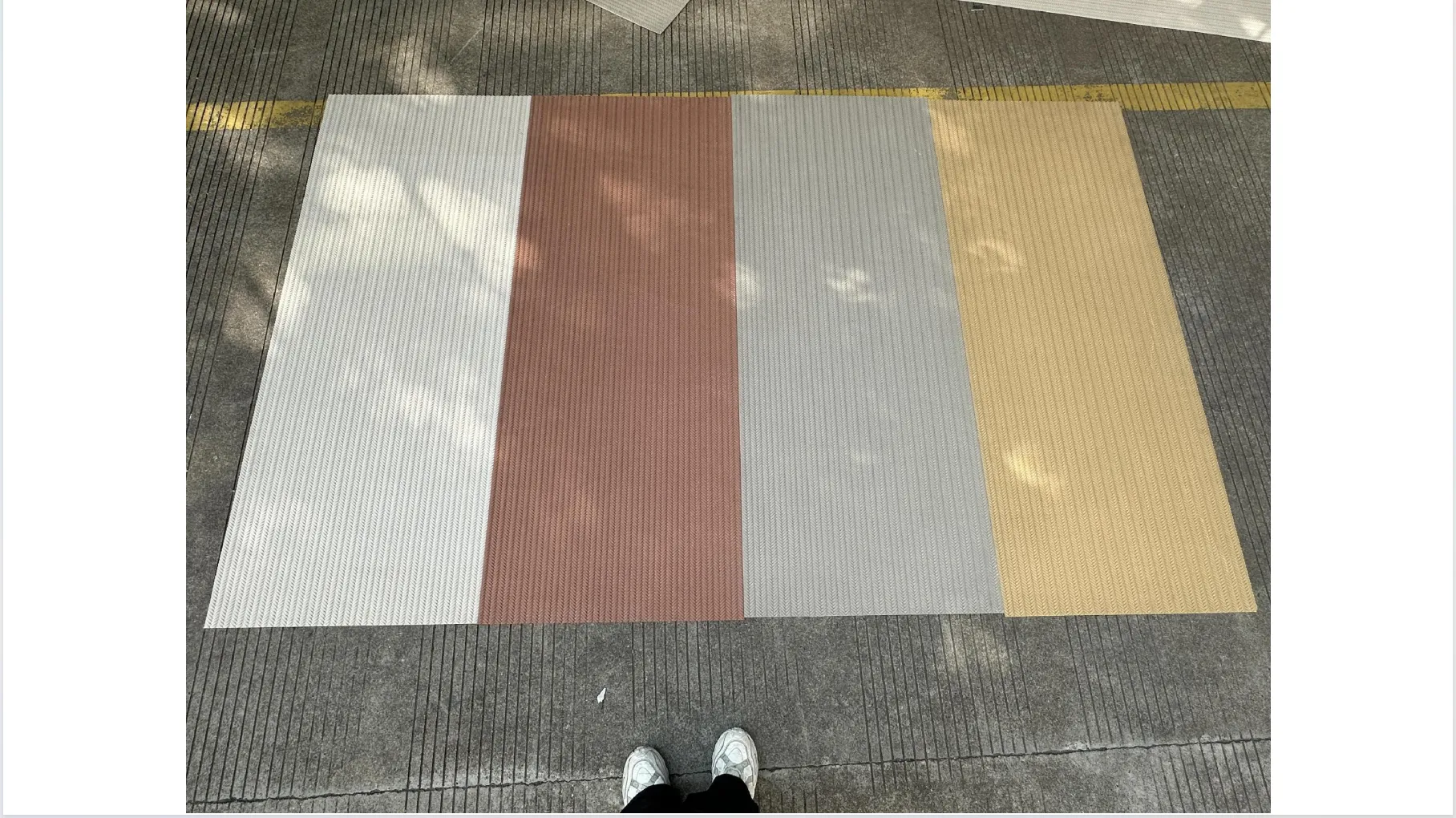
Picture this: you step into a modern boutique hotel lobby, and your eyes are immediately drawn to the walls. They're not flat or sterile—they undulate gently, with textures that look like they've been woven by hand, each thread catching the light to create a dance of shadows. You reach out, and instead of the cold, unyielding surface you expect from stone, your fingers brush against something surprisingly pliable, almost soft. That's the magic of MCM flexible stone, and woven real photos are the secret to telling its most compelling story. These aren't just images; they're windows into a material that bends, adapts, and transforms spaces in ways traditional stone never could. In this article, we'll explore how woven real photos capture the unique flexibility of MCM flexible stone, from the tactile allure of its textures to the technical marvels that make it possible.
Let's start with the basics. MCM stands for Modified Composite Material, and at its core, MCM flexible stone is a revolutionary building material designed to mimic the look and feel of natural stone—travertine, granite, slate—without the weight, rigidity, or installation headaches. Imagine taking the timeless beauty of a marble veil white slab or the rustic charm of a gobi panel and compressing it into a sheet so lightweight and flexible it can be curved around columns, wrapped over arches, or even used as a backsplash in a tight kitchen corner. That's MCM flexible stone in a nutshell.
Traditional stone cladding has always been a trade-off: stunning aesthetics but heavy, brittle, and limited in where it can be used. A single slab of natural travertine (beige) might weigh 20-30 kg per square meter, requiring structural reinforcement and heavy machinery to install. MCM flexible stone flips that script. By blending natural mineral aggregates with high-performance polymers, manufacturers have created a material that weighs as little as 3-5 kg per square meter—light enough to be installed on drywall without extra support—and flexible enough to bend up to 90 degrees without cracking. It's a game-changer for architects, designers, and homeowners who want the beauty of stone without the constraints.
And then there's the design versatility. From the intricate patterns of the weaving (khaki) and weaving (beige) textures to the bold, industrial look of fair-faced concrete , MCM flexible stone comes in a staggering array of styles. But what truly sets it apart is how these designs interact with flexibility. Woven textures, in particular, are a masterclass in this synergy. Think of them as the material's "flexibility fingerprint"—interlacing layers that not only look dynamic but also enhance the stone's ability to move and adapt.
Woven textures have been part of human design for millennia—from baskets to textiles to architecture. There's something inherently organic about the way threads or fibers crisscross, creating depth, movement, and a sense of rhythm. In MCM flexible stone, woven patterns aren't just decorative; they're functional. The interlacing "threads" (in reality, precision-engineered mineral-polymer composites) create micro-pockets of flexibility within the material. When the stone bends, these woven layers shift and adjust, distributing stress evenly to prevent cracking. It's like the difference between a rigid sheet of paper and a woven mat—one folds and tears, the other bends and springs back.
Take the weaving (jacinth) texture, for example. Its rich, reddish-brown tones and tight, basket-like pattern aren't just visually striking. When light hits it, the raised and recessed threads cast shadows that emphasize the material's three-dimensionality. But more importantly, that same pattern allows the stone to flex without losing structural integrity. A photographer capturing this texture isn't just taking a picture of a pattern—they're documenting a material that's engineered to move.
Woven textures in MCM flexible stone draw inspiration from both nature and traditional craftsmanship. The bamboo mat board texture, for instance, mimics the parallel lines of a hand-woven bamboo mat, evoking a sense of calm and sustainability. The thread texture, with its fine, linear grooves, looks like delicate embroidery stitched into the stone. These designs tap into our innate love for tactile, handcrafted surfaces, but with a modern twist: they're produced using cutting-edge technology, ensuring consistency and durability.
For designers, this blend of tradition and innovation is a dream. Imagine specifying a weaving (grey) texture for a restaurant's curved bar front. The woven pattern not only adds visual interest but also allows the MCM flexible stone to wrap seamlessly around the bar's rounded edges, creating a cohesive, inviting space. Without flexibility, that curved design would require expensive custom stone cutting or clunky, segmented panels. With MCM, it's smooth, elegant, and surprisingly affordable.
Here's the thing about MCM flexible stone: its most impressive feature—flexibility—is invisible in a static, flat photo. A traditional stone slab might look beautiful in a catalog, but it tells you nothing about how it behaves in real life. Woven real photos, on the other hand, are storytelling tools. They're taken in ways that highlight how the material moves, bends, and interacts with its environment. A skilled photographer doesn't just shoot the texture; they shoot the texture in action .
Let's break down how this works. First, lighting is everything. Soft, diffused natural light or angled artificial light can pick up the subtle undulations of a woven texture, showing where the material curves or dips. For example, a photo of flexible stone cladding panels with a weaving (khaki) pattern might be shot from a low angle, with light raking across the surface. This creates shadows in the "valleys" of the weave and highlights the "peaks," making it clear that the panel isn't flat—it has depth, and that depth is a result of its ability to flex.
Then there's the use of context. A photo of a single woven panel on a flat wall might look nice, but it doesn't scream "flexibility." But show that same panel wrapped around a 30-degree corner, or draped over a curved furniture piece, and suddenly the story changes. One striking example is the MCM big slab board series —large-format panels (up to 1200x2400mm) that are so flexible they can be used to create seamless, curved feature walls. A real photo of one of these slabs bending around a circular column isn't just impressive; it's proof that the material can do what traditional stone never could.
"I once worked with a photographer who spent an entire afternoon shooting a single weaving (beige) panel," recalls Maria, an interior designer based in Dubai. "He kept adjusting the angle, moving the panel slightly to create a gentle curve, until he got that perfect shot where you could almost see the material 'give' under its own weight. That photo ended up being the centerpiece of our client presentation. They didn't just see a wall covering—they saw a material that could turn their boring rectangular lobby into something dynamic."
Close-up shots are another secret weapon. By zooming in on the woven texture, photographers can capture the tiny details that reveal flexibility: the way individual "threads" of the pattern compress slightly when the material is bent, or the absence of cracks or stress marks even in tightly curved areas. Compare that to a close-up of traditional stone cladding, which often shows rigid, uniform grains that give no hint of movement. Woven real photos make flexibility tangible, even through a screen.
Woven textures aren't just for show; they're engineered to boost the material's flexibility. To understand why, let's dive into the composition of MCM flexible stone. At its base is a reinforced fiber mesh (often glass fiber or carbon fiber) that acts as the "backbone" of the material. On top of this mesh, manufacturers apply a layer of mineral composite—ground natural stone (like travertine, granite, or slate) mixed with polymers and resins. The woven texture is created by embossing or molding this composite layer into interlacing patterns, which introduces micro-gaps and channels between the "threads."
These micro-gaps are key. When the material is bent, the polymers in the composite allow the mineral particles to shift slightly, and the woven structure ensures that stress is distributed evenly across the surface. In contrast, traditional stone has a dense, uniform structure—bend it even a little, and the stresss in one area, leading to cracks. Woven MCM flexible stone, by design, is "pre-stressed" to flex. The texture isn't just a design choice; it's a structural feature.
Take the travertine (starry green) texture, which mimics the porous, natural look of travertine but with a subtle woven undercurrent. Under a microscope, you'd see that the "stars" (the small, circular pores) are aligned along the woven pattern, creating pathways for flexibility. A real photo of this texture, shot close-up, might focus on one of these stars, showing how the surrounding material curves gently around it—proof that even intricate natural patterns can coexist with flexibility.
To truly appreciate how woven real photos highlight MCM flexible stone's advantages, let's compare it to traditional stone cladding. The table below breaks down key attributes, with a focus on flexibility and how real photos capture these differences.
| Attribute | Traditional Stone Cladding | MCM Flexible Stone Cladding Panels |
|---|---|---|
| Weight (per sqm) | 20-30 kg – requires structural support | 3-5 kg – can be installed on drywall, no extra support |
| Flexibility | Rigid – cannot bend more than 2-3 degrees without cracking | Highly flexible – can bend up to 90 degrees (depending on thickness) |
| Installation | Requires heavy machinery and skilled labor; limited to flat/straight surfaces | Lightweight – can be cut with a utility knife and installed with basic tools; ideal for curves/arches |
| Design Versatility | Limited by natural stone slabs; patterns are fixed and cannot be customized | Endless options – woven textures, 3D prints, custom colors; patterns enhance flexibility |
| Real Photo Storytelling | Photos often look flat/stiff; focus on color/pattern, not movement | Photos highlight curves, bends, and texture depth; tell a story of adaptability |
As the table shows, MCM flexible stone isn't just a lighter alternative to traditional stone—it's a fundamentally different material, and woven real photos are the bridge between its technical specs and its real-world appeal. When a client sees a photo of flexible stone cladding panels with a weaving (grey) pattern wrapped around a curved staircase, they don't need to read the technical data sheet to understand the value. The photo speaks for itself.
In homes, MCM flexible stone with woven textures is transforming once-neglected spaces into focal points. Imagine a kitchen backsplash made with weaving (beige) panels—lightweight, heat-resistant, and flexible enough to follow the curves of a custom range hood. A real photo of this backsplash, taken at eye level, would show how the woven pattern catches the light from under-cabinet fixtures, creating a warm, inviting glow. Or consider a bedroom feature wall with travertine (starry blue) —a woven texture that mimics the night sky, with "stars" that seem to twinkle as the material gently curves behind the bed. It's not just a wall; it's a mood setter.
In commercial settings, the flexibility of MCM woven textures is even more impactful. Hotels, restaurants, and retail stores are using flexible stone cladding panels to create immersive environments. One standout example is a boutique hotel in Bali that used weaving (jacinth) panels to line the walls of its rooftop bar. The panels were curved to follow the bar's circular shape, and real photos of the space at sunset—with the warm red tones of the weave glowing against the sky—went viral on social media. Guests didn't just book a room; they booked an experience centered around that unique wall.
Office lobbies are another prime spot. Traditional lobbies often feel cold and corporate, with flat marble or concrete walls. But with MCM flexible stone, designers can create dynamic, welcoming spaces. A recent project in Singapore used the MCM big slab board series with a weaving (khaki) texture to create a 20-meter-long curved feature wall. The real photos of this wall—showing how the large slabs bend seamlessly into each other—became a key marketing tool for the building,ing tech companies looking for creative workspaces.
As MCM flexible stone continues to evolve, so too will the art of capturing it in woven real photos. New textures are emerging—like the gradient color rammed earth board , which blends earthy tones in a woven, ombre pattern—and with them, new opportunities to tell stories of flexibility. Imagine a real photo of a gradient panel bending around a spiral staircase, the colors shifting as the material curves—almost like a living, breathing tapestry.
For designers and architects, these photos aren't just marketing tools—they're sources of inspiration. They spark ideas for spaces that were once impossible: curved ceilings clad in travertine (vintage gold) woven panels, furniture pieces wrapped in weaving (white) textures, even wearable art (yes, some designers are experimenting with MCM for fashion!). Woven real photos capture not just what the material is, but what it can be .
At the end of the day, MCM flexible stone is more than a building material—it's a medium for creativity. And woven real photos are the language we use to speak that creativity. They turn technical specs into emotional connections, showing us that flexibility isn't just a feature; it's a gateway to spaces that feel alive, human, and full of possibility. So the next time you see a photo of a woven texture on a curved wall, take a closer look. You're not just seeing a wall—you're seeing the future of design.
Recommend Products












