
Picture this: An architect sits at their desk, scrolling through a catalog of building materials. They pause at a section labeled "travertine panels"—the images are bright, crisp, and... surprisingly generic. The photos show smooth surfaces with uniform color, but something feels off. There's no sense of the material's true texture, no hint of how light might play across its surface at different times of day, and certainly no indication of how it might age over decades. For anyone tasked with bringing a design vision to life, this disconnect between a product photo and reality is more than frustrating—it's a risk. After all, the wrong material can derail a project's aesthetic, durability, and even budget. This is where COLORIA's approach to material storytelling changes the game: through woven real photos that don't just show their MCM (Modified Composite Material) products, but prove their quality.
In the world of architecture and design, materials are the language of spaces. They speak to warmth, innovation, tradition, and resilience. A wall clad in mcm flexible stone doesn't just serve a functional purpose; it tells a story of adaptability and natural beauty. A facade finished with lunar peak silvery communicates modernity with a touch of celestial elegance. But for these stories to resonate, the materials must be authentic—and their visual representation must be honest. Generic, airbrushed photos might look appealing in a catalog, but they fail to capture the nuances that make a material unique. That's why COLORIA, a leader in MCM innovation, has redefined product visualization with woven real photos: high-fidelity, multi-dimensional images that act as a direct line between their strict quality control (QC) standards and the professionals who rely on their materials.
Before diving into the role of woven real photos, it's worth understanding why COLORIA's MCM products have become a go-to for architects and designers worldwide. MCM, or Modified Composite Material, is a revolutionary building material that combines the aesthetic appeal of natural stone, wood, and metal with the performance benefits of modern composites—lightweight, durable, and highly customizable. Unlike traditional materials, MCM panels are engineered to resist weathering, fading, and impact, making them ideal for both interior and exterior applications. From the earthy warmth of fair-faced concrete to the cosmic allure of travertine (starry blue) , COLORIA's MCM lineup spans dozens of textures and finishes, each designed to push the boundaries of what's possible in architectural design.
But innovation alone isn't enough. For COLORIA, quality is the foundation of every product. Their QC process starts long before a panel ever leaves the factory, encompassing raw material selection, manufacturing precision, durability testing, and aesthetic consistency. Every batch of mcm flexible stone undergoes rigorous checks for thickness uniformity; every sheet of lunar peak silvery is inspected for color consistency under different lighting conditions. The goal? To ensure that what's promised in the design phase is exactly what arrives on the construction site. And this is where woven real photos come into play: they're not just marketing tools, but tangible evidence of COLORIA's QC rigor.
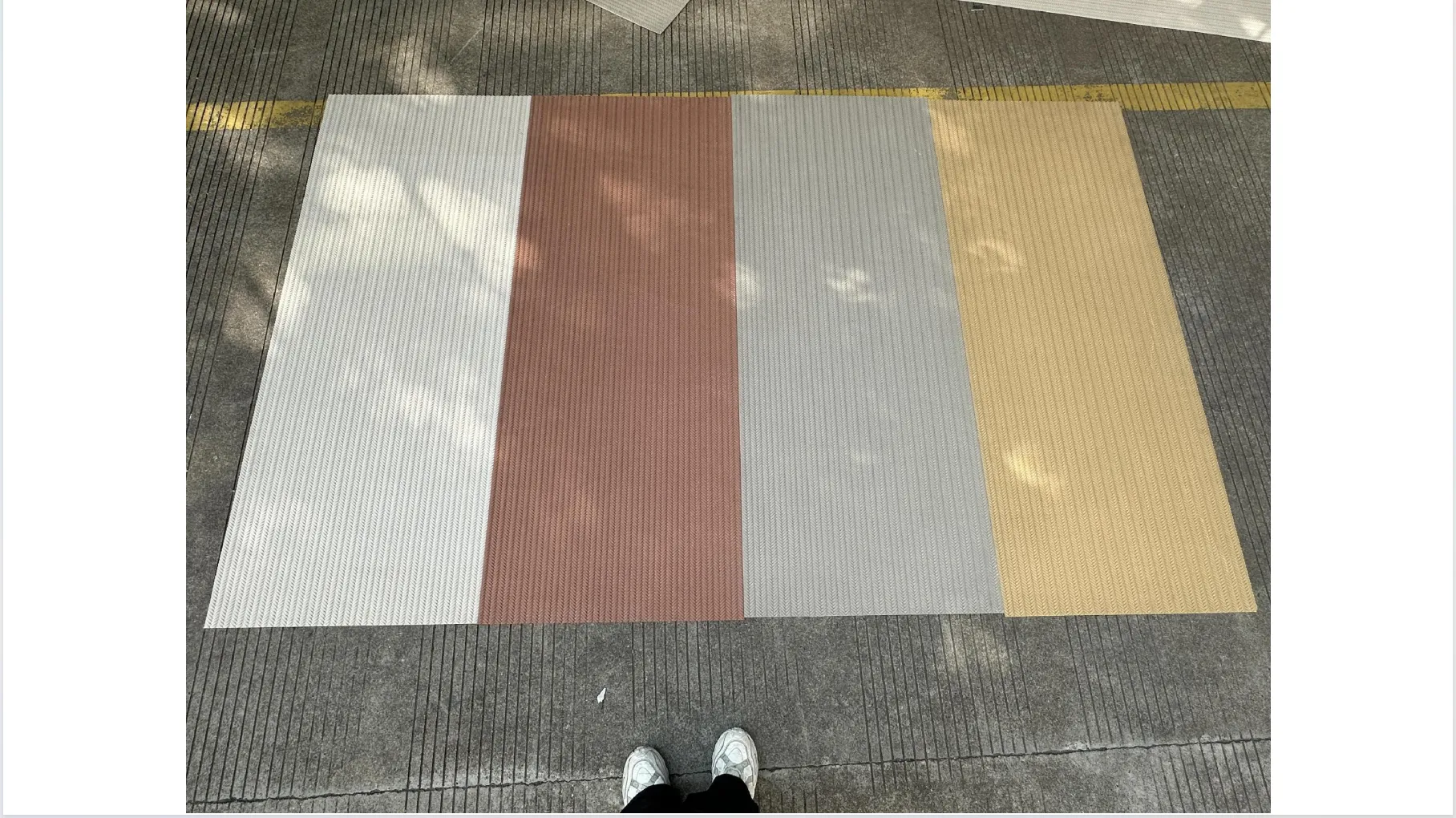
So, what exactly are woven real photos? They're not your average product snapshots. Unlike traditional photos, which often focus on a single angle or a heavily edited "perfect" sample, woven real photos are a curated collection of high-resolution images that weave together multiple perspectives: close-ups of texture, full-panel shots to show color variation, installations in real-world settings, and even macro shots of material composition. Think of them as a visual narrative—one that captures the material's personality, from the way its surface catches morning light to how its edges align seamlessly with adjacent panels.
For example, take COLORIA's travertine (starry blue) panels. A woven real photo series might include a close-up of the material's surface, highlighting the subtle "starry" veining—tiny mineral deposits that catch light like distant galaxies. Then, a mid-range shot of a full 1m x 3m panel, showcasing how the veining flows across the surface without repeating unnaturally (a sign of careful material blending during manufacturing). Finally, an installation photo of a restaurant facade clad in the same panels, demonstrating how the blue hue shifts from deep indigo at noon to a softer, more ethereal tone at sunset. Together, these images don't just show the product—they invite designers to experience it, building confidence that what they see is what they'll get.
| Aspect | Traditional Product Photos | COLORIA's Woven Real Photos |
|---|---|---|
| Color Accuracy | Often oversaturated or adjusted to "look perfect," masking natural variations. | Captured under standardized lighting to reflect real-world color, including subtle shifts in hue. |
| Texture Detail | Flat, two-dimensional; fails to convey tactile qualities like roughness or grain. | Macro and angled shots highlight texture, from the porous surface of travertine to the metallic sheen of lunar peak silvery. |
| Scale Representation | Often cropped or zoomed, making it hard to visualize how panels look in full size. | Includes full-panel and installation photos to show scale, alignment, and pattern repetition. |
| Durability Clues | No indication of how materials age or perform under stress. | Sometimes includes "aged" samples or test results (e.g., weathered panels) to demonstrate long-term resilience. |
At first glance, woven real photos might seem like a clever marketing strategy—and they are, in the best way. But their true power lies in how they act as a mirror, reflecting COLORIA's uncompromising QC standards. Let's break down exactly what these images reveal about the care that goes into every MCM panel.
COLORIA's QC process starts with raw material selection, and woven real photos leave no room for shortcuts. Take travertine (starry blue) , for instance. The "starry" effect comes from embedding tiny, iridescent mineral particles into the MCM matrix. In woven real photos, these particles aren't just visible—their distribution is consistent across panels, a sign that COLORIA's sourcing team rejects batches with uneven particle density. Similarly, mcm flexible stone relies on a blend of natural stone aggregates and polymer binders. Woven real photos of the material's cross-section (a rare detail in traditional catalogs) show a uniform mix, with no clumping or voids—proof that the raw materials are mixed with precision, not guesswork.
Even materials like fair-faced concrete , which might seem "simple" at first glance, tell a story through woven real photos. The images capture the subtle variations in aggregate size and color that give fair-faced concrete its character, while also highlighting the absence of cracks or blemishes—signs of strict quality checks during the mixing and curing process. For architects, this level of detail isn't just reassuring; it's inspiring. It means they can design with confidence, knowing the material's unique qualities will shine through in the final build.
MCM manufacturing is a delicate balance of art and engineering. Each panel must meet exacting standards for thickness, edge straightness, and surface finish. Woven real photos make these standards visible. For example, a series of photos showing lunar peak silvery panels lined up edge-to-edge reveals near-perfect alignment—a result of automated cutting machines calibrated to tolerances of ±0.5mm. There are no gaps, no uneven edges, just a seamless flow that speaks to COLORIA's investment in precision manufacturing.
Another example is the travertine (starry blue) panel's surface finish. Woven real photos include shots taken from multiple angles, highlighting how the finish is consistent across the entire panel—no areas of glossier or duller texture. This uniformity is the result of a proprietary coating process that's monitored in real time by QC technicians, who reject any panel that deviates from the standard. In traditional photos, such inconsistencies might be hidden with editing, but woven real photos lay them bare—because COLORIA has nothing to hide.
A material's beauty is only meaningful if it endures, and COLORIA subjects its MCM products to rigorous durability tests—many of which are documented in woven real photos. Imagine scrolling through a product page for fair-faced concrete and coming across a series of images: one of a panel fresh from the factory, another after 500 hours of UV exposure, and a third after being submerged in saltwater for a month. The photos show minimal color fading, no surface degradation, and no signs of corrosion. This isn't just marketing—it's transparency. Woven real photos of durability tests turn abstract claims ("weather-resistant") into concrete evidence ("here's how it looks after years of exposure").
For mcm flexible stone , durability testing includes flexural strength trials, where panels are bent to simulate installation on curved surfaces. Woven real photos capture these tests in action, showing the stone flexing without cracking—a testament to its reinforced composite core. Designers working on projects with unique geometries (think curved facades or undulating walls) can see firsthand that the material will perform as promised, reducing the risk of on-site failures.
To see the impact of woven real photos in practice, consider the Celestial Tower, a 42-story mixed-use building in downtown Chicago. The design called for a facade that balanced modernity with warmth, and the architect specified lunar peak silvery for the exterior panels and travertine (starry blue) for accent walls. Early in the design phase, the team was hesitant: lunar peak silvery's metallic finish can be tricky to photograph accurately, and they'd been burned before by materials that looked "silvery" in catalogs but appeared dull or brassy in person.
COLORIA provided woven real photos of both materials, including shots of lunar peak silvery panels installed on a test wall at different times of day (dawn, noon, dusk) and macro images of travertine (starry blue) highlighting its star-like veining. The photos revealed that lunar peak silvery maintained its cool, reflective sheen across lighting conditions, and the travertine's blue hue deepened subtly in shadow—exactly the effect the architect wanted. Confident in what they saw, the team moved forward with the order. When the panels arrived on-site, the architect noted, "It was like looking at the photos come to life. No surprises, no adjustments needed. The woven real photos didn't just show the materials—they vouched for them."
Woven real photos do more than validate QC standards—they foster collaboration between COLORIA, architects, contractors, and clients. In the past, material selection often involved physical samples, which are costly to ship, time-consuming to review, and limited in how many people can access them. Woven real photos, by contrast, are digital, shareable, and infinitely scalable. A contractor in Dubai can zoom into a photo of fair-faced concrete to check surface texture, while a client in New York can review installation shots of mcm flexible stone on a mobile device. This accessibility streamlines the decision-making process, reducing delays and ensuring everyone is aligned on the material's look and performance.
Moreover, woven real photos encourage dialogue about design intent. An architect might point to a woven real photo of travertine (starry blue) and say, "I love how the veining runs horizontally here—can we ensure that orientation for the lobby wall?" COLORIA's QC team can then reference the photo to confirm that the material can be manufactured with that specific veining direction, or explain any constraints. This back-and-forth, rooted in visual evidence, leads to more informed design choices and stronger partnerships.
In a world where marketing often prioritizes perfection over honesty, COLORIA's woven real photos stand out as a commitment to transparency. They're not just images; they're a window into the meticulous QC processes that make their MCM products exceptional—from the selection of raw materials to the final inspection of every panel. For architects, designers, and clients, these photos build trust: trust that mcm flexible stone will bend without breaking, trust that lunar peak silvery will retain its luster for decades, and trust that travertine (starry blue) will bring the celestial beauty of the night sky into built spaces.
At the end of the day, architecture is about creating spaces that endure—spaces that feel authentic, functional, and inspiring. COLORIA's woven real photos ensure that the materials used to build these spaces are seen for what they truly are: testaments to quality, innovation, and the belief that great design deserves great materials. So the next time you're scrolling through building materials, look beyond the glossy catalog shots. Seek out the woven real photos. They're not just telling you a story—they're proving it.
Recommend Products












